Unit 04 · Energy & Work
Energy is the currency of physics — the quantity that is transferred and transformed but never lost. This unit defines work as force acting through a displacement, builds kinetic and gravitational and elastic potential energy, and then uses conservation of energy to solve problems that would be brutal with forces alone. Mastery means you can track energy through a system, account for what friction removes, and reach for conservation before you reach for kinematics.
Student learning: Energy & Work
Choose the level by readiness, not age alone, and record it before instruction. Foundation, core, and honors tasks are study pathways, not an AP course or a promise of college credit. The instructor retains practical assessment and the published science rubric; integration is reported separately.
Prerequisites: [energy-ledger] Use cosine of a supplied angle, kinetic energy, constant-force work, energy units and average power.
Suggested sequence: read and discuss the explanation; attempt the worked model; analyze the data at your selected level; check the answers; then complete the source-linked response and a fresh transfer question. These activities supplement, not replace, supervised practical work and the full-year schedule.
Assigned reading and focus
- OpenStax University Physics Volume 1, 7.1 Work. [energy-ledger] Read the force-displacement angle and signed work. A force perpendicular to motion does not transfer energy through that displacement.
- OpenStax University Physics Volume 1, 8.3 Conservation of Energy. [energy-ledger] Read the system energy ledger with nonconservative effects. Define the system before classifying friction as work across a boundary or internal conversion.
- OpenStax University Physics Volume 2, 1.4: Mechanical Equivalent of Heat. Read only Mechanical Equivalent of Heat and its Joule apparatus figure. Distinguish the textbook’s historical explanation from our fictional cart-track energy ledger.
Learn the science
Choose a readiness level before instruction. Foundation scaffolds do not by themselves satisfy every Mastery criterion. The assigned college text may also present calculus; these tasks use the stated algebraic models and geometric areas. Source/model reasoning and approved practical observation remain different evidence.
[energy-ledger] Work enters a system; friction does not destroy energy. Work from a constant force is F d cos(angle), not always force magnitude times distance. For a cart-track system on level ground, external pulling work becomes cart kinetic energy and internal thermal energy from friction. Net work on the cart alone gives its change in kinetic energy. Average power is transferred energy divided by elapsed time. Gravitational and spring energy require their own reference and model, not extra terms invented for a horizontal case.
[energy-ledger] Assumptions: A 2 kg cart starts at rest and moves horizontally 2 m under a constant 10 N pull at 60 degrees to displacement and a supplied constant opposing 3 N friction force. Other horizontal forces are negligible; track remains fixed, height constant, and the stated 2 s duration is consistent with the net acceleration. The h/k/compression entries are separate potential-energy examples, not additional energy in this horizontal run.
[energy-ledger] Uncertainty: Angle, force, displacement and heat-transfer uncertainties would affect an actual experiment. The supplied friction force is not inferred from an unstated coefficient or normal force. A negative predicted final kinetic energy signals an inconsistent assumed trajectory from rest, not an imaginary physical speed.

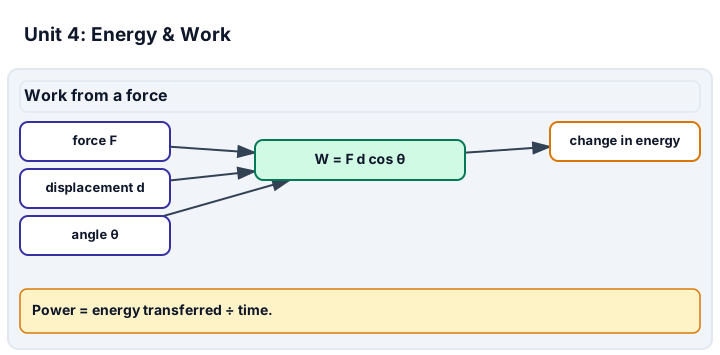
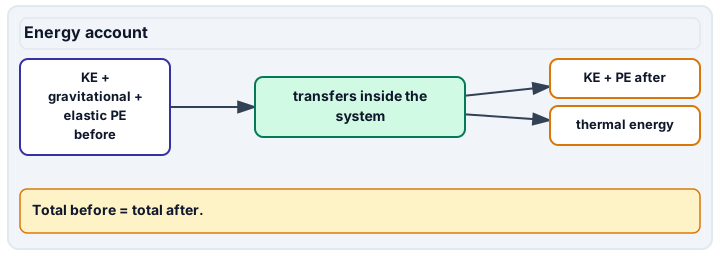
Diagram description
Work from a force uses force, displacement and angle to compute work and relates work to energy change and power. Energy account defines the system with kinetic, gravitational and elastic potential energy before, then internal transfers that produce kinetic/potential energy after and thermal energy while total energy is conserved.
Data, provenance, and assumptions
| Quantity | Value | Unit / meaning |
|---|---|---|
| m | 2 | kg |
| F | 10 | N pulling force |
| angle | 60 | degrees to displacement |
| d | 2 | m horizontal displacement |
| friction | 3 | N opposing motion |
| time | 2 | s |
| g | 9.81 | m/s^2 |
| h | 0.5 | m; separate reference lift |
| k | 100 | N/m; separate reference spring |
| compression | 0.2 | m; separate reference spring |
Paper investigation sequence and evidence record
Scope and safety: These are supplied-data and paper-model investigations, not laboratory procedures. No launches, high-speed rotors, elevated loads, pressurized vessels, hydraulic builds or improvised apparatus are assigned. An educator must approve any actual practical, equipment, facilities and accessible alternative separately. Synthetic records do not certify hands-on skill or performed lab hours; public answers are nonsecure practice.
Materials and preparation
- [energy-ledger] Use the supplied energy-inputs records, assigned source sections, calculator and an accessible graph or diagram. No physical apparatus is required.
Procedure and schedule
- [energy-ledger] Question: How do two legitimate system boundaries account for the same pulling work and frictional heating? Prerequisites: Use cosine of a supplied angle, kinetic energy, constant-force work, energy units and average power.
- [energy-ledger] Variables: Compare the cart-only and cart-track ledgers, then change only the opposing force in the transfer. Controls: Retain mass, displacement and force angle; do not import the separate lift/spring energies into the horizontal path. Replication: Reconcile two analytical ledgers and dimensional checks; these do not constitute repeat measured heat or speed records.
- [energy-ledger] Analysis: Compute each work term, require nonnegative final kinetic energy, solve speed and label average versus instantaneous power. Review: An educator reviews prerequisites, source interpretation, reasoning and accessibility before assessment. A paper response does not certify unobserved practical technique; approved hands-on work requires a separate record.
Record: Retain energy-ledger, the selected level, original inputs and first attempt, source/date, system and axes, units, assumptions, calculation/graph, uncertainty, correction and fresh transfer. Link only to the stated science criteria.
Worked model
[energy-ledger] Pulling work is 10(2)cos60 = 10 J; friction does -6 J on the cart, leaving 4 J kinetic energy and speed 2 m/s. For cart plus track, 10 J input equals 4 J kinetic plus 6 J thermal. Average pulling power is 10/2 = 5 W. Separately, mgh = 9.81 J and kx^2/2 = 2 J for the listed lift and spring examples.
Numerical calibration
- 10 J pulling work
- -6 J on the cart
- 2 m/s
- 5 W average
- 9.81 J in the separate lift
- 2 J in the separate spring
- 2.82842712475 m/s with lower opposing force
Attempt the assigned level
Try the tasks before reading the calibration. These are practice answers, not a secure examination; use a new dataset or changed assumption for the assessed transfer.
Foundation
- [energy-ledger] Label the force-displacement angle and explain which forces do zero work in the horizontal model. Identify why frictional heating is not missing energy.
Check after your attempt
- [energy-ledger] The pull is 60 degrees from the horizontal displacement. Weight and the vertical normal do zero work on this horizontal path. Friction transfers mechanical energy into internal thermal energy of the contact system rather than destroying the energy.
High-school core: typically grades 9-10
- [energy-ledger] Calculate pull work, friction work, final speed and average pulling power. Write both the cart-only work-energy equation and the cart-plus-track energy ledger.
Check after your attempt
- [energy-ledger] Pull work is 10 J, friction work -6 J, final kinetic energy 4 J and speed 2 m/s. Average pulling power is 5 W. Cart-only net work is 4 J; cart plus track retains 4 J kinetic and 6 J thermal from the same 10 J input.
Honors extension: typically grades 11-12
- [energy-ledger] Calculate the two separate potential-energy reference values, then test a claim that a cart initially at rest follows the same path with 6 N opposing friction and all other forces unchanged.
Check after your attempt
- [energy-ledger] The lift stores 9.81 J and the spring 2 J under their stated models. With 6 N friction, the assumed path would give 10 - 12 = -2 J final kinetic energy from rest. That trajectory is inconsistent with the assumptions; taking a square root does not repair the model.
History, reading, and writing connection
Explain how the assigned Joule account connects mechanical work with internal energy. Cite the section and compare its described experiment with our synthetic friction ledger; neither our values nor the textbook illustration are your measured results. Write a claim, evidence and limitation without inventing a historical quotation.
Write in your own words or use an approved accessible equivalent. Cite a specific assigned section or figure, identify its evidence, and state one limitation or counterargument. Use the AI practice contract only for permitted coaching, never to invent observations or write the assessed response.
Transfer to a new case
[energy-ledger] Keep the original cart, pull angle and 2 m path but reduce the opposing friction force to 1 N. Predict final speed without assuming that the old 2 s travel time still applies.
Calibration: [energy-ledger] Pull work remains 10 J and friction work becomes -2 J. Final kinetic energy is 8 J, giving speed sqrt(2 x 8 / 2) = 2.828427125 m/s. The acceleration and elapsed time change, so the old average-power time cannot simply be carried over.
Evidence to retain
[energy-ledger] Science criteria 1-4: signed work, system boundaries, kinetic/thermal ledger, separately defined potential energies and power. These calculations do not document a measured ramp or spring experiment.
Record units, calculations, source/date, uncertainty, and what is measured versus inferred. A simulation or supplied dataset must stay labeled as such. These are supplied-data and paper-model investigations, not laboratory procedures. No launches, high-speed rotors, elevated loads, pressurized vessels, hydraulic builds or improvised apparatus are assigned. An educator must approve any actual practical, equipment, facilities and accessible alternative separately. Synthetic records do not certify hands-on skill or performed lab hours; public answers are nonsecure practice.
Return to all eight learning pathways. Print this unit page for the student lessons; the linked five-page packet remains the separate assessment companion.
Match evidence to the actual criterion
Integration is reported separately and cannot lower the science grade or block a science demonstration pass. Science and practical criteria determine that pass. The paper cases assess named analytical criteria, not unobserved hands-on technique. Use an educator-selected fresh variant and retain the first attempt.
- Work enters a system; friction does not destroy energy: science criteria 1, 2, 3, 4.
Unit mastery rubric
| Criterion | Developing | Proficient | Mastery |
|---|---|---|---|
| Work | Thinks any force applied does work, regardless of motion. | Computes work but ignores the angle between force and displacement. | Calculates work correctly with the force–displacement angle and explains when work is zero, positive, or negative. |
| Kinetic & potential energy | Confuses the two or omits units. | Computes each separately but mishandles the reference height for potential energy. | Computes kinetic, gravitational, and elastic potential energy and chooses a sensible zero for potential energy. |
| Conservation of energy | Does not see energy as conserved; treats each step separately. | Applies conservation but forgets energy lost to friction. | Tracks energy transformations through a system, including thermal losses, and solves with the conservation principle. |
| Power | Confuses power with energy or force. | Uses the power equation but not in context. | Relates power to the rate of energy transfer and compares real devices by power output. |
| Lab technique (energy on a ramp / spring) | Takes single measurements with no check on conservation. | Measures heights and speeds but does not compare energy in to energy out. | Uses a ramp or spring to measure energy at two points and tests conservation against loss, with uncertainty. |
| Integration (cross-domain) | Makes no supported connection between the source and the science. | Uses the source but needs help connecting evidence, writing, or limitations to the science. | Independently connects History, Reading, and Writing using a cited source, appropriate evidence, a limitation, and a scientific explanation. |
Integration is reported separately and cannot lower the science grade or block a science demonstration pass. Science and practical criteria determine that pass. Use the integration guide's evidence checklist for the separately reported criterion.
“At the top the cart is all gravitational potential energy; at the bottom it’s mostly kinetic, but not all — friction turned some into heat. So I set potential at the top equal to kinetic at the bottom plus the friction loss, and I don’t need the acceleration at all.”
“It has more energy at the bottom because it’s going faster, and power is just how strong the push is.”
You demonstrate this unit through energy-conservation labs plus short oral checks where you trace energy through a system aloud — not a multiple-choice test. A criterion counts as mastered only when you can both take clean data and justify the physics behind it. Mastery is demonstrated, not awarded.
A 5-page clipboard packet — unit overview, key terms, the mastery rubric, anchor examples, and a score sheet you can print and grade against.