Unit 03 · Circular Motion & Gravitation
Motion in a circle is accelerated motion, even at constant speed — because direction is changing. This unit builds the idea of centripetal acceleration pointing toward the center, identifies what real force supplies it in each case, and then scales the same reasoning up to Newton's law of universal gravitation and the orbits it explains. Mastery means you never write "centrifugal force" as a cause, and you can connect a satellite's speed, radius, and period from first principles.
Student learning: Circular Motion & Gravitation
Choose the level by readiness, not age alone, and record it before instruction. Foundation, core, and honors tasks are study pathways, not an AP course or a promise of college credit. The instructor retains practical assessment and the published science rubric; integration is reported separately.
Prerequisites: [circular-orbits] Use inverse-square reasoning, square roots, circumference, period and a stated angular-momentum axis.
Suggested sequence: read and discuss the explanation; attempt the worked model; analyze the data at your selected level; check the answers; then complete the source-linked response and a fresh transfer question. These activities supplement, not replace, supervised practical work and the full-year schedule.
Assigned reading and focus
- OpenStax University Physics Volume 1, 6.3 Centripetal Force. [circular-orbits] Read radial acceleration and identify the physical force providing it. Centripetal describes a net radial requirement, not an extra force to add.
- OpenStax University Physics Volume 1, 13.4 Satellite Orbits and Energy. [circular-orbits] Read circular-orbit speed, period and energy. Compare two circular states without treating an orbit transfer as an unforced change in radius.
- MacTutor, University of St Andrews: Isaac Newton. Read the biography’s discussion of the gravitational work and Principia alongside the assigned satellite-orbit section; separate historical attribution from our invented planet parameters.
Learn the science
Choose a readiness level before instruction. Foundation scaffolds do not by themselves satisfy every Mastery criterion. The assigned college text may also present calculus; these tasks use the stated algebraic models and geometric areas. Source/model reasoning and approved practical observation remain different evidence.
[circular-orbits] Gravity supplies a centripetal requirement, not a second force. In a gravity-supported circular orbit, GMm/r^2 = mv^2/r, so v = sqrt(mu/r) with mu = GM. The same gravity that changes velocity direction supplies the radial acceleration. Period is 2pi sqrt(r^3/mu). For a circular orbit, L = m sqrt(mu r) about the central body and total mechanical energy is -mu m/(2r), taking potential zero at infinity. Two different circular radii have different L and energy.
[circular-orbits] Assumptions: Use a synthetic compact spherical primary with the supplied gravitational parameter, a much smaller satellite, circular orbits outside the primary and negligible atmosphere/other bodies. Radii are from the primary center, not heights above its surface. The comparisons are separate states, not a record of a spontaneous transfer.
[circular-orbits] Uncertainty: Real orbits may be eccentric, perturbed or thrust-driven; uncertain radius and time affect inference. Constant speed in a circle does not mean zero acceleration. Momentum/energy for a maneuver require the complete force and work history; two endpoint circular formulas do not supply a transfer trajectory.

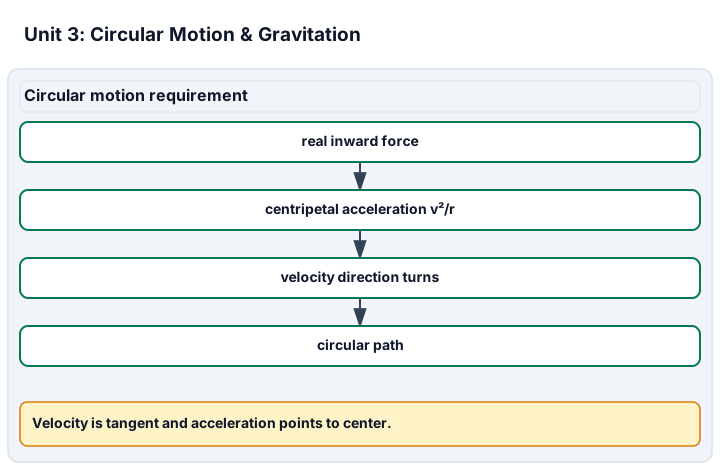
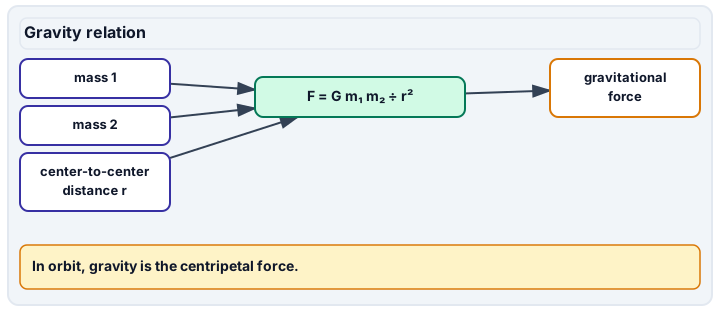
Diagram description
Circular motion requirement starts with a real inward force causing centripetal acceleration, which turns velocity and maintains the circular path. Gravity relation uses two masses and center-to-center distance for gravitational force and states that gravity supplies the centripetal force in orbit.
Data, provenance, and assumptions
| Quantity | Value | Unit / meaning |
|---|---|---|
| mu | 400000000000000 | m^3/s^2; central GM |
| m | 1000 | kg satellite |
| r1 | 10000000 | m from primary center |
| r2 | 20000000 | m from primary center |
Paper investigation sequence and evidence record
Scope and safety: These are supplied-data and paper-model investigations, not laboratory procedures. No launches, high-speed rotors, elevated loads, pressurized vessels, hydraulic builds or improvised apparatus are assigned. An educator must approve any actual practical, equipment, facilities and accessible alternative separately. Synthetic records do not certify hands-on skill or performed lab hours; public answers are nonsecure practice.
Materials and preparation
- [circular-orbits] Use the supplied orbit-inputs records, assigned source sections, calculator and an accessible graph or diagram. No physical apparatus is required.
Procedure and schedule
- [circular-orbits] Question: Which radius relationships follow from a circular gravitational model, and which do not describe an actual transfer? Prerequisites: Use inverse-square reasoning, square roots, circumference, period and a stated angular-momentum axis.
- [circular-orbits] Variables: Compare circular radius with the same central gravitational parameter; distinguish state comparison from time evolution. Controls: Retain central reference, circularity, negligible satellite mass and the same potential-energy zero. Replication: These deterministic reference states are not repeated observations of a satellite or independent evidence for a trajectory.
- [circular-orbits] Analysis: Equate gravity with radial mass times acceleration, derive speed and period, and compare L and energy before making a conservation claim. Review: An educator reviews prerequisites, source interpretation, reasoning and accessibility before assessment. A paper response does not certify unobserved practical technique; approved hands-on work requires a separate record.
Record: Retain circular-orbits, the selected level, original inputs and first attempt, source/date, system and axes, units, assumptions, calculation/graph, uncertainty, correction and fresh transfer. Link only to the stated science criteria.
Worked model
[circular-orbits] At r1, field magnitude is mu/r1^2 = 4 m/s^2, speed 6324.555320 m/s and period 9934.588266 s. At twice the radius, speed falls by sqrt(2) while period increases by 2sqrt(2). The outer/inner circular angular-momentum ratio is sqrt(2); the signed energy ratio is 1/2, with the outer energy less negative.
Numerical calibration
- 6324.5553203368 m/s
- 9934.5882657961 s
- 4 m/s^2
- 1.414213562373 outer/inner circular L
- 0.5 outer/inner signed circular energy
- 8 new/original circular period ratio
Attempt the assigned level
Try the tasks before reading the calibration. These are practice answers, not a secure examination; use a new dataset or changed assumption for the assessed transfer.
Foundation
- [circular-orbits] Draw velocity tangent to the orbit and gravitational acceleration toward the center. Explain why adding a separate outward or inward centripetal force would be wrong in this inertial diagram.
Check after your attempt
- [circular-orbits] Gravity is the inward physical force and velocity is tangent. Their directions differ, so velocity changes even at constant speed. Centripetal names the net inward requirement; it is not an additional interaction alongside gravity in this inertial frame.
High-school core: typically grades 9-10
- [circular-orbits] Calculate the inner circular speed, period and gravitational field, then predict their radius dependence. State the role of satellite mass in acceleration versus force.
Check after your attempt
- [circular-orbits] The inner values are 6324.555320 m/s, 9934.588266 s and 4 m/s^2. Speed varies as r^(-1/2), period as r^(3/2), and field as r^(-2). Satellite mass multiplies gravitational force but cancels from acceleration and the circular speed relation.
Honors extension: typically grades 11-12
- [circular-orbits] Compare angular momentum and signed energy for the two circular states. Explain why central gravity alone cannot move the satellite from one of these circles directly into the other.
Check after your attempt
- [circular-orbits] The outer circular L is sqrt(2) times greater and its energy is half as negative. Changing between these circles requires changes in energy and angular momentum; it is not an unpowered radius adjustment conserving both. Central gravity has zero torque about the primary along an unforced orbit, including a noncircular one.
History, reading, and writing connection
Compare the historical account of Newton’s gravitational work with the assigned circular-orbit derivation. Identify what observations would test an inverse-square model, distinguish those observations from our synthetic endpoint states, and explain why the state comparison is not a spacecraft maneuver plan.
Write in your own words or use an approved accessible equivalent. Cite a specific assigned section or figure, identify its evidence, and state one limitation or counterargument. Use the AI practice contract only for permitted coaching, never to invent observations or write the assessed response.
Transfer to a new case
[circular-orbits] For a separate circular orbit at four times r1 around the same primary, predict the period ratio and speed ratio. Does this comparison provide the thrust history needed to reach that orbit?
Calibration: [circular-orbits] Period increases by 4^(3/2) = 8 and speed becomes one half of the original. These are endpoint circular-state comparisons; they do not provide thrust, fuel, timing or a trajectory for an actual transfer.
Evidence to retain
[circular-orbits] Science criteria 1-4: radial force diagram, center-based radius, speed/period/field derivation and a qualified angular-momentum/energy comparison. This paper orbit model does not demonstrate centripetal-apparatus technique.
Record units, calculations, source/date, uncertainty, and what is measured versus inferred. A simulation or supplied dataset must stay labeled as such. These are supplied-data and paper-model investigations, not laboratory procedures. No launches, high-speed rotors, elevated loads, pressurized vessels, hydraulic builds or improvised apparatus are assigned. An educator must approve any actual practical, equipment, facilities and accessible alternative separately. Synthetic records do not certify hands-on skill or performed lab hours; public answers are nonsecure practice.
Return to all eight learning pathways. Print this unit page for the student lessons; the linked five-page packet remains the separate assessment companion.
Match evidence to the actual criterion
Integration is reported separately and cannot lower the science grade or block a science demonstration pass. Science and practical criteria determine that pass. The paper cases assess named analytical criteria, not unobserved hands-on technique. Use an educator-selected fresh variant and retain the first attempt.
- Gravity supplies a centripetal requirement, not a second force: science criteria 1, 2, 3, 4.
Unit mastery rubric
| Criterion | Developing | Proficient | Mastery |
|---|---|---|---|
| Centripetal acceleration & force | Thinks an object in a circle has no acceleration at constant speed. | Knows there is acceleration but points it the wrong way. | Shows centripetal acceleration points to the center, uses v²/r, and explains why speed can be constant while velocity changes. |
| Source of the centripetal force | Invents a "centrifugal force" pushing outward. | Names a real force but not consistently across situations. | Identifies the actual force supplying the centripetal requirement — tension, friction, gravity, or normal — in each case. |
| Universal gravitation | Confuses mass with weight; ignores distance. | Uses the gravitation equation but mishandles the inverse-square. | Applies the inverse-square law correctly and distinguishes mass from weight in any gravitational field. |
| Orbits & satellites | Treats orbit as unrelated to gravity. | Links gravity to orbit but cannot relate speed, radius, and period. | Derives the relationship among orbital speed, radius, and period and explains why an orbit is continuous free fall. |
| Lab technique (centripetal apparatus) | Swings the mass erratically; takes no repeatable data. | Collects data but does not control the radius or period cleanly. | Uses a conical pendulum or centripetal-force apparatus to measure force versus speed and compares to v²/r with uncertainty. |
| Integration (cross-domain) | Makes no supported connection between the source and the science. | Uses the source but needs help connecting evidence, writing, or limitations to the science. | Independently connects History, Reading, and Writing using a cited source, appropriate evidence, a limitation, and a scientific explanation. |
Integration is reported separately and cannot lower the science grade or block a science demonstration pass. Science and practical criteria determine that pass. Use the integration guide's evidence checklist for the separately reported criterion.
“Nothing pushes the ball outward — the string tension pulls it inward, and that’s the centripetal force. If the string snaps, it flies off along a tangent, not outward. A satellite is the same idea: gravity is the inward pull, and the orbit is just free fall that keeps missing the ground.”
“Centrifugal force throws it outward, and gravity is stronger up high because you’re closer to space.”
You demonstrate this unit through centripetal-force labs plus short oral checks where you reason about what supplies the inward force aloud — not a multiple-choice test. A criterion counts as mastered only when you can both take clean data and justify the physics behind it. Mastery is demonstrated, not awarded.
A 5-page clipboard packet — unit overview, key terms, the mastery rubric, anchor examples, and a score sheet you can print and grade against.