Unit 02 · Dynamics & Newton's Laws
Now you ask what causes motion to change. This unit is built on Newton's three laws and the discipline of the free-body diagram: every force named, none invented. You resolve forces into components, solve for acceleration on flat ground and on inclines, and treat friction as a force that depends on the normal force, not on speed. Mastery means you can look at any situation, draw the forces that are actually there, and predict what happens next.
Student learning: Dynamics & Newton’s Laws
Choose the level by readiness, not age alone, and record it before instruction. Foundation, core, and honors tasks are study pathways, not an AP course or a promise of college credit. The instructor retains practical assessment and the published science rubric; integration is reported separately.
Prerequisites: [force-systems] Understand mass, weight, signed forces, basic trigonometric components, weighted means and static/kinetic distinctions.
Suggested sequence: read and discuss the explanation; attempt the worked model; analyze the data at your selected level; check the answers; then complete the source-linked response and a fresh transfer question. These activities supplement, not replace, supervised practical work and the full-year schedule.
Assigned reading and focus
- OpenStax University Physics Volume 1, 6.1 Solving Problems with Newton’s Laws. [force-systems] Read connected-system free-body diagrams and force components. Draw each body separately before choosing a combined system.
- OpenStax University Physics Volume 1, 6.2 Friction. [force-systems] Read the static-friction inequality and kinetic-friction model; maximum static friction is not automatically the friction acting.
- MacTutor, University of St Andrews: Isaac Newton. Read the passages on Principia and the development of Newton’s mechanics. Distinguish publication history from the modern notation and ideal conditions of our two-body model.
Learn the science
Choose a readiness level before instruction. Foundation scaffolds do not by themselves satisfy every Mastery criterion. The assigned college text may also present calculus; these tasks use the stated algebraic models and geometric areas. Source/model reasoning and approved practical observation remain different evidence.
[force-systems] One system, two free-body diagrams and friction bounds. For a connected pair moving right, the external horizontal pull minus both kinetic friction forces accelerates the total mass. Internal tension cancels only in the combined system, not on either individual free-body diagram. The two string forces act on different bodies. Static friction can adjust up to a limit; at rest a smaller applied load need not produce the maximum value. Center of mass uses mass-weighted positions, not a simple midpoint when masses differ.
[force-systems] Assumptions: Two bodies connected by a taut massless horizontal string move right on a level surface. Pull is applied to A; each normal equals its own weight and both surfaces share muK. Neglect string/pulley mass and drag. The separate incline example slides downward at 30 degrees with the supplied kinetic coefficient. The transfer starts at rest and uses muS instead.
[force-systems] Uncertainty: Coefficients and loads are supplied model values, not measurements. A real force record needs sensor calibration, alignment and uncertainty. A stationary combined system fixes total friction but does not generally determine how static friction and tension split between contacts.

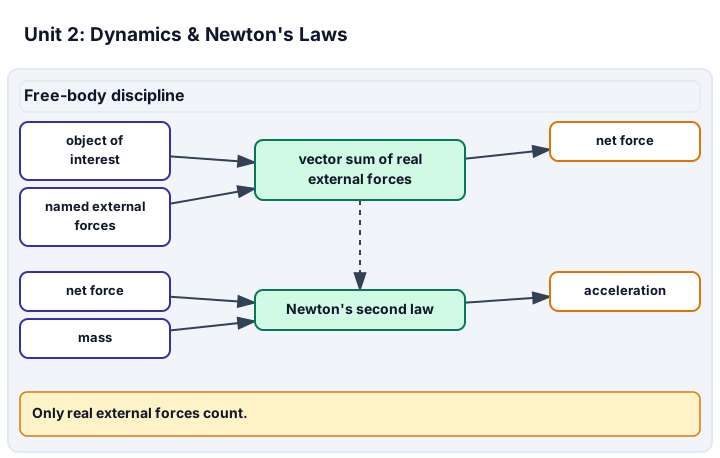
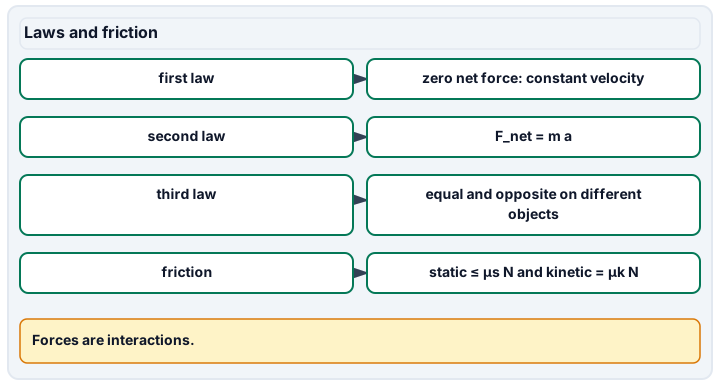
Diagram description
Free-body discipline identifies the object and named external forces, sums them to net force, and uses net force plus mass for acceleration. Laws and friction states the consequences of Newton's laws and the normal-force-based friction models.
Data, provenance, and assumptions
| Body | Mass (kg) | Reference x (m) |
|---|---|---|
| A | 2 | 1 |
| B | 3 | 0 |
| Quantity | Value | Unit / meaning |
|---|---|---|
| Fapplied | 15 | N rightward on A |
| muK | 0.1 | kinetic coefficient |
| muS | 0.2 | static limit coefficient |
| g | 9.81 | m/s^2 |
| Quantity | Value | Unit / meaning |
|---|---|---|
| m | 2 | kg |
| theta | 30 | degrees above horizontal |
| muK | 0.1 | kinetic coefficient |
| g | 9.81 | m/s^2 |
Paper investigation sequence and evidence record
Scope and safety: These are supplied-data and paper-model investigations, not laboratory procedures. No launches, high-speed rotors, elevated loads, pressurized vessels, hydraulic builds or improvised apparatus are assigned. An educator must approve any actual practical, equipment, facilities and accessible alternative separately. Synthetic records do not certify hands-on skill or performed lab hours; public answers are nonsecure practice.
Materials and preparation
- [force-systems] Use the supplied connected-bodies, force-settings, incline-inputs records, assigned source sections, calculator and an accessible graph or diagram. No physical apparatus is required.
Procedure and schedule
- [force-systems] Question: How does changing the selected system alter the force ledger without altering the predicted motion? Prerequisites: Understand mass, weight, signed forces, basic trigonometric components, weighted means and static/kinetic distinctions.
- [force-systems] Variables: Compare individual versus combined systems and a moving versus initially resting friction case. Controls: Keep masses, gravity, contact geometry, ideal string and the appropriate coefficient consistent within each model. Replication: Cross-check acceleration from both individual equations; this is an analytical consistency test, not a repeated force measurement.
- [force-systems] Analysis: Draw boundaries first, sum external forces, solve the total acceleration, recover tension and check the stationary friction inequality. Review: An educator reviews prerequisites, source interpretation, reasoning and accessibility before assessment. A paper response does not certify unobserved practical technique; approved hands-on work requires a separate record.
Record: Retain force-systems, the selected level, original inputs and first attempt, source/date, system and axes, units, assumptions, calculation/graph, uncertainty, correction and fresh transfer. Link only to the stated science criteria.
Worked model
[force-systems] Total kinetic friction is 0.1(5)(9.81) = 4.905 N, so a = (15 - 4.905)/5 = 2.019 m/s^2. On B, T - 2.943 = 3a, giving T = 9 N. Center of mass is (2 x 1 + 3 x 0)/5 = 0.4 m. A is ahead of B, so its rightward pull keeps the string taut. For the separate incline, a = g(sin30 - 0.1 cos30) = 4.055429079 m/s^2.
Numerical calibration
- 2.019 m/s^2 rightward
- 9 N
- 0.4 m
- 4.05542907889 m/s^2 down the incline
- 8 N total static friction magnitude
Attempt the assigned level
Try the tasks before reading the calibration. These are practice answers, not a secure examination; use a new dataset or changed assumption for the assessed transfer.
Foundation
- [force-systems] Draw diagrams for A, B and the combined system; label which forces cancel only when the system includes both bodies. Explain what zero net force would mean.
Check after your attempt
- [force-systems] A has pull right and string force/friction left; B has string force right and friction left. Each also has weight and normal. The internal string forces cancel in the combined ledger, not on one body. Zero net force means constant velocity, which can include rest.
High-school core: typically grades 9-10
- [force-systems] Calculate the combined acceleration, the tension from B and the center-of-mass position. Explain why equal/opposite interaction forces do not imply that either body has zero net force.
Check after your attempt
- [force-systems] Acceleration is 2.019 m/s^2, tension 9 N and reference center of mass 0.4 m. The interaction pair acts on different bodies; each diagram must include its own friction and any other external force before summing.
Honors extension: typically grades 11-12
- [force-systems] Resolve the separate incline forces and calculate its acceleration. Then distinguish a measured friction coefficient from a parameter assumed for every contact in this exercise.
Check after your attempt
- [force-systems] The normal is 2g cos30 = 16.99141842 N and downhill net force is 2g sin30 minus 0.1 times that normal. Acceleration is 4.055429079 m/s^2. Assuming one coefficient is a model choice; actual surfaces, alignment and measurement variation require evidence.
History, reading, and writing connection
Use the Newton biography and the connected-body diagrams to explain how a general law differs from a particular application. Cite a source-supported historical claim, show how the modern ledger tests a prediction and name an omitted condition. Do not claim that one equation or publication ended all earlier inquiry.
Write in your own words or use an approved accessible equivalent. Cite a specific assigned section or figure, identify its evidence, and state one limitation or counterargument. Use the AI practice contract only for permitted coaching, never to invent observations or write the assessed response.
Transfer to a new case
[force-systems] The original connected pair is now at rest with an 8 N pull and muS = 0.20. Can it remain stationary, what total friction is needed, and is the static tension uniquely determined?
Calibration: [force-systems] The available combined static limit is 0.20(5)(9.81) = 9.81 N, so a stationary balance is possible. Total friction adjusts to 8 N, not the maximum 9.81 N. The contact-by-contact split and static tension are not unique from this combined ledger alone.
Evidence to retain
[force-systems] Science criteria 1-4: separate and combined diagrams, interaction pairs, mass-weighted position, acceleration/tension, incline components and static-versus-kinetic reasoning. No force-sensor technique is certified.
Record units, calculations, source/date, uncertainty, and what is measured versus inferred. A simulation or supplied dataset must stay labeled as such. These are supplied-data and paper-model investigations, not laboratory procedures. No launches, high-speed rotors, elevated loads, pressurized vessels, hydraulic builds or improvised apparatus are assigned. An educator must approve any actual practical, equipment, facilities and accessible alternative separately. Synthetic records do not certify hands-on skill or performed lab hours; public answers are nonsecure practice.
Return to all eight learning pathways. Print this unit page for the student lessons; the linked five-page packet remains the separate assessment companion.
Match evidence to the actual criterion
Integration is reported separately and cannot lower the science grade or block a science demonstration pass. Science and practical criteria determine that pass. The paper cases assess named analytical criteria, not unobserved hands-on technique. Use an educator-selected fresh variant and retain the first attempt.
- One system, two free-body diagrams and friction bounds: science criteria 1, 2, 3, 4.
Unit mastery rubric
| Criterion | Developing | Proficient | Mastery |
|---|---|---|---|
| Newton's three laws | Recites the laws but applies them to the wrong situations. | States each law but confuses inertia with the second law. | Applies the right law to each situation and explains why an object at constant velocity has zero net force. |
| Free-body diagrams | Adds phantom forces (like "the force of motion") or omits real ones. | Draws most forces but misplaces the normal force on an incline. | Draws complete, correct free-body diagrams for any object, including inclines and connected systems. |
| Net force & acceleration (F = ma) | Adds force magnitudes without regard to direction. | Finds net force on flat ground but stalls on inclined-plane components. | Resolves forces into components and solves for acceleration on flat and inclined surfaces. |
| Friction | Thinks friction depends on surface area or speed. | Uses the friction equation but confuses static and kinetic. | Distinguishes static from kinetic friction and relates each correctly to the normal force. |
| Lab technique (force measurement) | Misreads the spring scale or ignores the string's mass assumptions. | Takes readings but does not check the system against prediction. | Uses an Atwood machine or force table to measure forces cleanly and compares result to prediction with uncertainty. |
| Integration (cross-domain) | Makes no supported connection between the source and the science. | Uses the source but needs help connecting evidence, writing, or limitations to the science. | Independently connects History, Reading, and Writing using a cited source, appropriate evidence, a limitation, and a scientific explanation. |
Integration is reported separately and cannot lower the science grade or block a science demonstration pass. Science and practical criteria determine that pass. Use the integration guide's evidence checklist for the separately reported criterion.
“On the incline there’s gravity straight down, the normal force perpendicular to the surface, and friction up the slope. I rotate my axes to the ramp, split gravity into components, and only the along-ramp part drives the acceleration. No 'force of motion' — that’s not a real force.”
“There’s the push forward and gravity down, and friction is bigger because the block is wide.”
You demonstrate this unit through force-measurement labs plus short oral checks where you draw and defend a free-body diagram aloud — not a multiple-choice test. A criterion counts as mastered only when you can both take clean force data and justify the physics behind it. Mastery is demonstrated, not awarded.
A 5-page clipboard packet — unit overview, key terms, the mastery rubric, anchor examples, and a score sheet you can print and grade against.