Unit 01 · Kinematics & Motion
This unit is about describing motion precisely, before asking what causes it. You separate position, velocity, and acceleration — and their signs and directions — learn to read and sketch the three motion graphs, choose the right kinematic equation for constant acceleration, and treat free fall and projectile motion as vertical and horizontal stories that run independently. Mastery means you read a velocity–time graph as the story of a moving object, not a formula to plug numbers into.
Student learning: Kinematics
Choose the level by readiness, not age alone, and record it before instruction. Foundation, core, and honors tasks are study pathways, not an AP course or a promise of college credit. The instructor retains practical assessment and the published science rubric; integration is reported separately.
Prerequisites: [motion-graphs] Read signed axes, triangle/trapezoid areas, slopes and the difference between an interval and an instant. [projectile-model] Use signed acceleration, a square root and a common time in two perpendicular component equations.
Suggested sequence: read and discuss the explanation; attempt the worked model; analyze the data at your selected level; check the answers; then complete the source-linked response and a fresh transfer question. These activities supplement, not replace, supervised practical work and the full-year schedule.
Assigned reading and focus
- OpenStax University Physics Volume 1, 3.4 Motion with Constant Acceleration. [motion-graphs] Read the velocity/time graphical interpretation and constant-acceleration equations. Use straight-line segment areas here, not calculus or an assumption that one acceleration describes the entire record.
- OpenStax University Physics Volume 1, 4.5 Relative Motion in One and Two Dimensions. [motion-graphs] Read one-dimensional relative velocity and the need to name each reference frame. Apply only the constant-velocity observer case in this activity.
- OpenStax University Physics Volume 1, 4.3 Projectile Motion. [projectile-model] Read the component method and the example of landing at a different height. Foundation uses diagrams and supplied algebra; no projectile experiment or calculus derivation is assigned.
- MacTutor, University of St Andrews: Galileo Galilei. Read the discussion of Galileo’s work on motion and the distinction between sources and later stories. This is a retrospective biography, not the raw data in our motion table.
Learn the science
Choose a readiness level before instruction. Foundation scaffolds do not by themselves satisfy every Mastery criterion. The assigned college text may also present calculus; these tasks use the stated algebraic models and geometric areas. Source/model reasoning and approved practical observation remain different evidence.
[motion-graphs] Signed motion areas and a moving observer. Position specifies a location relative to an origin; displacement is final minus initial position. Velocity carries direction, while speed is its magnitude. A velocity-time slope gives acceleration and signed area gives displacement. Distance requires positive contributions on both sides of zero. A momentarily zero velocity does not imply zero acceleration. For an observer moving at constant +1 m/s relative to the lab, subtract 1 m/s from every velocity; do not change only the final sample.
[motion-graphs] Assumptions: Take x = 0 at t = 0, positive motion to the right, and piecewise-linear velocity between the supplied samples. Each straight segment has constant acceleration, but acceleration can change at a join. The observer frame moves uniformly, so the same time intervals apply. The table is an ideal teaching trace, not measured motion.
[motion-graphs] Uncertainty: Real measurements require timing, position and calibration uncertainty; a handful of sampled velocities would not by itself establish straight-line behavior between samples. The model supplies that interpolation explicitly. Do not label the signed integral as distance when the object reverses direction.
[projectile-model] Two components share one flight time. In the ideal gravity-only model, horizontal velocity is constant while vertical velocity changes. Both components share the same elapsed time. With upward positive and initial vertical velocity zero, ground contact satisfies 0 = h0 - g t^2/2. Choose the positive future time, then compute horizontal displacement vx0 t. Horizontal speed does not determine the fall time under these stated assumptions.
[projectile-model] Assumptions: Use a point particle starting at height h0 above level ground, no air resistance, constant downward g and a stationary inertial ground frame. The record specifies a horizontal initial velocity and zero vertical velocity. It is a numerical trajectory, not a launch specification or a real safety calculation.
[projectile-model] Uncertainty: Drag, wind, object size, terrain and uncertain initial conditions can change the outcome. A model prediction is not a measured landing location. The independence of perpendicular components follows the specified forces, not a rule that components never interact in other systems.

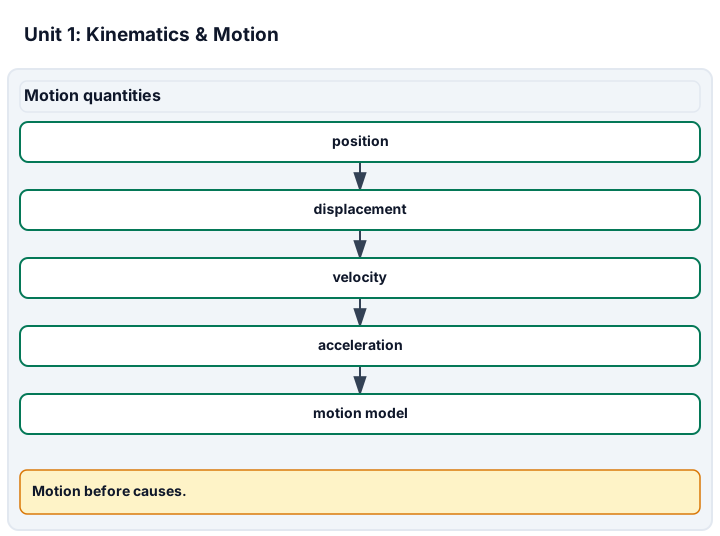
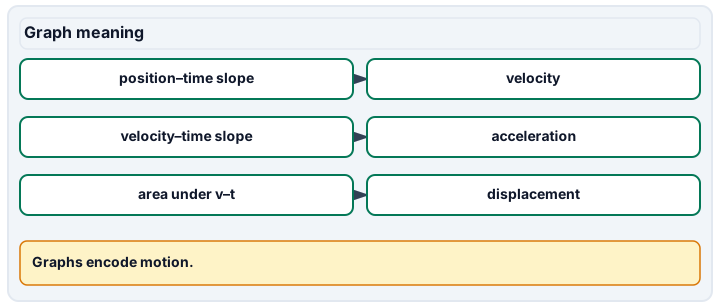
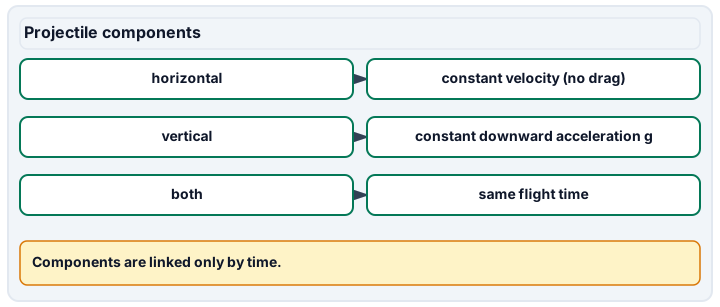
Diagram description
Motion quantities orders position, displacement, velocity and acceleration. Graph meaning states which graph feature gives which quantity. Projectile components separates horizontal constant velocity from vertical downward acceleration and states both share flight time.
Data, provenance, and assumptions
| Time (s) | Velocity (m/s) |
|---|---|
| 0 | 0 |
| 1 | 2 |
| 2 | 0 |
| 3 | -2 |
| 4 | 0 |
| Quantity | Value | Unit / meaning |
|---|---|---|
| h0 | 1.25 | m above ground |
| vx0 | 3 | m/s rightward |
| vy0 | 0 | m/s upward |
| g | 9.81 | m/s^2 downward magnitude |
Paper investigation sequence and evidence record
Scope and safety: These are supplied-data and paper-model investigations, not laboratory procedures. No launches, high-speed rotors, elevated loads, pressurized vessels, hydraulic builds or improvised apparatus are assigned. An educator must approve any actual practical, equipment, facilities and accessible alternative separately. Synthetic records do not certify hands-on skill or performed lab hours; public answers are nonsecure practice.
Materials and preparation
- [motion-graphs] Use the supplied motion-velocity records, assigned source sections, calculator and an accessible graph or diagram. No physical apparatus is required.
- [projectile-model] Use the supplied projectile-inputs records, assigned source sections, calculator and an accessible graph or diagram. No physical apparatus is required.
Procedure and schedule
- [motion-graphs] Question: How can a trace have zero displacement but positive distance, and what changes when the observer moves? Prerequisites: Read signed axes, triangle/trapezoid areas, slopes and the difference between an interval and an instant.
- [motion-graphs] Variables: Compare lab versus constant-speed observer coordinates; the transfer changes only the final velocity sample. Controls: Keep times, positive direction, initial position and straight-segment interpolation explicit in each comparison. Replication: Independent arithmetic/graph checks are not new physical trials; actual sampling would need repeated calibrated observations.
- [motion-graphs] Analysis: Plot the trace, sum signed and absolute areas, accumulate position, transform every velocity and split any zero-crossing interval. Review: An educator reviews prerequisites, source interpretation, reasoning and accessibility before assessment. A paper response does not certify unobserved practical technique; approved hands-on work requires a separate record.
- [projectile-model] Question: Which initial conditions control flight time versus horizontal displacement in the stated two-component model? Prerequisites: Use signed acceleration, a square root and a common time in two perpendicular component equations.
- [projectile-model] Variables: Compare changed horizontal speed or height separately while retaining the other stated initial conditions. Controls: Keep the inertial ground frame, constant gravity, zero vertical start speed and drag-free approximation fixed. Replication: These are deterministic model variants; actual trajectories would require repeated calibrated timing and position records.
- [projectile-model] Analysis: Solve the vertical landing equation first, reject the nonfuture root and use its time in both velocity and horizontal displacement. Review: An educator reviews prerequisites, source interpretation, reasoning and accessibility before assessment. A paper response does not certify unobserved practical technique; approved hands-on work requires a separate record.
Record: Retain motion-graphs, the selected level, original inputs and first attempt, source/date, system and axes, units, assumptions, calculation/graph, uncertainty, correction and fresh transfer. Link only to the stated science criteria. Retain projectile-model, the selected level, original inputs and first attempt, source/date, system and axes, units, assumptions, calculation/graph, uncertainty, correction and fresh transfer. Link only to the stated science criteria.
Worked model
[motion-graphs] The four signed trapezoid areas are +1, +1, -1 and -1 m: zero displacement but 4 m distance. Mean velocity is 0 m/s and mean speed is 1 m/s. The first acceleration is +2 m/s^2; in the final interval velocity is negative and acceleration positive, so the object slows. The +1 m/s observer measures displacement 0 - 1(4) = -4 m. [projectile-model] The positive landing time is sqrt(2 x 1.25 / 9.81) = 0.5048187773 s. Horizontal range is 3t = 1.5144563320 m, and impact vertical velocity is -9.81t = -4.9522722058 m/s. The negative time root is not the future landing event.
Numerical calibration
- 0 m signed displacement
- 4 m distance
- 2 m/s^2
- -4 m in the moving frame
- 4.66666666667 m distance in the changed trace
- 2 m signed displacement in the changed trace
- 0.504818777346 s
- 1.51445633204 m
- -4.95227220577 m/s upward-positive
- 3.02891266408 m range from the changed height
Attempt the assigned level
Try the tasks before reading the calibration. These are practice answers, not a secure examination; use a new dataset or changed assumption for the assessed transfer.
Foundation
- [motion-graphs] Sketch the supplied velocity trace, label rightward/leftward motion, and explain why returning to the initial position does not mean no distance was traveled.
- [projectile-model] Draw separate horizontal and vertical axes, label the given velocities and gravity, and explain which component supplies the landing-time equation.
Check after your attempt
- [motion-graphs] The first two intervals move right and the last two left. Their signed areas cancel, but adding the magnitudes gives 4 m traveled. Direction belongs to velocity and displacement, not to the nonnegative distance.
- [projectile-model] The horizontal component has initial 3 m/s and zero acceleration in this model. The vertical component starts at 1.25 m with zero velocity and acceleration -9.81 m/s^2; it determines when the particle reaches the ground.
High-school core: typically grades 9-10
- [motion-graphs] Calculate each signed area, total distance, mean velocity, mean speed and the first acceleration. Translate the accumulated areas into a position sketch.
- [projectile-model] Solve for the future landing time, horizontal range and signed vertical velocity at impact. State why a negative root and speed without a direction are different issues.
Check after your attempt
- [motion-graphs] Areas are +1,+1,-1,-1 m; positions at the listed times are 0,1,2,1,0 m. Distance is 4 m, mean velocity 0, mean speed 1 m/s and first acceleration 2 m/s^2. Position has curved segments because velocity changes within them.
- [projectile-model] The physical future root is 0.5048187773 s; range is 1.5144563320 m and vertical impact velocity -4.9522722058 m/s. Negative time describes the extended mathematical trajectory, while a negative velocity specifies direction in the chosen frame.
Honors extension: typically grades 11-12
- [motion-graphs] Describe the last interval and transform the complete trace to an observer moving uniformly at +1 m/s. Find relative displacement and state what the sampling model assumes.
- [projectile-model] Predict the effect of doubling horizontal speed without changing height, then evaluate why a real measured trajectory might not match that prediction.
Check after your attempt
- [motion-graphs] The object slows while its rightward acceleration opposes negative velocity. Relative velocities are -1,1,-1,-3,-1 m/s and relative displacement is -4 m. Straight interpolation is supplied, not inferred from noisy samples or from one global acceleration.
- [projectile-model] The ideal flight time stays fixed and range doubles because vx0 multiplies the same time. Drag, lift, wind and uncertain initial conditions would require additional forces or measurements; the ideal prediction alone does not validate a real landing location.
History, reading, and writing connection
Use the MacTutor Galileo biography and the assigned motion model to explain one historical question and one modern prediction. Cite the biography, distinguish its historical evidence from our synthetic trace, and identify a limit of both. From-rest displacement proportional to time squared requires constant acceleration; neither a straight graph nor one experiment establishes an entire historical narrative.
Write in your own words or use an approved accessible equivalent. Cite a specific assigned section or figure, identify its evidence, and state one limitation or counterargument. Use the AI practice contract only for permitted coaching, never to invent observations or write the assessed response.
Transfer to a new case
[motion-graphs] Keep times and the first four velocities, but replace the last velocity at 4 s with +4 m/s. Calculate both displacement and distance, splitting the final interval where velocity crosses zero. [projectile-model] Change only the initial height to 5.00 m while retaining a horizontal 3.00 m/s velocity and the same gravity-only assumptions. Predict the new range and its ratio to the original.
Calibration: [motion-graphs] The last interval crosses zero one third of a second after 3 s. Its signed area is +1 m, giving total displacement +2 m. Its two distance triangles total 5/3 m, so total distance is 3 + 5/3 = 14/3 m, about 4.666667 m. [projectile-model] Quadrupling height doubles flight time to about 1.009637555 s. The new range is 3.028912664 m, twice the original, not four times. This follows the square-root time dependence and the unchanged horizontal speed.
Evidence to retain
[motion-graphs] Science criteria 1-3: retain sign conventions, slopes, position/velocity sketches, separate distance and displacement, the frame transformation and the zero-crossing transfer. No timing technique is inferred from supplied samples. [projectile-model] Science criteria 1, 3 and 4: retain axes, independent component equations, physical time-root selection and the changed-height transfer. Calculations do not establish motion-capture or launch technique.
Record units, calculations, source/date, uncertainty, and what is measured versus inferred. A simulation or supplied dataset must stay labeled as such. These are supplied-data and paper-model investigations, not laboratory procedures. No launches, high-speed rotors, elevated loads, pressurized vessels, hydraulic builds or improvised apparatus are assigned. An educator must approve any actual practical, equipment, facilities and accessible alternative separately. Synthetic records do not certify hands-on skill or performed lab hours; public answers are nonsecure practice.
Return to all eight learning pathways. Print this unit page for the student lessons; the linked five-page packet remains the separate assessment companion.
Match evidence to the actual criterion
Integration is reported separately and cannot lower the science grade or block a science demonstration pass. Science and practical criteria determine that pass. The paper cases assess named analytical criteria, not unobserved hands-on technique. Use an educator-selected fresh variant and retain the first attempt.
- Signed motion areas and a moving observer: science criteria 1, 2, 3.
- Two components share one flight time: science criteria 1, 3, 4.
Unit mastery rubric
| Criterion | Developing | Proficient | Mastery |
|---|---|---|---|
| Position, velocity & acceleration | Uses the words interchangeably; ignores sign and direction. | Distinguishes the three but mixes up the sign of acceleration when slowing down. | Separates all three cleanly, reasons with signs and directions, and explains why an object can slow while accelerating. |
| Motion graphs (x–t, v–t, a–t) | Cannot read a value or slope off a motion graph. | Reads points but confuses slope and area when translating between graphs. | Reads, sketches, and translates between all three graphs — slope gives rate, area gives accumulation — fluently. |
| Kinematic equations | Grabs an equation at random and plugs numbers. | Picks a workable equation but mishandles a missing variable. | Selects the right constant-acceleration equation for the knowns and unknowns and justifies the choice. |
| Free fall & projectile motion | Treats a projectile as moving in a single lumped direction. | Separates axes but couples the horizontal and vertical times incorrectly. | Analyzes horizontal and vertical motion independently, linked only by time, and predicts range and flight time. |
| Lab technique (timing & motion capture) | Records times sloppily; ignores reaction-time error. | Collects data but does not repeat trials or average. | Uses photogates or video analysis to capture clean, repeated data and reports it with uncertainty. |
| Integration (cross-domain) | Makes no supported connection between the source and the science. | Uses the source but needs help connecting evidence, writing, or limitations to the science. | Independently connects History, Reading, and Writing using a cited source, appropriate evidence, a limitation, and a scientific explanation. |
Integration is reported separately and cannot lower the science grade or block a science demonstration pass. Science and practical criteria determine that pass. Use the integration guide's evidence checklist for the separately reported criterion.
“The cart is moving in the positive direction and slowing down, so its acceleration is negative. The signed area under its velocity–time graph gives displacement. For distance traveled, I add the absolute areas, or use the area under the speed–time graph.”
“It’s going down so the acceleration is… zero? And I’d use the one with all the letters in it.”
You demonstrate this unit through motion-capture labs plus short oral checks where you reason from a graph aloud — not a multiple-choice test. A criterion counts as mastered only when you can both take clean motion data and justify the physics behind it. Mastery is demonstrated, not awarded.
A 5-page clipboard packet — unit overview, key terms, the mastery rubric, anchor examples, and a score sheet you can print and grade against.