Teaching examples, not student testimonials. The sample week, model notebook, and demonstration prompts illustrate the intended learning process; they do not report an enrolled student's results. Current program status and next steps.
Look inside the Zoology pack.
No sign-up, no email required. Here is a sample week, a real rubric, a model lab-notebook entry, and a sample demonstration. These are the materials themselves, not a brochure. Every sample links to the full artifact it’s drawn from.
One week, two days with the animals.
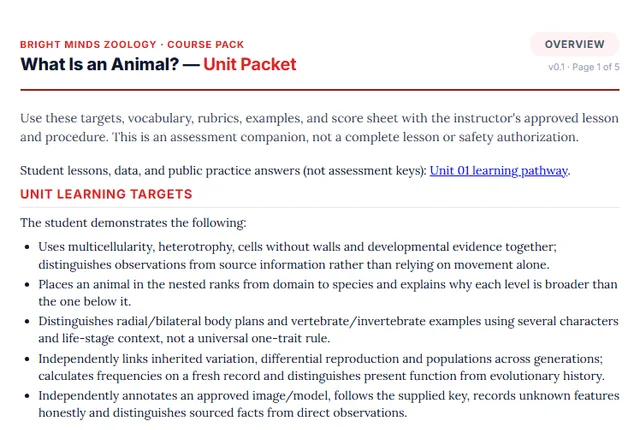
The course meets two days a week for about two hours a day, across roughly 32 weeks. Here is week one of Unit 1 — What Is an Animal?: the student keys out real specimens before a single group is memorized.
- Defining traits of animals
- Levels of classification & symmetry
- Reading: Linnaeus & the naming of life
- Key out specimens trait by trait
- Sort by body plan & symmetry
- Record observations & sketches
How “mastered” is actually judged.
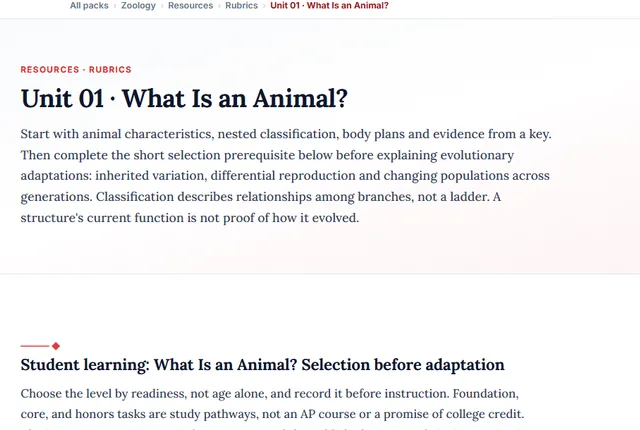
Every skill is scored at one of three levels against a published standard, without points or grading on a curve. Here is one criterion from the What Is an Animal? rubric — lab technique: keying out a specimen, shown as a parent or guide would read it:
| Level | What it looks like — “Key out an unknown specimen” |
|---|---|
| Developing | Skips the key or guesses a name without observing. |
| Proficient | Follows the key but misreads a trait or takes the wrong branch. |
| Mastery | Works a dichotomous key with a hand lens, records observations and sketches in a field notebook, and identifies an unknown specimen. |
Browse the full rubric set → · How this becomes an A–F grade →
The artifact a student builds, keeps, and defends.
The lab notebook is the primary record of a student's work, written in pen at the bench and explained aloud. Here is one model Experiment Day, showing how each section is recorded. Notice the crossed-out skipped interval and the honest sources of error.
| Behavior | With cover | No cover |
|---|---|---|
| hidden | 55% | 0% |
| still | 20% | 35% |
| walking | 15% | 55% |
| grooming | 10% | 10% |
- Dated & titled entries
- A testable question & hypothesis
- Units on every number
- Significant figures, honestly reported
- Calculations shown, not just answers
- Written in pen during the lab; errors crossed out, not erased
- Error analysis with direction & size
The moment that can’t be faked.
Three times across the year, a student performs and defends a demonstration, standing with their own work and reasoning aloud while an adult asks unscripted follow-ups. In the timed classification challenge, they key out and classify unfamiliar animals from observable traits, under time pressure.
“A spider isn’t an insect — eight legs, two body parts, no antennae — so the key branches me to arachnids, not insects. Both are invertebrates with no backbone, and I got there by reading traits down the key, not guessing from the photo.”
A passing answer from the timed classification challenge — keying out an unknown from real traits, not recognizing a picture.
The whole pack, ready for a binder.
Everything here is available to read online. Every rubric, checklist, and guide also has a print-ready packet version, formatted 8.5×11 for a clipboard or a three-ring binder. You assemble the student’s binder from the pack itself; there’s nothing else to buy to hold it in your hands. We’ve put them all in binder order on one page: Assemble the Zoology binder →
Seen enough to start?
The whole Zoology pack is open to read and print. Open it and begin, or ask us a question first. A real person answers.