Unit 01 · What Is an Animal?
Start with animal characteristics, nested classification, body plans and evidence from a key. Then complete the short selection prerequisite below before explaining evolutionary adaptations: inherited variation, differential reproduction and changing populations across generations. Classification describes relationships among branches, not a ladder. A structure's current function is not proof of how it evolved.
Student learning: What Is an Animal? Selection before adaptation
Choose the level by readiness, not age alone, and record it before instruction. Foundation, core, and honors tasks are study pathways, not an AP course or a promise of college credit. The instructor retains practical assessment and the published science rubric; integration is reported separately.
Prerequisites: Count groups, divide a part by the whole and distinguish an individual from a population. No prior Biology course is required; this is the mechanism bridge for subsequent animal comparisons.
Suggested sequence: read and discuss the explanation; attempt the worked model; analyze the data at your selected level; check the answers; then complete the source-linked response and a fresh transfer question. These activities supplement, not replace, supervised practical work and the full-year schedule.
Assigned reading and focus
- OpenStax Biology 2e, 18.1 Understanding Evolution. Read "Charles Darwin and Natural Selection" and the discussion of evolutionary misconceptions. Find inherited variation, reproductive success and change across generations; distinguish the voyage observations from the later Darwin-Wallace explanation.
Learn the science
To explain evolution by natural selection, connect inherited variation, differential reproduction and change in populations across generations. Variation must already exist; individuals do not acquire a needed feature on purpose. If inherited variants leave different numbers of descendants that themselves reach the next breeding census, their frequencies can change. Survival without reproductive contribution is not the full mechanism. Mutation, migration and chance can also change populations; selection is not an inevitable march toward perfection.
15-minute selection check: spend 3 minutes reading the assigned selection paragraphs, 4 minutes calculating G0 and G1 frequencies, 3 minutes explaining G2 and 5 minutes attempting the changed-background transfer independently. Use counters or a drawn grid if division needs scaffolding. Before explaining adaptations in later units, the instructor checks all three mechanism links and the transfer; reteach the missing link rather than requiring a Biology referral.
In this deliberately simplified model, pale and dark variants reproduce true to type. Inheritance is an explicit assumption, not something the counts establish. There are non-overlapping generations: each row contains only that generation of breeding-age recruits, not surviving parents added to offspring. No migration or new mutation is modeled. On the fictional dark background, each pale parent contributes one recruit and each dark parent contributes three. These are synthetic reproductive outcomes, not a claim that color caused predation or that we measured a real insect population.
Adaptation is an evolutionary claim about a heritable feature shaped by selection in a context. A present-day function alone does not establish that history. Evidence would also need inheritance, variation, reproductive consequences and historical or comparative support. A useful feature can be used in a new way; a single photo cannot reveal its origin. Animal classification uses multiple characters and common ancestry, not a ladder or a universal rule based on size, movement or temperature.

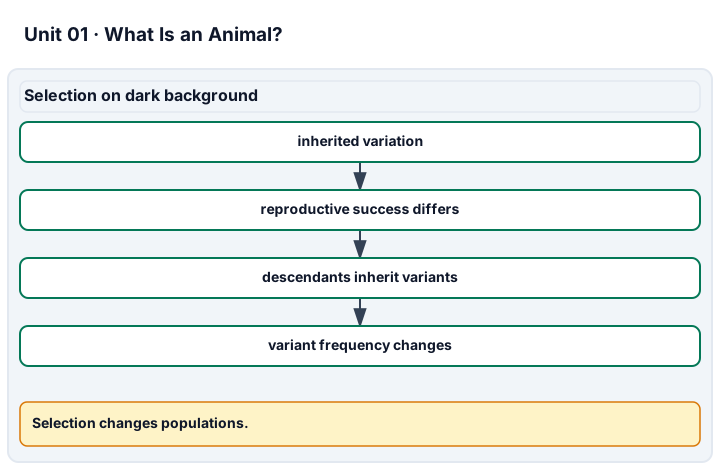
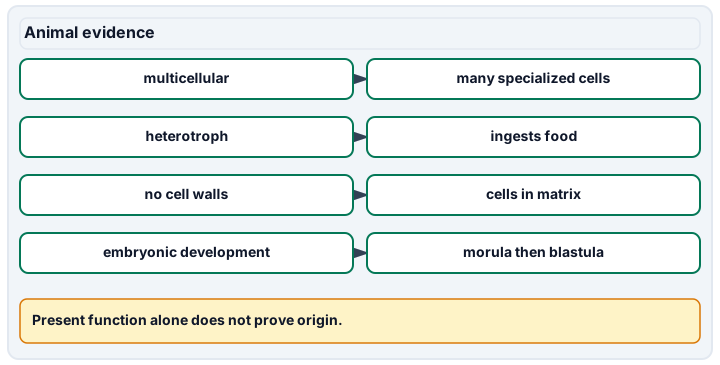
Diagram description
Selection starts with inherited variation, differential reproductive success, inherited descendants, and changed frequency. A separate grid lists animal evidence: multicellularity, ingestive heterotrophy, no cell walls, cells in extracellular matrix, and embryonic development. A present function alone does not prove adaptation.
Data, provenance, and assumptions
| Generation | Pale individuals | Dark individuals |
|---|---|---|
| 0 | 20 | 20 |
| 1 | 20 | 60 |
| 2 | 20 | 180 |
| Generation | Pale individuals | Dark individuals |
|---|---|---|
| 0 | 30 | 30 |
| 1 | 60 | 30 |
Worked model
G0 dark fraction = 20/(20 + 20) = 50%. G1 = 60/(20 + 60) = 75%, a rise of 25 percentage points, not 25% relative change. Dark recruits per G0 dark parent = 60/20 = 3; pale = 20/20 = 1. With the same modeled contributions at G1, G2 has 60 x 3 = 180 dark and 20 x 1 = 20 pale, so 180/200 = 90% dark. No individual changed color or climbed a biological rank.
Numerical calibration
- 75 % dark individuals in G1
- 90 % dark individuals in G2
- 25 percentage-point change, G0 to G1
- 3 G1 dark recruits per G0 dark parent
- 33.3333 % dark in the light-background transfer
Attempt the assigned level
Try the tasks before reading the calibration. These are practice answers, not a secure examination; use a new dataset or changed assumption for the assessed transfer.
Foundation
- Draw G0 and G1 as groups of ten; label the denominator for each dark fraction.
- Arrange the three mechanism links and explain why an individual changing color would be a different claim.
Check after your attempt
- G0 is 20 dark out of 40; G1 is 60 out of 80. The population totals, not just the dark counts, are the denominators.
- Inherited variation precedes different reproductive contributions; the next generation has a different composition. Learning or changing during one lifetime does not establish inherited population change.
High-school core: typically grades 9-10
- Calculate both variants' recruits per parent, G2 frequency and the G0-to-G1 percentage-point change.
- Write a four-sentence mechanism explanation. Label inheritance as assumed and give two missing observations needed to test a real adaptation claim.
Check after your attempt
- Dark: 3 recruits/parent; pale: 1. G2 dark frequency is 90%; the earlier shift is 25 percentage points (50% relative to the original 50%).
- A complete explanation links initial heritable differences, unequal reproductive contribution and changing descendant frequencies. Real evidence might include parent-offspring inheritance and replicated reproductive records with environmental context; color/function alone is insufficient.
Honors extension: typically grades 11-12
- Replace both contributions with two recruits per parent. Predict G1 frequency and explain why population growth is not automatically selection.
- Identify which assumption would fail if color were acquired from diet or if migrants supplied half of G1. Explain why the original counts cannot distinguish these possibilities.
Check after your attempt
- Both groups become 40; 40/80 = 50% dark. Equal per-parent contributions leave frequency unchanged although abundance doubles.
- Diet-dependent color could remove the inherited-variant link; migrants change composition without the modeled parental reproduction. Independent evidence is needed to distinguish mechanisms in nature.
History, reading, and writing connection
Using the assigned Darwin-Wallace account, write 80-120 words distinguishing an observation made during a voyage from a later explanatory mechanism. Cite the section and label the insect numbers as a modern synthetic model, not Darwin's measurements. Identify one kind of evidence a beak drawing cannot supply. Score this historical/source connection separately.
Write in your own words or use an approved accessible equivalent. Cite a specific assigned section or figure, identify its evidence, and state one limitation or counterargument. Use the AI practice contract only for permitted coaching, never to invent observations or write the assessed response.
Transfer to a new case
Use the supplied light-background transfer without reusing the dark-background answer. What is the G1 dark frequency, and which variant has the higher contribution here? Would seeing a pale insect alone prove adaptation? For assessment the instructor changes the founder counts or contributions and asks you to explain the new result independently.
Calibration: G1 contains 60 pale and 30 dark individuals, so dark frequency is 30/90 = 33.33%. Pale parents contribute two recruits each versus one for dark parents in this model. A pale insect alone establishes neither inheritance nor reproductive advantage nor evolutionary history; the advantage is conditional on the modeled evidence.
Evidence to retain
Selection prerequisite: retain the initial attempt, all three mechanism links, denominators, the independent changed-background response and the instructor's check before later adaptation explanations. Label independent analysis of supplied records separately from independent observation of approved media or safe non-intervention observation. Record the source/date, selected level, calculations, limitation and fresh follow-up; never relabel a supplied dataset as a performed lab.
Record units, calculations, source/date, uncertainty, and what is measured versus inferred. A simulation or supplied dataset must stay labeled as such. Use approved images/models, published or synthetic datasets, or instructor-approved non-intervention observation from safe access. No capture, animal manipulation, stress induction, feeding trials, biological sampling, or wildlife handling. Do not disturb nesting or rare animals or disclose sensitive wildlife sites. Stop if safe access or a non-disturbing view is unavailable; use supplied evidence instead. Instructor approval or a proposed observation is not a performed lab claim.
Return to all eight learning pathways. Print this unit page for the student lessons; the linked five-page packet remains the separate assessment companion.
Unit mastery rubric
| Criterion | Developing | Proficient | Mastery |
|---|---|---|---|
| What defines an animal | Uses movement alone to identify an animal. | Names several characteristics but confuses a visible feature with a supplied biological fact. | Uses multicellularity, heterotrophy, cells without walls and developmental evidence together; distinguishes observations from source information rather than relying on movement alone. |
| Levels of classification | Thinks “animal” is one flat group with no inner structure. | Knows there are ranks but scrambles their order or which is broader. | Places an animal in the nested ranks from domain to species and explains why each level is broader than the one below it. |
| Sorting by traits & symmetry | Groups animals by size or color alone. | Uses some traits but confuses symmetry or backbone evidence. | Distinguishes radial/bilateral body plans and vertebrate/invertebrate examples using several characters and life-stage context, not a universal one-trait rule. |
| Selection prerequisite | Explains change by need, effort or a ladder of progress. | Calculates frequencies but needs a prompt for inheritance or reproductive contribution. | Independently links inherited variation, differential reproduction and populations across generations; calculates frequencies on a fresh record and distinguishes present function from evolutionary history. |
| Lab technique (dichotomous key & observation) | Guesses a name or invents an unseen character. | Uses an approved image/model and key but misses an uncertain character. | Independently annotates an approved image/model, follows the supplied key, records unknown features honestly and distinguishes sourced facts from direct observations. |
| Integration (cross-domain) | Makes no supported connection between the source and the science. | Uses the source but needs help connecting evidence, writing, or limitations to the science. | Independently connects History, Reading, and Writing using a cited source, appropriate evidence, a limitation, and a scientific explanation. |
Integration is reported separately and cannot lower the science grade or block a science demonstration pass. Science and practical criteria determine that pass. Use the integration guide's evidence checklist for the separately reported criterion.
“A spider isn’t an insect — it’s an arachnid: eight legs, two body parts, no antennae, where an insect has six legs and three. Both are invertebrates, so neither has a backbone, and I can walk either one down a dichotomous key trait by trait instead of guessing from a photo.”
“It’s small, so it’s… a bug? And spiders are insects, right? Animals are just, you know, things that move.”
Use approved images/models and a supplied key for the classification check. Complete the selection calculation and independent mechanism explanation before later adaptation tasks. The instructor records the actual evidence mode; supplied records are not a performed animal lab. Integration remains a separate criterion.
A 5-page clipboard packet — unit overview, key terms, the mastery rubric, anchor examples, and a score sheet you can print and grade against.