Unit 02 · Sponges, Cnidarians & Worms
Compare sponge, cnidarian and worm body plans as living branches, not steps toward more advanced animals. Cnidarians have nerve nets; many bilateral worms have more concentrated anterior nervous structures. Some cnidarians have both polyp and medusa stages, while others do not. The supplied exchange models connect shape to diffusion without pretending that current function establishes evolutionary history.
Student learning: Sponges, Cnidarians & Worms: exchange without a ladder
Choose the level by readiness, not age alone, and record it before instruction. Foundation, core, and honors tasks are study pathways, not an AP course or a promise of college credit. The instructor retains practical assessment and the published science rubric; integration is reported separately.
Prerequisites: Unit 01 selection check: independently explain inherited variation, differential reproduction and populations across generations before making an evolutionary adaptation claim. Read length, width and thickness in millimeters; core students calculate rectangular area and volume.
Suggested sequence: read and discuss the explanation; attempt the worked model; analyze the data at your selected level; check the answers; then complete the source-linked response and a fresh transfer question. These activities supplement, not replace, supervised practical work and the full-year schedule.
Assigned reading and focus
- OpenStax Biology 2e, 33.1 Animal Form and Function. Read "Body Plans", "Limiting Effects of Diffusion on Size and Development" and the bioenergetics discussion. Relate dimensions and mass to exchange and energy demand without ranking living lineages as more advanced.
- OpenStax Biology 2e, 39.1 Systems of Gas Exchange. Read "Direct Diffusion", "Skin and Gills" and "Tracheal Systems", including Figures 39.3-39.6. Identify exchange surfaces and diffusion distances; a respiratory structure can occur in several animal groups.
Learn the science
Living sponges, cnidarians and worms are branches, not successive steps becoming more human. Many sponges lack conventional true tissues, while cnidarians have tissues and a nerve net. Many bilateral worms have concentrated sensory and nervous structures at an anterior end; they did not invent the first nervous system. Symmetry and tissue organization describe body plans, not worth or evolutionary goals.
Gas exchange requires short diffusion distances and sufficient surface relative to demand. For a rectangular model, surface area A = 2(LW + LH + WH) and volume V = LWH. A/V has units mm^-1. With all else equal, a shorter diffusion distance reduces the time to reach inner tissue. This describes a functional constraint, not evidence that a real worm evolved its shape because it needed oxygen.
The two blocks below isolate thickness while length and width stay fixed. They are geometric models at the same assumed 20 deg C, medium and concentration difference, not measurements of hydra or planaria. The diffusion-time extension assumes time proportional to distance squared and uses half-thickness as the shortest surface-to-center distance. Circulation, folded surfaces and metabolism are omitted.

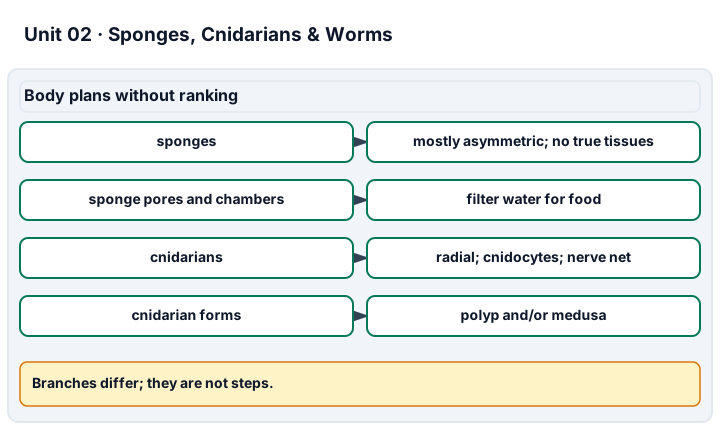
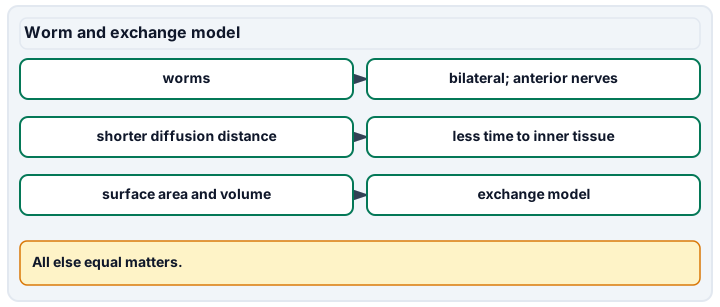
Diagram description
Sponges, cnidarians, and worms are compared as branches, not ranks. Sponge pores and chambers support filter feeding, cnidarians have cnidocytes and a nerve net, and worms are bilateral with anterior nerve concentration. The exchange model uses supplied block dimensions and states the all-else-equal assumption.
Data, provenance, and assumptions
| Model | Length (mm) | Width (mm) | Thickness (mm) |
|---|---|---|---|
| Thin | 10 | 2 | 0.5 |
| Thick | 10 | 2 | 2 |
Worked model
Thin model: A = 2(20 + 5 + 1) = 52 mm^2 and V = 10 mm^3, so A/V = 5.2 mm^-1. Thick model: A = 2(20 + 20 + 4) = 88 mm^2 and V = 40 mm^3, so A/V = 2.2 mm^-1. The thicker model has more total surface but less surface per volume. Center distances are 0.25 and 1 mm; the stated diffusion-time model gives (1/0.25)^2 = 16, not four.
Numerical calibration
- 5.2 mm^-1, thin model A/V
- 2.2 mm^-1, thick model A/V
- 16 thick/thin diffusion-time ratio under the model
- 2.6 mm^-1 after doubling every thin-model dimension
Attempt the assigned level
Try the tasks before reading the calibration. These are practice answers, not a secure examination; use a new dataset or changed assumption for the assessed transfer.
Foundation
- Sketch the two blocks and label their shortest surface-to-center distances.
- Use the worked A/V values to explain why more total surface does not necessarily mean more surface per tissue volume.
Check after your attempt
- Half-thickness is 0.25 mm for thin and 1 mm for thick.
- The thick block has 88 rather than 52 mm^2 of surface, but four times the volume; its A/V is only 2.2 versus 5.2 mm^-1.
High-school core: typically grades 9-10
- Calculate both surface areas, volumes and A/V ratios with units.
- Annotate an assigned flatworm or cnidarian figure. Separate a visible body-plan feature, an exchange explanation and an untested evolutionary claim.
Check after your attempt
- Thin: 52 mm^2, 10 mm^3, 5.2 mm^-1. Thick: 88 mm^2, 40 mm^3, 2.2 mm^-1.
- A thin profile can be described from a figure; shorter diffusion distance is a mechanism. That observation alone does not show historical reproductive advantage. Cnidarians already have a nerve net.
Honors extension: typically grades 11-12
- Calculate the thick/thin diffusion-time ratio under the supplied square-law assumption.
- Explain two reasons the result cannot predict a live animal's oxygen uptake rate.
Check after your attempt
- The distance ratio is four and the modeled time ratio is sixteen.
- Real exchange area may be folded, internal transport may occur, and metabolic demand or diffusion conditions may differ. The model includes no measured oxygen concentration or flux.
History, reading, and writing connection
Compare the modern textbook's body-plan figure with its exchange explanation in a short cited response. Explain why displaying animals from sponge to vertebrate in a book is not historical evidence that one living group turned into the next. Keep this source critique separate from the numerical science criterion.
Write in your own words or use an approved accessible equivalent. Cite a specific assigned section or figure, identify its evidence, and state one limitation or counterargument. Use the AI practice contract only for permitted coaching, never to invent observations or write the assessed response.
Transfer to a new case
Double every dimension of the thin block, not just its thickness. Predict and calculate the new A/V. Explain why this geometric change cannot establish a better or more advanced animal. The instructor may change the scale factor for the independent check.
Calibration: Area increases fourfold to 208 mm^2 and volume eightfold to 80 mm^3, so A/V becomes 2.6 mm^-1, half the original. This is a geometric trade-off under fixed assumptions; other exchange mechanisms and demands differ, and the model says nothing about a lineage's rank or selection history.
Evidence to retain
For observation and exchange-model reasoning, retain a labeled source figure, geometry, units and an independent scale-factor transfer. Identify which structures are visible and which mechanisms come from the reading. Label independent analysis of supplied records separately from independent observation of approved media or safe non-intervention observation. Record the source/date, selected level, calculations, limitation and fresh follow-up; never relabel a supplied dataset as a performed lab.
Record units, calculations, source/date, uncertainty, and what is measured versus inferred. A simulation or supplied dataset must stay labeled as such. Use approved images/models, published or synthetic datasets, or instructor-approved non-intervention observation from safe access. No capture, animal manipulation, stress induction, feeding trials, biological sampling, or wildlife handling. Do not disturb nesting or rare animals or disclose sensitive wildlife sites. Stop if safe access or a non-disturbing view is unavailable; use supplied evidence instead. Instructor approval or a proposed observation is not a performed lab claim.
Return to all eight learning pathways. Print this unit page for the student lessons; the linked five-page packet remains the separate assessment companion.
Unit mastery rubric
| Criterion | Developing | Proficient | Mastery |
|---|---|---|---|
| Sponges & filter feeding | Thinks a sponge is a plant or names no defining trait. | Calls a sponge an animal but cannot say how it feeds or that it lacks true tissues. | Explains that a sponge is an animal with no true tissues that filters food from water pulled through its pores. |
| Cnidarians, symmetry & nematocysts | Cannot name a trait that unites hydra, jellyfish, and anemones. | Groups cnidarians together but misses radial symmetry or the stinging cells. | Identifies cnidarians by radial symmetry and nematocysts and explains how the stinging cells capture prey. |
| Polyp & medusa forms | Treats every cnidarian as one fixed shape. | Names the forms but assumes every cnidarian alternates between both. | Distinguishes polyp and medusa forms with sourced examples and recognizes that not every cnidarian has both stages. |
| Worms, bilateral symmetry & cephalization | Treats wormlike shape as a single lineage or a rank. | Identifies bilateral form but overlooks cnidarian nervous tissue. | Compares flat, round and segmented worms; explains cephalization alongside cnidarian nerve nets without placing living groups on a ladder. |
| Observation & exchange-model reasoning | Invents observations or confuses area and volume. | Annotates a source figure but needs help normalizing the geometric model. | Independently calculates surface-area-to-volume ratios and diffusion-distance comparisons, labels units, annotates an approved figure and limits a fresh scale-factor prediction. |
| Integration (cross-domain) | Makes no supported connection between the source and the science. | Uses the source but needs help connecting evidence, writing, or limitations to the science. | Independently connects History, Reading, and Writing using a cited source, appropriate evidence, a limitation, and a scientific explanation. |
Integration is reported separately and cannot lower the science grade or block a science demonstration pass. Science and practical criteria determine that pass. Use the integration guide's evidence checklist for the separately reported criterion.
“The source describes a hydra's nerve net and a planarian's concentrated anterior nervous structures. Neither is a rung below the other. My thin model has 5.2 mm^-1 surface area per volume versus 2.2 for the thick one. That explains a diffusion constraint, not how these lineages evolved.”
“They’re all just squishy sea things. A sponge is a plant, right? Symmetry means it’s the same on both sides, maybe.”
Annotate approved images or existing recordings and analyze the supplied geometric models. Do not feed, stimulate, cut or handle animals for this activity. Independent source analysis and an actual observation are different evidence modes; the instructor records which was completed.
A 5-page clipboard packet — unit overview, key terms, the mastery rubric, anchor examples, and a score sheet you can print and grade against.