Unit 03 · Mollusks & Arthropods
Compare the molluscan foot, mantle and visceral mass with arthropod jointed appendages and exoskeletons. External shells and a single appendage count are not universal keys across every stage. Use multiple visible features, then calculate both absolute and body-length-relative speeds from supplied records. A speed comparison cannot establish motives, fitness or the success of an entire lineage.
Student learning: Mollusks & Arthropods: a fair locomotion comparison
Choose the level by readiness, not age alone, and record it before instruction. Foundation, core, and honors tasks are study pathways, not an AP course or a promise of college credit. The instructor retains practical assessment and the published science rubric; integration is reported separately.
Prerequisites: Unit 01 selection check: independently explain inherited variation, differential reproduction and populations across generations before making an evolutionary adaptation claim. Divide distance by elapsed time; distinguish millimeters per second from body lengths per second.
Suggested sequence: read and discuss the explanation; attempt the worked model; analyze the data at your selected level; check the answers; then complete the source-linked response and a fresh transfer question. These activities supplement, not replace, supervised practical work and the full-year schedule.
Assigned reading and focus
- OpenStax Biology 2e, 33.1 Animal Form and Function. Read "Body Plans", "Limiting Effects of Diffusion on Size and Development" and the bioenergetics discussion. Relate dimensions and mass to exchange and energy demand without ranking living lineages as more advanced.
- OpenStax Biology 2e, 39.1 Systems of Gas Exchange. Read "Direct Diffusion", "Skin and Gills" and "Tracheal Systems", including Figures 39.3-39.6. Identify exchange surfaces and diffusion distances; a respiratory structure can occur in several animal groups.
Learn the science
Mollusks have a mantle, visceral mass and a foot that can be modified; an external shell is not universal. Arthropods have jointed appendages and an exoskeleton that is replaced at molts. Identify an approved adult image using a stated key and several features, not movement speed or a single leg count across every life stage. Missing appendages or a hidden view can make a key result uncertain.
Distance/time is a speed. Dividing again by body length expresses body lengths per second, a size-relative comparison. Neither measure automatically controls for temperature, substrate, activity, age or sampling. These synthetic records specify those conditions so the arithmetic can be checked; two individuals do not establish an advantage of one phylum.
The distances are total path lengths from fictional existing recordings, not straight-line displacement. All records represent adults moving on a flat damp surface in still air at 22 deg C. No stimulus or food is introduced. The figures are not measurements collected from animals and do not show motivation, hunger or selection history.

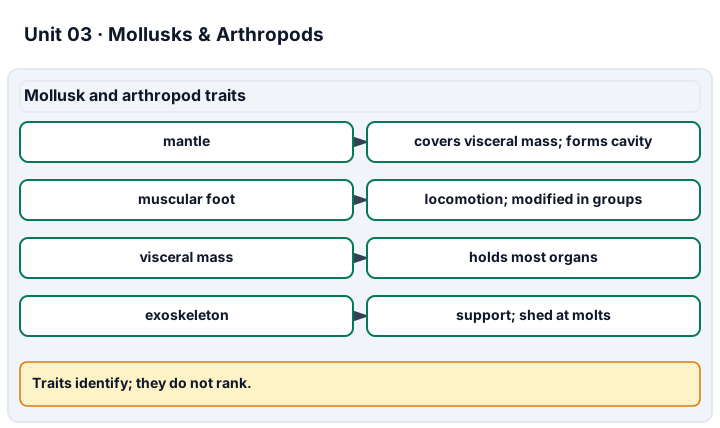
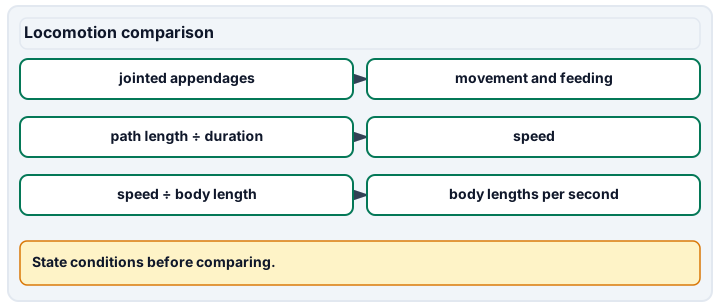
Diagram description
Mollusks are described by mantle, muscular foot, and visceral mass; arthropods by exoskeleton, molting, and jointed appendages. Locomotion uses path length, duration, and body length to compute speed and body-lengths per second, with denominators stated.
Data, provenance, and assumptions
| Record | Body length (mm) | Path length (mm) | Duration (s) | Ambient temperature |
|---|---|---|---|---|
| Snail A | 10 | 30 | 90 | 22 deg C |
| Beetle B | 20 | 120 | 30 | 22 deg C |
| Beetle C (transfer) | 40 | 360 | 60 | 22 deg C |
Worked model
Snail A: 30 mm/90 s = 0.3333 mm/s; 0.3333/10 = 0.03333 body lengths/s. Beetle B: 120/30 = 4 mm/s; 4/20 = 0.2 body lengths/s. B/A is 12 using mm/s but 6 using body lengths/s. State the denominator before saying faster. The difference describes these records, not the fitness, motivation or evolutionary success of all snails and beetles.
Numerical calibration
- 0.033333 body lengths/s for A
- 0.2 body lengths/s for B
- 6 B/A size-relative speed ratio
- 0.15 body lengths/s for C
Attempt the assigned level
Try the tasks before reading the calibration. These are practice answers, not a secure examination; use a new dataset or changed assumption for the assessed transfer.
Foundation
- Find each duration and calculate mm/s for A and B.
- From an approved image, record two visible body-plan features without guessing why the animal moved.
Check after your attempt
- A is 0.3333 mm/s over 90 s; B is 4 mm/s over 30 s. Comparing raw distances would ignore the different windows.
- Accept specific visible features with an image reference, such as jointed legs and segments; no image means no claimed observation. "Hungry" is an inferred state, not a visible action.
High-school core: typically grades 9-10
- Calculate body lengths/s and the B/A ratio, then label both axes of a comparison graph.
- Explain what is standardized in the synthetic comparison and name two missing kinds of evidence for a species-level claim.
Check after your attempt
- A = 0.03333 and B = 0.2 body lengths/s; ratio = 6. The horizontal axis identifies the individual record, the vertical axis gives the chosen speed unit.
- Ambient temperature, adult stage and surface context are stated. Replicated animals and quantified measurement error are missing; body-length normalization alone does not control all differences.
Honors extension: typically grades 11-12
- If A's path estimate is 30 +/- 3 mm with time and body length treated as exact, calculate the range of body lengths/s.
- Explain why changing substrate would weaken a direct comparison even after size normalization.
Check after your attempt
- 27/90/10 = 0.03 to 33/90/10 = 0.03667 body lengths/s. This is a stated measurement bound, not a confidence interval.
- Grip, friction and gait can differ with the surface; body length does not adjust for those variables. No universal phylum ranking follows.
History, reading, and writing connection
Use the assigned body-plan discussion to write a cited comparison of structural description and functional explanation. Explain why historical labels such as "successful design" cannot be tested by a two-record speed table. Distinguish the textbook source from the original synthetic calculation.
Write in your own words or use an approved accessible equivalent. Cite a specific assigned section or figure, identify its evidence, and state one limitation or counterargument. Use the AI practice contract only for permitted coaching, never to invent observations or write the assessed response.
Transfer to a new case
Compare C with B in both mm/s and body lengths/s. Which is faster in each sense, and why can both answers be correct? For assessment use a new supplied body length, path and duration rather than a memorized ordering.
Calibration: C travels 360/60 = 6 mm/s, greater than B's 4 mm/s. But C covers 6/40 = 0.15 body lengths/s, below B's 0.2. The denominators answer different questions. This does not establish different motives, fitness or a universal relationship between size and speed.
Evidence to retain
For Lab technique (image key & quantitative comparison), retain the independently annotated source image or explicitly supplied record, key steps, both speed units and the reversed-order transfer. Label independent analysis of supplied records separately from independent observation of approved media or safe non-intervention observation. Record the source/date, selected level, calculations, limitation and fresh follow-up; never relabel a supplied dataset as a performed lab.
Record units, calculations, source/date, uncertainty, and what is measured versus inferred. A simulation or supplied dataset must stay labeled as such. Use approved images/models, published or synthetic datasets, or instructor-approved non-intervention observation from safe access. No capture, animal manipulation, stress induction, feeding trials, biological sampling, or wildlife handling. Do not disturb nesting or rare animals or disclose sensitive wildlife sites. Stop if safe access or a non-disturbing view is unavailable; use supplied evidence instead. Instructor approval or a proposed observation is not a performed lab claim.
Return to all eight learning pathways. Print this unit page for the student lessons; the linked five-page packet remains the separate assessment companion.
Unit mastery rubric
| Criterion | Developing | Proficient | Mastery |
|---|---|---|---|
| Mollusc body plan | Cannot name a shared trait behind snails, clams, and squid. | Names the parts but cannot say what the foot or mantle does. | Identifies the foot, mantle, and visceral mass and explains the job of each across the mollusc classes. |
| Gastropods, bivalves & cephalopods | Treats every mollusc as one kind of animal. | Names the classes but places examples in the wrong one. | Sorts a snail, a clam, and an octopus into the right class from observable traits. |
| Exoskeleton & molting | Thinks an exoskeleton grows with the animal like skin. | Knows arthropods have a hard shell but not why they molt. | Explains that the exoskeleton must be shed and regrown to allow growth, and what that costs the animal. |
| Arthropod groups & jointed limbs | Calls every small animal a bug or an insect. | Names the groups but confuses a spider with an insect. | Uses body segments, leg count, and antennae to tell insects, arachnids, crustaceans, and myriapods apart. |
| Lab technique (image key & quantitative comparison) | Guesses an identity or compares distances without time. | Uses a key and calculates speed but needs help with body-length normalization. | Independently keys an approved image and compares mm per second with body lengths per second, states context and explains a fresh reversed-order comparison. |
| Integration (cross-domain) | Makes no supported connection between the source and the science. | Uses the source but needs help connecting evidence, writing, or limitations to the science. | Independently connects History, Reading, and Writing using a cited source, appropriate evidence, a limitation, and a scientific explanation. |
Integration is reported separately and cannot lower the science grade or block a science demonstration pass. Science and practical criteria determine that pass. Use the integration guide's evidence checklist for the separately reported criterion.
“This one has three body parts, six legs, and antennae, so it’s an insect — not the eight-legged, two-part arachnid next to it. Both are arthropods, so both wear an exoskeleton they have to molt to grow. The clam beside them is a mollusc: soft body, muscular foot, and a mantle that built the shell.”
“It’s a bug, and spiders are bugs too. The shell is just its skin. A clam is basically the same as a snail, I think.”
Use an approved image/model with a supplied key and the synthetic locomotion records. The assessment requires no capture, dissection, manipulation or feeding trial. Keep direct observations, supplied biological facts and calculated comparisons distinct, then answer a fresh normalization question independently.
A 5-page clipboard packet — unit overview, key terms, the mastery rubric, anchor examples, and a score sheet you can print and grade against.