Unit 04 · Echinoderms & the Chordate Transition
Echinoderms and chordates share ancestry; living sea stars are not ancestors waiting to become fish. Compare water-vascular structures, developmental evidence and stage-specific chordate characters. The four focus traits are joined by endostyle/thyroid in the assigned source. Record missing evidence as unknown, and do not mistake an adult photograph for the entire life history.
Student learning: Echinoderms & Chordates: compare stages, not rungs
Choose the level by readiness, not age alone, and record it before instruction. Foundation, core, and honors tasks are study pathways, not an AP course or a promise of college credit. The instructor retains practical assessment and the published science rubric; integration is reported separately.
Prerequisites: Unit 01 selection check: independently explain inherited variation, differential reproduction and populations across generations before making an evolutionary adaptation claim. Read a character matrix; distinguish known absence from an unknown entry.
Suggested sequence: read and discuss the explanation; attempt the worked model; analyze the data at your selected level; check the answers; then complete the source-linked response and a fresh transfer question. These activities supplement, not replace, supervised practical work and the full-year schedule.
Assigned reading and focus
- OpenStax Biology 2e, 29.1 Chordates. Read "Characteristics of Chordata" and the tunicate/lancelet accounts. Track the stage at which a trait occurs. The source includes endostyle/thyroid as well as the four traits emphasized in this unit.
Learn the science
Echinoderms and chordates share ancestry; a living sea star is not an intermediate on its way to becoming a lancelet or human. Adult echinoderms often have five-part symmetry while their larvae are bilateral. Symmetry and developmental evidence must be interpreted with other characters and life stage. A common ancestor is a branching relationship, not a rank.
This unit emphasizes notochord, dorsal hollow nerve cord, pharyngeal openings and post-anal tail. The assigned source also identifies endostyle/thyroid; it lists five, not just four, chordate features across development. A chordate need not display them all externally as an adult. The matrix is a teaching summary: 1 means the feature is described present, 0 described absent at that stage and ? unknown in this record, not absent.
The tunicate larval record deliberately withholds two entries. Do not replace those question marks with zeros, infer completeness from a percentage or reject tunicates because the adult loses conspicuous larval structures. For an unknown specimen, seek a life-stage record and independent comparative evidence rather than one universal classification rule.

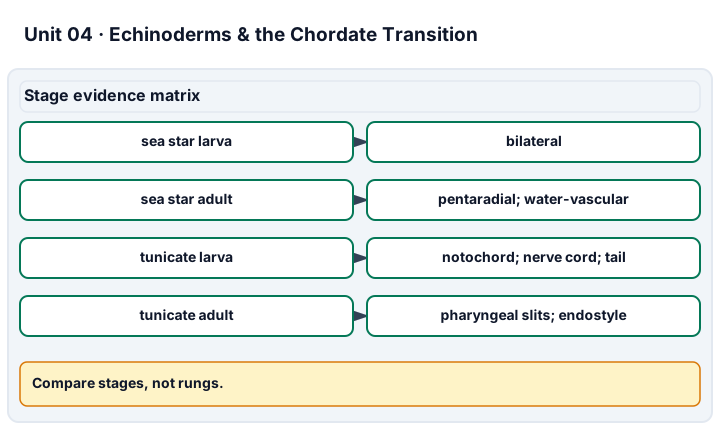
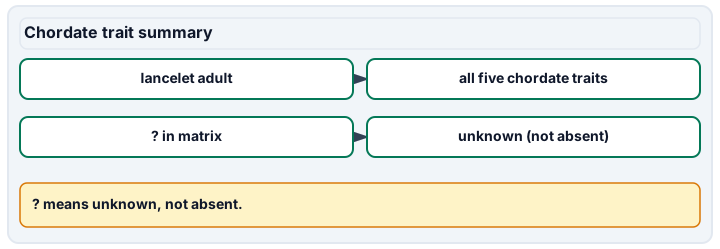
Diagram description
The diagram compares echinoderm larval and adult stages and chordate stages. It includes notochord, dorsal hollow nerve cord, pharyngeal slits, endostyle/thyroid, and post-anal tail, and marks unknown data as unknown rather than absent.
Data, provenance, and assumptions
| Record | Stage | Notochord | Dorsal hollow nerve cord | Pharyngeal openings | Post-anal tail | Endostyle/thyroid |
|---|---|---|---|---|---|---|
| Tunicate | Larva | 1 | 1 | ? | 1 | ? |
| Tunicate | Adult | 0 | 0 | 1 | 0 | 1 |
| Lancelet | Adult | 1 | 1 | 1 | 1 | 1 |
Worked model
The larval tunicate record has three known entries, all present, plus two unknowns. Three of three known entries is not evidence of five of five visible traits. The adult has two of five present = 40% of the selected columns at that stage. The lancelet has five of five. Those percentages describe these columns only; they are neither relatedness scores nor probabilities that an animal is a chordate.
Numerical calibration
- 3 known entries in the tunicate larval record
- 40 % of selected columns marked present in the tunicate adult
- 5 selected traits in the lancelet adult record
Attempt the assigned level
Try the tasks before reading the calibration. These are practice answers, not a secure examination; use a new dataset or changed assumption for the assessed transfer.
Foundation
- Count present, absent and unknown entries for both tunicate stages.
- Sketch a branching relationship that does not put living sea stars before living lancelets on a ladder.
Check after your attempt
- Larva: 3 present, 0 stated absent, 2 unknown. Adult: 2 present, 3 absent, 0 unknown.
- Show echinoderms and chordates on separate branches from shared ancestry. A classroom unit order is not an ancestor-descendant chain.
High-school core: typically grades 9-10
- Calculate the adult present-column percentage, then explain why it cannot exclude that animal from Chordata.
- Use the source to distinguish a notochord from a backbone and identify the source's additional fifth feature.
Check after your attempt
- 2/5 = 40%; the diagnostic features occur across development, and the adult record is not the entire life history.
- A notochord is an axial supporting rod, not a vertebral column. The additional feature is endostyle/thyroid. Invertebrate chordates do not become non-chordates for lacking a backbone.
Honors extension: typically grades 11-12
- Explain why 3/3 known larval entries should not be compared as a better score than 2/5 adult entries.
- Propose an evidence check for an incomplete adult photograph without collecting or handling an animal.
Check after your attempt
- The denominators cover different known subsets and stages; neither fraction measures certainty or evolutionary advancement.
- Use an approved developmental diagram or published description and an independent character set. Mark inaccessible traits unknown; do not invent their state.
History, reading, and writing connection
Cite the assigned developmental figure and explain how a modern comparative account changes a purely adult-appearance classification. Write a short evidence argument with the missing larval entries as its limitation. Do not treat the sequence of textbook chapters as the historical order of living species.
Write in your own words or use an approved accessible equivalent. Cite a specific assigned section or figure, identify its evidence, and state one limitation or counterargument. Use the AI practice contract only for permitted coaching, never to invent observations or write the assessed response.
Transfer to a new case
An approved adult tunicate photograph shows pharyngeal openings but neither a tail nor a notochord is visible. The other traits are not documented. Can you infer that the organism never had those structures or is not a chordate? Explain what additional evidence is needed.
Calibration: No. Not visible is not known absent, and an adult image cannot establish absence during development. Retain unknown entries and consult a published life-stage account plus multiple characters. The source's tunicate life history supports chordate placement; a single photo or trait is not a universal key.
Evidence to retain
For Chordate hallmarks across life stages, retain the source citation, stage-labeled matrix, explicit unknowns, denominator and independent incomplete-record transfer. Label independent analysis of supplied records separately from independent observation of approved media or safe non-intervention observation. Record the source/date, selected level, calculations, limitation and fresh follow-up; never relabel a supplied dataset as a performed lab.
Record units, calculations, source/date, uncertainty, and what is measured versus inferred. A simulation or supplied dataset must stay labeled as such. Use approved images/models, published or synthetic datasets, or instructor-approved non-intervention observation from safe access. No capture, animal manipulation, stress induction, feeding trials, biological sampling, or wildlife handling. Do not disturb nesting or rare animals or disclose sensitive wildlife sites. Stop if safe access or a non-disturbing view is unavailable; use supplied evidence instead. Instructor approval or a proposed observation is not a performed lab claim.
Return to all eight learning pathways. Print this unit page for the student lessons; the linked five-page packet remains the separate assessment companion.
Unit mastery rubric
| Criterion | Developing | Proficient | Mastery |
|---|---|---|---|
| Water-vascular system & tube feet | Cannot say how a sea star moves or feeds. | Names tube feet but not the system that drives them. | Explains how the water-vascular system powers hundreds of tube feet for movement and feeding. |
| Deuterostome development | Draws a ladder from living sea stars to humans. | Recognizes shared development but treats one character as a universal classification rule. | Uses developmental and other comparative evidence to explain common ancestry, not a chain of living ancestors or a rank. |
| Chordate hallmarks across life stages | Treats an unseen adult feature as absent throughout development. | Names the four focus traits but overlooks stage or the source's additional feature. | Independently compares life-stage records, marks unknown entries, counts known traits and interprets endostyle/thyroid alongside the four focus characters without a one-trait rule. |
| Invertebrate chordates | Assumes every chordate is a vertebrate. | Knows lancelets or tunicates exist but not why they count as chordates. | Explains that lancelets and tunicates are chordates without a backbone and shows which hallmarks they keep. |
| Lab technique (sea-star & lancelet observation) | Invents structures not visible in the approved source. | Annotates an image but omits its source or life stage. | Annotates approved images/models, identifies source and stage, separates visible structures from reference facts and explains what a fresh incomplete record cannot establish. |
| Integration (cross-domain) | Makes no supported connection between the source and the science. | Uses the source but needs help connecting evidence, writing, or limitations to the science. | Independently connects History, Reading, and Writing using a cited source, appropriate evidence, a limitation, and a scientific explanation. |
Integration is reported separately and cannot lower the science grade or block a science demonstration pass. Science and practical criteria determine that pass. Use the integration guide's evidence checklist for the separately reported criterion.
“The larval tunicate record has three known traits and two unknowns. The adult retains two of the five selected features, but 40% is not a probability of being a chordate. Its developmental evidence matters. Echinoderms and chordates share ancestry; one living group is not turning into the other.”
“A sea star just crawls somehow. A chordate is an animal with a spine. Lancelets aren’t really related to us, are they?”
Use approved images/models and published life-stage descriptions without wildlife handling. Identify what is actually visible and what comes from the source, then defend the incomplete-record comparison. Supplied diagrams and matrices are not a claim of performed animal observation.
A 5-page clipboard packet — unit overview, key terms, the mastery rubric, anchor examples, and a score sheet you can print and grade against.