Unit 08 · Animal Behavior & Ecology
Describe actions before proposing causes. Build an operational ethogram, sample at stated instants and distinguish visible-state proportions from continuous event rates. Missing observations and repeated records matter. A clip alone cannot establish motives, innate versus learned origins or selection history; use source evidence and ecological context without disturbing animals.
Student learning: Animal Behavior & Ecology: sampling before stories
Choose the level by readiness, not age alone, and record it before instruction. Foundation, core, and honors tasks are study pathways, not an AP course or a promise of college credit. The instructor retains practical assessment and the published science rubric; integration is reported separately.
Prerequisites: Unit 01 selection check: independently explain inherited variation, differential reproduction and populations across generations before making an evolutionary adaptation claim. Unit 03 rates; distinguish an observed action from an inferred motive and a sampling instant from a duration.
Suggested sequence: read and discuss the explanation; attempt the worked model; analyze the data at your selected level; check the answers; then complete the source-linked response and a fresh transfer question. These activities supplement, not replace, supervised practical work and the full-year schedule.
Assigned reading and focus
- OpenStax Biology 2e, 45.7 Behavioral Biology: Proximate and Ultimate Causes of Behavior. Use the innate/learned behavior and communication discussions to separate a description of an action, a proximate mechanism and an evolutionary hypothesis. Examples in a textbook are not permission to induce responses in an animal.
- National Park Service, Watching Wildlife: Observe the World Around You. Read the responsibility statement: leave animals alone, keep a safe distance and do not touch, feed or harass. Local rules and the instructor may require an approved-media or supplied-record alternative.
Learn the science
An ethogram is an operational codebook of observable actions. In this exercise P means beak contact with the substrate, not proof that food was swallowed or that the animal was hungry. W means a visible step without simultaneous pecking; S means visible with neither P nor W; O means out of view. Apply the priority P, then W, then S so each visible instant receives one code. A description does not by itself establish an innate cause, learning, a motive or an adaptation.
Instantaneous focal sampling records one preselected animal at prespecified times. Here sample at 30, 60, ... 600 seconds: 20 instants, excluding time zero. Fractions of scorable instants estimate an activity budget while visible, not exact durations. Report missing observations separately. Do not turn 8 pecking instants into 8 pecks or 4 minutes without a continuous record.
The synthetic scene contains one virtual adult ground bird observed in two sessions, A at 09:00 and B at 14:00, each 10 minutes in calm dry conditions at 18 deg C. Its mass is unspecified and unnecessary for these within-record time fractions. These repeated instants are not independent animals. Time of day, visibility and unrecorded context prevent causal or species-wide claims. There is no feeding, approach, disturbance or experimental treatment.
Continuous event sampling answers a different question: count distinct beak-contact events during seconds when the beak can be seen. Divide event count by visible minutes, not scheduled minutes. The separate timing log supplies those seconds; do not estimate them from scan counts. Independent double-coding can reveal ambiguous definitions, but simple agreement is not chance-corrected and correlated samples do not establish general reliability.

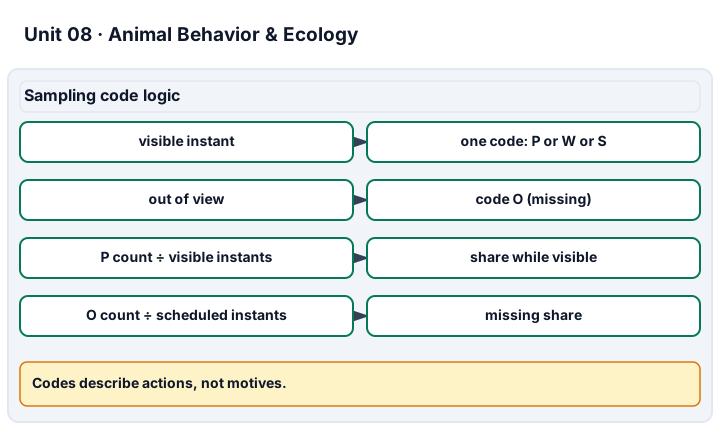
Diagram description
Each visible scheduled instant receives one behavior code: P, W, or S. Out-of-view instants are code O and are missing for visible-activity fractions. The diagram separately computes share while visible and missing share, preventing motives or adaptations from being inferred from codes alone.
Data, provenance, and assumptions
| Code | Visible rule |
|---|---|
| P | Beak touches substrate at the instant; takes priority over stepping. |
| W | A step is visible and no simultaneous beak contact is visible. |
| S | Animal is visible with neither P nor W at the instant. |
| O | Focal animal is out of view; do not score as stationary. |
| Elapsed time (s) | Session A code | Session B code |
|---|---|---|
| 30 | P | P |
| 60 | P | W |
| 90 | W | P |
| 120 | S | S |
| 150 | O | S |
| 180 | P | P |
| 210 | W | W |
| 240 | P | S |
| 270 | O | O |
| 300 | S | S |
| 330 | P | P |
| 360 | W | W |
| 390 | P | S |
| 420 | O | S |
| 450 | W | P |
| 480 | P | S |
| 510 | S | W |
| 540 | W | O |
| 570 | O | P |
| 600 | P | S |
| Session | Scheduled seconds | Visible seconds | Distinct beak-contact events |
|---|---|---|---|
| A | 600 | 480 | 12 |
| B | 600 | 540 | 9 |
| C transfer | 360 | 300 | 6 |
| Instant | Observer 1 | Observer 2 |
|---|---|---|
| 1 | P | P |
| 2 | P | W |
| 3 | W | W |
| 4 | S | S |
| 5 | P | P |
| 6 | W | W |
| 7 | S | P |
| 8 | P | P |
| Code | Number of instants |
|---|---|
| P | 4 |
| W | 2 |
| S | 4 |
| O | 2 |
Optional independent observation or approved-media extension
Scope and safety: Use approved images/models, published or synthetic datasets, or instructor-approved non-intervention observation from safe access. No capture, animal manipulation, stress induction, feeding trials, biological sampling, or wildlife handling. Do not disturb nesting or rare animals or disclose sensitive wildlife sites. Stop if safe access or a non-disturbing view is unavailable; use supplied evidence instead. Instructor approval or a proposed observation is not a performed lab claim.
Materials and preparation
- The codebook and blank time/code/reason columns; a timer; an instructor-approved existing video with lawful access or a safe non-intervention view.
- If no suitable view or recording is available, use the supplied records for analysis only. No observation, media coding or animal procedure is then claimed.
Procedure and schedule
- Before starting, record the evidence mode, source/date, broad non-sensitive context, focal ID if reliably distinguishable, scheduled duration and 30-second instants. Never publish a wildlife location.
- Observe from established safe access without approaching, following, moving, feeding or calling to an animal. Stop if the animal changes behavior in response to your presence or if nesting/rare animals or unsafe access are involved.
- At each scheduled instant record the code; do not replace an out-of-view animal with a convenient one or move missed observations to a busier moment. Add an explicitly unknown category if a visible action cannot be scored; disclose its denominator treatment.
- For approved video only, use a separate pass for continuous events and visible seconds. Two coders should work independently before resolving disagreements; keep original codes and reasons for revisions.
- Submit the raw log, visible and scheduled denominators, missing proportion, rates and one limitation. A second recording of the same animal is repeated observation, not independent animal replication.
Record: Keep approval, source and date; distinguish performed non-intervention observation, independently coded supplied media, independent analysis of supplied numeric records, and an unperformed plan. The instructor assesses only evidence actually produced, not a proposed lab or an AI account.
Worked model
A has 8 P, 5 W, 3 S and 4 O. Its visible denominator is 16: 8/16 = 50% pecking instants while visible; missing = 4/20 = 20%. B has 6 P, 4 W, 8 S and 2 O: 6/18 = 33.33% while visible. A has 40% pecking of all scheduled instants, a different denominator. From the separate event log, A = 12/(480/60) = 1.5 events/visible minute; B = 9/(540/60) = 1.0. Agreement = 6/8 = 75%. None of these quantities establishes feeding success, hunger or an innate cause.
Numerical calibration
- 50 % pecking instants among A visible instants
- 33.3333 % pecking instants among B visible instants
- 20 % A scheduled instants out of view
- 40 % minimum pecking across all A scheduled instants
- 60 % maximum if all missing A instants were pecking
- 1.5 beak-contact events/visible minute, A
- 1 beak-contact events/visible minute, B
- 75 % agreement on eight jointly visible instants
- 1.2 events/visible minute, C transfer
- 40 % pecking among C visible instants
- 33.3333 % pecking among C scheduled instants
- 16.6667 % C scheduled instants out of view
Attempt the assigned level
Try the tasks before reading the calibration. These are practice answers, not a secure examination; use a new dataset or changed assumption for the assessed transfer.
Foundation
- Tally each code for A and B and identify the missing category. Replace "hungry" with an observable statement.
- Using the worked denominators, calculate A's pecking fraction while visible and its missing fraction.
Check after your attempt
- A: P8 W5 S3 O4; B: P6 W4 S8 O2. O is missing, not rest. "The beak touches the substrate" is observable; hunger is not established.
- A visible fraction = 8/16 = 50%; missing fraction = 4/20 = 20%. These have different denominators and answer different questions.
High-school core: typically grades 9-10
- Calculate both visible pecking percentages and both continuous-event rates, with denominators and units.
- Graph state proportions while visible and report missing proportions alongside. Explain why one log cannot establish a behavior's motive, learning history or adaptive origin.
Check after your attempt
- A = 50% and B = 33.33% visible instants. Continuous rates are 1.5 and 1.0 events/visible minute, not 1.2 and 0.9 per scheduled minute.
- A visible state shares: P50%, W31.25%, S18.75%, missing20% of scheduled. B: P33.33%, W22.22%, S44.44%, missing10%. One repeated record cannot identify developmental, neural or evolutionary causes.
Honors extension: typically grades 11-12
- Bound the possible pecking proportions across all scheduled instants by assigning every O first to not-P, then to P. Calculate observer agreement and identify its limitations.
- Explain why comparing sessions cannot prove a time-of-day effect or a difference in food consumed.
Check after your attempt
- A bounds: 8/20 to 12/20 = 40%-60%; B: 6/20 to 8/20 = 30%-40%. These are missing-data bounds on instants, not duration confidence intervals. Agreement is 75%; it is not chance-corrected.
- Only one virtual animal is represented; sessions differ in visibility and timing with no independent replication or food-intake measure. Pecking is not proof that food was swallowed.
History, reading, and writing connection
Use the behavioral-biology reading and the NPS observation guidance in a 100-150 word source-linked response: why should an observer separate descriptive records from historical or evolutionary explanations? Cite a specific section, one number and one limitation. Contrast modern inference requirements with a story about what an animal wanted; score this writing/source connection separately.
Write in your own words or use an approved accessible equivalent. Cite a specific assigned section or figure, identify its evidence, and state one limitation or counterargument. Use the AI practice contract only for permitted coaching, never to invent observations or write the assessed response.
Transfer to a new case
New session C has 12 scheduled instants at 30-second spacing: P4 W2 S4 O2. Calculate visible and scheduled pecking percentages and, using the separate C event log, events per visible minute. State what you still cannot infer. The instructor provides changed counts for the independent assessment.
Calibration: C has 10 visible instants: 4/10 = 40% while visible and 4/12 = 33.33% of scheduled instants. Its event rate is 6/(300/60) = 1.2 events/visible minute. Missing observations are 2/12 = 16.67%. These measures neither give exact pecking duration nor establish food intake, motives, learning or adaptation history.
Evidence to retain
For Observing & recording behavior, retain the operational codebook, independently calculated visible/scheduled denominators, continuous-event timing and observer comparison. For Lab technique (safe observation & evidence), retain the actual log or clearly supplied record, revisions and a fresh transfer; a proposed observation is not completed fieldwork. Label independent analysis of supplied records separately from independent observation of approved media or safe non-intervention observation. Record the source/date, selected level, calculations, limitation and fresh follow-up; never relabel a supplied dataset as a performed lab.
Record units, calculations, source/date, uncertainty, and what is measured versus inferred. A simulation or supplied dataset must stay labeled as such. Use approved images/models, published or synthetic datasets, or instructor-approved non-intervention observation from safe access. No capture, animal manipulation, stress induction, feeding trials, biological sampling, or wildlife handling. Do not disturb nesting or rare animals or disclose sensitive wildlife sites. Stop if safe access or a non-disturbing view is unavailable; use supplied evidence instead. Instructor approval or a proposed observation is not a performed lab claim.
Return to all eight learning pathways. Print this unit page for the student lessons; the linked five-page packet remains the separate assessment companion.
Unit mastery rubric
| Criterion | Developing | Proficient | Mastery |
|---|---|---|---|
| Innate vs. learned behavior | Assigns a developmental cause from appearance alone. | Defines innate/learned influences but overinterprets one clip. | Uses published evidence to distinguish innate and learned influences; explains why one behavioral log cannot establish developmental history. |
| Fixed action patterns & signaling | Invents a motive or treats every repeated act as a fixed action pattern. | Describes a sourced pattern but overstates the causal evidence. | Explains a published pattern or signal, separates observation from causal interpretation and identifies missing evidence without inducing an animal response. |
| Observing & recording behavior | Guesses motives or mixes scans, events and durations. | Uses operational codes but needs help with missing data or denominators. | Builds operational codes; independently calculates visible-denominator state percentages and events per visible minute, reports missing data and separates scans from durations. |
| Ecology (niches, food webs, populations) | Treats pecking as proven food intake or a population trend. | Suggests an ecological link but overgeneralizes one repeated record. | Uses sourced food-web/context evidence, distinguishes individual behavior from population evidence and states why a short log cannot establish ecological cause or adaptive history. |
| Lab technique (safe observation & evidence) | Disturbs animals, invents a log or claims unperformed fieldwork. | Records approved evidence but omits schedule, source or revisions. | Independently codes approved media/non-intervention observation or analyzes a fresh supplied record; retains schedule, visibility and evidence mode, then defends limits and transfer. |
| Integration (cross-domain) | Makes no supported connection between the source and the science. | Uses the source but needs help connecting evidence, writing, or limitations to the science. | Independently connects History, Reading, and Writing using a cited source, appropriate evidence, a limitation, and a scientific explanation. |
Integration is reported separately and cannot lower the science grade or block a science demonstration pass. Science and practical criteria determine that pass. Use the integration guide's evidence checklist for the separately reported criterion.
“A has 8 pecking instants out of 16 visible, so 50%, with 4/20 missing. The separate event log gives 12 contacts in 8 visible minutes, or 1.5/min. Scans are not exact durations or event counts. One repeated virtual bird does not prove hunger, learning history or an adaptation.”
“The animal does stuff because it wants to, I think. Behavior is just instinct. I’m not sure how to write down what it’s doing without saying why.”
Use the supplied records, independently code instructor-approved media, or undertake approved non-intervention observation from safe access. No capture, feeding, handling, stress induction or disturbance is permitted. Record which evidence mode was actually completed; approval alone is not performed fieldwork. Assess the fresh quantitative response, not invented motives.
A 5-page clipboard packet — unit overview, key terms, the mastery rubric, anchor examples, and a score sheet you can print and grade against.