Unit 07 · Mammals
Use hair, mammary glands and other anatomical evidence across life stages to identify mammals. Warmth, heart chambers, teeth or habitat alone are not universal classification rules. Compare supplied oxygen records in both whole-body and per-gram units, retaining thermal assumptions. A larger total can coexist with a smaller mass-specific rate; neither is a superiority score.
Student learning: Mammals: whole-body versus mass-specific demand
Choose the level by readiness, not age alone, and record it before instruction. Foundation, core, and honors tasks are study pathways, not an AP course or a promise of college credit. The instructor retains practical assessment and the published science rubric; integration is reported separately.
Prerequisites: Unit 01 selection check: independently explain inherited variation, differential reproduction and populations across generations before making an evolutionary adaptation claim. Unit 06 distinguishes heat source and temperature; core students calculate whole-body and per-gram rates.
Suggested sequence: read and discuss the explanation; attempt the worked model; analyze the data at your selected level; check the answers; then complete the source-linked response and a fresh transfer question. These activities supplement, not replace, supervised practical work and the full-year schedule.
Assigned reading and focus
- OpenStax Biology 2e, 29.6 Mammals. Read "Characteristics of Mammals" and the three mammal groups. Use hair and mammary glands with other evidence; note the source says most, not all, mammals have differentiated teeth and that birds also have four-chambered hearts.
- OpenStax Biology 2e, 33.1 Animal Form and Function. Read "Body Plans", "Limiting Effects of Diffusion on Size and Development" and the bioenergetics discussion. Relate dimensions and mass to exchange and energy demand without ranking living lineages as more advanced.
- OpenStax Biology 2e, 33.3 Homeostasis. Read "Endotherms and Ectotherms" and "Heat Conservation and Dissipation". Distinguish heat source from temperature constancy; compare insulation, metabolic heat and behavioral heat exchange as trade-offs.
- OpenStax Biology 2e, 29.4 Reptiles. Use the amniotic-membrane account and crocodilian characteristics. Distinguish the embryo membranes from a universal external shell, and note that a four-chambered heart is not confined to mammals.
Learn the science
Hair and mammary glands are important mammalian characters interpreted across life stages and with anatomical evidence. A four-chambered heart is not a universal mammal test: birds and crocodilians also have one. Endothermy is also shared with birds. Not all mammals have differentiated adult teeth, obvious adult fur or live birth; monotremes lay eggs. Several features and source context support a classification.
A larger animal can consume more oxygen in total while consuming less per gram. Whole-body rate = total oxygen / hours; mass-specific rate divides that result by mass. Geometry helps explain exchange and heat-loss constraints, but insulation, activity and physiological state also matter. Size alone neither fixes a rate nor ranks the animals.
The records below are synthetic resting postabsorptive adults with body temperature 37 deg C and ambient temperature 30 deg C. Thermoneutral conditions are assumed for both virtual cases; that is not a statement that 30 deg C suits all mammals. Gas volumes are standardized to one reference condition. There is one virtual individual of each size and no population variance.

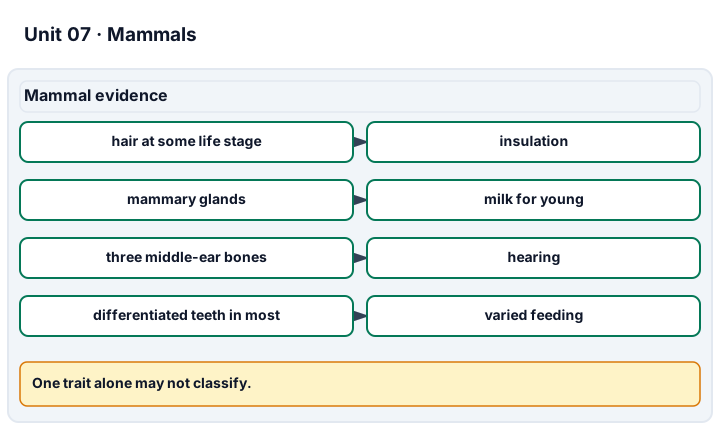
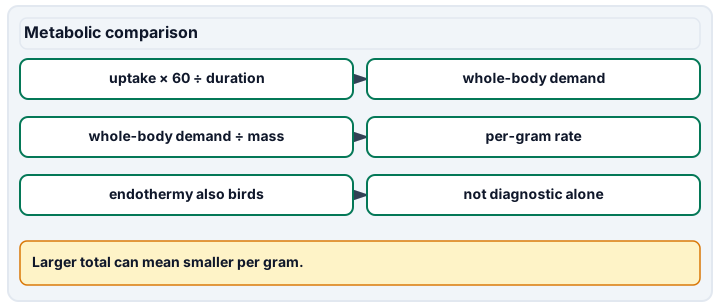
Diagram description
Hair, mammary glands, and three middle-ear bones support mammal evidence. Differentiated teeth occur in most mammals but are not universal, and endothermy is shared with birds. Oxygen uptake can be larger as a whole-body total but smaller per gram.
Data, provenance, and assumptions
| Record | Mass (g) | Duration (min) | Uptake (mL O2) | Ambient (deg C) | Body (deg C) |
|---|---|---|---|---|---|
| Small S | 20 | 10 | 8 | 30 | 37 |
| Large L | 200 | 20 | 80 | 30 | 37 |
| Transfer T | 100 | 10 | 25 | 30 | 37 |
Worked model
Small S: 8 mL x 60/10 = 48 mL O2/h; 48/20 = 2.4 mL O2/(g h). Large L: 80 x 60/20 = 240 mL/h; 240/200 = 1.2 mL O2/(g h). L uses five times as much oxygen overall but half as much per gram. A two-record power-law fit would have exponent ln(5)/ln(10) = 0.6990; fitting two synthetic points is not evidence of a universal mammalian exponent.
Numerical calibration
- 48 mL O2/h, S
- 240 mL O2/h, L
- 2.4 mL O2/(g h), S
- 1.2 mL O2/(g h), L
- 0.699 illustrative exponent from two synthetic records only
- 1.5 mL O2/(g h), T
Attempt the assigned level
Try the tasks before reading the calibration. These are practice answers, not a secure examination; use a new dataset or changed assumption for the assessed transfer.
Foundation
- Convert both recording windows to hourly oxygen totals.
- Use the supplied rates to finish: larger total demand can coexist with ___ demand per gram.
Check after your attempt
- S = 48 mL O2/h; L = 240 mL O2/h.
- Lower: L is 1.2 per gram while S is 2.4 mL O2/(g h). The comparison depends on the denominator.
High-school core: typically grades 9-10
- Calculate both mass-specific rates and the L/S ratios for mass, whole-body rate and per-gram rate.
- Explain why teeth, heart chambers or habitat alone cannot classify every mammal. Use the source for a counterexample.
Check after your attempt
- Mass ratio = 10, whole-body rate ratio = 5, per-gram ratio = 0.5. Units must accompany both oxygen-rate columns.
- Birds share a four-chambered heart and endothermy, tooth patterns vary within mammals, and whales remain mammals in water. Use several characters, source evidence and stage.
Honors extension: typically grades 11-12
- For R proportional to M^b, calculate the two-record b using logarithms. State why this is not a discovered law.
- List missing measurements needed for a serious comparison of insulation and metabolic demand.
Check after your attempt
- b = ln(240/48)/ln(200/20) = ln(5)/ln(10) = 0.6990. Two constructed points have no independent replication or uncertainty estimate.
- Species, individual replication, insulation, acclimation, activity, food state, temperatures and error matter. An oxygen table does not measure reproductive fitness.
History, reading, and writing connection
Cite the mammal-character and bioenergetics sections in a short evidence-based correction to a classification by habitat or warmth alone. Explain how source-based comparative anatomy improves an appearance-only account, and why this table is not a historical measurement series.
Write in your own words or use an approved accessible equivalent. Cite a specific assigned section or figure, identify its evidence, and state one limitation or counterargument. Use the AI practice contract only for permitted coaching, never to invent observations or write the assessed response.
Transfer to a new case
For T, calculate whole-body and per-gram oxygen demand and compare both with S and L. If T's temperature or activity were unknown, would its mass alone justify the comparison? The instructor changes one record for the independent assessment.
Calibration: T uses 25 x 60/10 = 150 mL O2/h and 150/100 = 1.5 mL O2/(g h). Its whole-body rate lies between 48 and 240; its per-gram rate lies between 1.2 and 2.4. Unknown temperature or activity weakens comparability; mass alone does not supply those conditions or a selection history.
Evidence to retain
For Endothermy & the mammalian body, retain the independent whole-body/per-gram comparison, stated thermal assumptions, classification counterexample and a fresh transfer record. Label independent analysis of supplied records separately from independent observation of approved media or safe non-intervention observation. Record the source/date, selected level, calculations, limitation and fresh follow-up; never relabel a supplied dataset as a performed lab.
Record units, calculations, source/date, uncertainty, and what is measured versus inferred. A simulation or supplied dataset must stay labeled as such. Use approved images/models, published or synthetic datasets, or instructor-approved non-intervention observation from safe access. No capture, animal manipulation, stress induction, feeding trials, biological sampling, or wildlife handling. Do not disturb nesting or rare animals or disclose sensitive wildlife sites. Stop if safe access or a non-disturbing view is unavailable; use supplied evidence instead. Instructor approval or a proposed observation is not a performed lab claim.
Return to all eight learning pathways. Print this unit page for the student lessons; the linked five-page packet remains the separate assessment companion.
Unit mastery rubric
| Criterion | Developing | Proficient | Mastery |
|---|---|---|---|
| Defining mammal traits | Uses warmth, habitat or heart chambers alone. | Uses several traits but overlooks life stage or counterexamples. | Uses hair, mammary glands and other sourced anatomy across stages; explains why teeth, endothermy or a four-chambered heart alone cannot classify every mammal. |
| Teeth & diet | Treats tooth shape as proof of a complete diet. | Suggests a functional interpretation but omits independent diet evidence. | Relates tooth structure to a plausible function, checks an independent dietary source and distinguishes a supported inference from proof of adaptation history. |
| Endothermy & the mammalian body | Ranks animals by warmth or oxygen totals. | Explains the trade-off but needs help separating rate denominators. | Independently compares whole-body and per-gram oxygen demand with time and thermal context; explains costs, limits and a fresh size-normalization transfer. |
| Monotremes, marsupials & placentals | Cannot tell the three mammal groups apart. | Names the groups but misplaces examples — calls a kangaroo a placental. | Sorts mammals into monotremes, marsupials, and placentals by how they reproduce, and places examples — a platypus, an opossum, a bat — correctly. |
| Lab technique (specimen & skeletal study) | Guesses an unseen structure or claims supplied data as an observation. | Annotates an approved image/model but omits source or uncertainty. | Independently annotates approved images/models, records the evidence source and mode, and separates visible anatomy, calculated rates and inferred function. |
| Integration (cross-domain) | Makes no supported connection between the source and the science. | Uses the source but needs help connecting evidence, writing, or limitations to the science. | Independently connects History, Reading, and Writing using a cited source, appropriate evidence, a limitation, and a scientific explanation. |
Integration is reported separately and cannot lower the science grade or block a science demonstration pass. Science and practical criteria determine that pass. Use the integration guide's evidence checklist for the separately reported criterion.
“A whale is a mammal, not a fish — it breathes air, nurses its calf, and carries the bones of a four-limbed ancestor inside its flippers. A bat is a mammal too, even though it flies: fur, milk, and differentiated teeth give it away. I don’t go by where the animal lives; I go by the traits.”
“Whales live in the ocean, so they’re fish. Bats fly, so they’re birds. Mammals are just the furry ones on land.”
Use approved images/models, published descriptions and supplied oxygen data, not animal handling or metabolic trials. The instructor checks independent reasoning and a fresh rate comparison. A completed analysis of supplied records is not a performed laboratory or field observation.
A 5-page clipboard packet — unit overview, key terms, the mastery rubric, anchor examples, and a score sheet you can print and grade against.