Unit 06 · Reptiles & Birds
Compare amniotic development and reptile/bird physiology in context. Birds are a lineage within reptiles and theropod dinosaurs; flight is not universal among birds. The supplied thermal records distinguish ambient from body temperature and oxygen use from fitness. Explain costs and constraints without ranking endothermy above ectothermy or reading evolutionary history from function alone.
Student learning: Reptiles & Birds: thermal trade-offs, not superiority
Choose the level by readiness, not age alone, and record it before instruction. Foundation, core, and honors tasks are study pathways, not an AP course or a promise of college credit. The instructor retains practical assessment and the published science rubric; integration is reported separately.
Prerequisites: Unit 01 selection check: independently explain inherited variation, differential reproduction and populations across generations before making an evolutionary adaptation claim. Unit 05 rate normalization and percent change relative to a named baseline.
Suggested sequence: read and discuss the explanation; attempt the worked model; analyze the data at your selected level; check the answers; then complete the source-linked response and a fresh transfer question. These activities supplement, not replace, supervised practical work and the full-year schedule.
Assigned reading and focus
- OpenStax Biology 2e, 33.3 Homeostasis. Read "Endotherms and Ectotherms" and "Heat Conservation and Dissipation". Distinguish heat source from temperature constancy; compare insulation, metabolic heat and behavioral heat exchange as trade-offs.
- OpenStax Biology 2e, 29.4 Reptiles. Use the amniotic-membrane account and crocodilian characteristics. Distinguish the embryo membranes from a universal external shell, and note that a four-chambered heart is not confined to mammals.
- OpenStax Biology 2e, 29.5 Birds. Use Figures 29.33-29.35 and the respiratory/evolutionary discussion. Trace air flow separately from wingbeats; not all bird bones are pneumatic, and multiple fossil/anatomical characters support theropod ancestry.
Learn the science
Endothermy refers to substantial internal metabolic heat used in temperature regulation; ectothermy relies more on environmental heat. These are heat-source strategies, not a superiority rank, and they are not synonyms for constant versus variable temperature. An ectotherm can maintain a fairly stable temperature by behavior; an endotherm can allow temperature to vary, including during torpor.
Compare a virtual lizard and bird at two ambient temperatures. All four baseline rows use the same mass, resting activity, postabsorptive state and 30-minute window. Body temperature is given separately from ambient temperature. All oxygen amounts are standardized to the same gas-volume reference conditions; mL O2/(g h) is an oxygen-demand proxy, not a measured food requirement or an evolutionary fitness score.
The cool bird record has higher oxygen demand while maintaining the same body temperature, consistent with extra metabolic heat production in the model. The lizard records show a lower rate at lower body temperature. Each strategy has constraints and costs; the data do not rank lineages or demonstrate selection history. One virtual individual per group is not a species mean, and per-gram scaling is not a complete correction for body size.
Birds are a lineage within reptiles and theropod dinosaurs, not a separate superior destination. Feathers can insulate or signal as well as contribute to flight; not all birds fly. Gas exchange in bird lungs is associated with flow through respiratory tissue, supported by air-sac ventilation, not a rule tied to each wingbeat. Amniotic membranes support embryo development without free-standing water; they are not a universal external shell or a claim that all amniotes live in deserts.

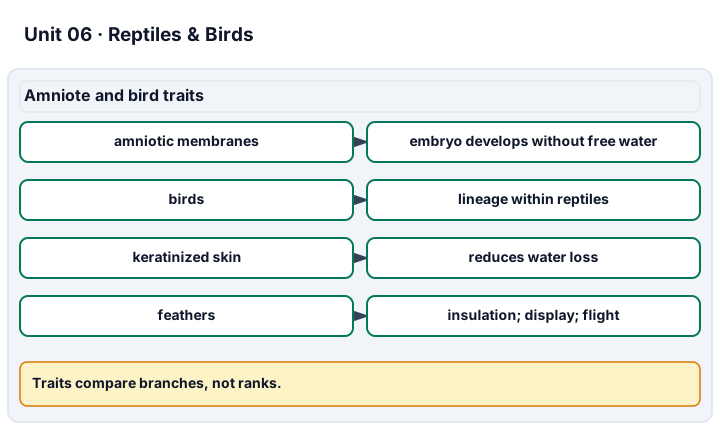
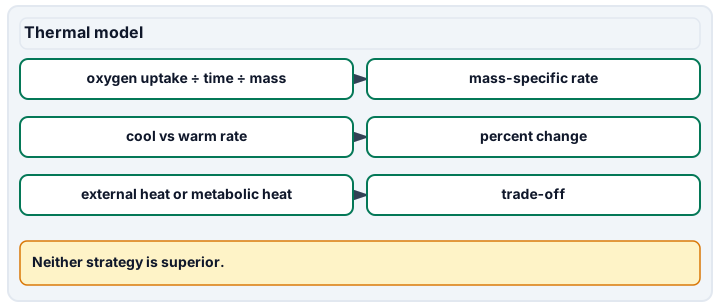
Diagram description
Amniotic membranes support development away from free water; birds are a lineage within reptiles; keratinized skin reduces water loss; feathers serve insulation, display, and flight. The thermal model compares oxygen uptake per gram per hour and percent change without ranking strategies.
Data, provenance, and assumptions
| Record | Mass (g) | Duration (min) | Uptake (mL O2) | Ambient (deg C) | Body (deg C) |
|---|---|---|---|---|---|
| L1 lizard cool | 20 | 30 | 3 | 15 | 15 |
| L1 lizard warm | 20 | 30 | 6 | 25 | 25 |
| B1 bird cool | 20 | 30 | 30 | 15 | 40 |
| B1 bird warm | 20 | 30 | 20 | 25 | 40 |
| B2 bird transfer | 40 | 30 | 30 | 25 | 40 |
Worked model
For L1 cool, 3 mL/(30/60 h)/20 g = 0.3 mL O2/(g h); warm is 0.6. B1 cool is 30/0.5/20 = 3 and warm is 20/0.5/20 = 2 mL O2/(g h). Relative to the warm bird baseline, the cool bird increase is (3 - 2)/2 x 100 = 50%. Its body temperature is 40 deg C in both records; the lizard changes from 15 to 25 deg C. These patterns describe this model and its conditions, not a measure of superiority.
Numerical calibration
- 0.3 mL O2/(g h), L1 cool
- 0.6 mL O2/(g h), L1 warm
- 3 mL O2/(g h), B1 cool
- 2 mL O2/(g h), B1 warm
- 50 % increase relative to B1 warm
- 1.5 mL O2/(g h), B2
Attempt the assigned level
Try the tasks before reading the calibration. These are practice answers, not a secure examination; use a new dataset or changed assumption for the assessed transfer.
Foundation
- Compare body with ambient temperature in each baseline record.
- Use the worked rates to identify one energy cost and one temperature-related constraint, without saying better.
Check after your attempt
- L1 matches 15 and 25 deg C ambient in this model; B1 remains 40 deg C at both ambient temperatures.
- B1 uses more oxygen in the cool condition to support heat production; L1's lower body temperature coincides with lower metabolic rate. Different environments change the trade-offs.
High-school core: typically grades 9-10
- Calculate all four baseline mass-specific rates and the bird's cool-condition percent increase using the warm rate as denominator.
- Draw two graphs against ambient temperature: body temperature and oxygen rate, with separate labeled vertical axes.
Check after your attempt
- L1: 0.3 and 0.6; B1: 3 and 2 mL O2/(g h). Bird increase = 50% relative to 2, not relative to 3.
- The bird body-temperature line is flat while its oxygen rate decreases toward the warmer condition. The lizard's two plotted quantities increase. Connect only the measured points; do not imply valid extrapolation.
Honors extension: typically grades 11-12
- Explain why mass-matched animals at the same ambient temperature do not have every physiological variable controlled.
- Distinguish an oxygen-use trade-off from evidence needed to infer evolutionary adaptation.
Check after your attempt
- Their body temperatures, tissue physiology and evolutionary histories differ; age, acclimation and measurement uncertainty are not quantified. Two repeated records are not two independent individuals.
- Oxygen rates show current function under assumptions. Selection history would also require inherited variation, reproductive consequences and comparative or historical evidence.
History, reading, and writing connection
Cite the heat-conservation section and write a short correction to a historical ladder-style description of warm-blooded animals. Use one numerical trade-off and one limitation. Distinguish a modern mechanistic account from evidence of what a historical author believed.
Write in your own words or use an approved accessible equivalent. Cite a specific assigned section or figure, identify its evidence, and state one limitation or counterargument. Use the AI practice contract only for permitted coaching, never to invent observations or write the assessed response.
Transfer to a new case
Calculate B2's rate and compare it with warm B1. Separately, a lizard in an approved photograph is basking and has a stated body temperature of 35 deg C in 25 deg C air. Does that temperature difference alone make it an endotherm? Give a fresh evidence-based answer.
Calibration: B2 = 30/0.5/40 = 1.5 mL O2/(g h), below B1's 2 per gram although its whole-body uptake is greater. Size scaling and unmeasured factors prevent a species-wide conclusion. Basking can supply external heat; a body-air difference alone does not identify the source of heat or classify the animal.
Evidence to retain
For Ectothermy vs. endothermy, retain independent rate calculations, ambient/body axes, named baseline, one cost, one benefit and the fresh basking/normalization transfer. Label independent analysis of supplied records separately from independent observation of approved media or safe non-intervention observation. Record the source/date, selected level, calculations, limitation and fresh follow-up; never relabel a supplied dataset as a performed lab.
Record units, calculations, source/date, uncertainty, and what is measured versus inferred. A simulation or supplied dataset must stay labeled as such. Use approved images/models, published or synthetic datasets, or instructor-approved non-intervention observation from safe access. No capture, animal manipulation, stress induction, feeding trials, biological sampling, or wildlife handling. Do not disturb nesting or rare animals or disclose sensitive wildlife sites. Stop if safe access or a non-disturbing view is unavailable; use supplied evidence instead. Instructor approval or a proposed observation is not a performed lab claim.
Return to all eight learning pathways. Print this unit page for the student lessons; the linked five-page packet remains the separate assessment companion.
Unit mastery rubric
| Criterion | Developing | Proficient | Mastery |
|---|---|---|---|
| The amniotic egg | Equates amniotic development with any hard shell. | Names membranes but overlooks internal development or exchange needs. | Explains protection, nourishment and exchange by amniotic membranes without claiming all amniotes lay externally shelled eggs or live in dry habitats. |
| Reptile adaptations to land | Attributes a useful trait to need or effort. | Connects a feature to function but assumes that proves its origin. | Explains a sourced water-balance or thermal function in context and distinguishes it from the inherited/reproductive evidence needed for an adaptation claim. |
| Ectothermy vs. endothermy | Ranks endotherms as superior or ignores denominators. | Defines heat source but needs help with rate or baseline. | Independently calculates mL O2/(g h), compares body/ambient temperatures and a named percent-change baseline, and explains trade-offs on a fresh record. |
| Birds as feathered dinosaurs | Treats flight as a universal bird trait. | Places birds among dinosaurs but overstates a structure's function or origin. | Places birds within theropod dinosaurs; explains feather and respiratory functions without assuming all birds fly or that current function proves evolutionary origin. |
| Lab technique (specimen study & comparison) | Invents unseen structures or a performed animal trial. | Uses an approved image/model but omits source or context. | Independently compares approved images/models and supplied thermal records, identifies evidence mode and states what the comparison cannot establish. |
| Integration (cross-domain) | Makes no supported connection between the source and the science. | Uses the source but needs help connecting evidence, writing, or limitations to the science. | Independently connects History, Reading, and Writing using a cited source, appropriate evidence, a limitation, and a scientific explanation. |
Integration is reported separately and cannot lower the science grade or block a science demonstration pass. Science and practical criteria determine that pass. Use the integration guide's evidence checklist for the separately reported criterion.
“B1 uses 3 mL O2/(g h) in cool air and 2 in warmer air, a 50% increase relative to the warm baseline. Its modeled body temperature stays at 40 deg C. L1 shows a different thermal strategy, not a lower rank. Basking supplies external heat; being warmer than the air alone would not establish endothermy.”
“Reptiles are cold and birds are warm, I guess. Feathers are just for flying. Warm-blooded is better than cold-blooded, right?”
Use approved images/models and the supplied thermal data. No heating, cooling, restraint, feeding or stress trial is assigned. Explain the Unit 01 selection mechanism before making an adaptation claim, then complete an independent normalization or changed-context transfer. Record only the work actually performed.
A 5-page clipboard packet — unit overview, key terms, the mastery rubric, anchor examples, and a score sheet you can print and grade against.