The scale problem: why atoms, cells, rocks, maps, and planets get students lost.
Vocabulary often feels manageable until the size of the thing changes. Scale is one of the quiet reasons science gets confusing.
Science asks students to move between sizes that ordinary life does not prepare them to imagine. One page might ask about atoms, the next about cells, the next about ecosystems, rocks, maps, geologic time, or planets. A student may know the vocabulary and still feel lost because the scale keeps changing.
That is not a small problem. NGSS names “Scale, proportion and quantity” as a crosscutting concept that helps students organize science across fields.1 In other words, scale is not a side note. It is one of the big ideas.
Many science mistakes are not vocabulary mistakes. They are scale mistakes.
From atoms to ecosystems
A molecule is not a tiny cell. A cell is not a tiny organ. An organ is not a tiny organism. Each level has its own parts, patterns, and questions. The model that helps at one level may mislead at another.
Students need practice asking, “What level am I looking at?” before they decide what evidence counts.
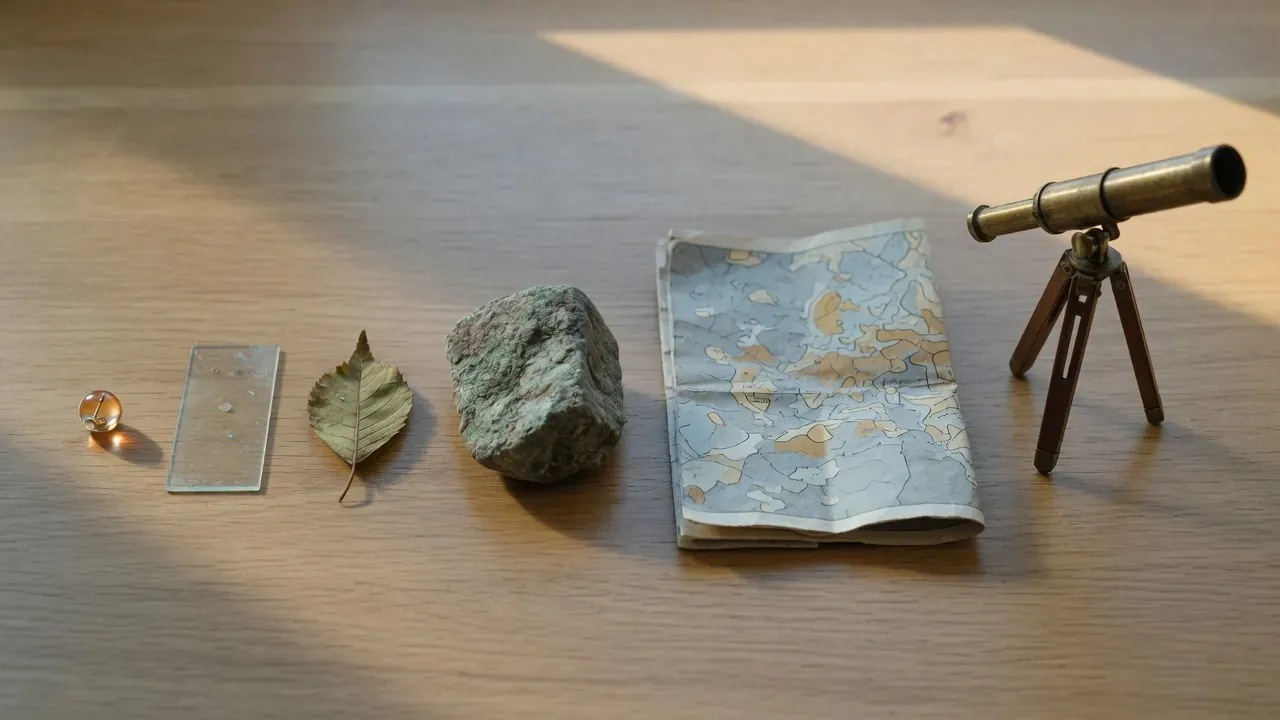
Microscopes, maps, rocks, and space
Microscope scale asks students to connect field of view, magnification, and actual size. Map scale asks them to understand that a few inches on paper may stand for miles. Geology adds time: layers and fossils make sense only when students stop thinking in weeks and start thinking in thousands or millions of years. Astronomy stretches the problem again, because a diagram of the solar system is almost never both size-to-scale and distance-to-scale.
The habit itself is simple: check the units, the power of ten, and the limits of the picture.
Models help, then betray you
Models are useful because they leave things out. A ball-and-stick molecule, a cell drawing, a food web, a rock column, and a planet diagram each exaggerate or simplify something on purpose. The danger is forgetting what the model left out.
A good scale question sounds ordinary: “What does one grid square stand for?” “Is this drawing to scale?” “Which object is the known comparison?” “What unit is missing?” Those questions slow students down before the mistake becomes a conclusion.
Where students can practice
The Bright Minds Microscopy, Biology, Chemistry, Geology, Earth Science, and Astronomy pages all point toward scale problems in different forms. The Scientific Method & Lab Skills course is the natural place to practice the measurement habits underneath them.
Sources & further reading
- Next Generation Science Standards, Three-Dimensional Learning, fetched Sept. 29, 2026. Used for the crosscutting-concept framing, including scale, proportion, and quantity.
- OpenStax, Biology 2e, fetched Sept. 29, 2026. Listed for further reading on biological organization across scales.
- OpenStax, Chemistry 2e, fetched Sept. 29, 2026. Listed for further reading on matter at atomic and molecular scales.
- OpenStax, Astronomy 2e, fetched Sept. 29, 2026. Listed for further reading on astronomical distance and scale.