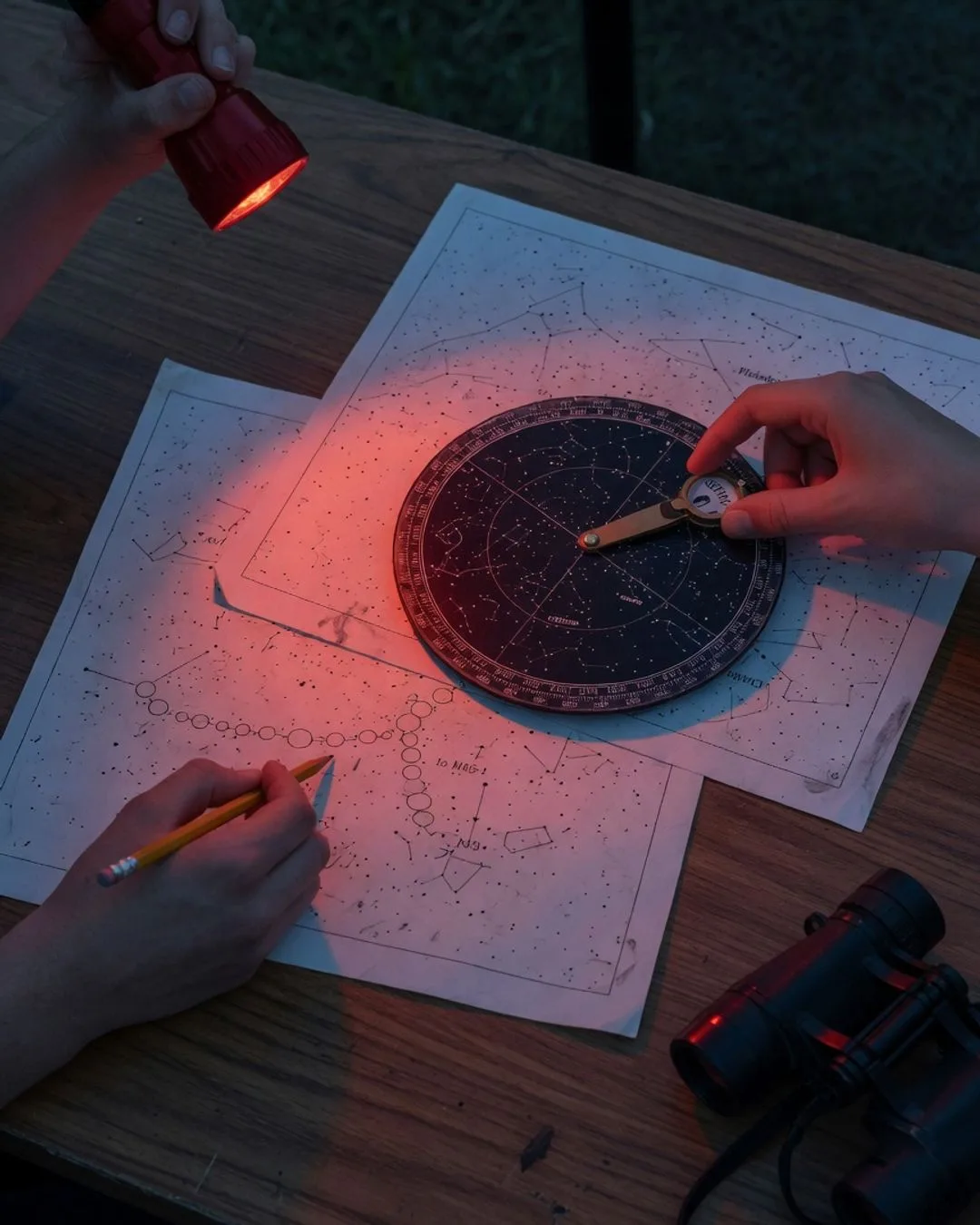
Ask a student who has only read about astronomy what a phase of the Moon is, and they will give you a definition. Ask a student who has watched one for a month what a phase of the Moon is, and they will tell you about the night the crescent hung low over the rooftops, the week it fattened toward full, the morning they caught it pale in a blue sky. The first student has a sentence. The second has an experience, and the experience is what the sentence was always trying to point at.
That gap is the whole reason this course is built the way it is. Astronomy, more than any other high-school science, lives at a distance you cannot cross. Biology has organisms you can hold and dissect. Physics has motion you can set up and time on a table. But the objects of astronomy (the Moon, the planets, the Sun, the far-off stars) can only be watched from where you stand. The danger is that the subject collapses into diagram-memorizing: a student learns to label the phases of the Moon without ever having watched one change.
Looking makes the idea real
The job of the observing session is to turn a claim in a book into something you have seen with your own eyes. You cannot travel to the Moon, but you can sketch it night after night and watch the terminator — the line between light and shadow — creep across its face on a schedule you can predict. You cannot visit a planet, but you can mark Jupiter against the background stars for two weeks and catch it drifting, and understand in your own notebook why the ancients called the planets "wanderers." You cannot hold a star, but you can split its light with a diffraction grating and read, in the bands you see, what it is made of.
This is what we mean when we say the course is observation-led, not textbook-led. The reading does not come first, with a single night under the sky bolted on to confirm it. The looking comes first. The question is posed where it actually lives (at the eyepiece, on a star chart, in a light curve that shifts from one night to the next), and the textbook is the tool we reach for to explain what we just saw. A student who has watched the constellations wheel across a season is ready to be told why Earth's tilt and orbit make them move. A student who has only been told is ready to forget it.
The diagram on the page is a claim about the real sky. The night you spend watching is where the student finds out the claim is true.
What the sky teaches that the page cannot
Beyond making ideas concrete, an observation-led course teaches a set of things a textbook structurally cannot, because they are not simply facts. They are judgments and habits that only form under a real sky:
- That observing is hard. Finding a faint target with binoculars, judging when the clouds have really cleared, watching your sketch from Tuesday disagree with your sketch from Thursday — these teach humility about data that no worked example ever will.
- That the sky doesn't read the textbook. The Moon rises later than you guessed. The planet isn't quite where the chart said. Haze swallows the target you came out for. Learning to reason about why the real sky departs from the tidy diagram is an observer's core skill.
- That technique is knowledge. How you let your eyes dark-adapt, how you star-hop from a bright landmark, how steadily you hold the binoculars, how carefully you log a time — the answer depends on the doing, and the doing can only be learned by doing.
The two-day rhythm
Practically, this conviction becomes a schedule. The course runs on a two-day rhythm. One day is the Concept Day: the idea is introduced and worked through on paper — the phases of the Moon, the motion of the planets, how parallax turns into a distance. The next is the Observation Day, where that same idea is made real under the sky and written into a real observation journal in the student's own hand. Running beneath it all, and across the whole term, the student keeps a sky-observation journal at home — moon phases night after night, a planet creeping against the stars, sunspots, the turning constellations — and that over-time record is where the concept and the experience knit together into something that lasts.
We are not against the textbook; a serious astronomy course needs a rigorous one, and this course has it. We are against the textbook going first and the looking going second, because we have watched what that produces: a student who can recite the definition of a lunar phase and has never once stood outside and watched the Moon change from one night to the next. Put the observing first, and astronomy stops being a vocabulary list. It becomes a thing the student has actually seen happen, which is the only kind of astronomy anyone remembers.