Why astronomy is taught this way.
Six short essays for parents and guides. The first two explain the core of the method; the next three address common family questions; the sixth explains how a course like this approaches learning in the age of AI.
The method
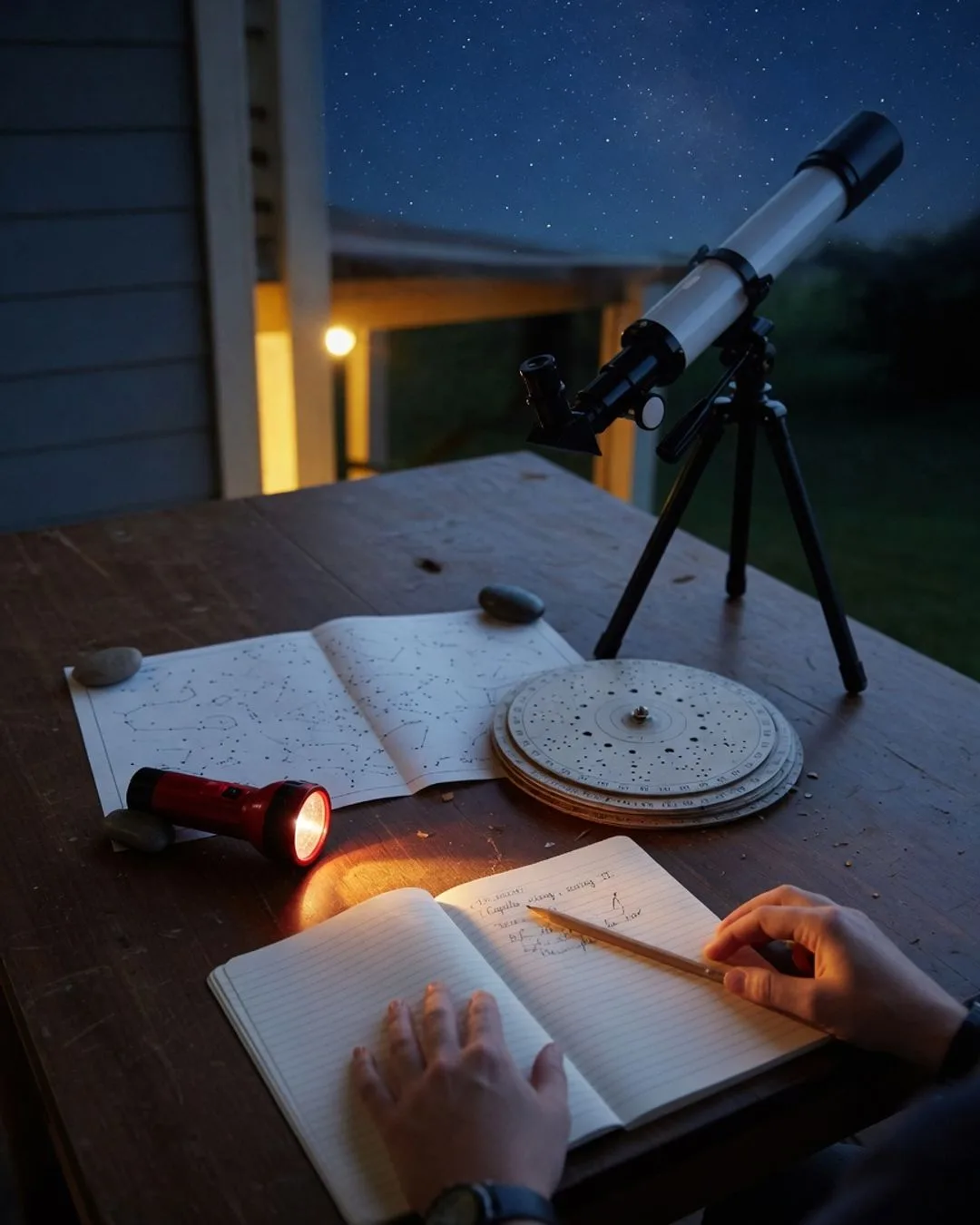
Why astronomy is taught under the sky.
Astronomy stays abstract without observation. What binoculars, a star chart, and a light curve that shifts night to night teach that no textbook can, and why "observation-led, not textbook-led" is the whole game.
Cram, pass, forget in astronomy.
Why the names of the constellations and the motions of the planets decay especially fast when they're crammed the night before a test, and what a term-long sky-observation journal — spaced night after night under "Learn → Master → Retain" — replaces the test-and-move-on model with.
The demonstrations
The observation-journal defense.
The single moment that captures the whole course: a student with a term's worth of dated sky sketches — moon phases, planets, a constellation traced week by week — and a guide asking "defend your observations, your method, and what the sky actually did."
Measurement under uncertainty.
Significant figures, precision versus accuracy, reading a light curve, error that propagates, and why a number without its uncertainty is meaningless. You can't touch a star; you infer it from the light it sends.
Integration & AI
Integration: Leavitt and the distance ladder.
How one insight (that Cepheid variable stars pulse in a rhythm set by their true brightness) turned Henrietta Leavitt's overlooked measurements into the yardstick Hubble used to measure the universe, pulling in history, ethics, and the people the record left out.
AI-proof by design.
We teach students to use AI thoughtfully while assessing the skills they must demonstrate themselves. This essay explains how the two approaches support each other.