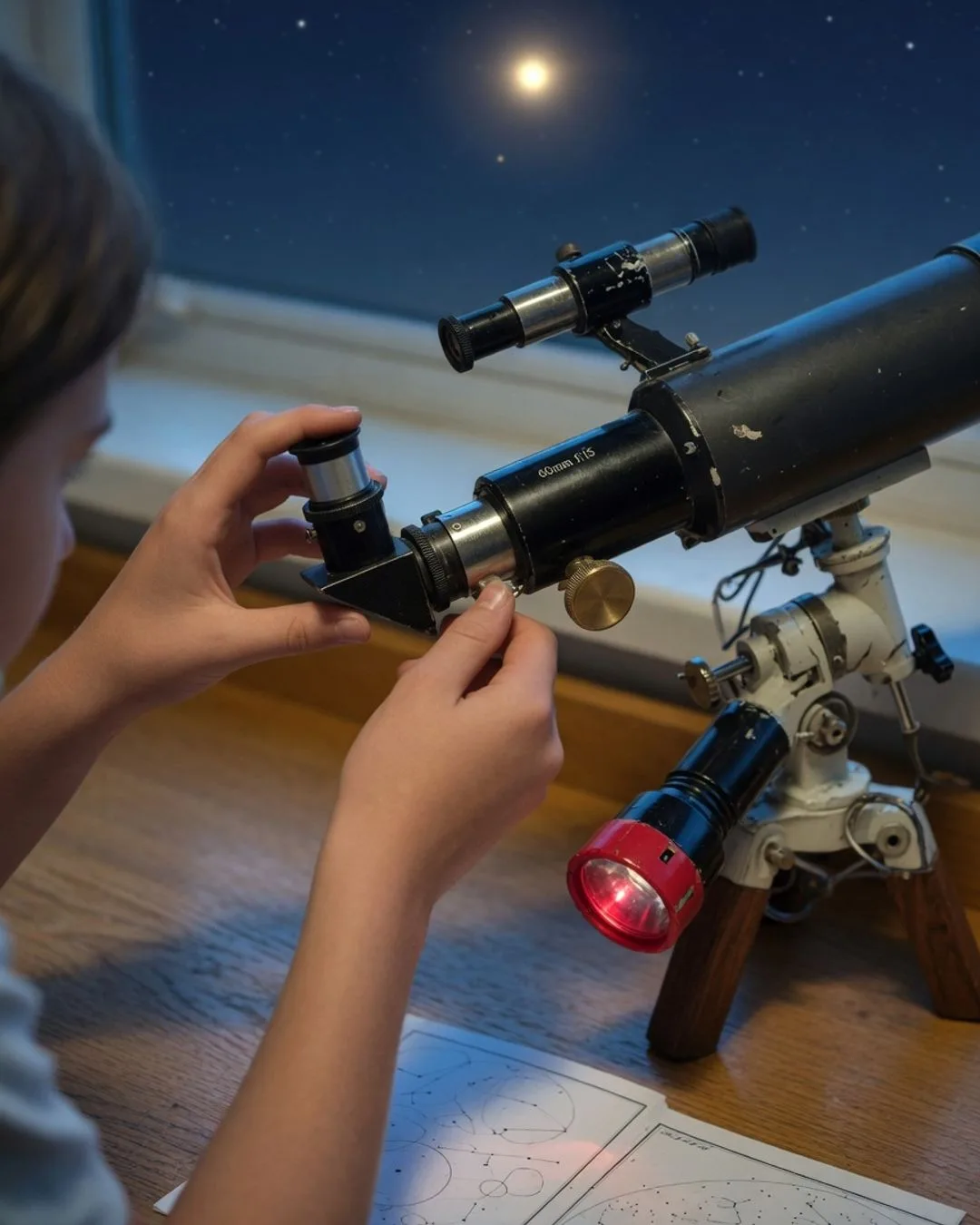
The signature demonstration isn't run in a single afternoon. It is built over weeks. From the first days of the term, a student keeps a dated sky-observation journal at home — the Moon sketched night after night as it waxes and wanes, a bright planet marked against the same background stars until it visibly drifts, sunspots tracked across the Sun's face, a constellation followed as it climbs earlier each evening. Then, partway through the year, they sit down with a guide, the journal open between them, and the questions begin: What was the Moon doing this week, and how do you know? Show me where the planet moved — and tell me why it moves that way. What does this pattern in your own pages mean?
It is, quite deliberately, an oral exam conducted over a record the student built with their own eyes, night by night. And it is the clearest single picture of what this whole course is for.
Why a defense, and not a worksheet
A worksheet hands the student a table of moon-phase dates and asks them to match each to a picture. That is a recognition task, and recognition is the thinnest slice of what observing actually demands. The defense asks something harder and truer: keep the record yourself, over weeks, on a real sky that clouds over and rises late and never quite matches the diagram; read the pattern out of your own pages with your own eyes; and then reason out loud about what it means. That is hard to bluff. Either you watched the Moon move from a thin evening crescent toward full and can say why, or you sit there and you can't.
Use AI to help you study the night sky. You still have to go outside, keep the record week after week, and explain your own observations in your own words.
What the guide is actually listening for
The defense isn't a recitation. A guide is listening for three things, and the rubric makes them explicit:
- The record, under control. Did the student log a real date and time, note the sky conditions, sketch what they actually saw, and keep it up night after night — or did they backfill a week of blank pages from memory the day before?
- The pattern, read honestly. Can the student point to the drift of the planet, the rhythm of the phases, the constellation climbing earlier each week, and describe the pattern in their own data rather than the one the textbook promised?
- The inference, defended. Not just what the sky did, but why: that the Moon's phase tracks its angle from the Sun, that a planet's wandering comes from its orbit and ours, that the seasons shift the stars because Earth is tilted and moving.
That third one is where mastery and memorization separate. A memorized fact has no give in it; the moment the guide asks "so where will the Moon be a week from now?" it collapses. Real understanding flexes. It can answer the question it wasn't expecting, because it knows what the pattern in the pages is actually telling it.
Why this is the assessment that survives the next decade
There is a practical reason the observation-journal defense sits at the center of the course, and it has to do with the world students are walking into. A take-home problem set can be generated. A multiple-choice exam can be gamed. But no tool can go outside night after night for a student, watch the Moon change with their eyes, and build a personal, time-stamped record over a whole term. A generated journal has no real Tuesday in it. The observation-journal defense is built around the student’s own work, not because we banned anything, but because a record built over weeks of real looking is very hard to outsource.
Years from now, most students will not remember the exact date the Moon was full in October. They will remember the weeks of stepping outside, sketch after sketch, watching the pattern emerge in their own pages, and explaining it to a person who kept asking why. What we are really teaching is the confidence that comes from understanding something well enough to explain it.