Unit 01 · The Sky & Celestial Motion
This unit starts with the plainest instrument there is — your own eyes — and works outward: how to read the night sky with a star chart and planisphere, how astronomers pin a point of light down with altitude and azimuth (and a first look at right ascension and declination), why the sky wheels overhead each night and shifts across the seasons, why the Moon runs through its phases, and why summer is warm. Mastery means you can stand under real stars, name what you see, and explain the motion behind it — logged in a dated journal you keep for weeks, not memorized for a quiz.
Student learning: Measure motion without confusing the coordinate systems
Choose the level by readiness, not age alone, and record it before instruction. Foundation, core, and honors tasks are study pathways, not an AP course or a promise of college credit. The instructor retains practical assessment and the published science rubric; integration is reported separately.
Prerequisites: Angles, elapsed time, ratios, graph axes, and the distinction between a model and an observation.
Suggested sequence: read and discuss the explanation; attempt the worked model; analyze the data at your selected level; check the answers; then complete the source-linked response and a fresh transfer question. These activities supplement, not replace, supervised practical work and the full-year schedule.
Assigned reading and focus
- OpenStax Astronomy 2e, 2.1: The Sky Above. Read The Celestial Sphere and Celestial Poles and Celestial Equator. Sketch the horizon, zenith, pole, and equator; identify what depends on the observing location.
Learn the science
The celestial sphere is a map of directions, not a shell holding equally distant stars. Altitude is angle above the horizon; azimuth locates a direction around it. Both depend on the observer and time.
Hour angle measures a star westward from the local meridian in the equatorial coordinate system. Our short teaching model uses 15 degrees per hour. It is not a model of altitude increasing at that constant rate.
Earth rotates relative to the stars in about 23 hours 56 minutes, slightly less than a solar day. Earth also travels around the Sun, changing which constellations are visible at a given evening hour. Axial tilt, not the small annual distance change, explains the seasons.
Moon phases come from how much of the sunlit half we see. An eclipse needs the extra alignment that puts one body in another body's shadow; ordinary phases are not Earth's shadow.

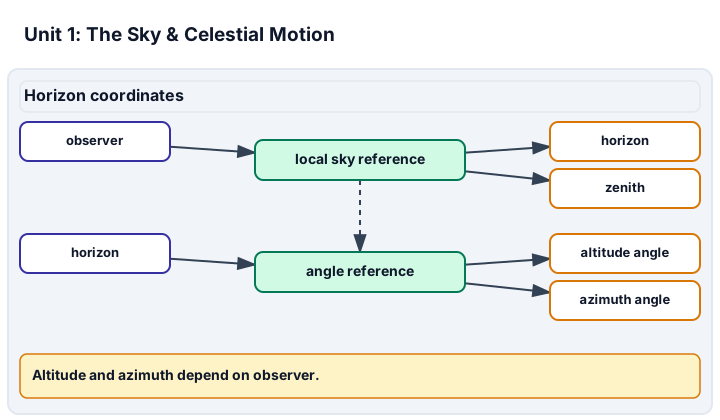
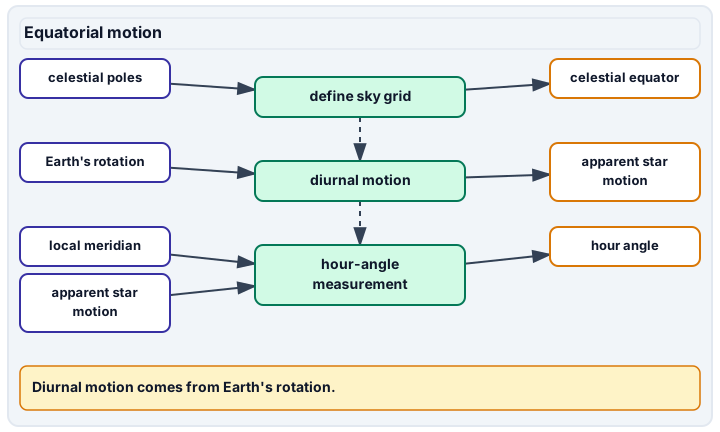
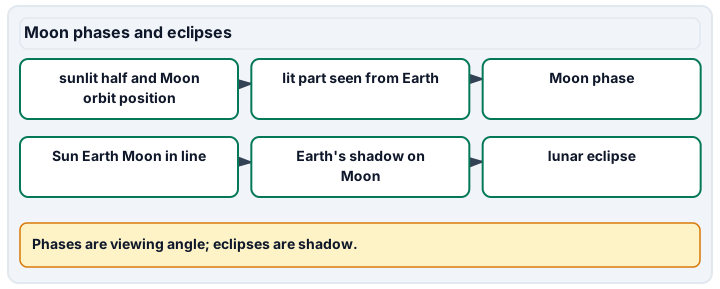
Diagram description
Horizon coordinates are observer-based: horizon supports altitude and azimuth, and the observer defines zenith. Equatorial motion uses celestial poles/equator, local meridian, and Earth's rotation causing apparent star motion that feeds hour angle. Moon phases come from the lit part seen from Earth; lunar eclipses come from Earth's shadow when Sun, Earth and Moon line up.
Data, provenance, and assumptions
| Elapsed time (minutes) | Hour angle (degrees west) | Reading uncertainty (degrees) |
|---|---|---|
| 0 | 0 | 0.2 |
| 10 | 2.5 | 0.2 |
| 20 | 5 | 0.2 |
| 40 | 10 | 0.2 |
Worked model
From 0 to 40 minutes, hour angle changes by 10 degrees. The rate is 10 / 40 = 0.25 degree/minute, or 15 degrees/hour. A straight line fits this deliberately idealized dataset; it does not describe every sky coordinate.
Numerical calibration
- 15 degrees/hour
Attempt the assigned level
Try the tasks before reading the calibration. These are practice answers, not a secure examination; use a new dataset or changed assumption for the assessed transfer.
Foundation: typically grades 7-8
- Draw and label the celestial-sphere directions. Plot the four hour-angle readings.
- Find the angular change during the first 20 minutes. Use a diagram to distinguish a quarter Moon from a lunar eclipse.
Check after your attempt
- The change is 5 degrees. The plotted model is a straight line through the origin.
- A quarter Moon shows half of the visible disk illuminated; a lunar eclipse involves Earth's shadow and a different Sun-Earth-Moon alignment.
High-school core: typically grades 9-10
- Calculate the hourly rate and predict hour angle at 60 minutes.
- State why applying that same linear rate to altitude or using this table without an observing-coordinate definition would be invalid.
Check after your attempt
- The model predicts 15 degrees/hour and 15 degrees at 60 minutes.
- Altitude depends on declination, hour angle, and latitude; it is not generally a linear function of elapsed time.
Honors extension: typically grades 11-12
- Use a 23-hour-56-minute sidereal day to calculate a more precise angular rate.
- Compare the 40-minute predictions from the two models with the stated 0.2-degree reading uncertainty.
Check after your attempt
- 360 / (23 + 56/60) is about 15.042 degrees/hour.
- The more precise prediction is about 10.028 degrees. Its difference from 10 degrees is smaller than the stated reading uncertainty; these measurements cannot resolve it.
History, reading, and writing connection
Use the assigned celestial-sphere figures as sources. Explain how a coordinate system makes different observers' records comparable, and distinguish the historical appearance of a moving sky from the modern rotation model.
Write in your own words or use an approved accessible equivalent. Cite a specific assigned section or figure, identify its evidence, and state one limitation or counterargument. Use the AI practice contract only for permitted coaching, never to invent observations or write the assessed response.
Transfer to a new case
A new table reports altitude, not hour angle. Can you reuse the fitted slope?
Calibration: Not without a model for the observer, target, and coordinate transformation. First identify the new measurement and its assumptions.
Evidence to retain
Submit a labeled coordinate sketch, graph with units, selected-level calculations, phase/eclipse explanation, and a limitation. An image or simulated track can support the analysis; it is not an invented personal observation.
Record units, calculations, source/date, uncertainty, and what is measured versus inferred. A simulation or supplied dataset must stay labeled as such. No direct solar viewing or unsupervised practical procedure is required by these data tasks.
Return to all eight learning pathways. Print this unit page for the student lessons; the linked five-page packet remains the separate assessment companion.
Unit mastery rubric
| Criterion | Developing | Proficient | Mastery |
|---|---|---|---|
| Naked-eye observation & star charts | Cannot orient a star chart or find a named constellation in the real sky. | Finds bright objects but fumbles the planisphere or loses track of direction. | Sets a planisphere for the date and hour, then locates constellations, bright stars, and visible planets by eye. |
| The celestial sphere & coordinates | Cannot locate an object in a defined coordinate system. | Uses coordinates but confuses their reference directions or rates. | Locates a target with altitude/azimuth, explains equatorial coordinates, and interprets a defined-coordinate track with units. |
| Diurnal & annual motion | Thinks the stars are fixed and that seasons come from Earth's distance to the Sun. | Describes nightly rising and setting but muddles why constellations change with the seasons. | Explains diurnal motion from Earth's rotation and the seasonal march of constellations from its orbit — and traces the seasons to axial tilt, not distance. |
| Moon phases & lunar features | Believes Earth's shadow causes the phases. | Names the phases in order but cannot draw the Sun–Earth–Moon geometry that makes them. | Predicts the phase from the Sun–Earth–Moon geometry and identifies maria, highlands, and major craters on the disk. |
| Observation technique & the journal | Skips setup, uses white light at the eyepiece, or leaves the journal blank. | Observes with binoculars or a telescope but keeps thin, undated notes. | Works cleanly under a red flashlight, uses binoculars, telescope, and sky-mapping apps well, and keeps dated, sketched journal entries across weeks. |
| Integration (cross-domain) | Makes no supported connection between the source and the science. | Uses the source but needs help connecting evidence, writing, or limitations to the science. | Independently connects History, Reading, and Writing using a cited source, appropriate evidence, a limitation, and a scientific explanation. |
Integration is reported separately and cannot lower the science grade or block a science demonstration pass. Science and practical criteria determine that pass. Use the integration guide's evidence checklist for the separately reported criterion.
“The Moon isn’t in Earth’s shadow tonight — it’s a waxing crescent because we’re seeing the sliver the Sun lights from off to the side. And it’s warm in July because our hemisphere is tilted toward the Sun, not because we’re closer. That’s motion I can reason out from geometry, not a fact I memorized.”
“It’s a crescent because… Earth’s shadow? And summer’s when we’re closest to the Sun, I think.”
You demonstrate this unit on real observation nights and in your dated journal, plus short oral checks where you reason from sky geometry aloud — not a multiple-choice test. A criterion counts as mastered only when you can both make the observation and justify the motion behind it. Mastery is demonstrated, not awarded.
A 5-page clipboard packet — unit overview, key terms, the mastery rubric, anchor examples, and a score sheet you can print and grade against.