Unit 02 · The History of Astronomy
Astronomy is the oldest science, and this unit walks the long argument that built it. It begins with the geocentric sky — a reasonable read of the evidence, since you feel no motion and the heavens wheel overhead each night — and traces why it strained against the wandering planets. From Ptolemy's careful geometry to Copernicus's Sun-centered turn, Tycho Brahe's precise naked-eye data, Kepler's three laws of orbital motion, and Galileo's first telescope views of Jupiter's moons and the phases of Venus, mastery means you can explain how patient observation overturned centuries of authority — and see a piece of it yourself in a planet you track across weeks in your own journal.
Student learning: Compare predictions instead of declaring a historical winner
Choose the level by readiness, not age alone, and record it before instruction. Foundation, core, and honors tasks are study pathways, not an AP course or a promise of college credit. The instructor retains practical assessment and the published science rubric; integration is reported separately.
Prerequisites: Unit 1 coordinates; subtraction, absolute differences, and the idea of a prediction made before a test.
Suggested sequence: read and discuss the explanation; attempt the worked model; analyze the data at your selected level; check the answers; then complete the source-linked response and a fresh transfer question. These activities supplement, not replace, supervised practical work and the full-year schedule.
Assigned reading and focus
- OpenStax Astronomy 2e, 2.4: The Birth of Modern Astronomy. Read The Heliocentric Model and the discussion of Galileo's telescope evidence. List observations separately from interpretations; critically assess broad claims about historical motives.
- OpenStax Astronomy 2e, 3.1: The Laws of Planetary Motion. Read the Tycho and Kepler sections. Explain how a long measurement record can distinguish orbital models that fit a short record similarly.
Learn the science
Retrograde motion is apparent backward motion against background stars, not a planet reversing its orbit. Ptolemaic constructions represented it with geometric devices; a heliocentric system explains it through relative orbital motion.
Venus's full range of phases conflicts with the original Ptolemaic Venus arrangement. It fits both a Sun-centered model and a Tychonic geoheliocentric arrangement in which planets orbit the Sun while the Sun orbits a stationary Earth. That observation alone does not uniquely prove Earth's motion.
Jupiter's moons show that not every orbit is centered on Earth. The evidence constrained models, but the historical change involved multiple observations, improved dynamics, and later measurements, not one decisive classroom picture.
The numerical models below are fictional training models, not recovered calculations by Ptolemy or Galileo. A small residual means agreement with this dataset; it does not prove the model's mechanism or its predictions outside the measured interval.

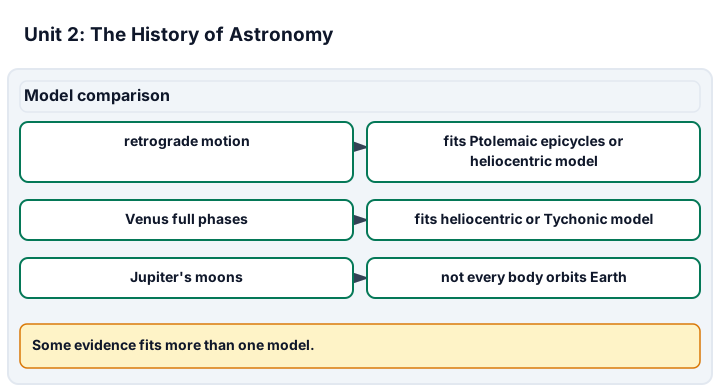
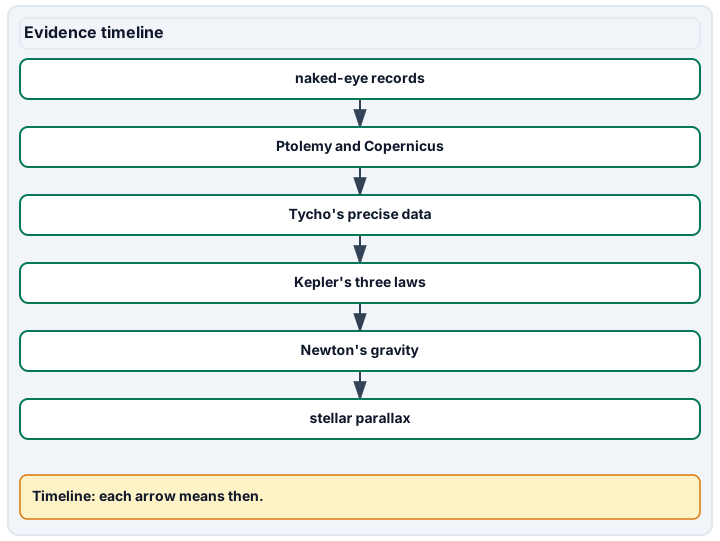
Diagram description
Retrograde motion can be modeled by Ptolemaic devices or heliocentric relative motion; Venus full phases fit heliocentric and Tychonic models, so they do not alone prove Earth's motion. Jupiter's moons support model comparison by showing not all bodies orbit Earth. The timeline highlights Tycho's precise data feeding Kepler's laws before later telescope and gravity evidence.
Data, provenance, and assumptions
| Time index | Observed angle (degrees) | Model A (degrees) | Model B (degrees) |
|---|---|---|---|
| 0 | 10 | 10 | 10 |
| 1 | 12 | 11 | 12 |
| 2 | 14 | 12 | 14 |
Worked model
Model A has absolute residuals 0, 1, and 2 degrees. Its mean absolute error is (0 + 1 + 2) / 3 = 1 degree. Model B has zero residual at each point. This favors B on the supplied record, not for all possible observations.
Numerical calibration
- 1 degree mean absolute error
Attempt the assigned level
Try the tasks before reading the calibration. These are practice answers, not a secure examination; use a new dataset or changed assumption for the assessed transfer.
Foundation: typically grades 7-8
- Count how many readings each model predicts within 0.5 degree.
- Draw the Sun-Earth-Venus arrangements and state which observation challenges the original Ptolemaic version.
Check after your attempt
- A agrees within 0.5 degree at one of three points; B agrees at all three.
- The full range of Venus phases challenges the original arrangement, but a compatible alternative model remains.
High-school core: typically grades 9-10
- Calculate mean absolute error for both models and graph their residuals.
- Write a claim that favors one numerical model while explicitly limiting the conclusion to the supplied evidence.
Check after your attempt
- A: 1 degree; B: 0 degrees.
- B agrees better with these data. A fresh prediction or independent observation is needed to test whether its apparent success generalizes.
Honors extension: typically grades 11-12
- Calculate the sum of squared normalized residuals, using residual / 0.5, for each model.
- Propose an additional observation that could distinguish currently compatible physical models, rather than merely repeating the same observation.
Check after your attempt
- The sums are 20 for A and 0 for B. Do not turn these into a probability without specifying a statistical model.
- Examples include a sufficiently precise stellar-parallax test or a new orbital prediction combined with a defensible dynamical theory; explain its required precision and competing predictions.
History, reading, and writing connection
Cite the assigned reading for two historical observations and distinguish the evidence, model, and later explanation. Avoid treating scientific agreement as proof of a historical person's motives.
Write in your own words or use an approved accessible equivalent. Cite a specific assigned section or figure, identify its evidence, and state one limitation or counterargument. Use the AI practice contract only for permitted coaching, never to invent observations or write the assessed response.
Transfer to a new case
Both models predict a new measurement within its uncertainty. Must one now be declared false?
Calibration: No. The new measurement does not discriminate between them at that precision. Identify a more informative test.
Evidence to retain
Submit model diagrams, a residual table, selected-level calculation, a source-linked argument, and a discriminating follow-up. The synthetic table is not historical data.
Record units, calculations, source/date, uncertainty, and what is measured versus inferred. A simulation or supplied dataset must stay labeled as such. No direct solar viewing or unsupervised practical procedure is required by these data tasks.
Return to all eight learning pathways. Print this unit page for the student lessons; the linked five-page packet remains the separate assessment companion.
Unit mastery rubric
| Criterion | Developing | Proficient | Mastery |
|---|---|---|---|
| The geocentric model & its logic | Dismisses the geocentric model as simply foolish or ignorant. | Says Earth was thought central but cannot say why that was reasonable. | Explains why an Earth-centered sky fit the evidence — no felt motion, the nightly wheeling overhead — and where it strained against the planets' retrograde loops. |
| The shift to a heliocentric model | Cannot contrast the geocentric and heliocentric pictures. | Names Copernicus but treats the switch as mere opinion. | Shows how a Sun-centered model explains retrograde motion more simply, and explains why acceptance came slowly. |
| Tycho's data & Kepler's laws | Does not connect observations to the laws of motion. | Recites one of Kepler's laws from memory without its basis. | Uses Tycho Brahe's precise naked-eye data to justify Kepler's three laws — ellipses, equal areas, and the period–distance relation. |
| Galileo's telescope evidence | Cannot identify an observation and its prediction. | Names observations but overstates what they ruled out. | Explains why Venus's phases challenge the original Ptolemaic model, why a Tychonic alternative also fits, and what Jupiter's moons establish. |
| Tracking the sky & the journal | Accepts claims on authority and leaves the observation journal blank. | Reads about the debate but keeps thin, undated notes. | Tracks a planet's position over weeks under a red flashlight, logging dated sketches, and argues from that evidence rather than authority. |
| Integration (cross-domain) | Makes no supported connection between the source and the science. | Uses the source but needs help connecting evidence, writing, or limitations to the science. | Independently connects History, Reading, and Writing using a cited source, appropriate evidence, a limitation, and a scientific explanation. |
Integration is reported separately and cannot lower the science grade or block a science demonstration pass. Science and practical criteria determine that pass. Use the integration guide's evidence checklist for the separately reported criterion.
“The full phases of Venus conflict with the original Ptolemaic arrangement, but both Copernican and Tychonic models can explain them. Jupiter's moons show that some bodies orbit a center other than Earth. These observations constrain models; they do not alone prove every part of the modern explanation.”
“Ancient people thought Earth was the center because they didn’t know better. Kepler made some laws. Galileo had a telescope, I think.”
Compare historical predictions and actual or approved recorded observations, then explain which models the evidence distinguishes and which remain compatible. Keep the dated sky journal or approved alternative, and complete the selected-level residual analysis. One observation need not settle every part of a theory.
A 5-page clipboard packet — unit overview, key terms, the mastery rubric, anchor examples, and a score sheet you can print and grade against.