Unit 03 · Light, Telescopes & Spectra
Almost everything we know about the universe arrives as light. This unit orders the electromagnetic spectrum from radio to gamma, shows how a telescope — refractor or reflector — gathers and focuses that light so aperture, light-gathering power, and resolution matter far more than raw magnification, and puts a diffraction grating in your hands to spread starlight into its colors. Mastery means you can read a spectrum's emission and absorption lines and explain what they reveal — the composition, temperature, and motion of a source you will never touch.
Student learning: Extract physical information from light with stated limits
Choose the level by readiness, not age alone, and record it before instruction. Foundation, core, and honors tasks are study pathways, not an AP course or a promise of college credit. The instructor retains practical assessment and the published science rubric; integration is reported separately.
Prerequisites: Scientific notation, wavelength units, ratios; honors work uses a simple blackbody approximation.
Suggested sequence: read and discuss the explanation; attempt the worked model; analyze the data at your selected level; check the answers; then complete the source-linked response and a fresh transfer question. These activities supplement, not replace, supervised practical work and the full-year schedule.
Assigned reading and focus
- OpenStax Astronomy 2e, 5.2: The Electromagnetic Spectrum. Read the spectrum and temperature sections. Identify the visible range, atmospheric limitations, and the wavelength form of Wien's law.
Learn the science
For light in vacuum, c = wavelength times frequency. Use c = 3.00e8 m/s in these exercises, and convert nanometers to meters before calculating.
A larger telescope aperture collects more light and can improve diffraction-limited resolution. Increasing magnification alone does not recover detail that was not resolved; atmosphere and detector sampling can also limit the observation.
An absorption or emission line must be compared with calibrated reference patterns before inferring composition. Our single artificial line illustrates a shift, not identification of an element. Define z = (observed wavelength - rest wavelength) / rest wavelength.
At small redshift, radial speed can be approximated by c times z. For a blackbody-like continuum plotted per unit wavelength, temperature is approximately 2.90e6 nm K divided by peak wavelength in nm. A spectral line is not the continuum peak.

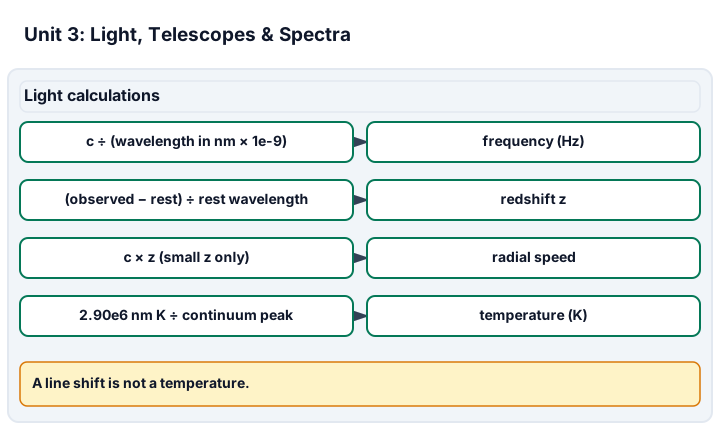
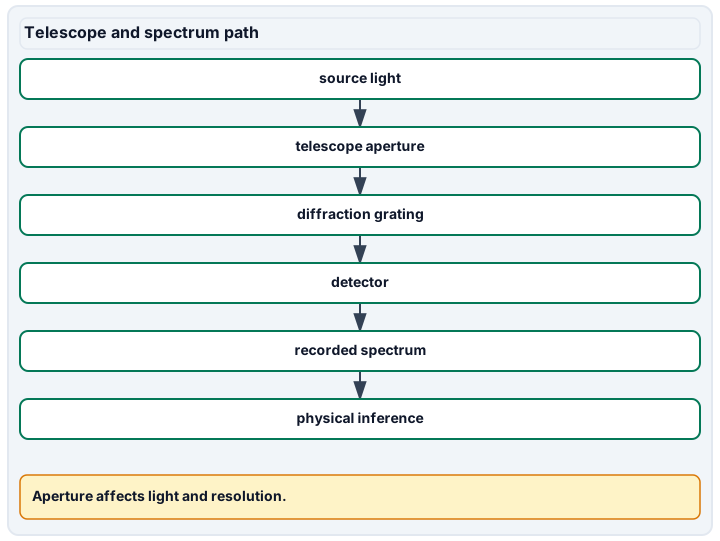
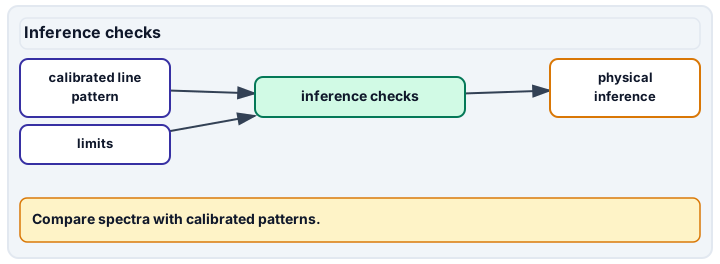
Diagram description
The light panel treats c as a constant input to frequency, not an output; wavelength in nanometers must be converted to meters. Rest and observed lines produce redshift, redshift gives approximate radial speed for small z, and continuum peak gives a blackbody-model temperature. The telescope path sends source light through aperture and grating to detector and recorded spectrum. Calibrated line patterns and limits constrain physical inference.
Data, provenance, and assumptions
| Rest wavelength (nm) | Observed wavelength (nm) | Continuum peak (nm) |
|---|---|---|
| 500 | 505 | 580 |
Worked model
500 nm is 5.00e-7 m, so its vacuum frequency is 3.00e8 / 5.00e-7 = 6.00e14 Hz. The artificial line has z = 5 / 500 = 0.0100. This is a shift calculation, not evidence of a particular chemical species.
Numerical calibration
- 600000000000000 Hz
- 0.01 dimensionless
- 5000 K
Attempt the assigned level
Try the tasks before reading the calibration. These are practice answers, not a secure examination; use a new dataset or changed assumption for the assessed transfer.
Foundation: typically grades 7-8
- Place 400 nm and 600 nm light in order of wavelength and frequency.
- State whether the supplied line is redshifted or blueshifted and distinguish the line from the continuum peak.
Check after your attempt
- 400 nm has the shorter wavelength and higher frequency.
- The line is redshifted from 500 to 505 nm. The continuum peak is a separate 580 nm measurement.
High-school core: typically grades 9-10
- Calculate the rest frequency and z.
- Use c = 300,000 km/s to estimate radial speed under the stated small-redshift approximation; identify one limit on this interpretation.
Check after your attempt
- Frequency is 6.00e14 Hz and z is 0.0100.
- The approximate speed is 3,000 km/s. Calibration, line identification, and the low-redshift approximation need checking; large cosmological redshifts need a different treatment.
Honors extension: typically grades 11-12
- Estimate temperature from the continuum peak.
- Predict the temperature if a comparable wavelength-based peak is 290 nm. Explain why dust, a non-blackbody spectrum, or confusing a line with the continuum would undermine the estimate.
Check after your attempt
- 580 nm gives about 5,000 K.
- 290 nm gives about 10,000 K. The estimate relies on the specified continuum model, not just the existence of a bright spectral line.
History, reading, and writing connection
Use the assigned spectrum figure to explain how observations beyond unaided vision extend evidence. Trace a claim from measurement to physical model and state what the data cannot identify.
Write in your own words or use an approved accessible equivalent. Cite a specific assigned section or figure, identify its evidence, and state one limitation or counterargument. Use the AI practice contract only for permitted coaching, never to invent observations or write the assessed response.
Transfer to a new case
A line is shifted from 500 to 495 nm. What changes?
Calibration: z becomes -0.0100, indicating a blueshift in the specified comparison; do not reuse the positive sign or confuse shift with temperature.
Evidence to retain
Submit conversions, the selected calculations, an annotated spectrum explanation, and a limitation. Use the supplied data; no direct solar viewing or laser activity is needed.
Record units, calculations, source/date, uncertainty, and what is measured versus inferred. A simulation or supplied dataset must stay labeled as such. No direct solar viewing or unsupervised practical procedure is required by these data tasks.
Return to all eight learning pathways. Print this unit page for the student lessons; the linked five-page packet remains the separate assessment companion.
Unit mastery rubric
| Criterion | Developing | Proficient | Mastery |
|---|---|---|---|
| The electromagnetic spectrum | Thinks visible light is all there is, or cannot order the bands. | Names a few bands but muddles their order or relative energy. | Orders the electromagnetic spectrum by wavelength and energy and explains what each band reveals about the sky. |
| Telescopes & gathering light | Thinks a telescope mainly magnifies the view. | Names refractor and reflector but cannot say why aperture matters. | Explains how aperture governs light-gathering and resolution, and contrasts refractor with reflector optics. |
| Producing a spectrum | Cannot spread light into a spectrum. | Makes a spectrum with a grating but cannot distinguish the line types. | Uses a diffraction grating to spread light and reads emission versus absorption lines. |
| What spectra reveal | Cannot distinguish a spectral line from the continuum. | Uses a relationship without its units or assumptions. | Interprets calibrated line patterns and applies the assigned wavelength, shift, or temperature model with units and limitations. |
| Observation technique & the journal | Uses white light at the eyepiece or leaves the journal blank. | Observes with a grating or telescope but keeps thin, undated notes. | Works cleanly under a red flashlight, uses the grating, binoculars, and telescope well, and logs dated spectrum sketches across weeks. |
| Integration (cross-domain) | Makes no supported connection between the source and the science. | Uses the source but needs help connecting evidence, writing, or limitations to the science. | Independently connects History, Reading, and Writing using a cited source, appropriate evidence, a limitation, and a scientific explanation. |
Integration is reported separately and cannot lower the science grade or block a science demonstration pass. Science and practical criteria determine that pass. Use the integration guide's evidence checklist for the separately reported criterion.
“The rainbow through my grating isn’t just pretty — the dark lines are colors gone missing, and each set fingerprints an element. A hotter source pushes its peak toward the blue, and if the whole pattern is shifted toward red the source is moving away. That’s how we read a star’s makeup, heat, and motion from its light alone.”
“The telescope makes things bigger. A prism makes a rainbow. The colors are just colors, right?”
You demonstrate this unit by ordering the electromagnetic spectrum, splitting light with a diffraction grating, and reading emission and absorption lines aloud — not a multiple-choice test. A criterion counts as mastered only when you can produce a spectrum and say what it reveals about composition, temperature, and motion. Mastery is demonstrated, not awarded.
A 5-page clipboard packet — unit overview, key terms, the mastery rubric, anchor examples, and a score sheet you can print and grade against.