Unit 04 · The Solar System
This unit is the tour of our own neighborhood. It contrasts the small rocky terrestrial planets with the gas and ice giants, sorts the moons, asteroids, comets, and Kuiper belt into place, and explains the orbital motion that keeps them running — Kepler's laws and gravity together, ellipses rather than circles, faster near the Sun and slower far out. You'll build or interpret a scale model, an orrery, to feel the true distances, and trace the whole system back to the collapsing solar nebula that sorted rock inward and gas outward. Mastery means you can explain not just what orbits the Sun but why it moves the way it does.
Student learning: Connect orbital models, scale, and formation
Choose the level by readiness, not age alone, and record it before instruction. Foundation, core, and honors tasks are study pathways, not an AP course or a promise of college credit. The instructor retains practical assessment and the published science rubric; integration is reported separately.
Prerequisites: Ratios, squares and square roots; honors work uses rearrangement of a power-law relationship.
Suggested sequence: read and discuss the explanation; attempt the worked model; analyze the data at your selected level; check the answers; then complete the source-linked response and a fresh transfer question. These activities supplement, not replace, supervised practical work and the full-year schedule.
Assigned reading and focus
- OpenStax Astronomy 2e, 3.1: The Laws of Planetary Motion. Read all three Kepler laws. Distinguish an ellipse's semimajor axis from instantaneous orbital distance and a scale drawing from a literal planetary arrangement.
Learn the science
Kepler's laws describe elliptical orbits with the Sun at one focus, equal swept areas in equal times, and a period-size relationship. Speed is not constant around an eccentric orbit.
For a body of negligible mass orbiting one solar mass, P squared = a cubed when P is in years and semimajor axis a is in AU. More generally, M in solar masses is approximately a cubed / P squared in these units. Do not mix kilometers with AU in that formula.
In the nebular model, gravity collapses a rotating cloud and material forms a disk. Temperature-dependent condensation helps explain rocky inner planets and the materials available farther out. Accretion, gas capture, migration, and collisions make the history more complex than a tidy set of fixed rings.
A scale model must state whether it preserves distances, sizes, or both. Small bodies are remnants and products of a changing system; a moon may form with its planet, arise after an impact, or be captured, depending on the case.

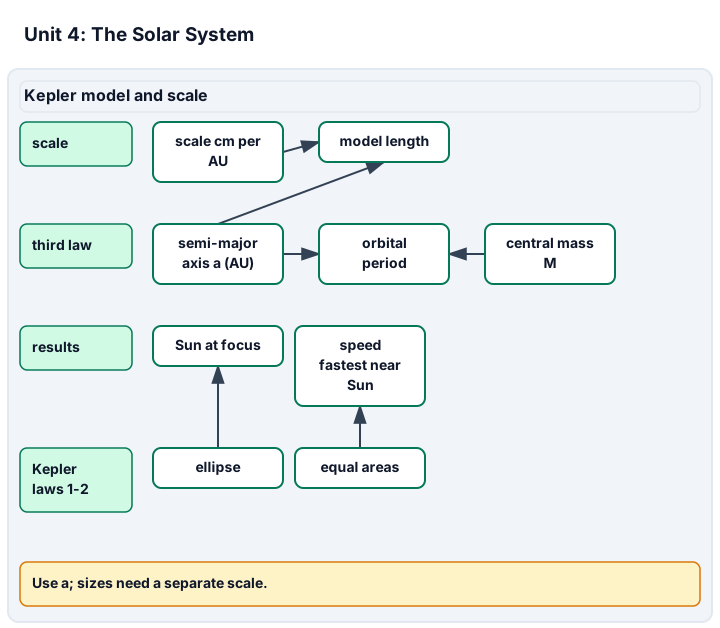
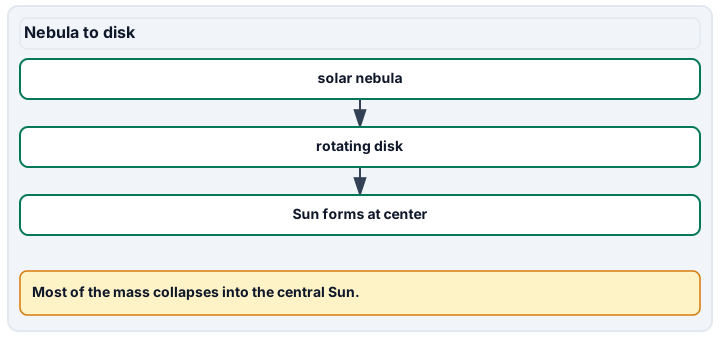
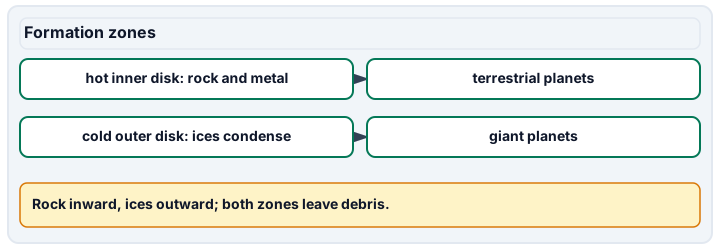
Diagram description
Kepler's model panel includes ellipse, focus, equal areas and speed changes, plus period and distance-scale formulas with AU, years and solar masses. Formation begins with the solar nebula collapsing into a rotating disk, with most of the mass forming the Sun at the center; hot inner disk material of rock and metal builds terrestrial planets, and cold outer disk material where ices can condense builds giant planets, with leftover debris from both zones.
Data, provenance, and assumptions
| Planet | Semimajor axis (AU) | Period (years) |
|---|---|---|
| Earth | 1 | 1 |
| Mars | 1.52 | 1.88 |
| Jupiter | 5.2 | 11.86 |
Worked model
For Jupiter, P = square root of 5.20 cubed, or about 11.86 years. At a model scale of 10 cm per AU, its orbit's semimajor axis is 52 cm. These are different calculations: one predicts time and one represents distance.
Numerical calibration
- 11.86 years
- 52 cm at 10 cm/AU
Attempt the assigned level
Try the tasks before reading the calibration. These are practice answers, not a secure examination; use a new dataset or changed assumption for the assessed transfer.
Foundation: typically grades 7-8
- Draw a distance model at 10 cm per AU for the three planets.
- Explain why this drawing does not also show planet sizes correctly unless a size scale is explicitly supplied.
Check after your attempt
- Earth: 10 cm; Mars: 15.2 cm; Jupiter: 52 cm.
- Planet radii are much smaller than orbital distances; using arbitrary icon sizes changes the size scale.
High-school core: typically grades 9-10
- Predict the periods of Mars and Jupiter from their semimajor axes and compare with the rounded table.
- Explain why using a planet's nearest distance instead of a is not the same calculation.
Check after your attempt
- Mars is about 1.87 years; Jupiter is about 11.86 years. Small differences follow from rounded inputs.
- a is half the major-axis length; instantaneous distance changes around an ellipse.
Honors extension: typically grades 11-12
- For a hypothetical low-mass planet with a = 4 AU and P = 4 years, estimate the host star's mass.
- Compare with a 4 AU orbit around one solar mass and state the assumptions behind the comparison.
Check after your attempt
- The mass is 4 cubed / 4 squared = 4 solar masses.
- Around one solar mass the period is 8 years. The model assumes a gravitational two-body system with negligible planet mass and the stated units.
History, reading, and writing connection
Cite Kepler's relationship and explain why Tycho's observations mattered. Use the numerical comparison to distinguish a predictive law from an explanation of planetary formation.
Write in your own words or use an approved accessible equivalent. Cite a specific assigned section or figure, identify its evidence, and state one limitation or counterargument. Use the AI practice contract only for permitted coaching, never to invent observations or write the assessed response.
Transfer to a new case
A proposed planet has a = 4 AU and P = 8 years. Must the previous 4-solar-mass answer apply?
Calibration: No. The same model now gives one solar mass; changing the observed period changes the inference.
Evidence to retain
Submit the scale drawing, period/mass work at the chosen level, a nebular-formation explanation, and the model limitations.
Record units, calculations, source/date, uncertainty, and what is measured versus inferred. A simulation or supplied dataset must stay labeled as such. No direct solar viewing or unsupervised practical procedure is required by these data tasks.
Return to all eight learning pathways. Print this unit page for the student lessons; the linked five-page packet remains the separate assessment companion.
Unit mastery rubric
| Criterion | Developing | Proficient | Mastery |
|---|---|---|---|
| Terrestrial vs. giant planets & small bodies | Cannot distinguish planet types or name the small bodies. | Sorts planets loosely but muddles moons, asteroids, comets, and the Kuiper belt. | Compares terrestrial and giant planets by composition and density; locates moons, asteroids, comets, and Kuiper-belt objects. |
| Orbital motion (Kepler & gravity) | Thinks every orbit has constant speed. | Names a law but omits its conditions. | Explains elliptical motion and changing speed; uses the assigned period or mass model with semimajor axis, correct units, and stated assumptions. |
| Scale model & the orrery | Has no sense of the solar system's true scale. | Builds a model but ignores relative sizes and distances. | Builds or interprets a scale model — an orrery — that honors relative sizes and distances. |
| Formation from the solar nebula | Cannot say how the system formed. | Names “a cloud of gas” but not the sorting by distance. | Explains nebular formation, inner/outer composition differences, and how remaining material and later collisions or capture help explain small bodies. |
| Observation technique & the journal | Cannot find a planet in the sky and leaves the journal blank. | Spots a planet but keeps thin, undated notes. | Locates planets and the Moon with binoculars, telescope, and star charts and logs their motion across weeks in a dated journal. |
| Integration (cross-domain) | Makes no supported connection between the source and the science. | Uses the source but needs help connecting evidence, writing, or limitations to the science. | Independently connects History, Reading, and Writing using a cited source, appropriate evidence, a limitation, and a scientific explanation. |
Integration is reported separately and cannot lower the science grade or block a science demonstration pass. Science and practical criteria determine that pass. Use the integration guide's evidence checklist for the separately reported criterion.
“The inner worlds are small and rocky, the outer ones huge and gassy, because the young Sun’s heat let only metal and rock condense close in. Planets orbit in ellipses and speed up near the Sun — Kepler and gravity, not magic. I’ve watched Jupiter drift against the stars week to week in my journal.”
“There are eight planets and some space rocks. They go around the Sun in circles. They formed somehow.”
You demonstrate this unit by building or interpreting a scale model of the solar system and tracking a planet’s motion in your dated sky journal, explaining orbital motion and formation aloud — not a multiple-choice test. A criterion counts as mastered only when your model honors real scale and you can justify the physics behind the orbits. Mastery is demonstrated, not awarded.
A 5-page clipboard packet — unit overview, key terms, the mastery rubric, anchor examples, and a score sheet you can print and grade against.