Unit 05 · The Sun & the Stars
Connect the Sun's structure and stellar properties to life cycles and the origin of elements. Distinguish primordial nuclei, energy-releasing fusion, slow and rapid neutron capture, and the dispersal of material into later stars and planets. Use H–R, parallax, and stellar-property data at the selected level. Approved solar-image records meet the observation objective; no unsupervised solar viewing is required.
Student learning: Explain stellar lives and where the elements come from
Choose the level by readiness, not age alone, and record it before instruction. Foundation, core, and honors tasks are study pathways, not an AP course or a promise of college credit. The instructor retains practical assessment and the published science rubric; integration is reported separately.
Prerequisites: Atoms and nuclei, conservation of matter/energy, ratios and powers; honors work uses square roots and temperature ratios.
Suggested sequence: read and discuss the explanation; attempt the worked model; analyze the data at your selected level; check the answers; then complete the source-linked response and a fresh transfer question. These activities supplement, not replace, supervised practical work and the full-year schedule.
Assigned reading and focus
- NASA Science: Stars. Read Life and Death. Trace the Sun-like and high-mass routes and identify why fusion of iron into heavier nuclei is not a continuing energy source for a stellar core.
- DOE Explains: Nucleosynthesis. Read the introductory explanation and Nucleosynthesis Facts. Distinguish primordial light nuclei from later stellar and explosive production.
- DOE: Investigation into the origin of elements. Read The Science and The Impact only. Explain why slow neutron capture matters for elements heavier than iron; the laboratory reaction details are optional.
- OpenStax Astronomy 2e, 18.4: The H-R Diagram. Read the diagram explanation and compare the main sequence, giants, and white dwarfs. Use both temperature and luminosity, not color alone.
- OpenStax Astronomy 2e, 19.2: Surveying the Stars. Read Distances to Stars. The stellar parallax angle uses the one-AU radius baseline; distinguish it from the full six-month angular shift.
Learn the science
A star is a self-gravitating plasma, not a chemical fire. Hydrogen fusion builds helium and releases energy. In the Sun, energy moves outward through radiative and convective regions before leaving the photosphere; gravity and pressure are approximately balanced during a stable stage.
Nucleosynthesis makes new nuclei. The Big Bang supplied most primordial hydrogen and helium, with small amounts of other light nuclei. Later stars build and redistribute many heavier elements; the shorthand that every atom was made in a star is therefore incorrect.
After core hydrogen is depleted, Sun-like stars can fuse helium to carbon and oxygen before ending as white dwarfs. Massive stars undergo additional burning stages toward iron-peak nuclei. Making heavier nuclei by fusion past the iron-peak region costs rather than supplies energy; it is not the next stable fuel source. Explosions, including Type Ia supernovae, also contribute to element production and distribution.
Many nuclei heavier than iron form by neutron capture and subsequent radioactive decay. The s-process is slow relative to relevant decays and operates in evolved-star environments, including asymptotic-giant-branch stars. The r-process is rapid in neutron-rich environments, including neutron-star mergers. Not every heavy element comes from the same event, and the relative contributions remain research questions.
Ejected material mixes into gas from which later stars and planets form. A surface spectrum measures atmospheric composition, not a direct view of a stellar core. An H-R position constrains an interpretation but does not uniquely reveal a star's age without additional models and information.
Use the approximate lifetime relation t = 10 Gyr times (M/Msun)/(L/Lsun) for main-sequence stars only. Use R/Rsun = square root of (L/Lsun) times (5800 K/T) squared for a simple effective-temperature luminosity model. These are teaching approximations, not full stellar-evolution calculations.
For a measured stellar parallax p in arcseconds, d in parsecs = 1/p. Here p is half the full apparent shift over a six-month baseline. Small parallax errors can produce asymmetric distance ranges; a zero or unresolved parallax is not evidence of a nearby star.

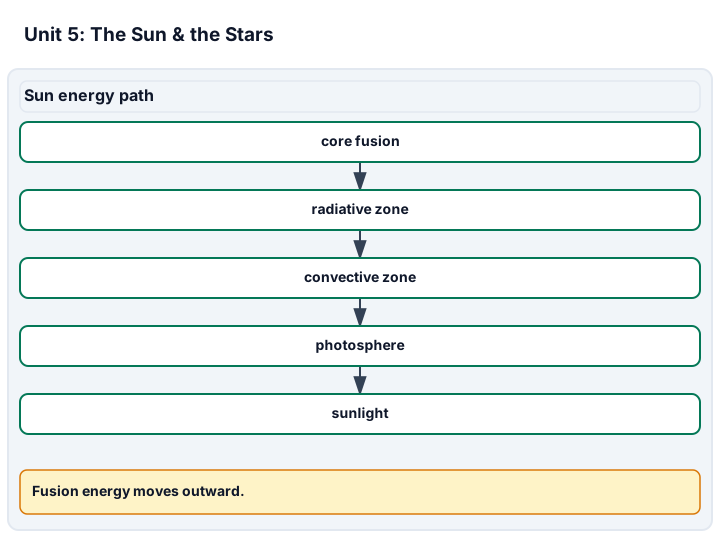
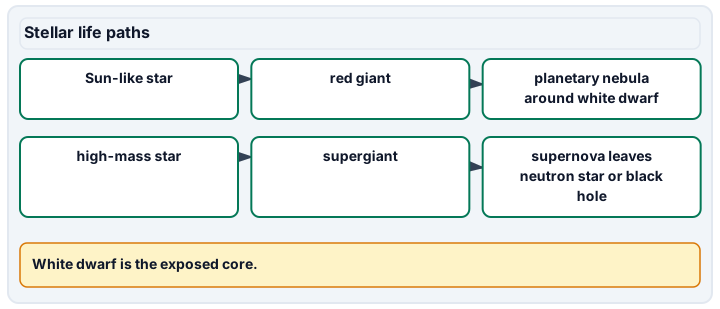
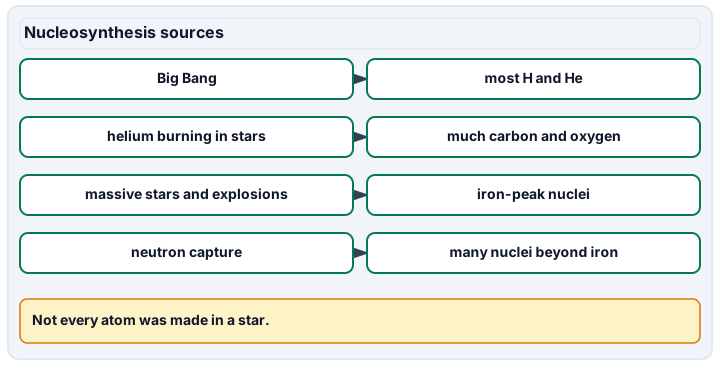
Diagram description
Solar energy moves from core fusion through radiative and convective zones to the photosphere and sunlight. A Sun-like star becomes a red giant; red-giant outer layers form a planetary nebula and the exposed core becomes a white dwarf. A high-mass star can become a supergiant, supernova, and neutron star or black hole. Element sources include the Big Bang, stellar burning, massive stars/explosions and neutron capture.
Data, provenance, and assumptions
| Star | Temperature (K) | Luminosity (Sun = 1) | Mass (Sun = 1) | Supplied stage |
|---|---|---|---|---|
| A | 5800 | 1 | 1 | Main sequence |
| B | 10000 | 16 | 2 | Main sequence |
| C | 3500 | 1000 | 1 | Giant |
| D | 11600 | 0.0016 | 0.6 | White dwarf |
| Object | Parallax (arcseconds) |
|---|---|
| Nearby A | 0.1 |
| Nearby B | 0.05 |
| Example material | Important production setting | Process to distinguish |
|---|---|---|
| Most primordial H and He | Early universe | Big Bang nucleosynthesis |
| Much carbon and oxygen | Evolved stars | Helium burning and later stellar processing |
| Iron-peak material | Massive-star and explosive environments | Advanced burning and explosive nucleosynthesis |
| Many nuclei beyond iron | Evolved stars and neutron-rich events | Slow or rapid neutron capture with radioactive decay |
Worked model
For main-sequence star B, the approximate lifetime is 10 times 2/16 = 1.25 Gyr, shorter than A's 10 Gyr despite B having more fuel. The giant and white dwarf are not valid inputs to this main-sequence lifetime rule. The white dwarf can be hot yet faint because its radiating area is small.
Numerical calibration
- 1.25 Gyr, main-sequence approximation
- 86.84 solar radii
- 0.01 solar radius
Attempt the assigned level
Try the tasks before reading the calibration. These are practice answers, not a secure examination; use a new dataset or changed assumption for the assessed transfer.
Foundation: typically grades 7-8
- Place A-D on an H-R sketch, with higher temperature to the left and greater luminosity upward.
- Trace the origin of a hydrogen nucleus and a carbon nucleus, then explain why gold is not simply the next ordinary fusion fuel after iron.
Check after your attempt
- A and B are on the supplied main sequence; C is cool/luminous, and D is hot/faint.
- Most primordial hydrogen predates stars. Much carbon is produced through stellar processing. Many heavy nuclei involve neutron capture; energy-releasing fusion does not continue indefinitely past iron.
High-school core: typically grades 9-10
- Calculate the approximate main-sequence lifetimes of A and B and explain why C/D are excluded. Calculate both parallax distances.
- Write a source-linked element-origin explanation distinguishing fusion, s-process, r-process, and dispersal into later planetary material.
Check after your attempt
- A: 10 Gyr; B: 1.25 Gyr. C/D are not in the hydrogen-burning main-sequence stage assumed by the formula. Nearby A is 10 pc; Nearby B is 20 pc.
- A valid explanation identifies evolved-star slow capture and rapid capture in neutron-rich events such as neutron-star mergers, and does not assign all heavy elements to one source.
Honors extension: typically grades 11-12
- Estimate the radii of C and D from the stated luminosity/temperature model.
- Explain why these calculations do not identify an exact age or measure the core composition. Distinguish the end of energy-releasing fusion from the impossibility of making heavier nuclei.
Check after your attempt
- C is about 86.84 solar radii; D is 0.0100 solar radius.
- Additional structure/evolution models are needed for age and interior inference. Heavier nuclei can form through other reactions; the energy balance, not a ban on nuclear reactions, limits stable fusion fuel.
History, reading, and writing connection
Compare the H-R evidence and the NASA/DOE explanations. Cite one observation, one physical model, and one limitation; explain how improved nuclear and astronomical evidence changes the element-origin story.
Write in your own words or use an approved accessible equivalent. Cite a specific assigned section or figure, identify its evidence, and state one limitation or counterargument. Use the AI practice contract only for permitted coaching, never to invent observations or write the assessed response.
Transfer to a new case
A hot object has low luminosity. Does that make it a short-lived massive main-sequence star?
Calibration: No. Temperature alone is insufficient; a small white dwarf can be hot and faint. Do not apply the main-sequence lifetime formula until the stage assumptions are justified.
Evidence to retain
Submit an H-R plot, selected calculations, and a sourced element-origin explanation. Mastery requires distinguishing primordial production, fusion, neutron capture, and dispersal, not just reciting stellar endpoints.
Record units, calculations, source/date, uncertainty, and what is measured versus inferred. A simulation or supplied dataset must stay labeled as such. No direct solar viewing or unsupervised practical procedure is required by these data tasks.
Return to all eight learning pathways. Print this unit page for the student lessons; the linked five-page packet remains the separate assessment companion.
Unit mastery rubric
| Criterion | Developing | Proficient | Mastery |
|---|---|---|---|
| The Sun's structure & fusion | Thinks the Sun burns like an ordinary fire. | Says fusion but cannot locate it or name the Sun's layers. | Describes the Sun's layers and explains its energy as hydrogen fusion in the core. |
| Stellar properties | Confuses temperature, luminosity, and mass. | Names properties but misuses the assigned model. | Relates temperature, luminosity, and mass; uses assigned lifetime or radius models only under their stated conditions. |
| The H–R diagram | Cannot place a star using the axes. | Identifies a region but treats it as an exact age. | Plots temperature and luminosity, interprets main-sequence/giant/remnant regions, and states what position alone cannot determine. |
| Stellar life cycles & element origins | Assumes all elements form by ordinary stellar fusion. | Names endpoints but confuses production processes. | Connects mass-dependent life cycles to primordial nuclei, fusion, neutron capture, and dispersal; explains the iron-peak energy limit. |
| Distance & safe solar observation | Cannot use the distance data or identify a safe observation route. | Uses one distance method but cannot explain the observation limits. | Uses supplied parallax and calibrated Cepheid data, and records sunspots from approved image datasets or a qualified, supervised solar session. |
| Integration (cross-domain) | Makes no supported connection between the source and the science. | Uses the source but needs help connecting evidence, writing, or limitations to the science. | Independently connects History, Reading, and Writing using a cited source, appropriate evidence, a limitation, and a scientific explanation. |
Integration is reported separately and cannot lower the science grade or block a science demonstration pass. Science and practical criteria determine that pass. Use the integration guide's evidence checklist for the separately reported criterion.
“The Sun's energy comes from fusion. I use temperature and luminosity on an H–R diagram to interpret a star's state, with mass affecting its life cycle. My distance calculation uses the supplied calibrated relation. My dated sunspot records come from an approved image dataset, not an unsupervised look at the Sun.”
“Stars are just balls of fire, and bigger ones are hotter, maybe? The Sun will explode someday. I’m not sure how you’d measure how far away a star is.”
Use stellar data and a dated solar-image record to explain the science. A supplied image dataset meets the solar-observation objective. Any live solar session requires a qualified operator and an approved, equipment-specific procedure; optical projection is not a default home activity. Never view the Sun through unfiltered optics.
A 5-page clipboard packet — unit overview, key terms, the mastery rubric, anchor examples, and a score sheet you can print and grade against.