Unit 06 · Galaxies & the Milky Way
Beyond the stars lie the galaxies, and this unit steps back to the largest structures we can see. It sorts galaxies into spirals, ellipticals, and irregulars from real images, maps the Milky Way's disk, bulge, and halo, and pins down where we live inside it — partway out a spiral arm. From there it takes on the evidence for dark matter, the unseen mass that makes galaxies spin faster than their visible stars can explain, and shows how galaxies gather into groups, clusters, and the vast cosmic web. Mastery means you can name what you see in an image or the eyepiece and defend the structure behind it.
Student learning: Use a rotation curve to test a mass-distribution model
Choose the level by readiness, not age alone, and record it before instruction. Foundation, core, and honors tasks are study pathways, not an AP course or a promise of college credit. The instructor retains practical assessment and the published science rubric; integration is reported separately.
Prerequisites: Unit 4 orbital reasoning; ratios, graphs, and square roots for core/honors work.
Suggested sequence: read and discuss the explanation; attempt the worked model; analyze the data at your selected level; check the answers; then complete the source-linked response and a fresh transfer question. These activities supplement, not replace, supervised practical work and the full-year schedule.
Assigned reading and focus
- OpenStax Astronomy 2e, 25.3: The Mass of the Galaxy. Read Kepler Helps Weigh the Galaxy and A Galaxy of Mostly Invisible Matter. Identify the simplifying geometry and what a rotation curve actually constrains.
- NASA Science: Galaxies. Read Our Milky Way and inspect the linked galaxy images/types. Distinguish the Milky Way from Andromeda and bound groups/clusters from the broader cosmic web.
Learn the science
The Milky Way contains a disk, central bulge, and extended halo. We live in its disk, not in Andromeda. Images show spirals, ellipticals, and irregular systems, but viewing angle and image quality can complicate classification.
For a circular orbit in a spherical mass model, enclosed mass is M(r) = r times v squared / G. This is a simplifying approximation, not an exact description of every disk galaxy.
If almost all mass is inside the innermost measured radius, speed should decrease roughly as 1/square root of r farther out. A flat speed curve instead implies increasing enclosed mass under the adopted dynamics.
Compare the inferred total mass with independent estimates of stars and gas before arguing for unseen mass. A rotation curve alone does not identify a dark-matter particle. Inclination, measurement uncertainties, baryonic matter, and model assumptions still matter.

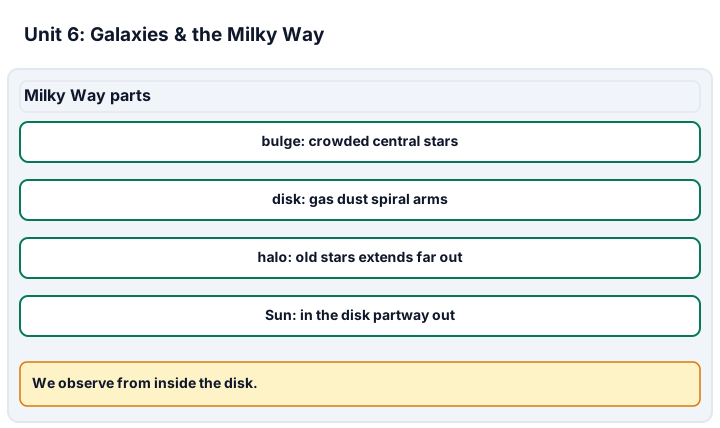
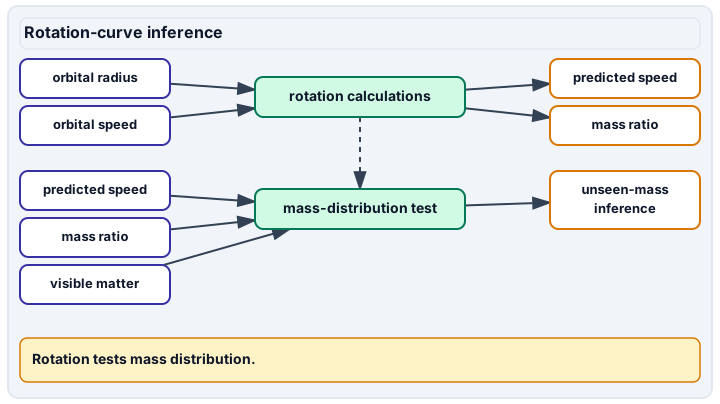
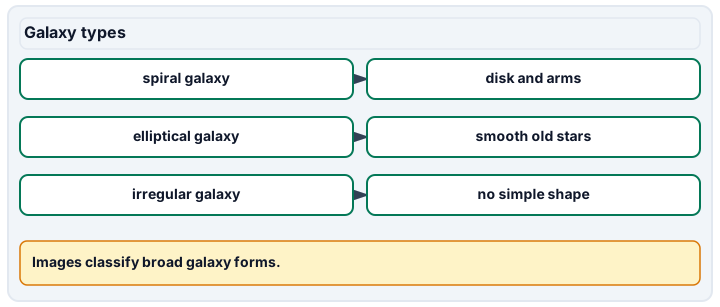
Diagram description
The Milky Way grid lists the crowded central bulge, the disk with gas, dust and spiral arms, the far-reaching halo of old stars, and the Sun's place in the disk partway out. The rotation panel uses radius and speed to compute predicted speed and mass ratio, then compares with visible matter for unseen-mass inference. The galaxy-type grid gives broad visual categories.
Data, provenance, and assumptions
| Radius (kpc) | Observed circular speed (km/s) | Speed uncertainty (km/s) |
|---|---|---|
| 5 | 200 | 10 |
| 10 | 200 | 10 |
| 15 | 200 | 10 |
Worked model
If the enclosed mass stopped increasing after 5 kpc, the predicted speed at 15 kpc would be 200 times square root of (5/15), or 115.47 km/s. The supplied curve remains at 200 km/s. Under the adopted model, enclosed mass at 15 kpc is three times the mass at 5 kpc.
Numerical calibration
- 115.47 km/s
- 3 dimensionless
Attempt the assigned level
Try the tasks before reading the calibration. These are practice answers, not a secure examination; use a new dataset or changed assumption for the assessed transfer.
Foundation: typically grades 7-8
- Graph the three speeds with units and describe the observed trend.
- Explain why a dark-looking image is not the scientific meaning of dark matter.
Check after your attempt
- The curve is flat at 200 km/s over the supplied radii.
- Dark matter is inferred from gravitational evidence and other observations, not simply from a visually dark patch.
High-school core: typically grades 9-10
- Predict the 15 kpc speed for the fixed-enclosed-mass model.
- Calculate the ratio M(15)/M(5), showing which constants cancel.
Check after your attempt
- About 115.47 km/s for the fixed-mass prediction.
- The ratio is (15 times 200 squared)/(5 times 200 squared) = 3. G cancels.
Honors extension: typically grades 11-12
- Use a 190-210 km/s range at 15 kpc and 200 km/s at 5 kpc to bound the mass ratio.
- State why a model discrepancy is not yet a laboratory identification of the unseen material.
Check after your attempt
- The ratio ranges from 3 times (190/200) squared = 2.7075 to 3 times (210/200) squared = 3.3075.
- The calculation constrains mass under assumptions. The nature of the material requires independent physical evidence and further tests.
History, reading, and writing connection
Cite the assigned rotation-curve discussion and explain which earlier mass assumption the evidence challenged. Separate the plotted measurements, gravitational model, and inference.
Write in your own words or use an approved accessible equivalent. Cite a specific assigned section or figure, identify its evidence, and state one limitation or counterargument. Use the AI practice contract only for permitted coaching, never to invent observations or write the assessed response.
Transfer to a new case
The measured speed falls as 1/square root of radius. Does this prove no unseen matter exists anywhere?
Calibration: No. It is compatible with nearly constant enclosed mass over that range; it does not identify the material or establish the mass distribution everywhere.
Evidence to retain
Submit a rotation plot, selected model calculations, and a qualified mass-distribution argument. Use supplied images/data for analysis; do not present them as personal telescope observations.
Record units, calculations, source/date, uncertainty, and what is measured versus inferred. A simulation or supplied dataset must stay labeled as such. No direct solar viewing or unsupervised practical procedure is required by these data tasks.
Return to all eight learning pathways. Print this unit page for the student lessons; the linked five-page packet remains the separate assessment companion.
Unit mastery rubric
| Criterion | Developing | Proficient | Mastery |
|---|---|---|---|
| Classifying galaxies | Cannot tell galaxy types apart. | Names the types but misclassifies them from images. | Classifies galaxies as spiral, elliptical, or irregular from real images. |
| The Milky Way & our place in it | Pictures the Milky Way as random scattered stars. | Names the disk but cannot locate us within it. | Describes the Milky Way's disk, bulge, and halo and places us partway out a spiral arm. |
| Evidence for dark matter | Confuses unseen mass with a dark image. | Names a curve without evaluating its model. | Compares a rotation curve with a mass model and states the evidence and limitations of the unseen-mass inference. |
| How galaxies cluster | Thinks galaxies are spread evenly through space. | Names structures but treats all as gravitationally bound. | Distinguishes bound groups and clusters from the larger cosmic web and explains where the Local Group fits. |
| Observation technique & the journal | Cannot find a deep-sky object and leaves the journal blank. | Finds the Milky Way band but keeps thin, undated notes. | Locates the Milky Way and a bright galaxy such as Andromeda with binoculars or telescope under a red flashlight and logs dated sketches. |
| Integration (cross-domain) | Makes no supported connection between the source and the science. | Uses the source but needs help connecting evidence, writing, or limitations to the science. | Independently connects History, Reading, and Writing using a cited source, appropriate evidence, a limitation, and a scientific explanation. |
Integration is reported separately and cannot lower the science grade or block a science demonstration pass. Science and practical criteria determine that pass. Use the integration guide's evidence checklist for the separately reported criterion.
“Andromeda is a neighboring galaxy; we live in the Milky Way's disk. Under the stated gravitational model, the flat rotation curve requires increasing enclosed mass. Comparing that mass with stars and gas supports an unseen-mass inference, but the curve does not identify a particle.”
“The Milky Way is just the stars around us. Galaxies are groups of stars somewhere out there. Dark matter is space being dark, I guess.”
You demonstrate this unit by classifying galaxies from images, locating the Milky Way and a bright galaxy in the real sky, and explaining the evidence for dark matter aloud — not a multiple-choice test. A criterion counts as mastered only when you can both name what you see and defend the structure behind it. Mastery is demonstrated, not awarded.
A 5-page clipboard packet — unit overview, key terms, the mastery rubric, anchor examples, and a score sheet you can print and grade against.