Unit 07 · Cosmology & the Big Bang
This unit asks the biggest question there is: where did all of it come from? It starts with Hubble's law — every distant galaxy racing away, faster the farther it lies — and the correction it forces: the Big Bang was not an explosion in space but the expansion of space itself, with no center and no edge. From there it builds the case with the cosmic microwave background, the cooled afterglow that evidences a hot, dense beginning, uses the expansion rate to estimate the universe's age, and confronts dark energy and the possible fates it implies. Mastery means you can replace the “cosmic bomb” cartoon with the honest, evidence-backed picture of an expanding universe.
Student learning: Build a calibrated distance estimate and an expansion model
Choose the level by readiness, not age alone, and record it before instruction. Foundation, core, and honors tasks are study pathways, not an AP course or a promise of college credit. The instructor retains practical assessment and the published science rubric; integration is reported separately.
Prerequisites: Inverse-square reasoning, graphs, scientific notation; core/honors work adds logarithms and unit conversion.
Suggested sequence: read and discuss the explanation; attempt the worked model; analyze the data at your selected level; check the answers; then complete the source-linked response and a fresh transfer question. These activities supplement, not replace, supervised practical work and the full-year schedule.
Assigned reading and focus
- OpenStax Astronomy 2e, 19.3: Variable Stars. Read Cepheid Variables and the distance discussion. Identify why period needs a calibrated luminosity relationship and an apparent-brightness measurement.
- OpenStax Astronomy 2e, 29.2: A Model of the Universe. Read The Expanding Universe. Distinguish expanding large-scale distances from an explosion with a special center, and from stretching every bound object.
Learn the science
A standard candle needs a calibrated intrinsic luminosity. For this exercise only, use absolute magnitude M = -2.76 log10(P in days) - 1.40. Actual calibrations depend on wavelength band, population, and other corrections.
With no extinction in the teaching model, distance modulus m - M = 5 log10(d in parsecs) - 5. Knowing the period alone is not enough: apparent magnitude and the calibration are also required.
Use v = H0 times d as a low-redshift classroom approximation for large-scale expansion. Nearby peculiar velocities and gravitationally bound systems do not all obey a simple recession rule.
The hot Big Bang interpretation combines expansion with independent evidence, including the cosmic microwave background and light-element abundances. One fitted straight line is not the whole case.
The reciprocal 1/H0 is an expansion timescale, not an exact age. The actual history depends on matter, radiation, dark energy, and how the expansion rate changed. Use 1 Mpc = 3.086e19 km and 1 Gyr = 3.156e16 seconds here.

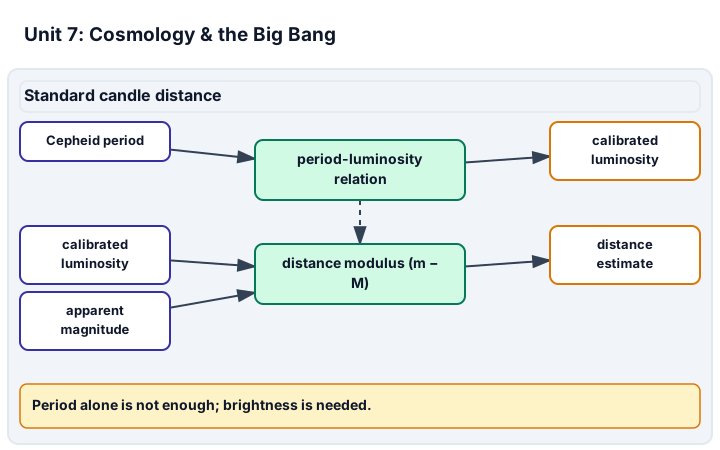
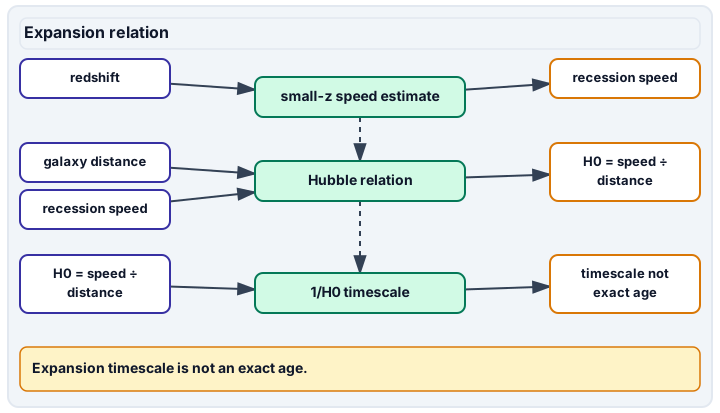
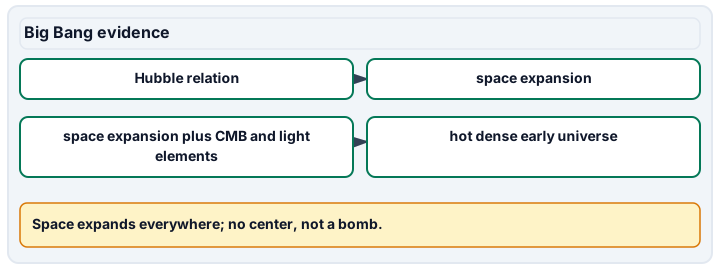
Diagram description
Cepheid period calibrates luminosity, which combines with apparent magnitude through distance modulus to estimate distance. Redshift gives small-z recession speed, and speed plus distance gives H0 and a timescale that is not an exact age. The Hubble relation shows space expanding everywhere; running that expansion backward, with the cosmic microwave background and light-element abundances, supports a hot dense early universe.
Data, provenance, and assumptions
| Object | Period (days) | Calibrated M | Apparent m |
|---|---|---|---|
| Cepheid A | 10 | -4.16 | 20.84 |
| Distance (Mpc) | Recession speed (km/s) |
|---|---|
| 20 | 1400 |
| 40 | 2800 |
| 60 | 4200 |
Worked model
The Cepheid has m - M = 25.00, so d = 10 to the power ((25 + 5)/5) = 1,000,000 parsecs. The synthetic expansion slope is 1,400/20 = 70 km/s/Mpc. Keep parsecs and megaparsecs distinct.
Numerical calibration
- 1000000 parsecs
- 70 km/s/Mpc
- 13.97 Gyr, expansion timescale only
Attempt the assigned level
Try the tasks before reading the calibration. These are practice answers, not a secure examination; use a new dataset or changed assumption for the assessed transfer.
Foundation: typically grades 7-8
- Describe the trend in the expansion table and predict the model speed at 80 Mpc.
- Explain why equal apparent brightness does not imply equal distance for stars with different luminosities.
Check after your attempt
- Speed increases linearly in the model; the prediction is 5,600 km/s.
- Distance inference needs intrinsic luminosity or an appropriate standard-candle calibration.
High-school core: typically grades 9-10
- Calculate the Cepheid distance and the Hubble slope, with units.
- Explain why these synthetic values are neither a new measurement of H0 nor proof of the entire cosmological model.
Check after your attempt
- Distance is 1,000,000 pc, or 1 Mpc; H0 is 70 km/s/Mpc for this table.
- The values were constructed for practice. Real inference needs calibrated observations, uncertainty, and independent evidence.
Honors extension: typically grades 11-12
- Convert the reciprocal H0 into Gyr.
- If uncorrected dust makes the Cepheid 0.5 magnitude fainter, find the factor by which the inferred distance is too large.
Check after your attempt
- The timescale is about 13.97 Gyr, not an exact age of the universe.
- The factor is 10 to the power (0.5/5), about 1.259: an overestimate of about 26%.
History, reading, and writing connection
Use the variable-star reading to trace the chain from Leavitt's relationship through later calibration to distance. Cite which link is an observation and which is a model assumption.
Write in your own words or use an approved accessible equivalent. Cite a specific assigned section or figure, identify its evidence, and state one limitation or counterargument. Use the AI practice contract only for permitted coaching, never to invent observations or write the assessed response.
Transfer to a new case
A galaxy in a bound nearby group approaches us. Does one blueshift falsify cosmic expansion?
Calibration: No. Local motion can dominate in bound systems; the large-scale expansion model is not a claim that every nearby object recedes.
Evidence to retain
Submit a distance calculation, expansion graph, selected uncertainty analysis, and a source-linked explanation that distinguishes a model timescale from an exact cosmic age.
Record units, calculations, source/date, uncertainty, and what is measured versus inferred. A simulation or supplied dataset must stay labeled as such. No direct solar viewing or unsupervised practical procedure is required by these data tasks.
Return to all eight learning pathways. Print this unit page for the student lessons; the linked five-page packet remains the separate assessment companion.
Unit mastery rubric
| Criterion | Developing | Proficient | Mastery |
|---|---|---|---|
| Hubble's law & expanding space | Cannot interpret the expansion data. | States a trend without units or conditions. | Uses the assigned calibrated-distance and low-redshift models, with units, and distinguishes large-scale expansion from local bound motion. |
| Correcting the “explosion” picture | Pictures the Big Bang as a bomb going off at one point. | Senses the picture is wrong but cannot say why. | Corrects the misconception — the Big Bang was the expansion of space everywhere, not an explosion into pre-existing space. |
| The cosmic microwave background | Knows no evidence for the Big Bang. | Names the CMB but not what it shows. | Explains the cosmic microwave background as the cooled afterglow that evidences a hot, dense early universe. |
| Age of the universe & its fate | Cannot distinguish an age from a rate. | Treats inverse H0 as an exact age. | Interprets an expansion timescale and explains how cosmic history and dark energy affect age and future evolution. |
| Modeling cosmic expansion | Requires a special explosion center. | Uses an analogy without identifying its limits. | Uses an expansion model to compare separations and explains its limits, including why bound objects do not simply expand with it. |
| Integration (cross-domain) | Makes no supported connection between the source and the science. | Uses the source but needs help connecting evidence, writing, or limitations to the science. | Independently connects History, Reading, and Writing using a cited source, appropriate evidence, a limitation, and a scientific explanation. |
Integration is reported separately and cannot lower the science grade or block a science demonstration pass. Science and practical criteria determine that pass. Use the integration guide's evidence checklist for the separately reported criterion.
“The supplied large-scale data fit a distance-speed relation. Local bound systems can behave differently. The CMB and light-element evidence also support a hot early universe. Inverse H0 is a timescale, not an exact age without a model of how expansion changed.”
“The Big Bang was a huge explosion that shot everything out from one spot. The universe is really old. I’ve heard of background radiation but not what it means.”
You demonstrate this unit by modeling cosmic expansion by hand and reasoning from the cosmic microwave background aloud — not a multiple-choice test. A criterion counts as mastered only when you can correct the “explosion in space” picture and defend the evidence for an expanding universe. Mastery is demonstrated, not awarded.
A 5-page clipboard packet — unit overview, key terms, the mastery rubric, anchor examples, and a score sheet you can print and grade against.