Unit 08 · Space Exploration & Life in the Universe
The year closes by looking outward and asking whether we are alone. This unit covers how we actually reach and explore space — rockets, the sideways-fast logic of orbital mechanics, robotic probes, and space telescopes — alongside the honest limits of human spaceflight: no crew has ever left the solar system, and no human has been to another star. It shows how astronomers detect exoplanets from the tiny dip of a transit light curve, why the habitable zone matters, and what a biosignature would and would not prove. Mastery means you can explain how space exploration truly works and give a clear-eyed account of what the search for life has — and has not — found.
Student learning: Read a transit and plan the next discriminating observation
Choose the level by readiness, not age alone, and record it before instruction. Foundation, core, and honors tasks are study pathways, not an AP course or a promise of college credit. The instructor retains practical assessment and the published science rubric; integration is reported separately.
Prerequisites: Fractions, percentages, repeating intervals; core/honors work uses square roots and the orbital model from Unit 4.
Suggested sequence: read and discuss the explanation; attempt the worked model; analyze the data at your selected level; check the answers; then complete the source-linked response and a fresh transfer question. These activities supplement, not replace, supervised practical work and the full-year schedule.
Assigned reading and focus
- NASA: How We Find and Characterize Exoplanets. Read the descriptions of transit detection and transit spectroscopy. Separate planet detection, orbital/radius estimates, atmosphere characterization, and evidence for life; changing mission counts are not learning targets.
- OpenStax Astronomy 2e, 21.4: Planets beyond the Solar System. Read the transit and stellar-wobble methods. Explain what different measurements can constrain; do not treat older discovery counts as current statistics.
- SETI Institute: The Drake Equation. Read the factor definitions and uncertainty discussion. Explain why the product contains a rate and a lifetime as well as fractions and counts.
Learn the science
A transit is a decrease in observed stellar flux when a body crosses the star's disk. A repeated dip is a candidate signal; an eclipsing binary, another blended source, stellar activity, or instrumental problems can create false positives.
For a small opaque planet crossing a uniformly bright star without contaminating light, depth is approximately (planet radius / star radius) squared. Limb darkening, geometry, blending, and star-radius uncertainty complicate real measurements.
This dataset uses a one-solar-radius, one-solar-mass host and observed midpoints at days 2, 12, and 22. Use 1 solar radius = 109 Earth radii and 1 year = 365.25 days for the teaching calculations.
A radius estimate is not a mass, surface-temperature, habitability, or life measurement. Even a possible atmospheric biosignature needs context and competing nonbiological explanations. This light curve is not evidence of life.
Mission design combines scientific value with limits on power, communication, time, and measurement precision. An informative follow-up is one that distinguishes plausible explanations, not merely repeats an attractive claim.
The Drake equation is a framework for assumptions, not a measured probability of aliens. In the supplied example, multiply star-formation rate, planet fraction, suitable-planet count, three biological/technological fractions, and transmitting lifetime. The rate and lifetime cancel units to give an expected count.

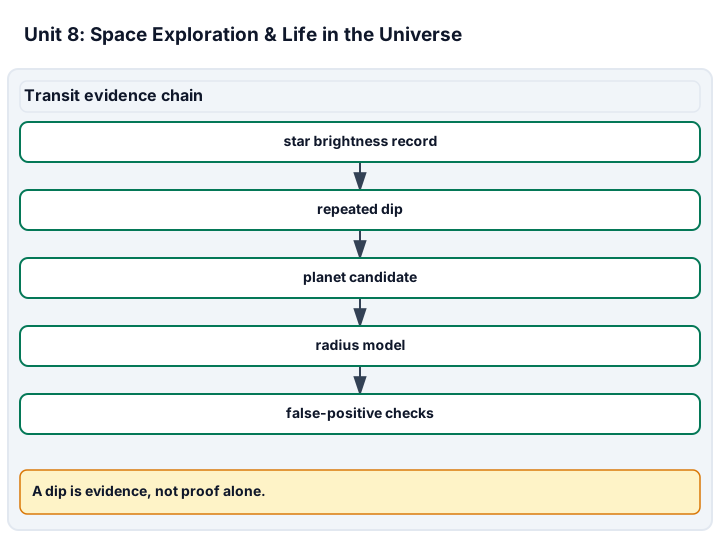
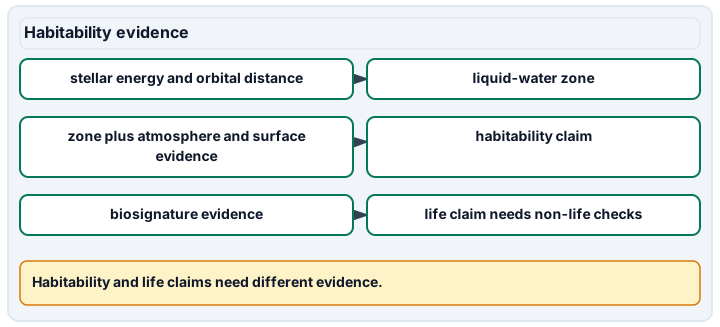
Diagram description
Transit evidence begins with a star brightness record and repeated dip supporting a planet candidate, radius model and false-positive checks; depth and radius are computed from inputs. Habitability reasoning uses stellar energy and orbital distance to define a liquid-water zone, then adds atmosphere and surface evidence for a habitability claim; biosignature evidence feeds only a separate life claim that still needs non-life explanations ruled out.
Data, provenance, and assumptions
| Time from midpoint (hours) | Normalized flux |
|---|---|
| -3 | 1 |
| -2 | 1 |
| -1 | 0.99 |
| 0 | 0.99 |
| 1 | 0.99 |
| 2 | 1 |
| 3 | 1 |
| Factor | Value | Unit or interpretation |
|---|---|---|
| Star formation | 2 | stars/year |
| Planet fraction | 0.5 | fraction |
| Suitable planets | 1 | planets per planetary system |
| Life fraction | 0.5 | fraction |
| Intelligence fraction | 0.1 | fraction |
| Transmitting fraction | 0.1 | fraction |
| Transmitting lifetime | 10000 | years |
Worked model
The baseline is 1.00 and the minimum is 0.99, so the fractional depth is 0.0100, or 1%. The radius ratio is square root of 0.0100 = 0.100. With the supplied host radius, that is 10.9 Earth radii. The repeated midpoints give a 10-day period.
Numerical calibration
- 0.01 fraction of baseline flux
- 0.1 planet/star radius
- 10.9 Earth radii for the assumed host
- 0.0908 AU
- 50 expected transmitting systems under arbitrary inputs
Attempt the assigned level
Try the tasks before reading the calibration. These are practice answers, not a secure examination; use a new dataset or changed assumption for the assessed transfer.
Foundation: typically grades 7-8
- Plot flux against time and calculate the percentage drop.
- Use days 2, 12, and 22 to find the repeat interval and name one nonplanet explanation worth checking.
Check after your attempt
- The drop is 1%.
- The period is 10 days. An eclipsing binary, blending, stellar variability, or an instrument artifact is a possible alternative.
High-school core: typically grades 9-10
- Calculate the radius ratio and planet radius in Earth radii using the supplied star size.
- Explain why changing the assumed stellar radius changes the planet-radius estimate.
Check after your attempt
- Radius ratio: 0.100; radius: 10.9 Earth radii.
- The inferred planet radius is proportional to the assumed star radius for the same depth.
Honors extension: typically grades 11-12
- Estimate semimajor axis from the 10-day period around one solar mass.
- A follow-up instrument uses 40 W and a radio uses 50 W, but available power is 80 W. Propose a feasible operating schedule and one observation that would help reject a false positive.
- Multiply the synthetic Drake factors and double only the transmitting lifetime. State what the calculation means and does not mean.
Check after your attempt
- P = 10/365.25 years, so a is about 0.0908 AU under the negligible-planet-mass model.
- Simultaneous use would exceed the limit at 90 W. Time-sharing is one feasible solution; justify an independent check such as resolved imaging or a radial-velocity measurement, with its limitations.
- The assumed count is 50, increasing to 100 when lifetime doubles. This is sensitivity to arbitrary assumptions, not a detection or a measured probability.
History, reading, and writing connection
Cite the NASA method explanation and argue for the next measurement within the stated resource constraint. Distinguish a detection candidate, a characterized planet, and a claim of life.
Write in your own words or use an approved accessible equivalent. Cite a specific assigned section or figure, identify its evidence, and state one limitation or counterargument. Use the AI practice contract only for permitted coaching, never to invent observations or write the assessed response.
Transfer to a new case
A different dip has depth 0.0025 around the same star. Is the radius half, a quarter, or unchanged?
Calibration: The radius ratio is 0.05, half the previous value, because depth scales with the square of the radius ratio.
Evidence to retain
Submit the light curve, selected calculations, a false-positive analysis, and a justified follow-up plan. Identify the synthetic data and do not claim a discovery or life detection.
Record units, calculations, source/date, uncertainty, and what is measured versus inferred. A simulation or supplied dataset must stay labeled as such. No direct solar viewing or unsupervised practical procedure is required by these data tasks.
Return to all eight learning pathways. Print this unit page for the student lessons; the linked five-page packet remains the separate assessment companion.
Unit mastery rubric
| Criterion | Developing | Proficient | Mastery |
|---|---|---|---|
| Reaching & exploring space | Thinks reaching orbit is simply going straight up. | Names rockets but not the orbital motion that keeps a craft up. | Explains how rockets and orbital mechanics reach space and how robotic probes and space telescopes explore it. |
| Human spaceflight & its honest limits | Believes humans have traveled to other stars. | Knows about astronauts but overstates how far crews have gone. | Describes human spaceflight accurately — no crew has left the solar system, and interstellar travel remains out of reach. |
| Exoplanet detection | Cannot interpret a light-curve dip. | Calculates a dip but assumes it proves a planet. | Interprets a transit candidate, estimates size using the assigned stellar model, and identifies false positives and useful follow-up evidence. |
| Habitable zone & biosignatures | Thinks any planet could host life. | Names the habitable zone but not what makes it habitable. | Explains the habitable zone and what biosignatures would — and would not — count as evidence for life. |
| Working from real data & the journal | Accepts sensational claims and leaves the journal blank. | Browses images but keeps thin, undated notes. | Pulls real data from public image and light-curve archives, logs dated exoplanet or sky observations, and reasons from evidence. |
| Integration (cross-domain) | Makes no supported connection between the source and the science. | Uses the source but needs help connecting evidence, writing, or limitations to the science. | Independently connects History, Reading, and Writing using a cited source, appropriate evidence, a limitation, and a scientific explanation. |
Integration is reported separately and cannot lower the science grade or block a science demonstration pass. Science and practical criteria determine that pass. Use the integration guide's evidence checklist for the separately reported criterion.
“We reach orbit by going sideways fast enough to keep falling around Earth, and probes and space telescopes do the far exploring — but no crew has ever left the solar system, and no human has been to another star. We find exoplanets by the tiny dip when one crosses its star, and we hunt for life in the habitable zone by looking for biosignatures we haven’t confirmed yet.”
“Humans have traveled to other stars and probably met aliens by now. Rockets just fly up into space. We’ve definitely found life on other planets.”
You demonstrate this unit by reading real transit light curves from public archives and reasoning about the search for life aloud — not a multiple-choice test. A criterion counts as mastered only when you can explain how we actually reach and study space and give an honest account of what we have and haven't found. Mastery is demonstrated, not awarded.
A 5-page clipboard packet — unit overview, key terms, the mastery rubric, anchor examples, and a score sheet you can print and grade against.