Unit 03 · Cellular Energetics
Use the cellular energetics learning pathway for original readings, models, supplied data, checked practice and fresh transfer. The five science criteria stay distinct from integration; a paper/data alternative does not certify an unobserved technique.
Student learning: Cellular Energetics
Choose the level by readiness, not age alone, and record it before instruction. Foundation, core, and honors tasks are study pathways, not an AP course or a promise of college credit. The instructor retains practical assessment and the published science rubric; integration is reported separately.
Prerequisites: Molecules and membranes, atom balance, signed change/time and independent replicates. Honors distinguishes variability and conditional gross-rate estimates.
Suggested sequence: read and discuss the explanation; attempt the worked model; analyze the data at your selected level; check the answers; then complete the source-linked response and a fresh transfer question. These activities supplement, not replace, supervised practical work and the full-year schedule.
Assigned reading and focus
- OpenStax Biology 2e (2018), 6.2 Potential, Kinetic, Free, and Activation Energy. [energy-coupling] Distinguish reaction free-energy change from activation energy and rate.
- OpenStax Biology 2e (2018), 6.4 ATP: Adenosine Triphosphate. [energy-coupling] Read energy coupling, including phosphate transfer to an intermediate.
- OpenStax Biology 2e (2018), 7.2 Glycolysis. [energy-coupling] Track one glucose into two three-carbon pyruvates and locate glycolysis in the cytosol.
- OpenStax Biology 2e (2018), 7.3 Oxidation of Pyruvate and the Citric Acid Cycle. [energy-coupling] Track carbon release during pyruvate oxidation and two turns of the cycle.
- OpenStax Biology 2e (2018), 7.4 Oxidative Phosphorylation. [energy-coupling] Identify the inner mitochondrial membrane, proton gradient, ATP synthase and oxygen’s role as terminal electron acceptor.
- OpenStax Biology 2e (2018), 7.5 Metabolism without Oxygen. [energy-coupling] Explain how fermentation regenerates NAD+ so glycolysis can continue; it is not an oxygen-producing pathway.
- OpenStax Biology 2e (2018), 8.2 The Light-Dependent Reactions of Photosynthesis. [photosynthesis-budget] Trace water splitting, electron transfer, the thylakoid proton gradient, ATP and NADPH; identify the source of released O₂.
- OpenStax Biology 2e (2018), 8.3 Using Light Energy to Make Organic Molecules. [photosynthesis-budget] Trace CO₂ fixation in the stroma and distinguish carbon fixation from the light reactions.
- NobelPrize.org: The Nobel Prize in Chemistry 1961. [photosynthesis-budget] Read the 1961 citation for Melvin Calvin’s carbon-dioxide assimilation research. Connect that historical question to the carbon-fixation model; the oxygen table below is not Calvin’s dataset.
- OpenStax Biology 2e (2018), 7.2 Glycolysis. [conserved-metabolism] Read glycolysis location, investment and payoff. Compare the conserved pathway with independent sequence/structure evidence rather than deriving ancestry from arithmetic alone.
- OpenStax Biology 2e (2018), 20.2 Determining Evolutionary Relationships. [conserved-metabolism] Read molecular comparisons and homologous characters; shared function is not by itself a complete phylogenetic argument.
Learn the science
[energy-coupling] A positive ΔG process can proceed when coupled through shared intermediates to a sufficiently negative ΔG process. Adding unrelated equations is not a cellular coupling mechanism. Breaking a bond alone requires energy; ATP hydrolysis is favorable because of the overall balance of bond changes and product stabilization under the stated conditions.
[energy-coupling] In a eukaryotic cell, glycolysis is cytosolic. Pyruvate oxidation and the citric acid cycle occur in the mitochondrial matrix; electron transport and ATP synthase use the inner membrane. Carbons, electron carriers and protons have different roles. Oxygen accepts electrons at the end of aerobic electron transport and is reduced to water.
[energy-coupling] For one six-carbon glucose, glycolysis produces two three-carbon pyruvates; conversion to two acetyl groups releases two CO₂, and the two cycle turns release four CO₂. This is a net carbon ledger, not a claim that every carbon exits at the first possible step. ATP yield varies with conditions, shuttles and proton leakage.
[energy-coupling] Fermentation regenerates NAD+ without the respiratory electron-transport chain, allowing glycolysis to make ATP by substrate-level phosphorylation. Matter cycles while energy flows through reactions and is ultimately dissipated as heat; respiration does not turn matter into energy without a material ledger.
[photosynthesis-budget] In chloroplasts, light reactions on thylakoid membranes use light energy, split water and generate oxygen, ATP and NADPH. Oxygen released by photosynthesis comes from water, not directly from CO₂. The Calvin cycle in the stroma uses CO₂, ATP and reducing power to build organic carbon; “light-independent” does not mean it operates indefinitely without light-reaction products.
[photosynthesis-budget] A light chamber’s oxygen change is net production after respiration, not gross photosynthesis. A dark chamber estimates oxygen consumption without light-driven production. Adding the magnitude of that consumption to the net light rate estimates gross production only if the same respiration rate applies in light and dark and other oxygen exchanges are negligible.
[photosynthesis-budget] Each synthetic chamber below is sealed in the model and independently assigned. Gas exchange with air, differing plant mass, temperature change, sensor drift and oxygen use by other organisms would threaten the estimate. Do not use a repeated sensor reading as a new organism replicate.
[conserved-metabolism] Representative bacterial, fungal, plant and animal cells use the familiar cytosolic glycolytic pathway. Widespread biochemical and sequence similarities support an ancient origin, but variants and alternative pathways mean that no single summary applies to every organism.
[conserved-metabolism] The net ATP balance in this reference model is four produced minus two invested per glucose. Two three-carbon pyruvates retain six carbons. Net yield is different from gross production and is not the full aerobic respiration yield.
[conserved-metabolism] Conserved metabolism can be considered with homologous enzyme sequences, gene relationships and other evidence. Four identical rows copied from a pathway reference are not four independent ancestral experiments and do not identify the first organism or a divergence date.

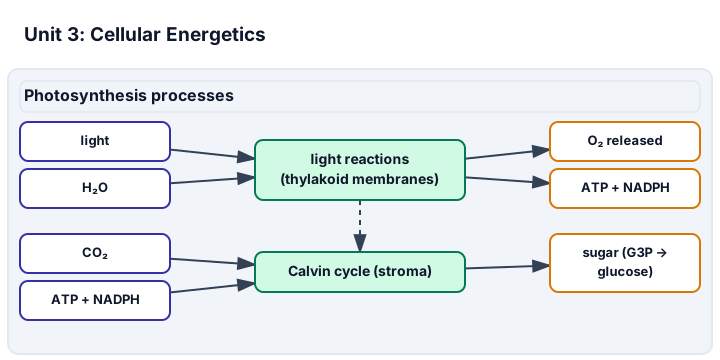
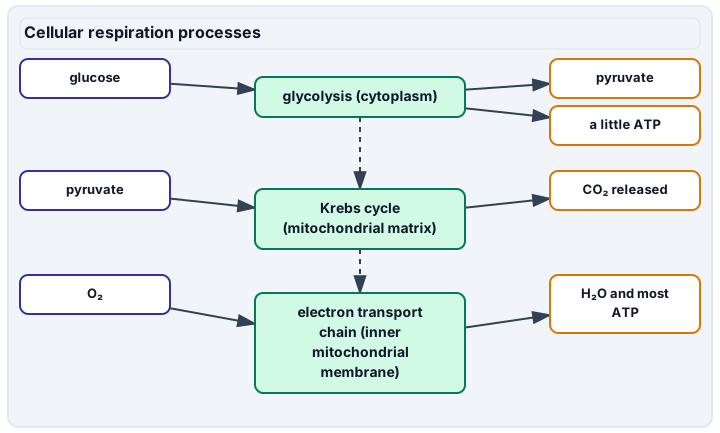
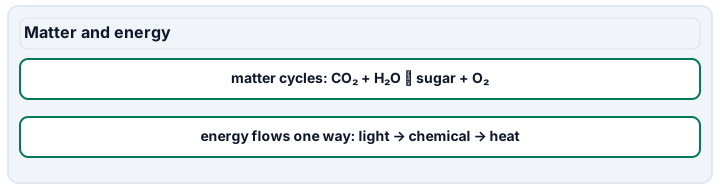
Diagram description
Unit 3: Cellular Energetics. Photosynthesis processes: light reactions (thylakoid membranes) takes inputs light, H₂O and outputs O₂ released, ATP + NADPH. Calvin cycle (stroma) takes inputs CO₂, ATP + NADPH and outputs sugar (G3P → glucose). Cellular respiration processes: glycolysis (cytoplasm) takes inputs glucose and outputs pyruvate, a little ATP. Krebs cycle (mitochondrial matrix) takes inputs pyruvate and outputs CO₂ released. electron transport chain (inner mitochondrial membrane) takes inputs O₂ and outputs H₂O and most ATP. Matter and energy: matter cycles: CO₂ + H₂O ⇄ sugar + O₂. energy flows one way: light → chemical → heat.
Data, provenance, and assumptions
| Unfavorable step ΔG | Coupled ATP hydrolysis ΔG |
|---|---|
| 5 | -30 |
| Stage output | Number | Carbons per molecule |
|---|---|---|
| Pyruvate after glycolysis | 2 | 3 |
| CO₂ from pyruvate oxidation | 2 | 1 |
| Acetyl groups entering cycle | 2 | 2 |
| CO₂ across two cycle turns | 4 | 1 |
| Treatment | Initial O₂ | Final chamber 1 | Final chamber 2 | Final chamber 3 |
|---|---|---|---|---|
| Light | 8 | 10 | 10.2 | 9.8 |
| Dark | 8 | 7.5 | 7.6 | 7.4 |
| Representative cell | Location | ATP invested | ATP produced | Pyruvate produced |
|---|---|---|---|---|
| Bacterial reference cell | Cytosol | 2 | 4 | 2 |
| Yeast reference cell | Cytosol | 2 | 4 | 2 |
| Leaf reference cell | Cytosol | 2 | 4 | 2 |
| Animal reference cell | Cytosol | 2 | 4 | 2 |
Worked model
[energy-coupling] The modeled coupled ΔG is +5 + (−30) = −25 kJ/mol. That favorable net value does not set the rate; enzymes and reactant availability still matter. Complete oxidation releases 2 + 4 = 6 carbons as CO₂ per glucose while oxygen reduction and ATP production follow linked but distinct electron/proton pathways. [photosynthesis-budget] Mean light change is +2 mg/L in 10 minutes, so net production is 0.2 mg/(L·min). Dark consumption is 0.5/10 = 0.05 mg/(L·min). Estimated gross production is 0.25 mg/(L·min) under the equal-respiration assumption. Show separate chamber rates: light 0.20, 0.22, 0.18; dark −0.05, −0.04, −0.06. [conserved-metabolism] Each representative model has net 4 - 2 = 2 ATP and two pyruvates containing 2 times 3 = 6 carbons. The repeated bookkeeping illustrates conservation; it is not a statistical test of common ancestry or a record of four newly performed experiments.
Numerical calibration
- -25 kJ/mol at the supplied condition
- 0.2 mg O₂/(L·min)
- 0.25 mg O₂/(L·min), conditional gross estimate
- 2 net ATP per model glucose
- 2 net ATP in the transfer ledger
Attempt the assigned level
Try the tasks before reading the calibration. These are practice answers, not a secure examination; use a new dataset or changed assumption for the assessed transfer.
Foundation: typically grades 7-8
- [energy-coupling] Use respiration-carbon to account for all six glucose carbons and label where glycolysis and mitochondrial electron transport occur. Does carbon disappear when ATP is made? Evidence: science criteria 2, 3, 4; AP-connection objectives 3.3.A, 3.5.A (selected task connection, not full objective mastery).
- [photosynthesis-budget] Calculate each chamber’s change and label a chloroplast diagram with thylakoid and stroma. Which input supplies the oxygen released in the light reactions? Evidence: science criteria 1, 4, 5; AP-connection objectives 3.4.A, 3.4.B (selected task connection, not full objective mastery).
- [conserved-metabolism] Find the shared location, calculate net ATP, and account for the six glucose carbons in the listed products. State why these are reference rows rather than experimental replicates. Evidence: science criteria 3, 4; AP-connection objectives 3.3.B (selected task connection, not full objective mastery).
Check after your attempt
- [energy-coupling] Two carbons are released during pyruvate oxidation and four during the two cycle turns. Glycolysis is in cytosol and the eukaryotic respiratory chain is in the inner mitochondrial membrane. Carbon is rearranged, not lost because ATP is produced.
- [photosynthesis-budget] Light changes are +2, +2.2 and +1.8 mg/L; dark changes are −0.5, −0.4 and −0.6 mg/L. Thylakoids host light reactions, stroma hosts carbon fixation, and the released oxygen derives from water splitting.
- [conserved-metabolism] All four selected models are cytosolic; net ATP is 2 and two pyruvates hold six carbons. The rows summarize the same biochemical model for selected examples, so they are not independently collected measurements.
High-school core: typically grades 9-10
- [energy-coupling] Calculate the net free-energy change in coupled-reactions and trace an electron-carrier/proton-gradient route to ATP. Explain why a negative net ΔG does not mean an uncatalyzed reaction happens rapidly. Evidence: science criteria 2, 3, 4; AP-connection objectives 3.3.A, 3.5.A, 3.5.B (selected task connection, not full objective mastery).
- [photosynthesis-budget] Graph individual chamber rates, calculate net light rate and dark consumption, then estimate gross photosynthesis with its key assumption. Trace where the resulting fixed carbon can go. Evidence: science criteria 1, 2, 4, 5; AP-connection objectives 3.4.A, 3.4.B, 8.2.B (selected task connection, not full objective mastery).
- [conserved-metabolism] Explain how a conserved pathway can contribute to an ancestry argument, then distinguish this argument from a claim that all living cells have identical metabolism. Evidence: science criteria 3, 4; AP-connection objectives 3.3.B (selected task connection, not full objective mastery).
Check after your attempt
- [energy-coupling] Net ΔG is −25 kJ/mol if the steps are actually coupled. NADH/FADH₂ supply electrons; the chain builds a proton gradient, and ATP synthase couples downhill proton movement to ATP formation. Activation barriers and substrate access still control rate.
- [photosynthesis-budget] Net light rate is 0.2, dark consumption magnitude 0.05, and conditional gross production 0.25 mg/(L·min). Respiration must be the same in light and dark for that subtraction method. Fixed carbon can enter growth, storage or respiration; matter cycles while energy flows and dissipates as heat.
- [conserved-metabolism] A widely shared pathway and related enzyme sequences can support an ancient inherited biochemical system. Different pathways and modified enzymes occur; the selected examples do not establish identical metabolism across all organisms.
Honors extension: typically grades 11-12
- [energy-coupling] In the supplied pathway model, predict effects of losing the inner-membrane proton gradient while electron transfer continues. Contrast this with fermentation, and name a measurement that would distinguish ATP production from carbon release. Evidence: science criteria 2, 3, 5; AP-connection objectives 3.3.A, 3.5.B (selected task connection, not full objective mastery).
- [photosynthesis-budget] Compute sample SD for light-chamber rates and explain how air leakage or a light-dependent respiration change would alter the gross estimate. Propose a paper control design without claiming that oxygen alone measures ATP. Evidence: science criteria 1, 3, 5; AP-connection objectives 3.4.B (selected task connection, not full objective mastery).
- [conserved-metabolism] Identify independent evidence that would strengthen or challenge the ancestry interpretation and explain why matching ATP yields alone are weak phylogenetic evidence. Evidence: science criteria 3, 4; AP-connection objectives 3.3.B (selected task connection, not full objective mastery).
Check after your attempt
- [energy-coupling] Loss of the gradient reduces gradient-driven ATP synthesis even if oxygen consumption continues. Fermentation regenerates NAD+ to sustain glycolytic substrate-level ATP, rather than using the mitochondrial gradient. Independent ATP and CO₂/O₂ measurements are needed; a carbon ledger alone does not measure ATP yield.
- [photosynthesis-budget] Light rate sample SD is 0.02 mg/(L·min). Leakage adds unmeasured exchange; different respiration in light biases the dark correction. Matched no-producer blanks and independently replicated biomass/temperature-matched chambers help address alternatives. Oxygen is not a direct ATP measurement.
- [conserved-metabolism] Homologous enzyme sequences, structural similarities and a well-supported multi-gene tree provide independent evidence. Equal ATP yields alone can arise from different mechanisms and cannot establish topology, dates or a complete ancestral genome.
History, reading, and writing connection
Read the official 1961 Nobel chemistry summary of Calvin’s carbon-assimilation research with the assigned carbon-fixation figure. Explain the historical question, distinguish a carbon pathway from a net oxygen measurement, and state what the prize citation does not document. The synthetic chamber values are not historical observations.
Write in your own words or use an approved accessible equivalent. Cite a specific assigned section or figure, identify its evidence, and state one limitation or counterargument. Use the AI practice contract only for permitted coaching, never to invent observations or write the assessed response.
Transfer to a new case
[energy-coupling] A fresh coupled process needs +18 kJ/mol and is linked to a −12 kJ/mol step at the given condition. Is one such event sufficient for a favorable net ΔG? What if two −12 events are genuinely coupled? [photosynthesis-budget] A new synthetic light group rises from 6 to 7.2 mg/L in 20 minutes; a matched dark group falls from 6 to 5.6. Estimate net and gross rates, then state why neither is a direct carbon-fixation measurement. [conserved-metabolism] An invented alternative pathway invests 1 ATP and produces 3 ATP. Does its net match prove it is homologous to the reference pathway or identify its ancestor?
Calibration: [energy-coupling] One gives +6 kJ/mol and is not net favorable; two give −6 kJ/mol. The arithmetic assumes real coupling and the specified conditions. It neither creates a pathway automatically nor predicts reaction rate or a universal ATP yield. [photosynthesis-budget] Net oxygen production is 0.06 and dark consumption 0.02 mg/(L·min), giving a conditional gross estimate of 0.08. Oxygen-to-carbon relations and competing processes require additional assumptions; this oxygen dataset does not directly measure carbon fixation. [conserved-metabolism] The net is also 2 ATP. Matching yield does not prove homology or establish ancestry; compare reactions, enzyme sequences and other independent evidence before making that claim.
Evidence to retain
[energy-coupling] Science criteria 2–4: location, carbon balance and ATP coupling; criterion 5: testable perturbation design and limitations, with observed laboratory technique separate. [photosynthesis-budget] Science criteria 1–4: photosynthesis, respiration and energy/matter pathways; criterion 5: replicate graph/control defense, never a worksheet-only laboratory pass. [conserved-metabolism] Science criteria 3 and 4: energy bookkeeping and a bounded explanation connecting conserved processes with independent evolutionary evidence.
Record units, calculations, source/date, uncertainty, and what is measured versus inferred. A simulation or supplied dataset must stay labeled as such. These are public, nonsecure paper/data practice activities, not performed laboratory work. No culture of unknown microbes, human biological samples, medical or genetic personal disclosures, unsafe chemicals, or DNA manipulation instructions are authorized. Use supplied data, approved reference images, or a preapproved non-destructive observation. An instructor must review safety, accessibility and the exact practical contract before any physical activity; a worksheet does not certify hands-on technique.
Return to all eight learning pathways. Print this unit page for the student lessons; the linked five-page packet remains the separate assessment companion.
Use the investigation design before assessment
Each linked design gives materials, controls, sampling, procedure, uncertainty and the required human practical/safety review. No worksheet certifies an unobserved technique.
Unit mastery rubric
| Criterion | Developing | Proficient | Mastery |
|---|---|---|---|
| Photosynthesis process | Confuses carbon fixation and oxygen release. | Names stages with incomplete locations. | Traces water, light, ATP/NADPH and CO₂ through thylakoid reactions and stromal carbon fixation. |
| Cellular respiration process | Loses carbon or confuses oxygen’s role. | Orders stages but misses carriers or compartments. | Tracks carbon through glycolysis, pyruvate oxidation and cycle; explains oxygen, carriers and the membrane gradient. |
| Energy coupling / ATP | Treats broken bonds as free energy without context. | Adds energy values without a coupling explanation. | Explains physically coupled reactions and ATP synthesis; separates ΔG, rate and activation energy. |
| Connecting energetics to ecology / carbon | Claims matter disappears as energy is produced. | Names cycles without balancing a pathway. | Explains how matter cycles while energy flows and dissipates as heat; evaluates conserved pathways as bounded ancestry evidence. |
| Lab investigation | Ignores controls, replicates or source labels. | Calculates a rate with incomplete assumptions. | Defends replicated rate/control evidence and conditional gross estimates; separately completes any approved observed technique. |
| Integration (cross-domain) | Makes no supported connection between the source and the science. | Uses the source but needs help connecting evidence, writing, or limitations to the science. | Independently connects History, Reading, and Writing using a cited source, appropriate evidence, a limitation, and a scientific explanation. |
Integration is reported separately and cannot lower the science grade or block a science demonstration pass. Science and practical criteria determine that pass. Use the integration guide's evidence checklist for the separately reported criterion.
The modeled coupled ΔG is +5 + (−30) = −25 kJ/mol. That favorable net value does not set the rate; enzymes and reactant availability still matter. Complete oxidation releases 2 + 4 = 6 carbons as CO₂ per glucose while oxygen reduction and ATP production follow linked but distinct electron/proton pathways.
“I completed the cellular energetics worksheet, so I have mastered every science and practical criterion.” Completion and public answers are not evidence of independent mastery or observed technique.
Agree the level and specific science/practical contract before instruction. Retain an independent first attempt, source interpretation, calculations and a fresh instructor variation or observation. Public worked answers are nonsecure practice, not a private examination.
A 5-page clipboard packet — unit overview, key terms, the mastery rubric, anchor examples, and a score sheet you can print and grade against.