Unit 04 · Cell Communication & the Cell Cycle
Use the cell communication & cell cycle learning pathway for original readings, models, supplied data, checked practice and fresh transfer. The five science criteria stay distinct from integration; a paper/data alternative does not certify an unobserved technique.
Student learning: Cell Communication & Cell Cycle
Choose the level by readiness, not age alone, and record it before instruction. Foundation, core, and honors tasks are study pathways, not an AP course or a promise of college credit. The instructor retains practical assessment and the published science rubric; integration is reported separately.
Prerequisites: Cell compartments, DNA/chromosome distinction, graphing means and fractions. Honors critiques causal rescue and snapshot-duration assumptions.
Suggested sequence: read and discuss the explanation; attempt the worked model; analyze the data at your selected level; check the answers; then complete the source-linked response and a fresh transfer question. These activities supplement, not replace, supervised practical work and the full-year schedule.
Assigned reading and focus
- OpenStax Biology 2e (2018), 9.1 Signaling Molecules and Cellular Receptors. [signal-response] Compare direct contact, local signals and long-distance signaling; identify receptor specificity.
- OpenStax Biology 2e (2018), 9.2 Propagation of the Signal. [signal-response] Trace receptor activation, phosphorylation cascades and second messengers.
- OpenStax Biology 2e (2018), 9.3 Response to the Signal. [signal-response] Compare changes in enzyme activity with changes in gene expression and discuss signal termination.
- OpenStax Biology 2e (2018), 10.2 The Cell Cycle. [cycle-sampling] Compare G1, S, G2 and mitosis; distinguish a chromosome counted by centromere from the number of DNA molecules.
- OpenStax Biology 2e (2018), 10.3 Control of the Cell Cycle. [cycle-sampling] Read cyclin/CDK control and checkpoints; identify what must be checked before DNA replication and division progress.
- OpenStax Biology 2e (2018), 10.4 Cancer and the Cell Cycle. [cycle-sampling] Connect checkpoint disruption to uncontrolled proliferation without treating a mitotic count as a clinical diagnosis.
- NobelPrize.org: The Nobel Prize in Physiology or Medicine 2001. [cycle-sampling] Read the 2001 recognition of Hartwell, Hunt and Nurse for cell-cycle regulators. Connect the recognized question to checkpoints; the summary does not supply our fictional root counts or authorize human tissue work.
Learn the science
[signal-response] Cells can communicate by direct contact, locally secreted signals or long-distance messengers. A target responds when it has the relevant receptor and machinery, not merely because a messenger is nearby. Reception, transduction and response are distinct stages; not every signal must enter the target cell.
[signal-response] A kinase cascade can amplify a signal through successive activation steps. Phosphatases and messenger removal can terminate it. A rescue by activating a downstream component during receptor blockade is consistent with that component being downstream, provided the blockade and activation are specific and cell viability is comparable.
[signal-response] Negative feedback opposes a change in a regulated variable; positive feedback reinforces a change until a separate stopping process acts. A dry leaf’s closure of stomata can reduce water loss, while ripening-related ethylene can promote further ripening in a positive loop. A pathway’s large response is not itself evidence of positive feedback.
[cycle-sampling] DNA is replicated during S phase before mitosis. For a modeled diploid cell with 2n = 4, G1 contains four chromosomes and four DNA molecules; G2 contains four duplicated chromosomes and eight DNA molecules. When sister centromeres separate in anaphase, the undivided cell briefly contains eight chromosomes before two daughter cells each receive four.
[cycle-sampling] Prophase condenses chromosomes, metaphase aligns them, anaphase separates sisters and telophase forms daughter nuclei. Interphase is active cell life, not simply “rest.” Mitosis generally conserves chromosome number; meiosis, studied next, separates homologs and then sisters to generate haploid products.
[cycle-sampling] A mitotic index is cells in mitosis divided by all scored cells. Estimating stage duration from a snapshot assumes an asynchronous, representative, approximately steady population with comparable survival and a known cycle time. A stalled stage, synchronized culture or biased field invalidates that simple time interpretation.
[cycle-sampling] Checkpoints monitor conditions such as DNA damage or spindle attachment; cyclins and CDKs help regulate progression. Multiple regulatory changes can contribute to cancer, but a high mitotic fraction alone is not a diagnosis. The supplied records are not human samples.

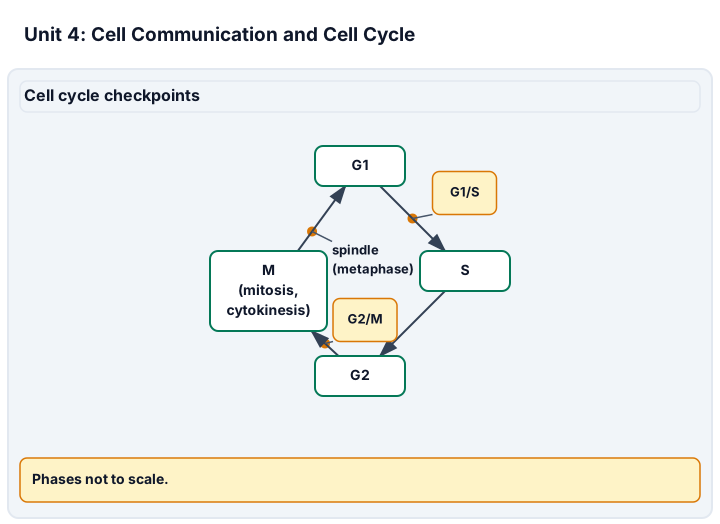
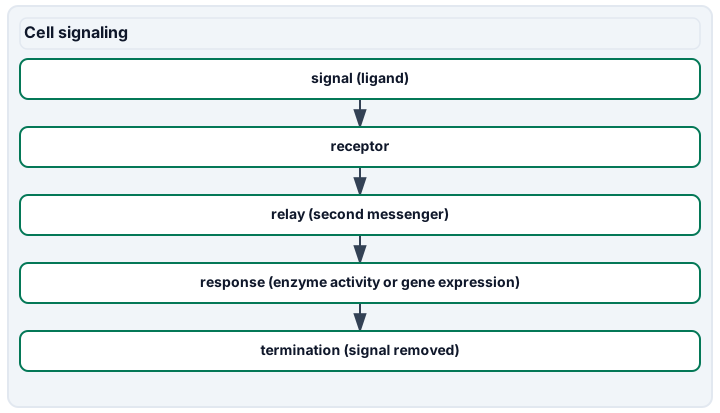
Diagram description
The cell cycle runs G1 to S to G2 to M, with G1/S and G2/M checkpoints and a spindle (M) checkpoint near the end of metaphase, before anaphase. Cell signaling proceeds from signal ligand to receptor to relay second messenger to response and then termination when the signal is removed.
Data, provenance, and assumptions
| Condition | Replicate 1 | Replicate 2 | Replicate 3 |
|---|---|---|---|
| Vehicle | 1 | 1 | 1 |
| Ligand | 8 | 10 | 9 |
| Ligand + receptor block | 1 | 2 | 0 |
| Block + downstream activation | 8 | 9 | 10 |
| Stage | Count |
|---|---|
| Interphase | 800 |
| Prophase | 80 |
| Metaphase | 40 |
| Anaphase | 40 |
| Telophase | 40 |
| State | Chromosomes per cell | DNA molecules per cell |
|---|---|---|
| G1 | 4 | 4 |
| G2 | 4 | 8 |
| Anaphase before division | 8 | 8 |
| Each daughter after division | 4 | 4 |
Worked model
[signal-response] Mean activity is 1 for vehicle, 9 for ligand, 1 for ligand plus receptor block and 9 for downstream rescue. The rescue supports a pathway-order model, but does not prove receptor identity, exclude off-target actions or show that every gene changed. [cycle-sampling] Mitosis accounts for 200/1000 = 20% of scored cells. Metaphase is 40/1000 = 4%; with the expressly assumed 24-hour cycle and representative asynchronous sampling, its estimated duration is 0.96 h. This is a conditional estimate, not a timed observation of one cell.
Numerical calibration
- 9 relative reporter units
- 9 relative reporter units
- 20 %
- 0.96 hours, conditional snapshot estimate
Attempt the assigned level
Try the tasks before reading the calibration. These are practice answers, not a secure examination; use a new dataset or changed assumption for the assessed transfer.
Foundation: typically grades 7-8
- [signal-response] Compute the mean for each signal-activity condition and draw reception → transduction → response. Compare direct contact, local secretion and circulation-carried long-distance signaling. Why might a cell lacking the receptor not respond? Evidence: science criteria 2, 3; AP-connection objectives 4.1.A, 4.1.B, 4.2.A, 4.2.B (selected task connection, not full objective mastery).
- [cycle-sampling] Order the phases in mitotic-counts, find the mitotic fraction and use chromosome-model to explain why G2 has twice the DNA without twice the chromosome count. Evidence: science criteria 1, 5; AP-connection objectives 4.5.A, 4.5.B (selected task connection, not full objective mastery).
Check after your attempt
- [signal-response] Means are 1, 9, 1 and 9. Contact requires neighboring cells; local secretion reaches nearby targets; circulation can carry a signal to distant targets. Specific reception initiates transduction; a cell without the matching receptor cannot initiate that route merely because ligand is present.
- [cycle-sampling] Interphase precedes prophase, metaphase, anaphase and telophase. The mitotic fraction is 200/1000 = 20%. Sister chromatids remain joined before anaphase, so four duplicated G2 chromosomes contain eight DNA molecules.
High-school core: typically grades 9-10
- [signal-response] Interpret the receptor-block and rescue comparison, then diagram one negative and one positive feedback loop. Distinguish pathway amplification from a loop that feeds back onto its own input. Evidence: science criteria 2, 3, 4; AP-connection objectives 4.2.A, 4.3.A, 4.3.B, 4.4.A (selected task connection, not full objective mastery).
- [cycle-sampling] Estimate metaphase duration under the stated 24-hour model, list its assumptions and explain a spindle-checkpoint failure. Can many fields from this one slide be counted as independent roots? Evidence: science criteria 1, 3, 4, 5; AP-connection objectives 4.5.A, 4.5.B, 4.6.A, 4.6.B (selected task connection, not full objective mastery).
Check after your attempt
- [signal-response] The block lowers reporter response and downstream activation restores it, consistent with the proposed order if specificity and viability controls hold. Stomatal closure opposing water loss is negative feedback; ethylene-promoted further ripening is positive. A one-way kinase amplification chain need not be a feedback loop.
- [cycle-sampling] Estimated metaphase duration is 0.04 × 24 = 0.96 h. It assumes representative asynchronous steady sampling and comparable survival. A spindle-checkpoint failure can allow missegregation. Multiple fields are not independent biological replicates or independent roots.
Honors extension: typically grades 11-12
- [signal-response] Use signal-activity to propose two missing controls. Predict a receptor binding-site change that prevents ligand binding and a blocked pathway-terminating phosphatase; distinguish their possible response time courses from the one measured endpoint. Evidence: science criteria 2, 3, 4; AP-connection objectives 4.3.A, 4.3.B (selected task connection, not full objective mastery).
- [cycle-sampling] If metaphase-arrested cells accumulate, evaluate whether the same snapshot formula estimates normal phase duration. Propose a sampling and observer-agreement check for independently prepared reference roots. Evidence: science criteria 1, 3, 4, 5; AP-connection objectives 4.5.A, 4.6.A, 4.6.B (selected task connection, not full objective mastery).
Check after your attempt
- [signal-response] Specificity and viability controls address off-target actions or unequal material. A binding-site change preventing ligand binding could suppress reception; blocking a terminating phosphatase could prolong phosphorylation and response. The single observation time cannot show either time course; independent preparation trajectories would be needed.
- [cycle-sampling] Arrest violates the steady progression assumption, so a larger fraction is not an estimate of normal duration. Randomly select fields within independently sourced roots, use a fixed classification rule, blind a second scoring pass and report disagreements/uncertain cells rather than converting recounts into extra roots.
History, reading, and writing connection
Read the official 2001 Nobel medicine summary naming Hartwell, Hunt and Nurse, then connect the recognized cell-cycle question to OpenStax’s checkpoint model. Explain why a retrospective recognition summary is not the complete research record. No human samples or personal medical history are requested; our reporter/root counts are fictional.
Write in your own words or use an approved accessible equivalent. Cite a specific assigned section or figure, identify its evidence, and state one limitation or counterargument. Use the AI practice contract only for permitted coaching, never to invent observations or write the assessed response.
Transfer to a new case
[signal-response] A new synthetic receptor-block treatment gives reporter values 2, 3 and 4, but a downstream activation gives 2, 3 and 4 as well. What is the shared mean, and does this result support the earlier successful-rescue inference? [cycle-sampling] A fresh synthetic snapshot has 90 mitotic cells among 600; 18 are metaphase. With a stated 20-hour cycle, calculate the mitotic index and conditional metaphase time, then name a reason not to use that time estimate.
Calibration: [signal-response] Both means are 3 relative units. There is no restoration in this new comparison, so the earlier rescue argument does not carry over. Failed activation, a different block site or impaired viability are alternatives requiring controls. [cycle-sampling] Mitotic index is 15%; metaphase fraction 18/600 = 3% gives 0.6 h. Synchronization, arrest, biased fields or different survival could invalidate that inference. Image classification alone does not certify microscope handling or a medical conclusion.
Evidence to retain
[signal-response] Science criterion 2: pathway diagram and rescue argument; criterion 3: signed feedback loop; criterion 4: bounded dysregulation reasoning rather than personal medical conclusions. [cycle-sampling] Science criterion 1: phase and DNA/chromosome reasoning; criteria 3–4: checkpoints and limitations; criterion 5: image identification with separately recorded supervised microscope evidence.
Record units, calculations, source/date, uncertainty, and what is measured versus inferred. A simulation or supplied dataset must stay labeled as such. These are public, nonsecure paper/data practice activities, not performed laboratory work. No culture of unknown microbes, human biological samples, medical or genetic personal disclosures, unsafe chemicals, or DNA manipulation instructions are authorized. Use supplied data, approved reference images, or a preapproved non-destructive observation. An instructor must review safety, accessibility and the exact practical contract before any physical activity; a worksheet does not certify hands-on technique.
Return to all eight learning pathways. Print this unit page for the student lessons; the linked five-page packet remains the separate assessment companion.
Use the investigation design before assessment
Each linked design gives materials, controls, sampling, procedure, uncertainty and the required human practical/safety review. No worksheet certifies an unobserved technique.
Unit mastery rubric
| Criterion | Developing | Proficient | Mastery |
|---|---|---|---|
| Cell cycle & mitosis stages | Confuses replication with division. | Orders phases with incomplete DNA counts. | Orders interphase/mitosis and tracks chromosomes versus DNA molecules through replication and sister separation. |
| Signal transduction | Confuses ligand, receptor and response. | Traces a pathway with help. | Traces reception, transduction and response; interprets block/rescue controls with causal limits. |
| Feedback regulation | Calls any large response positive feedback. | Names feedback without predicting its direction. | Predicts how negative or positive feedback changes a condition and explains how checkpoints regulate cell division. |
| Cancer as cycle dysregulation | Treats one count as a diagnosis. | Names checkpoints without their consequence. | Explains cancer as lost checkpoint control of the cell cycle, without inferring diagnosis from a synthetic count. |
| Microscopy of mitotic stages | Forces uncertain cells into stages. | Identifies stages with guidance. | Identifies stages with stated sampling/scale limits; separately demonstrates approved prepared-slide microscopy or the agreed practical. |
| Integration (cross-domain) | Makes no supported connection between the source and the science. | Uses the source but needs help connecting evidence, writing, or limitations to the science. | Independently connects History, Reading, and Writing using a cited source, appropriate evidence, a limitation, and a scientific explanation. |
Integration is reported separately and cannot lower the science grade or block a science demonstration pass. Science and practical criteria determine that pass. Use the integration guide's evidence checklist for the separately reported criterion.
Mean activity is 1 for vehicle, 9 for ligand, 1 for ligand plus receptor block and 9 for downstream rescue. The rescue supports a pathway-order model, but does not prove receptor identity, exclude off-target actions or show that every gene changed.
“I completed the cell communication & cell cycle worksheet, so I have mastered every science and practical criterion.” Completion and public answers are not evidence of independent mastery or observed technique.
Agree the level and specific science/practical contract before instruction. Retain an independent first attempt, source interpretation, calculations and a fresh instructor variation or observation. Public worked answers are nonsecure practice, not a private examination.
A 5-page clipboard packet — unit overview, key terms, the mastery rubric, anchor examples, and a score sheet you can print and grade against.