Unit 05 · Heredity
Use the heredity learning pathway for original readings, models, supplied data, checked practice and fresh transfer. The five science criteria stay distinct from integration; a paper/data alternative does not certify an unobserved technique.
Student learning: Heredity
Choose the level by readiness, not age alone, and record it before instruction. Foundation, core, and honors tasks are study pathways, not an AP course or a promise of college credit. The instructor retains practical assessment and the published science rubric; integration is reported separately.
Prerequisites: Chromosomes, alleles, fractions and conditional probability. Foundation uses counts/cross grids; core introduces an explained χ² reference; honors audits independence, linkage and model limits.
Suggested sequence: read and discuss the explanation; attempt the worked model; analyze the data at your selected level; check the answers; then complete the source-linked response and a fresh transfer question. These activities supplement, not replace, supervised practical work and the full-year schedule.
Assigned reading and focus
- OpenStax Biology 2e (2018), 11.1 The Process of Meiosis. [mendel-counts] Trace homologous chromosomes through meiosis I and sisters through meiosis II; identify crossing over and independent assortment.
- OpenStax Biology 2e (2018), 12.1 Mendel’s Experiments and the Laws of Probability. [mendel-counts] Read Mendel’s experimental approach and the sum/product probability rules. Distinguish his historical observations from our synthetic counts.
- OpenStax Biology 2e (2018), 12.3 Laws of Inheritance. [mendel-counts] Study segregation, independent assortment and dihybrid crosses. State the assumptions before using a 9:3:3:1 ratio.
- NIST/SEMATECH e-Handbook: Critical Values of the Chi-Square Distribution. [mendel-counts] Use the upper-tail critical-value table: cumulative probability 0.95 gives 3.841 at df = 1 and 7.815 at df = 3. These supplied thresholds calibrate the tests here, not a p-value-as-proof rule.
- OpenStax Biology 2e (2018), 12.2 Characteristics and Traits. [inheritance-models] Read incomplete dominance, codominance, sex-linked inheritance and multiple alleles. Distinguish a population’s possible alleles from an individual’s two copies at an autosomal locus.
- OpenStax Biology 2e (2018), 13.2 Chromosomal Basis of Inherited Disorders. [inheritance-models] Read pedigree logic and chromosome segregation changes as reference models. Do not analyze the learner’s family or infer a medical condition.
- OpenStax Biology 2e (2018), 13.1 Chromosomal Theory and Genetic Linkage. [linkage-environment] Study the testcross logic and recombination maps. Explain why undetected multiple crossovers can make recombination fraction underestimate distance.
- OpenStax Biology 2e (2018), 12.2 Characteristics and Traits. [linkage-environment] Compare genotype, phenotype and environmental effects; not every phenotype difference is an allele-frequency change.
Learn the science
[mendel-counts] Homologs carry corresponding loci; sister chromatids are replicated copies. Homolog separation explains segregation of alleles. Independent orientation of chromosome pairs and crossing over create new combinations; linked loci need not assort independently. Meiosis reduces chromosome number and fertilization restores the diploid state.
[mendel-counts] In the fictional RrYy × RrYy pea model, R gives round and Y yellow, each completely dominant. Assume unlinked loci, independent gamete formation, equal fertilization/survival and complete phenotype classification. Gametes RY, Ry, rY and ry each have probability 1/4. Multiply independent probabilities: round yellow is 3/4 × 3/4 = 9/16.
[mendel-counts] Chi-square goodness of fit uses χ² = Σ[(O − E)²/E] over mutually exclusive categories; O is a count, not a percentage, and E is the total times the model probability, not the observed count. Use independent offspring counted once, fixed categories, no fitted model parameters here and expected counts at least 5. This approximation is inappropriate for tiny expected categories without another explained method.
[mendel-counts] Set α = 0.05 before analysis. With four categories and fixed probabilities, df = 4 − 1 = 3; the supplied NIST upper-tail threshold is 7.815. A smaller statistic means fail to reject this model at that threshold, not that the model is proven true or that the probability of the null hypothesis is 95%. Design bias, linkage and differential survival remain biological questions.
[inheritance-models] Incomplete dominance gives the heterozygote an intermediate phenotype under the stated model; codominance gives both products, not a blend. Multiple alleles can exist in a population even though a diploid individual usually carries two alleles at an autosomal locus. Dominant does not mean common, stronger or healthier.
[inheritance-models] For the invented XX/XY beetle model, an X-linked recessive allele has different conditional probabilities among sons and among all offspring. Assume equal sex probability, ordinary segregation and full penetrance. These assumptions do not describe every trait, species or person.
[inheritance-models] In the supplied fictional animal pedigree, two trait-absent parents have a trait-present offspring under a stipulated autosomal-recessive model. Both parents must be heterozygotes. This is deduction within a model, not evidence that a small real pedigree uniquely establishes an inheritance mechanism.
[linkage-environment] In the AB/ab × ab/ab testcross, the recessive tester makes offspring classes reveal gametes from the heterozygote under complete penetrance and equal survival. AB and ab are the stated parental haplotypes; Ab and aB are recombinant. Homologous recombination is not an intentional response to what offspring need.
[linkage-environment] Recombination fraction is recombinant offspring divided by total. For short intervals it approximates map distance in centimorgans, but multiple crossovers can restore parental combinations and cause an underestimate. A fraction near 50% does not distinguish distant linked loci from loci on different chromosomes.
[linkage-environment] Phenotype depends on genotype and environment. In the synthetic plant model both genotypes grow more under the warm condition; a within-genotype environmental change is not automatically a mutation or evolution. A comparison must control plant age, duration, resources and sampling, and cannot be generalized to every temperature.

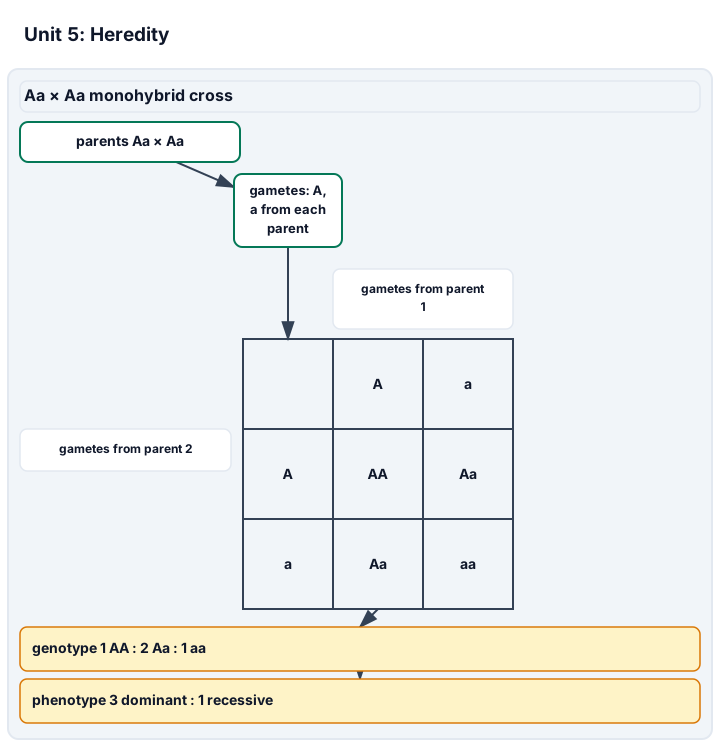
Diagram description
Unit 5: Heredity. Aa × Aa monohybrid cross: parents Aa × Aa make gametes A, a and A, a; genotype ratio 1 AA : 2 Aa : 1 aa; phenotype ratio 3 dominant : 1 recessive.
Data, provenance, and assumptions
| Phenotype | Observed count | Expected ratio weight /16 |
|---|---|---|
| Round yellow | 94 | 9 |
| Round green | 26 | 3 |
| Wrinkled yellow | 28 | 3 |
| Wrinkled green | 12 | 1 |
| Model | Given cross | Phenotype rule |
|---|---|---|
| Incomplete dominance | Rr × Rr | RR red; Rr pink; rr white |
| Codominance | LM × LM | LL product L; LM both products; MM product M |
| X-linked beetle | XᴬXᵃ × XᴬY | a recessive; XX female and XY male; equal sex probability |
| Individual | Relationship | Observed model trait |
|---|---|---|
| P1 | Parent paired with P2 | Absent |
| P2 | Parent paired with P1 | Absent |
| C1 | Offspring of P1/P2 | Present |
| C2 | Another offspring of P1/P2 | Absent |
| Gamete class | Offspring count |
|---|---|
| AB | 44 |
| Ab | 12 |
| aB | 8 |
| ab | 36 |
| Genotype / condition | Plant 1 | Plant 2 | Plant 3 |
|---|---|---|---|
| AA / cool | 11 | 12 | 13 |
| AA / warm | 17 | 18 | 19 |
| aa / cool | 7 | 8 | 9 |
| aa / warm | 13 | 14 | 15 |
Worked model
[mendel-counts] N = 160 gives expected counts 90, 30, 30 and 10. Contributions are 16/90, 16/30, 4/30 and 4/10; χ² = 1.244444. Since 1.244444 < 7.815 at df 3 and α 0.05, fail to reject the specified model. The result is compatible with random variation under the model; it does not prove independent assortment in a real organism. [inheritance-models] Rr × Rr gives RR:Rr:rr = 1:2:1, hence red:pink:white = 1:2:1 under incomplete dominance. LM × LM has the same genotype ratio but the middle group shows both products. In XᴬXᵃ × XᴬY, half the sons and one quarter of all offspring express the recessive trait. In the pedigree, P1 and P2 are Aa, C1 is aa, and C2 is AA or Aa; conditional on absence, P(C2 is Aa) = 2/3. [linkage-environment] Recombinants are 12 + 8 = 20 of 100, giving 20%. A rough 20 cM map estimate needs the limited-multiple-crossover assumption. Height means are 12, 18, 8 and 14 cm: warming adds 6 cm within each genotype, while AA exceeds aa by 4 cm at either condition in this synthetic sample.
Numerical calibration
- 1.244444 χ² with df = 3
- 7.815 upper-tail α = 0.05 critical value, NIST df = 3
- 0.25 probability among all offspring in the fictional X-linked model
- 0.666667 conditional probability, absent-trait offspring of Aa × Aa
- 20 % recombinant offspring
- 6 cm within either genotype
Attempt the assigned level
Try the tasks before reading the calibration. These are practice answers, not a secure examination; use a new dataset or changed assumption for the assessed transfer.
Foundation: typically grades 7-8
- [mendel-counts] Use dihybrid-counts to total the offspring. With the supplied 9:3:3:1 ratio, compute the expected four counts and explain why observed counts need not match exactly. Evidence: science criteria 1, 2; AP-connection objectives 5.1.A, 5.2.A, 5.3.A (selected task connection, not full objective mastery).
- [inheritance-models] Solve the incomplete-dominance and codominance crosses in inheritance-cards. Explain what each heterozygous phenotype means rather than labeling both as a “mix.” Evidence: science criteria 2, 3, 5; AP-connection objectives 5.4.A (selected task connection, not full objective mastery).
- [linkage-environment] Identify parental and recombinant classes in testcross-counts, and calculate the four phenotype-environment means. Does the height difference within AA require a change in its allele label? Evidence: science criteria 1, 3, 5; AP-connection objectives 5.2.A, 5.4.A, 5.5.A (selected task connection, not full objective mastery).
Check after your attempt
- [mendel-counts] The total is 160 and expected counts are 90, 30, 30 and 10. Expectations describe a probability model, not guaranteed counts in each sample. Independent gamete draws can give a different realized sample even when the model applies.
- [inheritance-models] Both crosses give 1:2:1 genotypes. Rr is intermediate pink in the defined model; LM shows both distinct products. Each homozygote has probability 1/4 and each heterozygote 1/2; codominance is not blending away the two alleles.
- [linkage-environment] AB/ab are parental and Ab/aB recombinant. Heights average 12, 18, 8 and 14 cm. The within-AA environmental response does not require changing the genotype; environment can alter expression or growth while the genotype stays the same.
High-school core: typically grades 9-10
- [mendel-counts] Contrast chromosome separation in mitosis and meiosis, derive the four phenotype probabilities from the two monohybrid crosses, and interpret χ² for dihybrid-counts against the supplied df 3 reference without claiming proof. Evidence: science criteria 1, 2, 5; AP-connection objectives 5.1.B, 5.2.A, 5.3.A (selected task connection, not full objective mastery).
- [inheritance-models] Solve the fictional X-linked cross and identify the genotypes forced by pedigree-records. Keep the denominator “sons” separate from “all offspring.” Evidence: science criteria 2, 3, 4, 5; AP-connection objectives 5.3.A, 5.4.A (selected task connection, not full objective mastery).
- [linkage-environment] Calculate recombination fraction and compare within-genotype versus between-genotype height differences. Explain why the four count categories are not four independent experimental replicates. Evidence: science criteria 1, 2, 3, 5; AP-connection objectives 5.2.A, 5.4.A, 5.5.A (selected task connection, not full objective mastery).
Check after your attempt
- [mendel-counts] Mitosis separates sisters while usually conserving ploidy; meiosis separates homologs then sisters after one replication, producing haploid products. Probabilities are 9/16, 3/16, 3/16 and 1/16. χ² is 1.244444, below 7.815: fail to reject at α 0.05. Expected values come from the model, not observed proportions; compatibility is not proof.
- [inheritance-models] Offspring classes XᴬXᴬ, XᴬXᵃ, XᴬY and XᵃY each have probability 1/4. Recessive-trait sons are half of sons but one quarter of all offspring. The stipulated pedigree gives Aa parents and aa C1; C2 could be AA or Aa.
- [linkage-environment] Recombination is 20/100 = 20%. Warming changes each genotype mean by +6 cm; AA is 4 cm taller than aa at both conditions. The categories partition one offspring sample, rather than being replicate samples; inferential replication must be designed separately.
Honors extension: typically grades 11-12
- [mendel-counts] Audit the independence, expected-frequency and fixed-model assumptions. Predict how counting siblings under unequal viability or merging rare phenotypes after seeing results could undermine this test. Evidence: science criteria 1, 2, 5; AP-connection objectives 5.2.A, 5.3.A (selected task connection, not full objective mastery).
- [inheritance-models] Find the conditional heterozygote probability for C2 and explain how incomplete penetrance or an unstated new mutation would change the pedigree deduction. Do not diagnose a real person. Evidence: science criteria 2, 3, 4, 5; AP-connection objectives 5.4.A (selected task connection, not full objective mastery).
- [linkage-environment] Explain why a recombination-derived map may underestimate distance and why these parallel mean temperature responses do not prove every gene has no genotype-by-environment interaction. Evidence: science criteria 1, 3, 5; AP-connection objectives 5.4.A, 5.5.A (selected task connection, not full objective mastery).
Check after your attempt
- [mendel-counts] All expected counts exceed 5 and the synthetic model fixes probabilities before counting. Shared survival effects can make a real sample unrepresentative or correlated; post-hoc category changes alter the test and its degrees of freedom. Retain missing/dead categories and design evidence rather than claiming the small statistic proves Mendelian inheritance.
- [inheritance-models] Among the three absent-trait genotype outcomes AA, Aa and aA, two are heterozygous, giving 2/3. Incomplete penetrance or a new mutation invalidates the simple genotype deduction; additional evidence and a different model would be required, not a personal-health inference.
- [linkage-environment] Multiple crossovers may be undetected because parental combinations are restored; recombination can therefore underestimate distance. The supplied means show parallel responses only for these lines and conditions, with limited replication. Other environments or traits can interact differently with genotype.
History, reading, and writing connection
Read OpenStax 12.1’s dated account of Mendel’s pea investigations. Compare historical design choices with our explicitly synthetic offspring counts; write an evidence-based argument about why prespecified categories and complete reporting matter. Do not call the new numbers Mendel’s data.
Write in your own words or use an approved accessible equivalent. Cite a specific assigned section or figure, identify its evidence, and state one limitation or counterargument. Use the AI practice contract only for permitted coaching, never to invent observations or write the assessed response.
Transfer to a new case
[mendel-counts] Fresh synthetic independent monohybrid offspring have 70 dominant and 30 recessive phenotypes under a fixed 3:1 model. Calculate expected counts and χ²; use df = 1, α = 0.05 and critical value 3.841. [inheritance-models] In a fresh synthetic incomplete-dominance flower cross Rr × rr, RR is red, Rr pink and rr white. Give genotype and phenotype probabilities, then explain why a 3:1 phenotype ratio is inappropriate. [linkage-environment] A fresh synthetic AB/ab testcross gives AB 42, Ab 6, aB 4 and ab 48. Calculate recombinant fraction and explain whether it establishes physical base-pair distance or the cause of a growth response.
Calibration: [mendel-counts] Expected counts are 75 and 25. χ² = 25/75 + 25/25 = 1.333333, below 3.841, so fail to reject the specified model. That does not prove a genotype, mechanism or null-hypothesis probability; assumptions and sampling still matter. [inheritance-models] Half are Rr (pink), half rr (white), with no RR offspring. The parents and phenotype rule differ from a completely dominant heterozygote self-cross, so a memorized 3:1 ratio is not justified. [linkage-environment] The recombinant fraction is (6 + 4)/100 = 10%, approximately 10 cM only under the mapping assumptions. It does not directly measure base-pair distance and cannot identify a causal environmental-growth mechanism.
Evidence to retain
[mendel-counts] Science criteria 1–2: meiosis, probability and χ² calculations; criterion 5: molecular/chromosomal conditions behind a ratio rather than an automatic whole-unit pass. [inheritance-models] Science criteria 2–4: solvable crosses and pedigree deductions; criterion 5: explicit allele-to-product explanation and model limitations. [linkage-environment] Science criteria 1–3: meiosis, linkage and probability; criterion 5: genotype/environment mechanism; the pedigree criterion remains separately evidenced in inheritance-models.
Record units, calculations, source/date, uncertainty, and what is measured versus inferred. A simulation or supplied dataset must stay labeled as such. These are public, nonsecure paper/data practice activities, not performed laboratory work. No culture of unknown microbes, human biological samples, medical or genetic personal disclosures, unsafe chemicals, or DNA manipulation instructions are authorized. Use supplied data, approved reference images, or a preapproved non-destructive observation. An instructor must review safety, accessibility and the exact practical contract before any physical activity; a worksheet does not certify hands-on technique.
Return to all eight learning pathways. Print this unit page for the student lessons; the linked five-page packet remains the separate assessment companion.
Use the investigation design before assessment
Each linked design gives materials, controls, sampling, procedure, uncertainty and the required human practical/safety review. No worksheet certifies an unobserved technique.
Unit mastery rubric
| Criterion | Developing | Proficient | Mastery |
|---|---|---|---|
| Meiosis & variation | Confuses homologs and sister chromatids. | Names crossing over with limited mechanism. | Links homolog separation, crossing over and independent assortment to variation and states when linkage matters. |
| Punnett / probability problems | Uses ratios without a specified cross. | Solves a cross but omits conditions. | Solves mono-/dihybrid probability and expected-count tasks; interprets an appropriate χ² comparison with assumptions. |
| Non-Mendelian patterns | Treats all traits as completely dominant. | Recognizes alternatives without solving them. | Identifies and solves incomplete dominance, codominance, and sex-linked crosses using the stated model. |
| Pedigree analysis | Claims every genotype is uniquely known. | Infers genotypes with prompts. | Deduces forced and uncertain genotypes in a fictional pedigree; states penetrance and inheritance assumptions. |
| Connecting to molecular basis | Treats phenotype as DNA alone. | Connects alleles and chromosomes with help. | Connects alleles, linkage and environmental effects to phenotype without personal genetic inference. |
| Integration (cross-domain) | Makes no supported connection between the source and the science. | Uses the source but needs help connecting evidence, writing, or limitations to the science. | Independently connects History, Reading, and Writing using a cited source, appropriate evidence, a limitation, and a scientific explanation. |
Integration is reported separately and cannot lower the science grade or block a science demonstration pass. Science and practical criteria determine that pass. Use the integration guide's evidence checklist for the separately reported criterion.
N = 160 gives expected counts 90, 30, 30 and 10. Contributions are 16/90, 16/30, 4/30 and 4/10; χ² = 1.244444. Since 1.244444 < 7.815 at df 3 and α 0.05, fail to reject the specified model. The result is compatible with random variation under the model; it does not prove independent assortment in a real organism.
“I completed the heredity worksheet, so I have mastered every science and practical criterion.” Completion and public answers are not evidence of independent mastery or observed technique.
Agree the level and specific science/practical contract before instruction. Retain an independent first attempt, source interpretation, calculations and a fresh instructor variation or observation. Public worked answers are nonsecure practice, not a private examination.
A 5-page clipboard packet — unit overview, key terms, the mastery rubric, anchor examples, and a score sheet you can print and grade against.