Unit 06 · Gene Expression & Regulation
Use the gene expression & regulation learning pathway for original readings, models, supplied data, checked practice and fresh transfer. The five science criteria stay distinct from integration; a paper/data alternative does not certify an unobserved technique.
Student learning: Gene Expression & Regulation
Choose the level by readiness, not age alone, and record it before instruction. Foundation, core, and honors tasks are study pathways, not an AP course or a promise of college credit. The instructor retains practical assessment and the published science rubric; integration is reported separately.
Prerequisites: Complementary base pairing, 5′/3′ ends, compartments and allele models. Core uses codon lookup/ratios; honors adds logarithmic gel calibration and competing regulatory mechanisms.
Suggested sequence: read and discuss the explanation; attempt the worked model; analyze the data at your selected level; check the answers; then complete the source-linked response and a fresh transfer question. These activities supplement, not replace, supervised practical work and the full-year schedule.
Assigned reading and focus
- OpenStax Biology 2e (2018), 14.2 DNA Structure and Sequencing. [replication-evidence] Compare nucleotide linkage, complementary bases and antiparallel strand direction.
- OpenStax Biology 2e (2018), 14.3 Basics of DNA Replication. [replication-evidence] Read the Meselson–Stahl model comparison; identify what the density bands discriminate.
- OpenStax Biology 2e (2018), 14.4 DNA Replication in Prokaryotes. [replication-evidence] Trace helicase, topoisomerase, RNA primer, DNA polymerase and ligase at a replication fork.
- OpenStax Biology 2e (2018), 14.5 DNA Replication in Eukaryotes. [replication-evidence] Compare multiple origins and chromosome-end issues with the bacterial example; no laboratory protocol is assigned.
- OpenStax Biology 2e (2018), 15.1 The Genetic Code. [sequence-flow] Use the RNA codon chart, including start, stop and degeneracy. A stop codon is not an amino acid.
- OpenStax Biology 2e (2018), 15.2 Prokaryotic Transcription. [sequence-flow] Track RNA polymerase reading a DNA template and producing RNA; compare the coding strand.
- OpenStax Biology 2e (2018), 15.3 Eukaryotic Transcription. [sequence-flow] Contrast nuclear transcription in the eukaryotic model with prokaryotic transcription.
- OpenStax Biology 2e (2018), 15.4 RNA Processing in Eukaryotes. [sequence-flow] Read the 5′ cap, poly-A tail, intron removal and alternative splicing.
- OpenStax Biology 2e (2018), 15.5 Ribosomes and Protein Synthesis. [sequence-flow] Trace ribosome initiation, tRNA anticodons, peptide elongation and release at stop.
- OpenStax Biology 2e (2018), 14.6 DNA Repair. [mutation-effects] Compare base substitutions, insertions/deletions, spontaneous errors, damage and repair; mutation does not arise because it would be useful.
- OpenStax Biology 2e (2018), 15.1 The Genetic Code. [mutation-effects] Use codon degeneracy and stop codons to distinguish synonymous, missense and nonsense consequences.
- OpenStax Biology 2e (2018), 13.2 Chromosomal Basis of Inherited Disorders. [mutation-effects] Distinguish short sequence variants from chromosome-number/structure changes; this activity does not supply a diagnostic chromosome bank.
- OpenStax Biology 2e (2018), 16.2 Prokaryotic Gene Regulation. [regulation-contrast] Compare the lac repressor/operator with positive cAMP–CAP regulation and the repressible trp example. Do not use one on/off rule for every operon.
- OpenStax Biology 2e (2018), 16.3 Eukaryotic Epigenetic Gene Regulation. [regulation-contrast] Compare accessible and less-accessible chromatin; distinguish epigenetic regulation from a changed DNA sequence.
- OpenStax Biology 2e (2018), 16.4 Eukaryotic Transcription Gene Regulation. [regulation-contrast] Trace promoter, transcription factors and enhancer interactions.
- OpenStax Biology 2e (2018), 16.5 Eukaryotic Post-transcriptional Gene Regulation. [regulation-contrast] Read alternative splicing and RNA stability, including small RNA effects.
- OpenStax Biology 2e (2018), 16.6 Eukaryotic Translational and Post-translational Gene Regulation. [regulation-contrast] Separate translational control and protein degradation from transcription rate.
- OpenStax Biology 2e (2018), 17.1 Biotechnology. [biotech-interpretation] Read PCR, gel electrophoresis and DNA sequencing conceptually. Use the figures to interpret controls and size; no experimental steps from the chapter are assigned.
- NHGRI: Human Genome Project (public overview). [biotech-interpretation] Read the project overview and dated milestones. Distinguish a reference sequence from a full explanation of regulation, phenotype or an individual’s health.
Learn the science
[replication-evidence] DNA polymerase adds nucleotides to a 3′ end, so a new DNA strand grows 5′ → 3′ while its template is read 3′ → 5′. At a moving fork the leading strand is synthesized continuously toward fork movement; the lagging strand is assembled as fragments. Both new strands are still synthesized 5′ → 3′.
[replication-evidence] Helicase separates strands, topoisomerase relieves twisting ahead of the fork, primers supply a starting 3′ end, polymerase extends and ligase joins remaining backbone gaps. In the simplified eukaryotic nuclear model replication starts at multiple origins. End replication presents a separate problem on linear chromosomes; not every cell has the same telomerase activity.
[replication-evidence] Semiconservative copying leaves one parental strand in each daughter duplex after the first round. The synthetic density percentages model descendants after transfer from heavy to light building blocks; they are idealized predictions, not copied historical measurements or instructions for isotope experiments.
[replication-evidence] An all-hybrid first generation contradicts a simple conservative model predicting separate heavy and light duplexes. At generation two, separate hybrid and light bands help distinguish semiconservative copying from a simple dispersive model predicting one intermediate band. Evidence discriminates specified models; it does not prove every possible molecular mechanism from one image.
[sequence-flow] Read the given strand labels before translating. The coding DNA strand matches the RNA sequence except T becomes U; RNA polymerase actually reads the complementary template 3′ → 5′ and makes RNA 5′ → 3′. A sequence supplied in the opposite orientation must be reversed appropriately, not merely have T replaced by U.
[sequence-flow] In the ordinary eukaryotic nuclear-gene model, transcription and pre-mRNA processing occur in the nucleus. A 5′ cap, poly-A tail and splicing support mature mRNA processing, stability and use; exons are retained while introns are removed. Retained exons can include untranslated regions, so “exon” does not always mean “protein-coding.” Alternative splicing can produce different transcripts from one gene.
[sequence-flow] Ribosomes translate mRNA 5′ → 3′ on cytoplasmic ribosomes, including those at the rough ER. tRNA carries amino acids and anticodons; rRNA has structural and catalytic roles. For AUG, a complementary anticodon written antiparallel is 3′-UAC-5′. Initiation establishes a reading frame; a release factor, not a stop-carrying tRNA, acts at a stop codon.
[sequence-flow] Prokaryotes lack a membrane-bound nucleus, allowing translation to begin while transcription continues. The supplied 15-base sequence is a short synthetic coding excerpt with a specified start; it is not a complete real gene, promoter, genome or functional engineering design. The standard code is nearly universal, with known exceptions.
[mutation-effects] A mutation is a DNA sequence change. A coding substitution can be synonymous, missense or nonsense depending on the codon and frame. The same class can have different biological effects in different genes or environments. Not every mutation is harmful, and a synonymous change is not guaranteed to be functionally neutral in every context.
[mutation-effects] An insertion/deletion in a coding region shifts the reading frame when its length is not divisible by three. An in-frame three-base deletion removes one codon in this model but may still alter folding or function. A frameshift does not mean every downstream amino acid must be different; an early stop may end translation immediately.
[mutation-effects] Changes to promoters, enhancers or splice sites can affect transcript abundance or composition without directly changing a codon. DNA damage can be repaired; unrepaired sequence changes passed through replication can become variants. Phenotype inference requires functional and environmental context, not just the word mutation.
[mutation-effects] Only germline transmission or analogous heritable transmission affects descendant lineages; a somatic change is not automatically inherited by offspring. The short examples below have no medical interpretation and no personal genetic data.
[regulation-contrast] An operon can coordinate transcription of several bacterial genes. In the lac model, allolactose reduces repressor binding at the operator, allowing transcription. Low glucose is associated with higher cAMP and CAP activation, increasing transcription further. Lactose availability and glucose signaling therefore provide distinct negative and positive controls; “lactose present” alone does not guarantee the maximum rate.
[regulation-contrast] In a repressible trp model, abundant tryptophan can act as a corepressor and reduce transcription of its synthesis pathway. This differs from lac induction. The synthetic lac values are relative illustrative outputs, not universal expression levels or instructions for bacterial growth.
[regulation-contrast] Eukaryotic regulation operates through chromatin accessibility, transcription factors/enhancers, RNA processing and stability, translation and protein turnover. Cells with the same inherited DNA can differ in these regulatory states and therefore in their products and functions. A missing transcript is not automatically evidence that the DNA gene is absent.
[regulation-contrast] A promoter positions transcription machinery at a gene. In the lac model the nearby operator allows repressor binding to interfere with transcription. A eukaryotic enhancer can be distant along DNA; DNA looping and bound activators can influence transcription-factor/machinery assembly at the promoter. Regulatory location affects which gene is contacted, not a rule that every control sequence must be immediately adjacent.
[regulation-contrast] Histone modifications and DNA methylation can be associated with transcriptional accessibility in context; associations alone do not establish causation. Alternative splicing changes RNA products; microRNA can promote RNA degradation or reduce translation. Ubiquitin-mediated protein degradation can change protein abundance with no immediate change in RNA abundance.
[regulation-contrast] The normalized RNA/protein model assumes a stable reference and equal sampled material. Comparing RNA alone cannot distinguish every downstream change. A lower protein/RNA ratio is consistent with reduced translation or faster protein loss; one endpoint does not uniquely separate those mechanisms.
[biotech-interpretation] Gel electrophoresis can separate DNA fragments by size under specified conditions; shorter comparable fragments usually travel farther in the same gel. Compare unknowns with a size standard. Over a calibrated interval, log10(fragment length) may be approximately linear in migration distance, not length itself.
[biotech-interpretation] PCR selectively amplifies a defined target in an idealized model; perfect doubling gives N = N₀2ⁿ. Real efficiency, substrate depletion and background limit that model. A visible band at a target size is not a complete sequence identification and cannot by itself establish provenance or absence of contamination.
[biotech-interpretation] A negative/no-template control with a target-sized band makes the affected run invalid for a simple positive-sample conclusion. An appropriate positive reference and size ladder answer different control questions. No sample identity or human genetic inference is authorized here.
[biotech-interpretation] Sequencing reads nucleotide order; amplification increases selected material; a gel estimates length. A genome reference does not by itself tell which genes a cell expresses. Discuss access, consent and misuse in abstract terms, with no personal genetic records and no instructions for DNA manipulation.

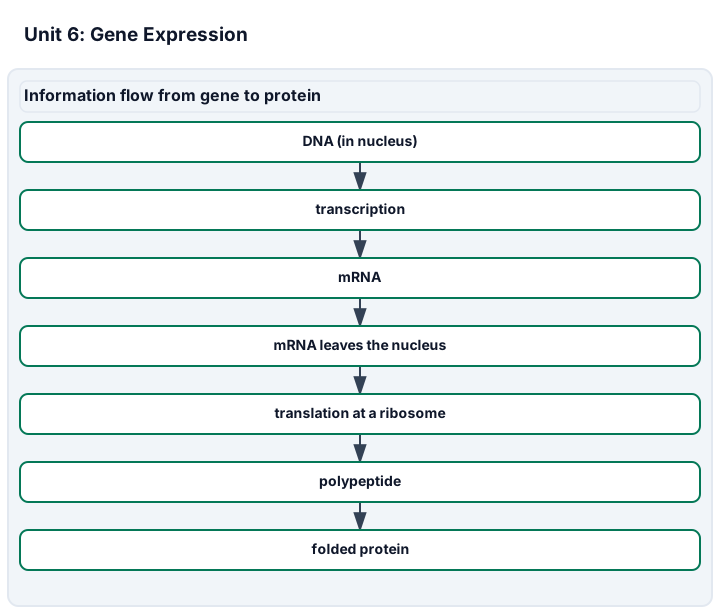
Diagram description
Unit 6: Gene Expression. Information flow from gene to protein: DNA (in nucleus) to transcription to mRNA to mRNA leaves the nucleus to translation at a ribosome to polypeptide to folded protein.
Data, provenance, and assumptions
| Generation | Heavy duplex % | Hybrid duplex % | Light duplex % |
|---|---|---|---|
| 0 | 100 | 0 | 0 |
| 1 | 0 | 100 | 0 |
| 2 | 0 | 50 | 50 |
| 3 | 0 | 25 | 75 |
| Molecule | Written direction | Sequence |
|---|---|---|
| Coding DNA | 5′ → 3′ | ATGGAATTTCCGTAA |
| Template DNA | 3′ → 5′ | TACCTTAAAGGCATT |
| Mature mRNA | 5′ → 3′ | AUGGAAUUUCCGUAA |
| RNA codon | Meaning |
|---|---|
| AUG | Met |
| GAA | Glu |
| GAG | Glu |
| UUU | Phe |
| UUC | Phe |
| CCG | Pro |
| GUA | Val |
| UAA | Stop |
| UGA | Stop |
| Exon card | RNA sequence |
|---|---|
| E1 | AUGGAA |
| E2 | UUU |
| E3 | CCGUAA |
| Variant class | Coding DNA | Checked peptide before stop |
|---|---|---|
| Reference | ATGGAATTTCCGTAA | Met–Glu–Phe–Pro |
| Synonymous substitution | ATGGAGTTTCCGTAA | Met–Glu–Phe–Pro |
| Missense substitution | ATGGTATTTCCGTAA | Met–Val–Phe–Pro |
| Nonsense substitution | ATGTAATTTCCGTAA | Met |
| One-base insertion | ATGTGAATTTCCGTAA | Met |
| Three-base deletion | ATGTTTCCGTAA | Met–Phe–Pro |
| Lactose | Glucose | Relative transcript output |
|---|---|---|
| Absent | Present | 0 |
| Absent | Absent | 0 |
| Present | Present | 2 |
| Present | Absent | 10 |
| Condition | RNA units | Protein units |
|---|---|---|
| Reference | 10 | 100 |
| Lower RNA abundance | 5 | 50 |
| Lower protein per RNA | 10 | 20 |
| Migration (mm) | Fragment length (bp) |
|---|---|
| 10 | 4000 |
| 20 | 2000 |
| 30 | 1000 |
| 40 | 500 |
| Run / lane | Recorded band size (bp) |
|---|---|
| Run A positive reference | 1000 |
| Run A negative control | None |
| Run A sample | 1000 |
| Run B negative control | 1000 |
| Run B sample | 1000 |
| Starting target copies | Perfect doubling cycles |
|---|---|
| 1 | 5 |
Worked model
[replication-evidence] After one round all duplexes contain one old heavy strand. At generation two the number of original heavy strands is unchanged while total duplexes double, giving 50% hybrid and 50% light. Generation three gives 25% hybrid and 75% light. Neither strand is synthesized 3′ → 5′. [sequence-flow] Reading the template 3′-TAC CTT AAA GGC ATT-5′ makes 5′-AUG GAA UUU CCG UAA-3′. Translation gives Met–Glu–Phe–Pro, then stops: four amino acids, not five. There are 4³ = 64 possible triplet codons. Isoform B is AUG GAA CCG UAA and encodes Met–Glu–Pro; this designed three-base skip preserves frame, unlike every possible exon skip. [mutation-effects] GAA → GAG retains Glu; GAA → GUA produces Val; GAA → UAA stops after Met. Inserting T after ATG gives ATG TGA …, so translation also stops after Met. Removing the complete GAA codon leaves ATG TTT CCG TAA, giving Met–Phe–Pro. Equal peptide length is not proof of equal activity. [regulation-contrast] With lactose present, the low-glucose model output is 10/2 = 5 times the high-glucose output. Zero-baseline conditions do not permit a finite fold change from zero. In expression-levels, reference protein/RNA is 10, the lower-RNA condition remains 10, and the lower-protein condition is 2. The last pattern points to downstream regulation but does not distinguish translation from degradation by itself. [biotech-interpretation] An unknown at 25 mm lies halfway between 2000 and 1000 bp in log space, so length = √(2000 × 1000) ≈ 1414.213562 bp, not the arithmetic midpoint 1500. Five ideal doublings from one target give 32 copies. Run B’s negative control band invalidates a simple sample-positive interpretation.
Numerical calibration
- 25 % hybrid duplexes, ideal model
- 4 amino acids before stop
- 64 possible RNA triplets
- 3 amino acids before stop
- 1 amino acid before the new early stop
- 5 fold, lactose present with glucose absent versus present
- 2 protein units per RNA unit, low-protein condition
- 1414.213562 bp, log-linear interpolation at 25 mm
- 32 ideal target copies
Attempt the assigned level
Try the tasks before reading the calibration. These are practice answers, not a secure examination; use a new dataset or changed assumption for the assessed transfer.
Foundation: typically grades 7-8
- [replication-evidence] Use replication-bands and colored strand cards to trace one original strand through three rounds. Label original and new strands rather than calling an entire daughter molecule old. Evidence: science criteria 1; AP-connection objectives 6.1.A, 6.2.A (selected task connection, not full objective mastery).
- [sequence-flow] Cover the mature-mRNA row in sequence-inputs, transcribe the labeled template using complementary bases, then translate with codon-key. Identify which molecule carries a codon versus an anticodon. Evidence: science criteria 2; AP-connection objectives 6.1.B, 6.3.A, 6.4.A (selected task connection, not full objective mastery).
- [mutation-effects] Cover the checked peptide column in mutation-sequences and classify which variants retain, replace, remove or terminate the original amino-acid sequence. Use the codon-key rather than guessing from DNA letter changes. Evidence: science criteria 2, 4; AP-connection objectives 6.7.A, 6.7.B (selected task connection, not full objective mastery).
- [regulation-contrast] Read lac-expression to identify the largest transcript output and compare the RNA/protein patterns in expression-levels. Can identical DNA coexist with different protein abundance? Evidence: science criteria 3; AP-connection objectives 6.5.A, 6.6.B (selected task connection, not full objective mastery).
- [biotech-interpretation] Read gel-ladder and gel-controls to rank fragment lengths and judge whether Run A and Run B can be interpreted in the same way. State what an amplification count does and does not identify. Evidence: science criteria 5; AP-connection objectives 6.8.A (selected task connection, not full objective mastery).
Check after your attempt
- [replication-evidence] Original strands persist, each paired with a newly made strand, while the fraction of duplexes containing an original heavy strand becomes 100%, 50% and 25%. Each first-generation duplex has one old and one new strand.
- [sequence-flow] The RNA is AUGGAAUUUCCGUAA in the 5′ → 3′ direction, encoding Met–Glu–Phe–Pro before stop. Codons are on mRNA and anticodons on tRNA; stop contributes no amino acid.
- [mutation-effects] The synonymous substitution retains the peptide; missense replaces Glu with Val; nonsense and this one-base insertion stop after Met; the three-base deletion removes Glu while keeping the later frame. Mutation class alone does not give a medical or fitness verdict.
- [regulation-contrast] The highest modeled lac output is 10 when lactose is present and glucose absent. Reference and low-RNA groups have protein/RNA ratio 10, while the last group has ratio 2. Identical DNA can produce different amounts through regulated transcription or later stages.
- [biotech-interpretation] Smaller ladder fragments travel farther under this calibration. Run A controls behave as stipulated; Run B is invalid because the negative control has a band. Copy number describes amplification, not the complete identity, function or origin of a sequence.
High-school core: typically grades 9-10
- [replication-evidence] Draw an antiparallel fork with both new strands labeled 5′ → 3′; assign helicase, topoisomerase, polymerase, primer and ligase roles. Use the first two density generations to compare copying models. Evidence: science criteria 1, 2; AP-connection objectives 6.1.B, 6.2.A (selected task connection, not full objective mastery).
- [sequence-flow] Compare coding and template direction, then assemble both rna-exons isoforms and translate them. State the eukaryotic sites of transcription, RNA processing and translation, and a prokaryotic difference. Evidence: science criteria 2, 3; AP-connection objectives 6.3.A, 6.4.A, 6.6.B (selected task connection, not full objective mastery).
- [mutation-effects] Explain why the one-base insertion and three-base deletion have different frame consequences, and why this nonsense variant and insertion happen to produce the same short peptide in this example. Evidence: science criteria 2, 4; AP-connection objectives 6.7.A, 6.7.B (selected task connection, not full objective mastery).
- [regulation-contrast] Explain both lac controls and calculate the fold contrast with lactose present. Compare operator/promoter position with a distant enhancer’s action at a eukaryotic promoter; add an RNA-level and a protein-level mechanism that need not delete a gene. Evidence: science criteria 2, 3, 5; AP-connection objectives 6.5.A, 6.5.B, 6.6.A, 6.6.B (selected task connection, not full objective mastery).
- [biotech-interpretation] Compute the ideal pcr-model target count and identify which separate questions a size standard, positive control and negative control answer. Is a target-sized band the same as knowing its complete sequence? Evidence: science criteria 1, 5; AP-connection objectives 6.8.A (selected task connection, not full objective mastery).
Check after your attempt
- [replication-evidence] Polymerase extends 3′ ends; helicase opens the fork, topoisomerase relieves strain, primers initiate and ligase joins fragments. Continuous and discontinuous copying differ relative to fork movement, not synthesis direction. All-hybrid generation one disfavors simple conservation; hybrid/light generation two distinguishes the stated dispersive prediction.
- [sequence-flow] Coding DNA matches RNA with T/U substitution, but the template is read antiparallel. Isoform A encodes Met–Glu–Phe–Pro; B encodes Met–Glu–Pro. Nuclear transcription/processing precedes cytoplasmic translation in the model; prokaryotic translation can overlap transcription because there is no separating nucleus.
- [mutation-effects] One added base changes triplet grouping; deleting three bases preserves the downstream reading frame. Both short variants encounter a stop at their second codon here, so only Met is produced. This coincidence does not make all insertions equivalent to all nonsense substitutions.
- [regulation-contrast] Inducer reduces repressor action; low glucose favors cAMP–CAP activation, giving a five-fold contrast. A nearby operator can block transcription, while a distant enhancer can contact promoter-associated factors through looping and change transcription. Splicing/RNA decay and translation/protein degradation act at later levels without deleting DNA.
- [biotech-interpretation] One target after five perfect doublings gives 32. The ladder calibrates length, the positive control checks expected detection, and the negative control checks background/contamination. A matching size is not complete sequence identity; further appropriate evidence is needed.
Honors extension: typically grades 11-12
- [replication-evidence] Predict generation four’s hybrid fraction and identify assumptions needed to treat band fractions as molecule fractions. Explain why multiple origins do not permit reverse-direction polymerase synthesis. Evidence: science criteria 1, 5; AP-connection objectives 6.2.A (selected task connection, not full objective mastery).
- [sequence-flow] Write the AUG-pairing anticodon with both ends labeled, calculate the number of possible triplets, and explain why an exon skip or a changed RNA half-life could alter protein output without a coding-DNA mutation. Evidence: science criteria 2, 3, 4; AP-connection objectives 6.3.A, 6.4.A, 6.6.B (selected task connection, not full objective mastery).
- [mutation-effects] For the synonymous and in-frame variants, state a functional question that sequencing alone cannot answer. Propose a supplied-data comparison controlling expression level, and distinguish inherited variation from a need-directed mutation claim. Evidence: science criteria 3, 4, 5; AP-connection objectives 6.7.A, 6.7.B, 6.7.C (selected task connection, not full objective mastery).
- [regulation-contrast] Use expression-levels to distinguish a proportional RNA/protein decrease from downstream regulation. Propose measurements that would separate reduced translation and accelerated protein turnover, and evaluate a simple repressor-loss lac prediction. Evidence: science criteria 3, 4, 5; AP-connection objectives 6.5.A, 6.6.B (selected task connection, not full objective mastery).
- [biotech-interpretation] Estimate the 25 mm unknown length using log-linear interpolation and explain why 1500 bp is not the calibrated answer. Discuss one genome-reference benefit and one ethical/interpretive limit using the assigned NHGRI account. Evidence: science criteria 3, 5; AP-connection objectives 6.8.A (selected task connection, not full objective mastery).
Check after your attempt
- [replication-evidence] Generation four is 12.5% hybrid under complete rounds with equal survival and detectable, calibrated bands. Unequal detection or incomplete replication can bias fractions. Multiple origins change the number and arrangement of forks, but extension still occurs at 3′ ends in the 5′ → 3′ direction.
- [sequence-flow] The anticodon is 3′-UAC-5′ (or 5′-CAU-3′ when reversed). Four bases in three positions give 64 triplets. Splicing changes mature RNA composition, and RNA stability changes template availability. Neither necessarily changes DNA, and skipping an exon does not always preserve the reading frame.
- [mutation-effects] The functional question could be whether activity or RNA stability changes at equal expression and comparable conditions. Compare reference and variant product amount plus activity, with blinded replicates and controls. Mutation is not produced because an organism needs it; heritable sequence variation can alter products and reproductive contribution, then be filtered by selection.
- [regulation-contrast] A 5/50 pattern is proportional to the reference 10/100; 10/20 has lower protein per RNA. Time-resolved synthesis and decay comparisons under matched RNA and viable material would separate alternatives. Losing repressor control could permit output without lactose, but glucose/CAP control can still limit it; not every condition becomes maximally expressed.
- [biotech-interpretation] The log midpoint gives √(2000 × 1000) = 1414.213562 bp. A linear bp average assumes a different calibration. Reference genomes support shared research comparisons, but do not determine cell-specific expression or warrant personal-health claims; access and consent require explicit governance.
History, reading, and writing connection
Use OpenStax’s historical DNA-replication account and NHGRI’s Human Genome Project overview. Explain what sequence, size, transcript and protein evidence each adds; distinguish a historical milestone from a claim about an individual. Compare access/consent stakes without requesting private genetic records.
Write in your own words or use an approved accessible equivalent. Cite a specific assigned section or figure, identify its evidence, and state one limitation or counterargument. Use the AI practice contract only for permitted coaching, never to invent observations or write the assessed response.
Transfer to a new case
[replication-evidence] A fresh ideal lineage starts with one all-heavy duplex. After four complete rounds in light building blocks there are 16 duplexes. How many retain an original heavy strand, and why is “half heavy forever” incorrect? [sequence-flow] A fresh synthetic template is written 5′-TTA AAA CAT-3′. First orient it for transcription, then find the mRNA and peptide using the supplied code. Why is direct T-to-U substitution on that row wrong? [mutation-effects] In a fresh synthetic coding excerpt 5′-ATG GAG TTC TAA-3′, translate the peptide. If TTC changes to TTT, does the protein sequence change under the supplied code, and does that settle every possible biological effect? [regulation-contrast] A fresh synthetic pair of specialized cell types has equal gene copies and RNA units of 8 each, but protein units of 80 and 40. Calculate the two protein/RNA ratios and name two compatible regulatory explanations without claiming the gene disappeared. [biotech-interpretation] A fresh synthetic unknown migrates 35 mm under the same ladder relation, and amplification starts from two copies for four perfect cycles. Give both estimates and state whether they certify a learner’s pipetting or sequencing technique.
Calibration: [replication-evidence] Two duplexes retain the two original strands, giving 2/16 = 12.5% hybrid. The original-strand count is conserved while total duplex number doubles each round; half hybrid applies only at the second complete generation in this model. [sequence-flow] Read the reversed template 3′-TAC AAA ATT-5′ to make 5′-AUG UUU UAA-3′, which encodes Met–Phe then stop. T-to-U substitution belongs to a coding-strand comparison, not direct transcription of a template written in the opposite direction. [mutation-effects] The peptide is Met–Glu–Phe before stop. TTC → TTT gives UUC → UUU, both Phe, so this is synonymous at the peptide level. RNA stability, processing or expression context could still matter; the code alone does not settle every effect. [regulation-contrast] Ratios are 10 and 5. Reduced translation or increased protein degradation can explain the lower protein per RNA; these endpoints do not uniquely identify either. Equal gene copies make simple gene deletion inconsistent with the stated model. [biotech-interpretation] The estimated fragment length is √(1000 × 500) ≈ 707.106781 bp; ideal copies are 2 × 2⁴ = 32. These calculations do not certify any hands-on technique, sequence identity or genetic-engineering competence.
Evidence to retain
[replication-evidence] Science criterion 1: strand lineage and directional replication mechanism; criterion 5: limits of a molecular measurement model, separate from practical laboratory certification. [sequence-flow] Science criterion 2: direction-correct transcription/translation and locations; criterion 3: RNA processing as regulation; criterion 4: frame-aware predictions rather than memorized central-dogma labels. [mutation-effects] Science criteria 2 and 4: checked sequence/variant reasoning; criteria 3 and 5: expression controls and limits on phenotype claims. [regulation-contrast] Science criterion 3: distinct prokaryotic/eukaryotic mechanisms; criterion 2: RNA versus protein; criteria 4–5: perturbation limits and measurement controls. [biotech-interpretation] Science criterion 5: method interpretation, calibration and ethics; criteria 1 and 3: replication/expression distinctions. Hands-on method certification requires separate observed evidence.
Record units, calculations, source/date, uncertainty, and what is measured versus inferred. A simulation or supplied dataset must stay labeled as such. These are public, nonsecure paper/data practice activities, not performed laboratory work. No culture of unknown microbes, human biological samples, medical or genetic personal disclosures, unsafe chemicals, or DNA manipulation instructions are authorized. Use supplied data, approved reference images, or a preapproved non-destructive observation. An instructor must review safety, accessibility and the exact practical contract before any physical activity; a worksheet does not certify hands-on technique.
Return to all eight learning pathways. Print this unit page for the student lessons; the linked five-page packet remains the separate assessment companion.
Use the investigation design before assessment
Each linked design gives materials, controls, sampling, procedure, uncertainty and the required human practical/safety review. No worksheet certifies an unobserved technique.
Unit mastery rubric
| Criterion | Developing | Proficient | Mastery |
|---|---|---|---|
| Replication | Copies DNA without strand direction or lineage. | Names semiconservative copying with missing details. | Explains semiconservative replication and identifies original/new strands, 5′→3′ synthesis and leading/lagging mechanisms. |
| Transcription & translation | Confuses template, coding strand and codon. | Names processes but needs frame/location help. | Translates a sequence and states where each step occurs; checks strand direction, RNA processing, codons and stop. |
| Gene regulation | Assumes one on/off rule for all genes. | Names control without a mechanism. | Explains distinct prokaryotic and eukaryotic controls and uses RNA/protein evidence to evaluate regulation. |
| Mutations & effects | Treats every change as harmful or identical. | Names variants without checking their sequence. | Classifies mutation types and predicts possible protein/phenotype effects from the supplied sequence, frame and context. |
| Biotechnology / ethics reasoning | Confuses length, copies and sequence. | Describes a tool without controls or limits. | Interprets gel/amplification controls and calibration, separates sequence from expression, and reasons about ethical limits. |
| Integration (cross-domain) | Makes no supported connection between the source and the science. | Uses the source but needs help connecting evidence, writing, or limitations to the science. | Independently connects History, Reading, and Writing using a cited source, appropriate evidence, a limitation, and a scientific explanation. |
Integration is reported separately and cannot lower the science grade or block a science demonstration pass. Science and practical criteria determine that pass. Use the integration guide's evidence checklist for the separately reported criterion.
After one round all duplexes contain one old heavy strand. At generation two the number of original heavy strands is unchanged while total duplexes double, giving 50% hybrid and 50% light. Generation three gives 25% hybrid and 75% light. Neither strand is synthesized 3′ → 5′.
“I completed the gene expression & regulation worksheet, so I have mastered every science and practical criterion.” Completion and public answers are not evidence of independent mastery or observed technique.
Agree the level and specific science/practical contract before instruction. Retain an independent first attempt, source interpretation, calculations and a fresh instructor variation or observation. Public worked answers are nonsecure practice, not a private examination.
A 5-page clipboard packet — unit overview, key terms, the mastery rubric, anchor examples, and a score sheet you can print and grade against.