Unit 02 · Roots, Stems & Leaves
Anatomy is where the plant becomes a working body. This unit follows the two great systems — the root system that anchors and absorbs and the shoot system that lifts leaves to the light — through primary growth at the tips and the secondary growth that thickens woody stems. You read leaf anatomy from the epidermis and its stomata down through the photosynthetic mesophyll and the veins, and trace how xylem and phloem are arranged differently in roots and stems. Mastery means you can look at a real cross-section and explain each layer as a structure doing a job, not a diagram to label.
Student learning: Measure organs, allocation, and leaf arrangement without forcing a pattern
Choose the level by readiness, not age alone, and record it before instruction. Foundation, core, and honors tasks are study pathways, not an AP course or a promise of college credit. The instructor retains practical assessment and the published science rubric; integration is reported separately.
Prerequisites: Plant tissues, areas, fractions, and angles; honors work uses circular differences and ratios.
Suggested sequence: read and discuss the explanation; attempt the worked model; analyze the data at your selected level; check the answers; then complete the source-linked response and a fresh transfer question. These activities supplement, not replace, supervised practical work and the full-year schedule.
Assigned reading and focus
- OpenStax Biology 2e, 30.1: The Plant Body. Review root/shoot systems, apical growth, and lateral meristems. Relate organ growth to its tissues.
- OpenStax Biology 2e, 30.4: Leaves. Read Leaf Arrangement, Leaf Form, and Leaf Structure and Function. Compare alternate, opposite, whorled, and spiral examples rather than assuming one universal arrangement.
Learn the science
Roots provide anchorage and usually much of the water/mineral uptake; shoots support leaves and reproductive organs. Primary growth extends organs; secondary growth in appropriate plants adds girth through lateral meristems.
Leaf veins contain xylem and phloem, linking gas-exchange and photosynthetic tissues to the rest of the plant. Modified stems, roots, and leaves can store resources, but their identity follows structure and development, not simply their job.
A grid estimate adds fully covered squares and fractions of partially covered squares. State the grid area and approximation method. Root/shoot ratio and root fraction of total mass are different quantities.
Phyllotaxy varies: not all plants show Fibonacci spirals or a golden angle. A short angular record may be consistent with an approximate pattern without proving a universal law.

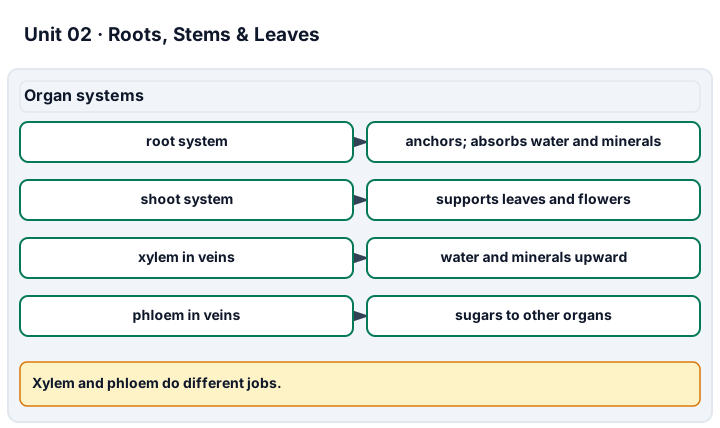
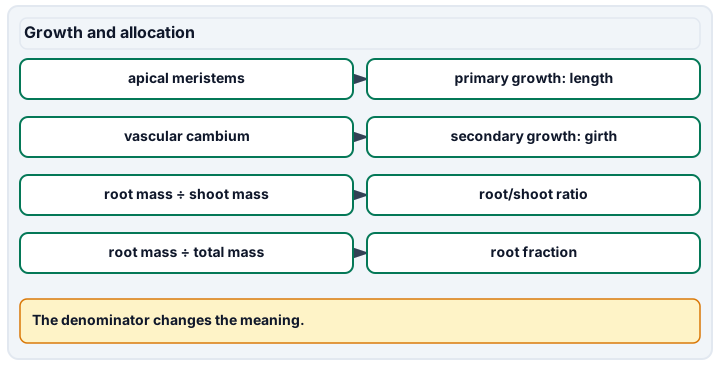
Diagram description
Roots anchor and absorb water and minerals, shoots support leaves and reproductive organs, xylem carries water/minerals upward, and phloem carries sugars from leaves to other organs. Apical meristems lengthen organs; vascular cambium thickens stems. Root/shoot ratio and root fraction use different denominators.
Data, provenance, and assumptions
| Outline | Full squares | Half squares |
|---|---|---|
| L1 | 24 | 12 |
| L2 | 16 | 8 |
| L3 | 30 | 10 |
| Root dry mass (g) | Shoot dry mass (g) |
|---|---|
| 0.9 | 2.1 |
| Leaf order | Angle (degrees) |
|---|---|
| 1 | 0 |
| 2 | 138 |
| 3 | 275 |
| 4 | 52 |
Worked model
L1 has area 24 + 12/2 = 30 cm^2. Root fraction is 0.9/(0.9 + 2.1) = 0.30, whereas root/shoot ratio is 0.9/2.1, about 0.429. The denominator determines the interpretation.
Numerical calibration
- 28.33 cm^2
- 0.3 root/total dry mass
- 137.33 degrees in this record
Attempt the assigned level
Try the tasks before reading the calibration. These are practice answers, not a secure examination; use a new dataset or changed assumption for the assessed transfer.
Foundation
- Calculate the three leaf areas and identify root, stem, and leaf functions in an assigned figure.
- Name a leaf arrangement that is not a single spiral.
Check after your attempt
- Areas are 30, 20, and 35 cm^2.
- Opposite or whorled arrangements provide examples; observations decide the classification.
High-school core: typically grades 9-10
- Find the mean estimated leaf area and both allocation measures.
- Explain why a larger estimated leaf area alone does not prove a higher photosynthetic rate.
Check after your attempt
- Mean area is about 28.33 cm^2; root fraction is 0.30; root/shoot ratio is about 0.429.
- Light, tissue condition, stomata, temperature, and other factors also affect rates. Area is a denominator or predictor, not the whole mechanism.
Honors extension: typically grades 11-12
- Unwrap the final angle and calculate the three successive angular differences and their mean.
- Compare with 137.5 degrees under the stated uncertainty and explain why four leaves cannot establish a universal pattern.
Check after your attempt
- Treat 52 degrees as 412 after the turn: differences are 138, 137, and 137 degrees, with mean about 137.33.
- The difference from 137.5 is smaller than the stated uncertainty. More observations and other species are needed; many plants have different arrangements.
History, reading, and writing connection
Cite the assigned leaf-arrangement examples and compare a measured pattern with a general claim about plant form. Explain why attractive geometry must remain accountable to observations and counterexamples.
Write in your own words or use an approved accessible equivalent. Cite a specific assigned section or figure, identify its evidence, and state one limitation or counterargument. Use the AI practice contract only for permitted coaching, never to invent observations or write the assessed response.
Transfer to a new case
Another plant has the same root mass but twice the shoot mass. Does its root fraction stay 0.30?
Calibration: No. It becomes 0.9/(0.9 + 4.2), about 0.176. A ratio changes when its denominator changes.
Evidence to retain
Submit the area estimates, allocation calculations, chosen-level angle analysis, and a source-linked explanation distinguishing organ identity, function, and a geometric model.
Record units, calculations, source/date, uncertainty, and what is measured versus inferred. A simulation or supplied dataset must stay labeled as such. Use the approved normal-care observation plan or supplied data. Do not culture unknown microbes, inoculate plants, apply hormones or pesticides, or eat study specimens.
Return to all eight learning pathways. Print this unit page for the student lessons; the linked five-page packet remains the separate assessment companion.
Unit mastery rubric
| Criterion | Developing | Proficient | Mastery |
|---|---|---|---|
| Root & shoot systems | Cannot say what roots and shoots each do for the plant. | Names the two systems but confuses their organs or jobs. | Distinguishes the root and shoot systems, names the organs of each, and explains how anchorage, absorption, support, and light capture divide between them. |
| Primary vs. secondary growth | Thinks all growth is just getting taller. | Defines primary growth but cannot explain what makes a stem woody. | Separates primary growth at the apical meristems from secondary growth at the vascular cambium, and explains how the cambium adds girth and wood. |
| Leaf anatomy | Cannot connect a leaf feature to its function. | Names tissues but misuses the measurement or arrangement model. | Identifies epidermis, mesophyll, stomata, and veins; explains their functions and interprets assigned leaf-area or arrangement measurements. |
| Xylem & phloem organization | Cannot tell xylem from phloem or say what each carries. | Knows xylem carries water and phloem carries sugar but not how they are arranged. | Locates xylem and phloem in a stem and a root, explains the different arrangements, and relates modified organs like bulbs or tubers back to their tissues. |
| Lab technique (dissection & microscopy of plant sections) | Cannot cut a clean section or bring it into focus. | Makes a section but misidentifies mesophyll, cambium, or the vascular bundles. | Cuts a thin stem, root, or leaf section, focuses it under the scope, and correctly identifies the tissue layers and vascular arrangement. |
| Integration (cross-domain) | Makes no supported connection between the source and the science. | Uses the source but needs help connecting evidence, writing, or limitations to the science. | Independently connects History, Reading, and Writing using a cited source, appropriate evidence, a limitation, and a scientific explanation. |
Integration is reported separately and cannot lower the science grade or block a science demonstration pass. Science and practical criteria determine that pass. Use the integration guide's evidence checklist for the separately reported criterion.
“You can see it in the stem cross-section — the xylem sits toward the inside and the phloem toward the outside, with the cambium ring between them adding girth each year. In the leaf, the tall palisade cells near the top are packed with chloroplasts for light, and the stomata on the underside open to let CO₂ in.”
“Roots are the bottom part and leaves are green. There’s tubes inside — one is xylem, I think. I found the section but I’m not sure which layer is which.”
You demonstrate this unit through dissection and microscopy labs — sectioning roots, stems, and leaves and reading them under the scope — plus short oral checks where you reason from what you see aloud, not a multiple-choice test. A criterion counts as mastered only when you can both run the technique and justify the plant biology behind it. Mastery is demonstrated, not awarded.
A 5-page clipboard packet — unit overview, key terms, the mastery rubric, anchor examples, and a score sheet you can print and grade against.