Unit 03 · Photosynthesis & Plant Energy
Photosynthesis is where a plant builds itself out of air and light. This unit works through the two stages inside the chloroplast — the light reactions on the thylakoid membranes that capture energy, and the Calvin cycle in the stroma that fixes carbon into sugar — the pigments that harvest different wavelengths, and the C3, C4, and CAM strategies plants use in different climates. It also follows the sugar back through cellular respiration and confronts the big surprise: most of a plant's dry mass comes from CO₂ in the air, not from the soil. Mastery means you can trace energy and carbon through the whole system and explain where a plant's substance actually comes from.
Student learning: Trace carbon and distinguish net exchange from gross photosynthesis
Choose the level by readiness, not age alone, and record it before instruction. Foundation, core, and honors tasks are study pathways, not an AP course or a promise of college credit. The instructor retains practical assessment and the published science rubric; integration is reported separately.
Prerequisites: Chloroplasts and mitochondria, graph slopes, signed rates, and area normalization.
Suggested sequence: read and discuss the explanation; attempt the worked model; analyze the data at your selected level; check the answers; then complete the source-linked response and a fresh transfer question. These activities supplement, not replace, supervised practical work and the full-year schedule.
Assigned reading and focus
- OpenStax Biology 2e, 8.3: Using Light Energy to Make Organic Molecules. Read carbon fixation, reduction, and regeneration. Explain the role of ATP/NADPH and why calling these reactions nighttime-only dark reactions is misleading.
- OpenStax Biology 2e, 30.5: Transport of Water and Solutes. Read stomatal regulation and the transport of photosynthates. Connect CO2 entry, water loss, and movement of sugars to sources and sinks.
Learn the science
Light reactions in thylakoid membranes support ATP and NADPH production and split water, releasing oxygen. The Calvin cycle in the stroma incorporates carbon from CO2 into organic molecules; it is not a process reserved for nighttime.
Plants also carry out cellular respiration in the light and dark. Matter cycles while energy flows through transformations and is ultimately dissipated as heat. Growth in a young seedling can initially use seed reserves, so germination alone does not prove that new biomass came from current photosynthesis.
Net oxygen exchange combines oxygen production and consumption. In this teaching model only, assume respiration is constant across light treatments, so gross production equals net exchange plus the positive respiration rate inferred in darkness.
C3, C4, and CAM pathways manage carbon fixation and water loss differently. C4 and CAM incur costs and are not universally superior. A change in light can interact with temperature, water availability, and stomatal behavior.

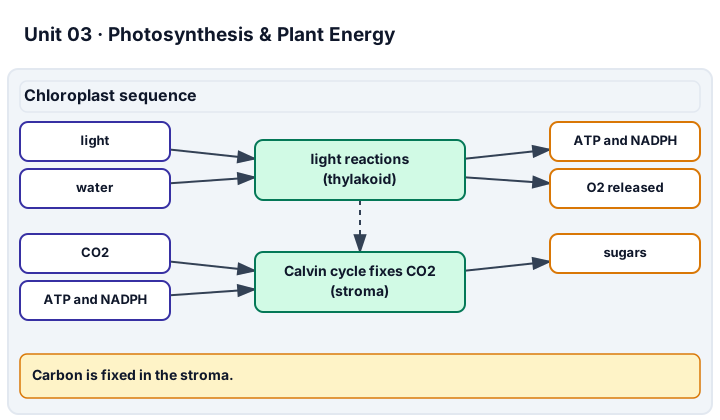
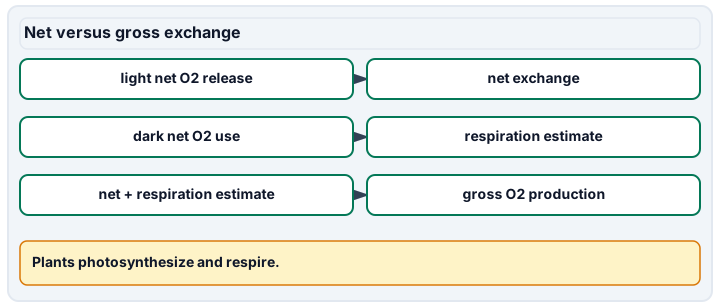
Diagram description
Light reactions in thylakoid membranes use light and water, releasing oxygen and producing ATP and NADPH. ATP and NADPH support the Calvin cycle in the stroma, where carbon dioxide is fixed into sugars. Gross oxygen production is computed from net exchange plus the positive respiration estimate inferred from darkness under the unit's model assumption.
Data, provenance, and assumptions
| Light (micromol photons/m^2/s) | Net O2 exchange (microlitres/min) |
|---|---|
| 0 | -2 |
| 50 | 1 |
| 100 | 3.5 |
| 200 | 5 |
| 400 | 5.1 |
Worked model
At light level 200, net release is 5 microlitres/min. Darkness indicates consumption of 2 microlitres/min. Under the stated constant-respiration assumption, gross production is 7 microlitres/min. Net release per leaf area is 5/20 = 0.25 microlitre/min/cm^2.
Numerical calibration
- 7 microlitres/min under the assumption
- 0.25 microlitre/min/cm^2
- 33.33 micromol photons/m^2/s, linear estimate
Attempt the assigned level
Try the tasks before reading the calibration. These are practice answers, not a secure examination; use a new dataset or changed assumption for the assessed transfer.
Foundation
- Graph net exchange against light and describe where increasing light has little additional effect.
- Trace the carbon in a leaf carbohydrate and explain the negative dark reading.
Check after your attempt
- The curve approaches a plateau between 200 and 400 in this dataset.
- Carbon comes mainly from fixed CO2; a negative reading means net oxygen consumption, not negative oxygen molecules.
High-school core: typically grades 9-10
- Calculate gross production at light level 200 and area-normalized net exchange.
- State why changing respiration with light or temperature would make the simple gross-rate estimate uncertain.
Check after your attempt
- Gross model rate is 7 microlitres/min; normalized net rate is 0.25 microlitre/min/cm^2.
- The calculation assumes the dark consumption rate applies in light; if it changes, another estimate or measurement is needed.
Honors extension: typically grades 11-12
- Linearly interpolate between 0 and 50 to estimate the light compensation point.
- Explain why the estimate and a C3/C4/CAM comparison require more than this one leaf record.
Check after your attempt
- The linear estimate is about 33.33 micromol photons/m^2/s, where net exchange is zero.
- The true response need not be linear between sampled points. Replicate plants, matched conditions, and appropriate physiological measurements are needed for a broader comparison.
History, reading, and writing connection
Connect the historical effort to understand plant gas exchange with the assigned carbon-fixation reading. Distinguish a measured gas flux from a model of gross production or a claim about biomass.
Write in your own words or use an approved accessible equivalent. Cite a specific assigned section or figure, identify its evidence, and state one limitation or counterargument. Use the AI practice contract only for permitted coaching, never to invent observations or write the assessed response.
Transfer to a new case
A second leaf has twice the area. Must its net rate be twice as large?
Calibration: Only under additional assumptions about comparable tissue and conditions. Normalize the actual measurements rather than assuming identical physiology.
Evidence to retain
Retain the graph, signed-rate calculations, carbon/energy explanation, and assumptions. These supplied gas data are analysis practice, not a claim to have performed a gas-exchange experiment.
Record units, calculations, source/date, uncertainty, and what is measured versus inferred. A simulation or supplied dataset must stay labeled as such. Use the approved normal-care observation plan or supplied data. Do not culture unknown microbes, inoculate plants, apply hormones or pesticides, or eat study specimens.
Return to all eight learning pathways. Print this unit page for the student lessons; the linked five-page packet remains the separate assessment companion.
Unit mastery rubric
| Criterion | Developing | Proficient | Mastery |
|---|---|---|---|
| Light reactions & the Calvin cycle | Treats photosynthesis as one vague step that “makes food.” | Names the two stages but cannot say what each produces or consumes. | Traces light energy to ATP and NADPH in the light reactions and their use to fix CO₂ into sugar in the Calvin cycle. |
| Chloroplast structure & pigments | Cannot locate where photosynthesis happens in the cell. | Names the chloroplast but not the thylakoids, stroma, or why leaves are green. | Maps the light reactions to the thylakoids and the Calvin cycle to the stroma, and explains how chlorophyll and accessory pigments absorb different wavelengths. |
| C3, C4 & CAM pathways | Assumes every plant fixes carbon the same way. | Names the pathways but cannot link them to climate or leaf structure. | Compares C3, C4, and CAM, and explains how each manages the trade-off between fixing carbon and losing water. |
| Respiration & the source of plant mass | Confuses mineral uptake with organic carbon fixation. | Names photosynthesis but omits respiration or seed reserves. | Traces carbon from CO2 and seed reserves where relevant; distinguishes respiration in light/dark and net versus gross exchange under stated assumptions. |
| Lab technique (floating-disk assay & pigment chromatography) | Cannot run the approved assay or pigment separation. | Records results but ignores controls or what the method measures. | Runs approved disk and pigment work, records controlled measurements, and explains proxy-rate and sampling limits rather than claiming a direct gross rate. |
| Integration (cross-domain) | Makes no supported connection between the source and the science. | Uses the source but needs help connecting evidence, writing, or limitations to the science. | Independently connects History, Reading, and Writing using a cited source, appropriate evidence, a limitation, and a scientific explanation. |
Integration is reported separately and cannot lower the science grade or block a science demonstration pass. Science and practical criteria determine that pass. Use the integration guide's evidence checklist for the separately reported criterion.
“The disk result is consistent with greater net oxygen accumulation under the tested light conditions. It is a proxy, not a direct gross photosynthesis measurement. New fixed carbon comes from CO2, while respiration continues and young seedlings can also use stored seed reserves.”
“Plants eat sunlight and grow out of the dirt. There’s a light part and a dark part, maybe? The disks did something in the cups.”
Complete the approved practical work and selected-level data analysis, explaining method, carbon, energy, and uncertainty. A defensible unexpected result is not a failure of understanding merely because it differs from a predicted curve. Supplied data demonstrates analysis, not performance of the practical technique.
A 5-page clipboard packet — unit overview, key terms, the mastery rubric, anchor examples, and a score sheet you can print and grade against.