Unit 04 · Water & Nutrient Transport
Connect water potential, xylem tension, stomatal control, and phloem pressure-flow to nutrition. Explain how roots and microbial partners acquire resources, including mycorrhizal uptake and rhizobial nitrogen fixation. Predict from the stated model and distinguish uptake, transpiration, and context-dependent benefits rather than treating every plant as an identical isolated system.
Student learning: Connect water potential, plant nutrition, and microbial partners
Choose the level by readiness, not age alone, and record it before instruction. Foundation, core, and honors tasks are study pathways, not an AP course or a promise of college credit. The instructor retains practical assessment and the published science rubric; integration is reported separately.
Prerequisites: Membranes, water movement, source-sink transport, signed numbers, means, and unit conversions.
Suggested sequence: read and discuss the explanation; attempt the worked model; analyze the data at your selected level; check the answers; then complete the source-linked response and a fresh transfer question. These activities supplement, not replace, supervised practical work and the full-year schedule.
Assigned reading and focus
- OpenStax Biology 2e, 30.5: Transport of Water and Solutes. Read Water Potential, stomatal control, and photosynthate transport. Use total potential for direction and distinguish the small-cell approximation from a tall-tree or soil model.
- OpenStax Biology 2e, 31.3: Nutritional Adaptations of Plants. Read Nitrogen Fixation and Mycorrhizae. Distinguish a mutualistic outcome from the broader term symbiosis; benefits vary with the partners and environment.
Learn the science
Water moves from higher to lower total water potential when an appropriate pathway exists. For the two small-cell examples, use potential = solute potential + pressure potential and neglect gravity and matric effects. Do not extend that simplification automatically to soil or a tall tree.
Transpiration can place the xylem water column under tension. Cohesion helps transmit the pull; roots often supply water, but root pressure and foliar uptake can occur in particular conditions. A potometer measures uptake: uptake is not identical to transpiration because storage, growth, leaks, and other losses may matter.
Phloem moves photosynthates from sources to sinks by a pressure-flow mechanism. Source and sink roles can change with development. Plants need mineral nutrients for molecules, enzymes, and ionic functions; minerals do not replace the CO2 source of most newly fixed organic carbon.
Mycorrhizae associate fungi with plant roots. Fungal hyphae can improve access to phosphorus and other resources; the plant supplies organic carbon. A carbon cost remains even when resources are abundant, so the growth effect is not always positive and not all plants form the same associations.
In many legumes, rhizobia in root nodules perform nitrogen fixation, converting N2 into usable reduced nitrogen. The plant does not itself provide the microbial nitrogen-fixing enzymes. Nitrification is a different microbial process that converts reduced nitrogen toward nitrite and nitrate; it is not N2 fixation.
Growth alone does not prove colonization or identify the mechanism. A real study needs appropriate controls, verified partner status, independent plants, and matched conditions. The microbial table below is supplied for analysis only, not an instruction to inoculate or culture organisms.

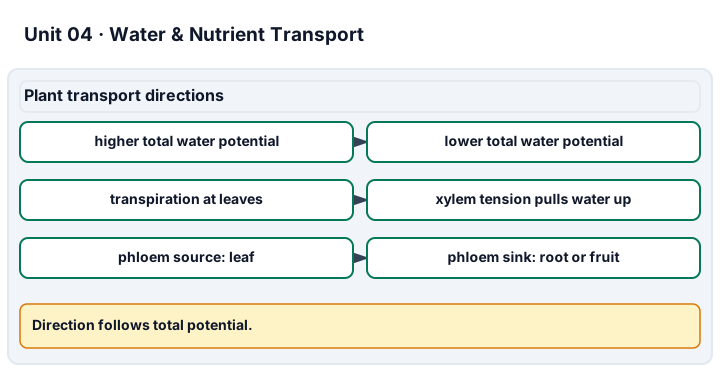
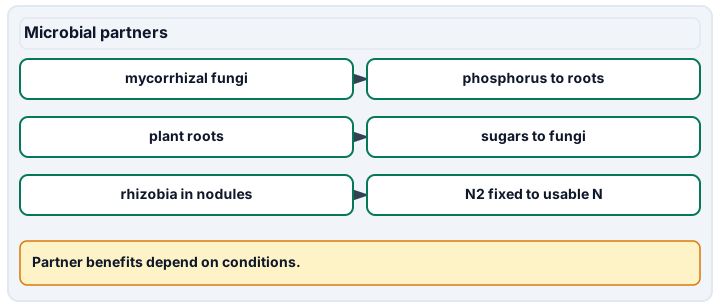
Diagram description
Water tends from higher to lower total water potential in the stated small-cell model. Transpiration at leaves can create xylem tension that pulls water upward. Phloem moves sugars from sources to sinks. Mycorrhizal fungi can provide phosphorus while receiving plant sugars, and rhizobia in legume nodules can fix nitrogen.
Data, provenance, and assumptions
| Cell | Solute potential (MPa) | Pressure potential (MPa) |
|---|---|---|
| A | -0.8 | 0.5 |
| B | -0.5 | 0.1 |
| Condition | Uptake (mL) | Time (minutes) | Leaf area (cm^2) |
|---|---|---|---|
| Still air | 0.6 | 30 | 100 |
| Moving air | 1.2 | 30 | 100 |
| Phosphorus | Partner treatment | Plant replicate | Dry mass (g) |
|---|---|---|---|
| Low | Absent | L1 | 10 |
| Low | Absent | L2 | 11 |
| Low | Absent | L3 | 9 |
| Low | Present | L4 | 16 |
| Low | Present | L5 | 15 |
| Low | Present | L6 | 17 |
| High | Absent | H1 | 20 |
| High | Absent | H2 | 21 |
| High | Absent | H3 | 19 |
| High | Present | H4 | 19 |
| High | Present | H5 | 18 |
| High | Present | H6 | 20 |
Worked model
Cell A has potential -0.3 MPa and B has -0.4 MPa, so water initially tends from A toward B under this model. Low-phosphorus group means are 10 g without and 16 g with the partner treatment, an effect of +6 g. Under high phosphorus, the means are 20 and 19 g, an effect of -1 g.
Numerical calibration
- -0.3 MPa
- -0.4 MPa
- 0.0002 mL/min/cm^2
- 6 g difference in group means
- -1 g difference in group means
- -0.248 MPa, model estimate
Attempt the assigned level
Try the tasks before reading the calibration. These are practice answers, not a secure examination; use a new dataset or changed assumption for the assessed transfer.
Foundation
- Explain what the plant and fungus can exchange, and distinguish root uptake from microbial nitrogen fixation.
- Find the mean mass in each of the four supplied treatment groups.
Check after your attempt
- The plant can supply organic carbon and the fungus can improve resource access. Nitrogen fixation is performed by particular microbes, not by root absorption alone.
- The means are 10, 16, 20, and 19 g for Low/Absent, Low/Present, High/Absent, and High/Present.
High-school core: typically grades 9-10
- Calculate both cell potentials and predict the initial water direction.
- Normalize the still-air uptake by time and leaf area; calculate partner effects at each phosphorus level and explain their different signs.
Check after your attempt
- A: -0.3 MPa; B: -0.4 MPa; initial tendency A to B.
- The normalized uptake is 0.0002 mL/min/cm^2. Effects are +6 g and -1 g; the outcome depends on conditions and may reflect costs as well as benefits.
Honors extension: typically grades 11-12
- Calculate the difference between the two partner effects and distinguish this interaction from a universal treatment benefit.
- Using solute potential = -iCRT with i = 1, C = 0.100 mol/L, R = 0.008314 L MPa/(mol K), and T = 298 K, compute the solute contribution. Name controls needed before a real causal claim.
Check after your attempt
- The effect differs by 7 g between phosphorus conditions. Pooling the groups would hide that context dependence.
- The solute contribution is about -0.248 MPa. A real study needs controls for carrier/media effects, independent replication, matched care, and evidence of the intended association.
History, reading, and writing connection
Use the assigned root-microbe figures to explain how evidence changes a plant-as-an-isolated-organism model. Evaluate a claim that an inoculant must improve every crop using the supplied conditional data, without making a product recommendation.
Write in your own words or use an approved accessible equivalent. Cite a specific assigned section or figure, identify its evidence, and state one limitation or counterargument. Use the AI practice contract only for permitted coaching, never to invent observations or write the assessed response.
Transfer to a new case
A treated plant grows larger. Does that alone prove nitrogen fixation caused the difference?
Calibration: No. Partner status, nutrient supply, other treatment differences, and replication must be examined; fungal phosphorus uptake is not the same process as nitrogen fixation.
Evidence to retain
Submit potential and rate calculations, four group means, the context-dependent interpretation, and a source-linked mechanism. Do not culture unknown microbes or inoculate plants for this data task.
Record units, calculations, source/date, uncertainty, and what is measured versus inferred. A simulation or supplied dataset must stay labeled as such. Use the approved normal-care observation plan or supplied data. Do not culture unknown microbes, inoculate plants, apply hormones or pesticides, or eat study specimens.
Return to all eight learning pathways. Print this unit page for the student lessons; the linked five-page packet remains the separate assessment companion.
Unit mastery rubric
| Criterion | Developing | Proficient | Mastery |
|---|---|---|---|
| Water potential | Cannot identify the direction of a potential gradient. | Uses one component without checking the total model. | Calculates and interprets total water potential in assigned cell/plant models, stating included and neglected components before predicting movement. |
| Transpiration & cohesion-tension | Believes the plant pushes water up from the roots. | Knows leaves lose water but not how that pulls the column upward. | Explains how transpiration at the leaves creates tension that pulls a cohesive water column up the xylem — roots absorb while leaves pull. |
| Stomatal control | Sees stomata as fixed holes that never change. | Knows guard cells open stomata but not what triggers it. | Explains how guard cells swell and shrink to open and close stomata, balancing CO₂ intake against water loss. |
| Phloem translocation & mineral nutrition | Confuses transport, mineral uptake, and nitrogen fixation. | Names partners but assumes every association benefits the plant. | Explains source-sink transport and mineral roles; distinguishes mycorrhizal uptake from microbial nitrogen fixation and evaluates context-dependent costs and benefits. |
| Lab technique (transpiration & the potometer) | Cannot safely prepare or read the approved setup. | Records uptake but ignores normalization or method limits. | Runs the approved investigation, normalizes uptake by time and leaf area, and explains uncertainty and why uptake only approximates transpiration. |
| Integration (cross-domain) | Makes no supported connection between the source and the science. | Uses the source but needs help connecting evidence, writing, or limitations to the science. | Independently connects History, Reading, and Writing using a cited source, appropriate evidence, a limitation, and a scientific explanation. |
Integration is reported separately and cannot lower the science grade or block a science demonstration pass. Science and practical criteria determine that pass. Use the integration guide's evidence checklist for the separately reported criterion.
“Transpiration can pull a cohesive xylem column under tension. I normalized the uptake by time and leaf area, but storage or leaks could make uptake differ from transpiration. A microbial partner may improve nutrient access at a carbon cost; the growth effect depends on the conditions.”
“The roots push the water up to the leaves. Stomata are just holes. The potometer number went up when I did the thing.”
Use the approved transport investigation and the supplied microbial data to explain models and limits. Assess technique, normalization, and reasoning, not whether a result matches the expected answer. Microbial analysis does not require culturing or inoculation, and provided data must not be presented as a performed experiment.
A 5-page clipboard packet — unit overview, key terms, the mastery rubric, anchor examples, and a score sheet you can print and grade against.