Unit 06 · Flowers, Seeds & Fruit
This is the reproduction unit — and the year’s integration anchor. It covers flower structure, from the sepals and petals to the stamens (anther and filament) and the carpel (stigma, style, and ovary); how pollination and double fertilization turn an ovule into a seed and an ovary into a fruit; the alternation of generations behind it all; and the basics of Mendelian genetics — dominant and recessive traits and the 3:1 ratio Gregor Mendel counted out in his pea garden. Mastery means you can dissect a flower, trace its parts forward to seed and fruit, and predict the offspring of a cross.
Student learning: Connect reproduction to breeding, variation, and ploidy
Choose the level by readiness, not age alone, and record it before instruction. Foundation, core, and honors tasks are study pathways, not an AP course or a promise of college credit. The instructor retains practical assessment and the published science rubric; integration is reported separately.
Prerequisites: Flower structure, meiosis, alleles, probability, means, and the difference between a binary Mendelian trait and a quantitative trait.
Suggested sequence: read and discuss the explanation; attempt the worked model; analyze the data at your selected level; check the answers; then complete the source-linked response and a fresh transfer question. These activities supplement, not replace, supervised practical work and the full-year schedule.
Assigned reading and focus
- OpenStax Biology 2e, 32.2: Pollination and Fertilization. Read pollination, compatibility, and double fertilization. Distinguish pollen transfer from fertilization and the embryo from other seed tissues.
- OpenStax Biology 2e, 32.3: Asexual Reproduction. Compare sexual reproduction, vegetative propagation, and apomixis conceptually. The propagation descriptions are not authorization to perform cutting, chemical, or tissue-culture procedures.
- OpenStax Biology 2e, 18.2: Formation of New Species. Read the polyploidy discussion. Distinguish chromosome-set arithmetic from a guarantee of fertile or viable offspring.
Learn the science
Pollination transfers pollen; fertilization joins gametes. In a typical diploid angiosperm, double fertilization produces a diploid embryo and usually triploid endosperm, while maternal seed-coat tissues have the maternal ploidy. A whole seed is not one uniform haploid or diploid tissue.
Meiosis and fertilization reshuffle inherited variation. Selection changes which plants contribute offspring, but a quantitative trait such as height can involve many genes and environmental effects; it is not automatically the same single-gene trait used in a Punnett exercise.
Asexual propagation usually preserves a parental genotype apart from mutation, but it does not guarantee identical phenotypes or pathogen-free plants. Grafting joins tissues; it does not simply blend the genomes of stock and scion into one new inherited genotype.
For the supplied diploid testcross, assume complete dominance, known recessive tester aa, and no differential survival. An Aa parent crossed with aa predicts 1:1 phenotypes; an AA parent predicts all dominant. These assumptions must be checked rather than inferred from any arbitrary family trait.
For the separate quantitative selection exercise, define S as selected-parent mean minus original mean, and R as offspring mean minus original mean. R/S describes the supplied response. Interpreting it as realized heritability requires suitable design and environmental assumptions; it is not the percentage of an individual plant that is genetic.
Polyploid plants have extra chromosome sets. With base number x = 10, a tetraploid has 40 chromosomes and a diploid has 20. If normal gametes form and fertilization succeeds, their embryo has 20 + 10 = 30 chromosomes. Odd ploidy often reduces fertility, but is not a universal guarantee of sterility. No chemical induction of polyploidy is part of this lesson.

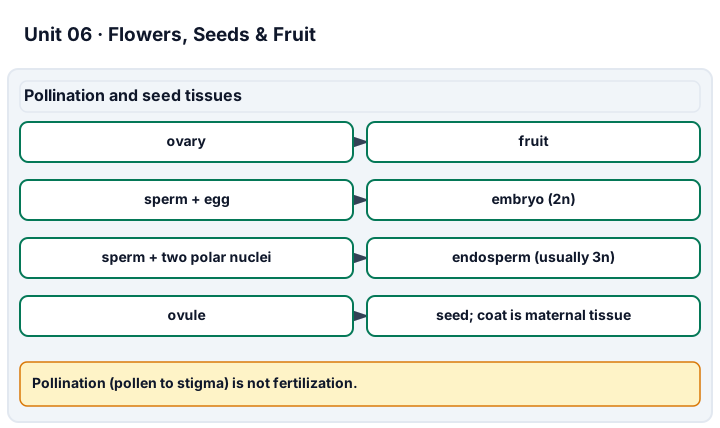
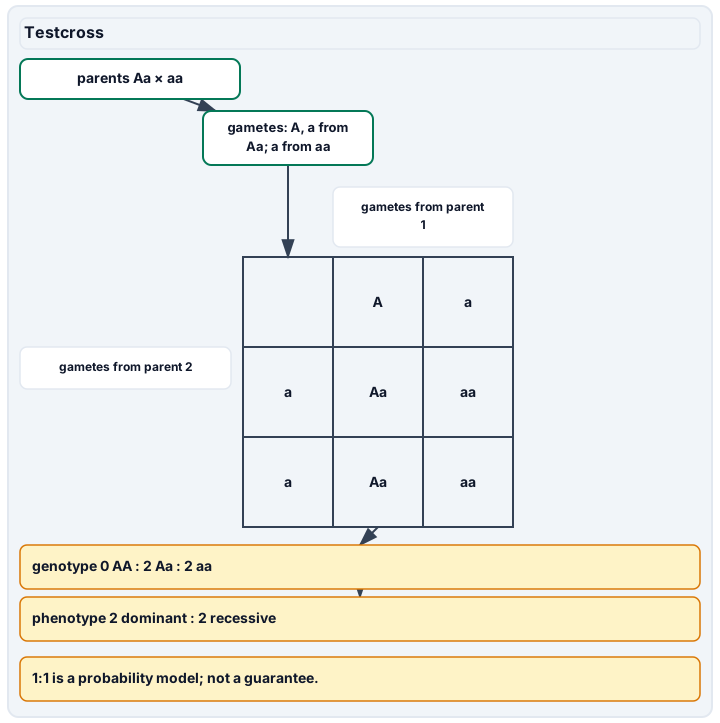
Diagram description
Pollination transfers pollen to a stigma. Fertilization events produce an embryo and usually triploid endosperm, while the ovule becomes a seed with maternal seed-coat tissue and the ovary becomes fruit. The Aa × aa testcross computes expected phenotype counts from the Punnett grid and compares observed counts with chi-square.
Data, provenance, and assumptions
| Phenotype | Observed offspring |
|---|---|
| Dominant | 51 |
| Recessive | 49 |
| Original mean (cm) | Selected-parent mean (cm) | Offspring mean (cm) |
|---|---|---|
| 20 | 26 | 23 |
Worked model
The testcross model expects 50 of each phenotype, so chi-square is (51-50)^2/50 + (49-50)^2/50 = 0.04. Separately, S = 26-20 = 6 cm and R = 23-20 = 3 cm, giving R/S = 0.5 under this teaching example.
Numerical calibration
- 0.04 chi-square under the specified model
- 6 cm
- 3 cm
- 0.5 R/S for the synthetic study
- 30 chromosomes if the stated cross succeeds
Attempt the assigned level
Try the tasks before reading the calibration. These are practice answers, not a secure examination; use a new dataset or changed assumption for the assessed transfer.
Foundation
- Trace pollen transfer through fertilization to embryo, endosperm, and seed coat.
- Compare a seed-grown offspring with a vegetatively propagated plant and explain why similar genotypes need not have identical growth.
Check after your attempt
- Pollination precedes fertilization. The typical embryo is diploid, endosperm triploid, and seed coat maternal tissue.
- Sexual reproduction reshuffles alleles; vegetative propagation usually preserves genotype, but environment and mutation can still produce differences.
High-school core: typically grades 9-10
- Find the testcross expected counts and compare the two possible parental genotypes under the assumptions.
- Calculate S and R in the separate quantitative dataset. Complete the existing genetics-practice section on this unit page for the monohybrid/dihybrid foundation.
Check after your attempt
- The 1:1 expectation is 50 and 50, consistent with Aa x aa; observed recessives contradict an AA x aa model under the stated assumptions.
- S is 6 cm and R is 3 cm. These means do not prove a single-gene mechanism for quantitative height.
Honors extension: typically grades 11-12
- Calculate the testcross chi-square and interpret it using the supplied 5% critical value 3.841 for one degree of freedom.
- Calculate R/S and the hypothetical 4x-by-2x embryo chromosome count; state the distinct assumptions needed for each inference.
Check after your attempt
- 0.04 is below 3.841: fail to reject the 1:1 model, not prove it true.
- R/S is 0.5; the hypothetical embryo count is 30. Environmental differences can confound a response estimate, and chromosome arithmetic alone does not ensure viability or fertility.
History, reading, and writing connection
Use the reproductive reading and the existing genetics-practice material to explain how a crop-breeding claim depends on the trait model, selection, and environment. Separate measured phenotype, inferred genotype, and a breeding objective.
Write in your own words or use an approved accessible equivalent. Cite a specific assigned section or figure, identify its evidence, and state one limitation or counterargument. Use the AI practice contract only for permitted coaching, never to invent observations or write the assessed response.
Transfer to a new case
The offspring grew in a warmer greenhouse than the original population. Does R/S still isolate inherited response?
Calibration: Not without accounting for that environmental change. The observed response can include environmental effects; the ratio alone does not isolate genetic causation.
Evidence to retain
Submit the reproductive diagram, testcross analysis, selected response/ploidy calculations, and a source-linked limitation. These data do not authorize breeding manipulations, hormone treatment, or genetic engineering.
Record units, calculations, source/date, uncertainty, and what is measured versus inferred. A simulation or supplied dataset must stay labeled as such. Use the approved normal-care observation plan or supplied data. Do not culture unknown microbes, inoculate plants, apply hormones or pesticides, or eat study specimens.
Return to all eight learning pathways. Print this unit page for the student lessons; the linked five-page packet remains the separate assessment companion.
Unit mastery rubric
| Criterion | Developing | Proficient | Mastery |
|---|---|---|---|
| Flower structure | Thinks a flower is decoration, not a reproductive organ. | Names petals and sepals but confuses the stamen and carpel parts. | Identifies sepals, petals, stamens (anther and filament), and the carpel (stigma, style, ovary) and states each part’s role in reproduction. |
| Pollination & double fertilization | Cannot explain how pollen reaches an egg. | Describes pollination but not double fertilization or its two products. | Traces pollination through double fertilization to the seed embryo and the endosperm, and explains how the ovary becomes fruit. |
| Seed, fruit & alternation of generations | Confuses seed tissues and life-cycle stages. | Names the stages but misassigns chromosome sets. | Explains seed/fruit formation and sporophyte/gametophyte stages, distinguishing embryo, endosperm, and maternal tissue ploidy in assigned examples. |
| Mendelian genetics & breeding | Cannot predict a defined cross. | Uses a model without checking inheritance or environmental assumptions. | Solves a monohybrid cross and assigned dihybrid, chi-square, selection, or ploidy tasks, distinguishing inherited variation from environmental effects. |
| Lab technique (flower dissection) | Cannot open a flower without destroying its parts. | Dissects a flower but mislabels the reproductive structures. | Dissects a flower cleanly, identifies every whorl under the hand lens, and documents a pollination or seed-set observation. |
| Integration (cross-domain) | Makes no supported connection between the source and the science. | Uses the source but needs help connecting evidence, writing, or limitations to the science. | Independently connects History, Reading, and Writing using a cited source, appropriate evidence, a limitation, and a scientific explanation. |
Integration is reported separately and cannot lower the science grade or block a science demonstration pass. Science and practical criteria determine that pass. Use the integration guide's evidence checklist for the separately reported criterion.
Practice: a ratio is a model, not a guaranteed count
Read the Mendelian-cross examples in OpenStax Biology 2e, Laws of Inheritance. The counts below are synthetic practice data, not Mendel's observations. The guide declares core or advanced depth before assessment.
| Tt × Tt, complete dominance | Observed |
|---|---|
| Dominant phenotype | 76 |
| Recessive phenotype | 24 |
Core task: derive the 3:1 probability ratio, predict counts for 100 offspring, compare them with 76 and 24, and explain why disagreement does not by itself disprove the model.
Advanced prerequisites: independent assortment, expected frequencies, and goodness-of-fit testing. For a specified AaBb × AaBb cross with independent loci and complete dominance, derive 9:3:3:1.
| Phenotype | Observed |
|---|---|
| A_B_ | 92 |
| A_bb | 28 |
| aaB_ | 30 |
| aabb | 10 |
Advanced task: calculate expected counts and χ² = Σ (observed − expected)² / expected for both datasets. For these specified models, degrees of freedom are categories minus one. Use the supplied 5% critical values: 3.841 for one degree of freedom and 7.815 for three.
Submit the calculation, a source-linked explanation, and one limitation. A fresh transfer question changes the parental genotypes or assumptions; the 3:1 and 9:3:3:1 ratios must not be reused automatically. Required quantitative work is assessed as science, separately from the integration response.
“I identified the stamens and carpel. In double fertilization, one sperm fertilizes the egg and another fuses with the central cell to form endosperm. A defined Tt × Tt cross predicts a 3:1 phenotype ratio with complete dominance; crossing a true-breeding tall plant with a short plant does not directly give that ratio.”
“Flowers are just the pretty part of the plant. Pollen goes somewhere and then there’s a seed. I set up the pea square but I’m not sure how the ratio comes out.”
You demonstrate this unit through a flower dissection and a genetics cross — identifying every floral part under the hand lens and working a Punnett square aloud, not a multiple-choice test. A criterion counts as mastered only when you can both do the dissection and justify the plant biology behind it. Mastery is demonstrated, not awarded.
A 5-page clipboard packet — unit overview, key terms, the mastery rubric, anchor examples, and a score sheet you can print and grade against.