Unit 07 · Plant Diversity & Classification
Compare major plant groups through their traits, life cycles, and branching ancestry, not an evolutionary ladder. Use monocot/eudicot character combinations, recognize the limits of the traditional dicot category, and distinguish an identification key from a phylogenetic hypothesis.
Student learning: Use trait evidence and life cycles without an evolutionary ladder
Choose the level by readiness, not age alone, and record it before instruction. Foundation, core, and honors tasks are study pathways, not an AP course or a promise of college credit. The instructor retains practical assessment and the published science rubric; integration is reported separately.
Prerequisites: Plant tissues and reproduction, fractions, a supplied identification key, and the distinction between classification and ancestry.
Suggested sequence: read and discuss the explanation; attempt the worked model; analyze the data at your selected level; check the answers; then complete the source-linked response and a fresh transfer question. These activities supplement, not replace, supervised practical work and the full-year schedule.
Assigned reading and focus
- OpenStax Biology 2e, 26.3: Angiosperms. Read the flowering-plant life cycle and monocot/eudicot comparison. Use typical trait combinations and distinguish sporophyte, gametophyte, spores, and gametes.
- OpenStax Biology 2e, 30.4: Leaves. Review leaf arrangement, venation, and simple/compound leaves as observable identification characters; do not turn one trait into an exceptionless rule.
Learn the science
Mosses, ferns, conifers, and flowering plants are modern branches, not a line of living ancestors. Vascular tissue, seeds, and flowers are useful characters, but real phylogenies use broader evidence and allow losses or convergence.
In alternation of generations, a diploid sporophyte produces haploid spores by meiosis; a haploid gametophyte produces gametes by mitosis. Fertilization restores diploidy. The dominant visible stage differs among plant groups.
Monocots and eudicots can often be compared using cotyledons, venation, and floral patterns. The traditional category dicots is not one natural clade; a single leaf feature should not override all other evidence.
A dichotomous key is an identification tool, not automatically an evolutionary tree. The four representatives below are a selected teaching sample, not a worldwide biodiversity survey.

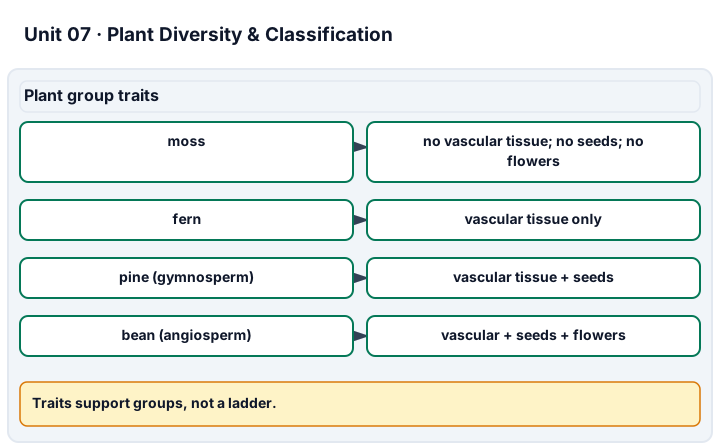
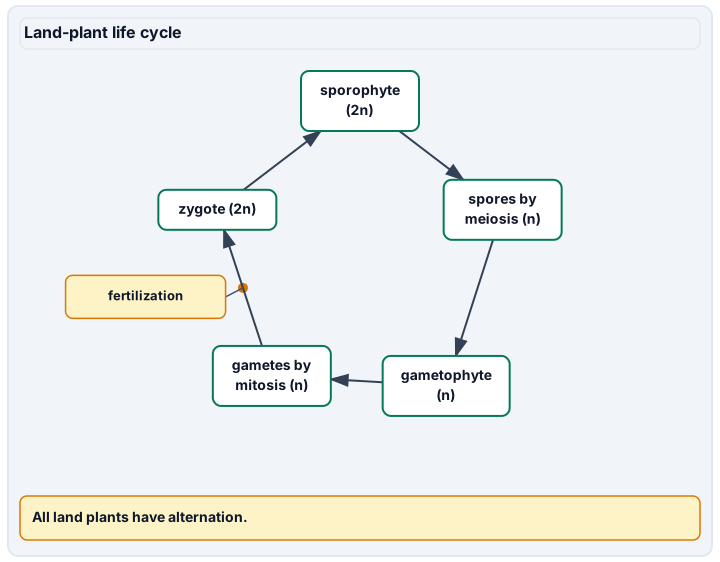
Diagram description
Moss, fern, pine, and bean are compared by vascular tissue, seeds, and flowers without using spores as a simple present/absent trait. The life-cycle panel shows alternation of generations: sporophyte, spores, gametophyte, gametes, zygote, and back to sporophyte.
Data, provenance, and assumptions
| Representative | Vascular tissue | Seeds | Flowers |
|---|---|---|---|
| Moss | 0 | 0 | 0 |
| Fern | 1 | 0 | 0 |
| Pine | 1 | 1 | 0 |
| Bean | 1 | 1 | 1 |
Worked model
Two of the four representatives are seed-bearing, a fraction of 0.5 in this selected matrix. That fraction describes the exercise, not the proportion of all plant species. Shared characters support a hypothesis of relationships, not a ladder from moss to bean.
Numerical calibration
- 0.5 fraction of the selected representatives
Attempt the assigned level
Try the tasks before reading the calibration. These are practice answers, not a secure examination; use a new dataset or changed assumption for the assessed transfer.
Foundation
- Use the matrix to build a yes/no identification key for the four representatives.
- Count seed-bearing and flowering examples.
Check after your attempt
- One valid key asks flowers first, then seeds, then vascular tissue; each branch ends at the appropriate supplied representative.
- There are two seed-bearing examples and one flowering example.
High-school core: typically grades 9-10
- Calculate the seed-bearing fraction and explain its sampling limit.
- Draw the sporophyte-spore-gametophyte-gamete-zygote cycle and label meiosis, mitosis, and fertilization.
Check after your attempt
- The fraction is 0.5, not a worldwide estimate.
- Meiosis produces spores from the sporophyte; gametophytes make gametes by mitosis; fertilization produces the diploid zygote.
Honors extension: typically grades 11-12
- Draw a simple branching hypothesis for these characters, then distinguish it from the identification key.
- Explain how a convergent trait, a lost trait, or molecular evidence could complicate that hypothesis.
Check after your attempt
- A branching representation can show nested character acquisition without making any living representative another's ancestor.
- A small character matrix is incomplete. Independent characters and genetic evidence can alter relationships or reveal misleading similarities.
History, reading, and writing connection
Compare the assigned classification figures with the key you built. Explain how common naming and explicit characters help communication while leaving room for revised evidence about ancestry.
Write in your own words or use an approved accessible equivalent. Cite a specific assigned section or figure, identify its evidence, and state one limitation or counterargument. Use the AI practice contract only for permitted coaching, never to invent observations or write the assessed response.
Transfer to a new case
An unknown plant has net-like veins. Is that alone enough to prove it is a eudicot?
Calibration: No. Use the approved key and additional traits; typical venation is evidence, not an exceptionless proof of ancestry.
Evidence to retain
Retain the trait-based key, selected calculations, life-cycle diagram, and a distinction between identification, sampling, and phylogenetic inference.
Record units, calculations, source/date, uncertainty, and what is measured versus inferred. A simulation or supplied dataset must stay labeled as such. Use the approved normal-care observation plan or supplied data. Do not culture unknown microbes, inoculate plants, apply hormones or pesticides, or eat study specimens.
Return to all eight learning pathways. Print this unit page for the student lessons; the linked five-page packet remains the separate assessment companion.
Unit mastery rubric
| Criterion | Developing | Proficient | Mastery |
|---|---|---|---|
| Major plant groups | Cannot relate groups to traits. | Lists groups but treats living representatives as ancestors of one another. | Compares bryophytes, seedless vascular plants, gymnosperms, and angiosperms by traits and life cycles on a branching model. |
| Monocots & eudicots | Cannot use diagnostic character combinations. | Uses one trait as an exceptionless rule. | Uses cotyledon, venation, and floral evidence to compare monocots/eudicots and explains why traditional dicots are not one natural clade. |
| Taxonomy & binomial nomenclature | Cannot explain why a plant has a two-part scientific name. | Reads a binomial name but muddles genus, species, or the ranks. | Explains binomial nomenclature, writes a name correctly, and places a plant in the taxonomic hierarchy. |
| Phylogeny & cladistics | Treats classification as a random list. | Reads a simple tree but cannot infer relationships from it. | Uses shared derived traits to read a cladogram and explains how phylogeny reflects common ancestry. |
| Lab technique (dichotomous key) | Cannot follow a key’s paired choices. | Works a key but takes wrong branches or ignores the specimen’s traits. | Uses a dichotomous key to identify an unknown plant, justifying each couplet choice from the specimen in hand. |
| Integration (cross-domain) | Makes no supported connection between the source and the science. | Uses the source but needs help connecting evidence, writing, or limitations to the science. | Independently connects History, Reading, and Writing using a cited source, appropriate evidence, a limitation, and a scientific explanation. |
Integration is reported separately and cannot lower the science grade or block a science demonstration pass. Science and practical criteria determine that pass. Use the integration guide's evidence checklist for the separately reported criterion.
“Parallel veins and flower parts in threes told me it was a monocot; then I ran it through the key one couplet at a time — leaf shape, then margin, then venation — down to the genus. The binomial is genus first, capitalized, then the species, both italicized.”
“There are like mosses and trees and flowers. The scientific name is just Latin. I started the key but I kept guessing which branch to take.”
You demonstrate this unit through a dichotomous-key identification — keying real specimens out to a name and defending each couplet choice aloud, not a multiple-choice test. A criterion counts as mastered only when you can both work the key and justify the plant biology behind it. Mastery is demonstrated, not awarded.
A 5-page clipboard packet — unit overview, key terms, the mastery rubric, anchor examples, and a score sheet you can print and grade against.