Unit 01 · Atomic Structure & the Periodic Table
This unit builds from the inside of the atom outward: the three subatomic particles and what each contributes to mass and charge, how isotopes differ, how electrons fill orbitals, and how those configurations explain the patterns — atomic radius, ionization energy, electronegativity — that march across the periodic table. Mastery means you can read the table as a map of electron behavior, not a chart to memorize.
Student learning: Atomic populations, spectra and electron evidence
Choose the level by readiness, not age alone, and record it before instruction. Foundation, core, and honors tasks are study pathways, not an AP course or a promise of college credit. The instructor retains practical assessment and the published science rubric; integration is reported separately.
Prerequisites: Scientific notation, proportions, signed charge, atom versus ion and simple electron configurations.
Suggested sequence: read and discuss the explanation; attempt the worked model; analyze the data at your selected level; check the answers; then complete the source-linked response and a fresh transfer question. These activities supplement, not replace, supervised practical work and the full-year schedule.
Assigned reading and focus
- OpenStax Chemistry 2e, 2.3 Atomic Structure and Symbolism. [isotope-pattern] Read Isotopes and Atomic Mass. Distinguish mass number, isotope mass, and the abundance-weighted average; annotate what a mass spectrum measures.
- OpenStax Chemistry 2e, 6.4 Electronic Structure of Atoms (Electron Configurations). [isotope-pattern] Read orbital filling, noble-gas notation and the Cr/Cu exceptions. Draw Mg and Mg2+ with separate orbital boxes; an isotope change is not an electron-configuration change.
- OpenStax Chemistry 2e, 6.5 Periodic Variations in Element Properties. [isotope-pattern] Read effective nuclear charge, atomic radius and ionization energy. Explain a comparison in the same period and a comparison down a group, rather than just stating arrows.
- OpenStax Chemistry 2e, 6.1 Electromagnetic Energy. [photons-pes] Read wavelength, frequency and the photoelectric effect. Follow E = hν = hc/λ, converting nanometres to metres before using SI constants; do not treat an emission color as a unique chemical identity.
- Chemistry Student: Photoelectron Spectroscopy. [photons-pes] Read Interpreting a PES Spectrum and Interactions Between Electrons and the Nucleus. State that its classroom peak-height rule requires comparable response and resolved subshell peaks, not arbitrary raw experimental peak heights.
- OpenStax Chemistry 2e, 7.1 Ionic Bonding. [ionic-formulas] Read cation/anion formation and the simplest charge-balanced formula ratio. Distinguish an ionic lattice formula unit from a discrete molecule and use only supplied or justified common ion charges.
- OpenStax Chemistry 2e, 6.4 Electronic Structure of Atoms (Electron Configurations). [ionic-formulas] Compare neutral and ionic electron counts. Use shell occupation to explain common main-group charges, while recognizing that transition-metal charges need additional chemical information.
Learn the science
Foundation support does not by itself demonstrate Mastery; all rubric decisions require the published independent science evidence. Honors adds breadth and model criticism, not an extra practical-pass gate. The public worked answers are nonsecure practice, not unseen exams. Complete an independent first attempt, check the explanation, then defend a fresh transfer or educator-chosen variant. Source citations used to justify chemistry are science evidence; the History/Reading/Writing integration judgment is reported separately and cannot lower the science grade or block a practical pass.
[isotope-pattern] Isotope abundance is a weighted population claim. Atomic number counts protons; mass number counts protons plus neutrons. A 25Mg2+ ion has 12 protons, 13 neutrons and 10 electrons. Ionization changes electrons, not the nucleus. Isotopes share proton number and mostly share chemical behavior but differ in mass. A sample average is the sum of isotope mass times fraction: it is not the mass of a single atom. Mass-to-charge peaks require a charge-state assumption before assigning an isotope.
[isotope-pattern] Assumptions before calculation: The three constructed peaks below are singly charged, resolved Mg isotopes with corrected equal detector response and fractions summing to one. Masses and abundances are deliberately rounded teaching inputs, not a certified natural-abundance assay. For electron diagrams use isolated ground-state species; an orbital holds at most two opposite-spin electrons.
[isotope-pattern] Uncertainty and model checks: Peak overlap, background and different detector response can bias an abundance estimate. Rounding the isotope masses to integers changes the weighted answer; it is not a new isotope. A natural-source sample need not match this constructed mixture. Radius trends need comparisons at the same charge and an explanation using shell occupancy and shielding.
[photons-pes] Emission and photoelectron evidence answer different questions. An emission photon records an energy difference between occupied states; photoelectron spectroscopy removes an electron and reports its binding energy. For an isolated-atom teaching model, binding energy = photon energy - ejected-electron kinetic energy. A solid-state instrument also needs work-function/reference calibration. Resolved, response-corrected PES peak areas can support subshell populations, but raw peak height also depends on width and sensitivity. UV-visible absorption commonly probes electronic transitions; infrared bands probe vibrational modes, while microwave transitions can probe rotation.
[photons-pes] Assumptions before calculation: Use c = 299792458 m s^-1, h = 6.62607015e-34 J s and NA = 6.02214076e23 mol^-1. The 589 nm line is one rounded reference line; the four PES peaks below are idealized synthetic Mg-like inputs with response-corrected areas, not measured photoelectron spectra. The atom is in its ground state and photon energy is sufficient to eject the electron.
[photons-pes] Uncertainty and model checks: Two close lines may be unresolved at a stated instrument bandwidth; a matching line alone is not proof of a pure element. Calibration error in either photon or kinetic energy changes inferred binding energy. Peak areas indicate populations only under the response correction. No flame, laser, UV source or unknown salt is to be used for this paper exercise.
[ionic-formulas] Valence electrons, common ions and neutral formula ratios. For a monatomic ion, electron count equals proton count minus signed ion charge. Common main-group charges can be connected to valence-shell occupation, but an octet shortcut does not determine every possible ion or a reaction pathway. An ionic formula gives the smallest whole-number ratio with zero total charge, not an isolated molecule. For Mg2+ and Cl-, one magnesium requires two chloride ions: MgCl2. Subscripts count ions or atoms; they do not replace the superscript charge on an individual ion.
[ionic-formulas] Assumptions before calculation: The reference ledger supplies selected common monatomic charges. The formula inputs state which ions are present; do not infer an unknown metal charge from position alone. Treat each supplied polyatomic ion as an intact group for formula bookkeeping. This is a symbolic exercise, not a claim that mixing elements or arbitrary ions produces a stable material under every condition.
[ionic-formulas] Uncertainty and model checks: No measured composition or lattice structure is provided. Variable-charge metals, covalent compounds and atypical ions require more evidence than a group-number rule. Charge neutrality is necessary for the stated bulk formulas but does not prove solubility, synthesis conditions, energetic favorability or a unique solid structure.

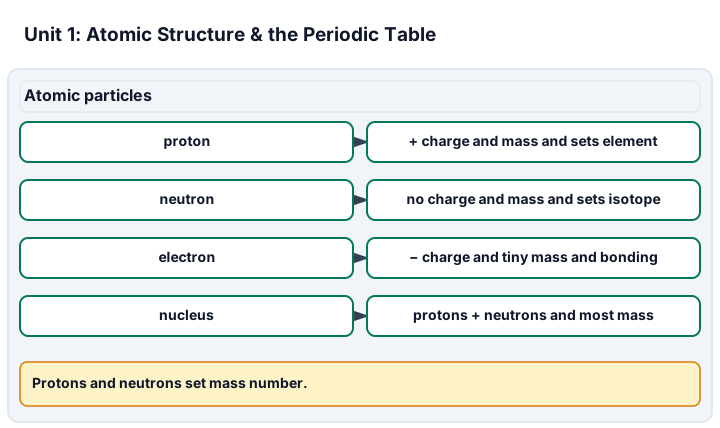
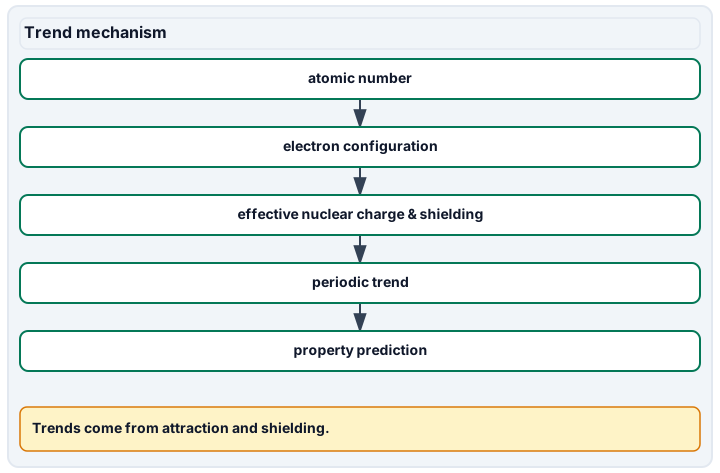
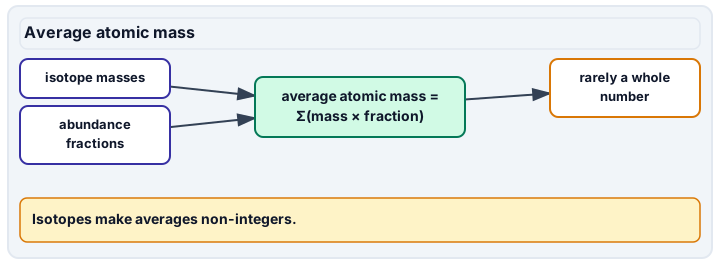
Diagram description
Atomic particles states each particle's charge, mass and role. Trend mechanism connects atomic number to electron configuration, effective nuclear charge and shielding, then trend and property prediction. Average atomic mass uses isotope masses and abundance fractions to compute a weighted average that is rarely a whole number.
Data, provenance, and assumptions
| Isotope | Mass (u) | Fraction |
|---|---|---|
| Mg-24 | 24 | 0.79 |
| Mg-25 | 25 | 0.1 |
| Mg-26 | 26 | 0.11 |
| Line | Wavelength (nm) |
|---|---|
| P | 589 |
| Peak | Binding energy (eV) | Corrected relative area |
|---|---|---|
| a | 1310 | 2 |
| b | 95 | 2 |
| c | 55 | 6 |
| d | 8 | 2 |
| Element | Protons | Neutral valence electrons | Selected ion charge |
|---|---|---|---|
| Na | 11 | 1 | 1 |
| Mg | 12 | 2 | 2 |
| Al | 13 | 3 | 3 |
| O | 8 | 6 | -2 |
| Cl | 17 | 7 | -1 |
| Pair | Cation | Cation charge | Anion | Anion charge |
|---|---|---|---|---|
| Mg/Cl | Mg | 2 | Cl | -1 |
| Al/O | Al | 3 | O | -2 |
| Ca/S | Ca | 2 | S | -2 |
Paper investigation sequence and exact evidence record
Scope and safety: All new cases are paper/data investigations, not laboratory procedures. Any physical exercise requires prior educator and safety approval, an approved protocol, suitable facilities and accessibility provisions. Do not improvise acid/base, electrolysis, gas, high-voltage, combustion, toxic-substance or unknown-substance experiments from these tables. Supplied records do not demonstrate hands-on technique or performed lab hours.
Materials and preparation
- [isotope-pattern] Use only the isotope-pattern table, the two fraction sets in the transfer, periodic-table atomic numbers and the assigned OpenStax sections.
- [photons-pes] Use photons-pes, pes-peaks, the stated 100/92 eV pair, 1 nm bandwidth and the assigned electromagnetic/PES readings.
- [ionic-formulas] Use the two reference ledgers, periodic-table proton counts, the specified iron/phosphate ions and assigned textbook sections only.
Procedure and schedule
- [isotope-pattern] Question: How much does a population average move when one isotope fraction is replaced at fixed total atoms? Prerequisites: Fraction normalization, isotope notation, multiplication and ground-state electron configurations.
- [isotope-pattern] Design: Change the Mg-26 fraction at the expense of Mg-24; record mean mass as the response and keep Mg-25 fixed. Controls: Keep mass assignments, detector-response assumption, total atom count and charge state fixed across comparisons. Replication: Compute independently twice and compare ledgers; these are arithmetic checks, not independent physical samples.
- [isotope-pattern] Analysis procedure: Check fractions total one, calculate each weighted term, predict a 0.01 substitution and assess sensitivity to rounding. Record: Retain case ID, both fraction ledgers, atom/electron counts, each weighted term in u, assumptions, trend explanation, source section/date and the independent transfer response.
- [photons-pes] Question: Can the supplied line and corrected peak pattern support a unique identity, or only a constrained electronic model? Prerequisites: Scientific notation, unit conversion, electron configurations and the isotope-pattern distinction between atom and ion.
- [photons-pes] Design: Compare wavelength and corrected subshell area; responses are photon energy and allowed electron configurations. Controls: Keep units, ground-state assumption, photon constants and response correction identical between candidates. Replication: Have a second solver repeat the energy conversion; supplied single lines have no experimental replicate uncertainty.
- [photons-pes] Analysis procedure: Compute ν and molar energy, infer binding energy by subtraction, assign subshells and reject overconfident identity claims. Record: Retain the two tables with IDs, units and provenance, worked dimensional chain, configuration, resolution limit, missing evidence, source/date and transfer.
- [ionic-formulas] Question: What can common valence occupation and explicitly supplied ion charges establish about a neutral ionic formula? Prerequisites: Understand atomic number, signed integers, valence electrons, factors and the difference between subscripts and ion charges.
- [ionic-formulas] Design: Change the cation/anion charge pair and calculate electron counts or smallest formula ratios as distinct outputs. Controls: Keep each ion identity, signed charge and intact polyatomic group fixed while reducing the formula ratio. Replication: Check neutrality and common-factor reduction independently; repeated arithmetic is not replicate chemical synthesis.
- [ionic-formulas] Analysis procedure: Subtract signed charge from proton count, find the smallest balanced ion counts, then evaluate the variable-charge counterexample. Record: Retain source/date, each input charge, electron counts, neutral sums, reduced formulas, the limits of the shell heuristic and the fresh phosphate transfer.
Record: Label every page with case and dataset IDs, selected readiness level, date and source section. Preserve the independent first attempt, units, assumptions, calculations, uncertainty, feedback and transfer. Cite the specific science criterion; do not sign a practical observation that did not occur. The course-map inventory connects every case to these exact records.
Worked model
[isotope-pattern] For the constructed mixture, mean mass = 24(0.79) + 25(0.10) + 26(0.11) = 24.32 u per atom. Neutral Mg has 1s2 2s2 2p6 3s2 = [Ne]3s2; Mg2+ loses the two 3s electrons and is [Ne]. Within the same period Mg has greater nuclear attraction than Na with a similar core, so its radius is generally smaller; shell changes prevent applying that sentence blindly down a group. [photons-pes] Convert 589 nm to 589e-9 m. ν = c/λ = 508.985497 THz and E = hc/λ = 3.3725736e-19 J per photon, or 203.101130 kJ per mole of photons. Do not confuse per-photon joules with per-mole kilojoules. The corrected PES areas 2:2:6:2 total twelve electrons and support 1s2 2s2 2p6 3s2; the least-bound electrons are in 3s. A 100 eV photon ejecting a 92 eV electron has an 8 eV binding-energy difference in the isolated-atom model. [ionic-formulas] Mg2+ has 12 - 2 = 10 electrons; O2- has 8 - (-2) = 10. For Al3+ and O2-, the smallest common charge magnitude is 6: two aluminum ions and three oxide ions give 2(+3) + 3(-2) = 0, so Al2O3. Ca2+ and S2- reduce to CaS, not Ca2S2. Electron counts and formula subscripts answer different questions.
Numerical calibration
- 24.32 u per atom in this model mixture
- 24.4 u per atom in the transfer mixture
- 508.9854974533 THz for 589 nm
- 203.1011301166 kJ mol^-1 of 589 nm photons
- 184.0408702134 kJ mol^-1 of 650 nm photons
- 10 electrons per Mg2+ ion
- 10 electrons per O2- ion
- 2 Al3+ ions per simplest formula unit
- 3 O2- ions per simplest formula unit
- 3 Ca2+ ions per Ca3(PO4)2 formula unit
Attempt the assigned level
Try the tasks before reading the calibration. These are practice answers, not a secure examination; use a new dataset or changed assumption for the assessed transfer.
Foundation
- [isotope-pattern] Using Atomic Structure and Symbolism and the isotope-pattern table, label protons, neutrons and electrons in 25Mg2+; complete the three multiplication terms for the average and explain why the fraction denominator is atoms, not grams.
- [photons-pes] From Electromagnetic Energy, use the provided SI constants to convert 589 nm to metres and find frequency. Count the electrons represented by pes-peaks and state why the twelve-electron total alone cannot distinguish a neutral atom from an ion.
- [ionic-formulas] Use the valence-ion ledger to calculate Na+, Mg2+, O2- and Cl- electron counts. Explain which species lose or gain electrons and why ion formation does not change the proton number.
Check after your attempt
- [isotope-pattern] The ion has 12 protons, 13 neutrons and 10 electrons. The weighted terms are 18.96, 2.50 and 2.86 u; they sum to 24.32 u. Number fractions count atoms, so weighting by sample grams without conversion would answer a different question.
- [photons-pes] 589 nm = 5.89e-7 m and frequency is approximately 5.08985497e14 s^-1. The four corrected areas sum to 12. Electron count alone permits multiple isoelectronic species; a known proton number or additional calibrated evidence is needed to identify an atom or ion.
- [ionic-formulas] Na+ and Mg2+ each have 10 electrons, O2- has 10 and Cl- has 18. Positive ions have lost electrons; negative ions have gained them relative to the neutral atom. The nucleus and element identity remain unchanged in this electron bookkeeping.
High-school core: typically grades 9-10
- [isotope-pattern] Calculate the mean independently, draw Mg and Mg2+ orbital diagrams, then use the Periodic Variations section to compare Na with Mg and Mg with Ca. Give a shielding/shell explanation and identify one trend exception from the reading.
- [photons-pes] Calculate both photon energy in J and energy per mole in kJ. Assign the corrected PES areas to subshells using the PES reading, and explain why a high binding-energy peak differs from a high-energy emission line.
- [ionic-formulas] Derive the three smallest neutral formulas in ionic-formula-inputs, show each signed charge sum, and connect the selected main-group charges to the reference valence counts without claiming all atoms must form those ions.
Check after your attempt
- [isotope-pattern] Mean 24.32 u; the neutral 3s pair is absent in Mg2+. Na is generally larger than Mg across period 3, whereas Ca is larger than Mg because a new principal shell is occupied. Subshell energies and pairing account for ionization-energy exceptions; a memorized arrow alone is insufficient.
- [photons-pes] Energy is about 3.37257e-19 J per photon and 203.101130 kJ mol^-1. Assign areas to 1s, 2s, 2p and 3s in descending binding energy. Binding energy removes an electron to the continuum; an emission line is a difference between two states, not the absolute binding energy of either one.
- [ionic-formulas] MgCl2 gives +2 + 2(-1) = 0; Al2O3 gives 2(+3) + 3(-2) = 0; CaS gives +2 - 2 = 0. The listed common charges correspond to losing or gaining the stated valence electrons toward a filled shell, not a universal ion-formation law.
Honors extension: typically grades 11-12
- [isotope-pattern] Move 0.01 of the atom fraction from Mg-24 to Mg-26 at fixed total atoms, predict the mean without a full recomputation, and contrast that change with losing two electrons. Use the configuration reading to explain why Cr and Cu are not simple unqualified Aufbau predictions.
- [photons-pes] Use a 100 eV photon and 92 eV ejected-electron kinetic energy to infer binding energy. Then evaluate an identification from one unresolved line spanning 589.0–589.6 nm with a 1 nm bandwidth and from unequal-width raw PES peaks.
- [ionic-formulas] Compare the formula implied by Fe2+ with oxide to that implied by Fe3+ with oxide. Explain why a blind group-number or criss-cross rule can fail and why neutrality does not prove a synthesis or crystal structure.
Check after your attempt
- [isotope-pattern] The average increases by 0.01(26 - 24) = 0.02 u, to 24.34 u. Ionization does not convert Mg-24 into Mg-26; it removes electrons. Cr and Cu ground states redistribute occupation between close-energy 4s and 3d subshells, so the simple filling mnemonic has stated exceptions.
- [photons-pes] The isolated-atom binding energy is 8 eV. A 1 nm bandwidth does not resolve the two proposed lines, so require other lines, a calibrated reference and composition controls. Unequal-width or unequal-response raw peak heights are not electron counts; corrected areas and uncertainty are necessary.
- [ionic-formulas] The stated Fe2+ charge gives FeO; Fe3+ gives Fe2O3. Iron is a variable-charge transition metal, so its chemical state must be supplied or independently established. Reduce common factors and preserve polyatomic groups; a neutral formula does not certify an actual preparation or structure.
History, reading, and writing connection
Compare the isotope and spectroscopy readings as histories of how an atomic model is constrained by evidence. Write a source-specific explanation of what each method made observable and what it left inferred; do not invent historical observations or quotations.
Write in your own words or use an approved accessible equivalent. Cite a specific assigned section or figure, identify its evidence, and state one limitation or counterargument. Use the AI practice contract only for permitted coaching, never to invent observations or write the assessed response.
Transfer to a new case
[isotope-pattern] A different constructed sample has fractions 0.75, 0.10 and 0.15 for Mg-24, Mg-25 and Mg-26. Predict the average and decide whether the change proves a change in the number of protons or in ion charge. [photons-pes] Replace the visible line with 650 nm while retaining the same constants. Calculate molar photon energy, rank it against 589 nm, and decide whether the energy calculation establishes the identity or purity of a sample. [ionic-formulas] Use the new supplied pair Ca2+ and intact PO4 with charge -3 to derive the simplest neutral formula. State the calcium/phosphate counts and why parentheses are necessary in the written answer.
Calibration: [isotope-pattern] The new mean is 24.40 u. The higher abundance of the heavier isotope raises the mean, but all species still have 12 protons. No charge-state measurement was supplied, so the mass pattern alone does not establish a new ion charge. [photons-pes] The 650 nm photons carry 184.040870 kJ mol^-1, less than at 589 nm because energy is inversely proportional to wavelength. No sample identity or purity follows from that conversion; multiple transitions and instrument/reference evidence would be needed. [ionic-formulas] Three calcium ions balance two phosphate ions: 3(+2) + 2(-3) = 0, giving Ca3(PO4)2. The parentheses multiply the entire phosphate group, not just oxygen. This result uses the supplied ion identities and does not authorize synthesis or establish solubility.
Evidence to retain
[isotope-pattern] Science criteria 1–4: keep the isotope notation ledger, atom-fraction normalization, weighted calculation, ground-state diagrams and a justified two-direction periodic comparison. Label the invented sample and its transfer; a mass calculation is not a flame-test technique demonstration under criterion 5. [photons-pes] Criteria 1, 3 and 4 use the ion/atom distinction, orbital assignment and nuclear-attraction explanation. Criterion 5 can use the spectral reasoning component, not a claimed performed flame test. Retain nm-to-m and photon-to-mole conversions, resolution judgment and a qualified identification statement. [ionic-formulas] Science criteria 1, 3 and 4: retain signed charge/electron ledgers, three reduced neutral formulas, a valence-shell explanation and the variable-charge/polyatomic transfer. Neither a correct formula nor a paper electron count demonstrates flame-test or sample-identification technique.
Record units, calculations, source/date, uncertainty, and what is measured versus inferred. A simulation or supplied dataset must stay labeled as such. All new cases are paper/data investigations, not laboratory procedures. Any physical exercise requires prior educator and safety approval, an approved protocol, suitable facilities and accessibility provisions. Do not improvise acid/base, electrolysis, gas, high-voltage, combustion, toxic-substance or unknown-substance experiments from these tables. Supplied records do not demonstrate hands-on technique or performed lab hours.
Return to all eight learning pathways. Print this unit page for the student lessons; the linked five-page packet remains the separate assessment companion.
Unit mastery rubric
| Criterion | Developing | Proficient | Mastery |
|---|---|---|---|
| Subatomic particles & atomic notation | Confuses protons, neutrons, and electrons or their charges. | Names the particles but stumbles reading mass number vs. atomic number. | Interprets atomic notation, electron counts and signed ion charge; derives simplest neutral ionic formulas from justified or supplied ion identities. |
| Isotopes & average atomic mass | Thinks all atoms of an element are identical. | Defines isotopes but cannot weight a mass average. | Calculates average atomic mass from isotope abundances and explains why it is rarely a whole number. |
| Electron configuration & orbitals | Writes configurations as random letters and numbers. | Fills orbitals but violates Hund's rule or the Aufbau order. | Writes ground-state, noble-gas, and orbital-diagram configurations correctly, including exceptions like Cr and Cu; relates corrected photoelectron peaks to subshell populations. |
| Periodic trends | Cannot state whether a property rises or falls across a period. | Recalls a trend's direction but not its cause. | Predicts and ranks radius, ionization energy, and electronegativity using effective nuclear charge and shielding. |
| Lab technique (flame tests / spectra) | Skips or contaminates the flame-test loop. | Runs the test but misassigns colors to elements. | Performs clean flame tests, links emission colors to electron transitions, and identifies an unknown salt. |
| Integration (cross-domain) | Makes no supported connection between the source and the science. | Uses the source but needs help connecting evidence, writing, or limitations to the science. | Independently connects History, Reading, and Writing using a cited source, appropriate evidence, a limitation, and a scientific explanation. |
Integration is reported separately and cannot lower the science grade or block a science demonstration pass. Science and practical criteria determine that pass. Use the integration guide's evidence checklist for the separately reported criterion.
“Chlorine-37 still has 17 protons and 20 neutrons — the mass number changes, not the element, because the proton count is fixed. And chlorine sits to the right of silicon, so it’s smaller and pulls electrons harder. That’s a trend I can reason out, not a fact I memorized.”
“It has 17… protons? And the table goes by size, I think — the big ones are over on one side.”
You demonstrate this unit through flame-test and spectroscopy labs plus short oral checks where you reason from electron structure aloud — not a multiple-choice test. A criterion counts as mastered only when you can both run the technique and justify the atomic chemistry behind it. Mastery is demonstrated, not awarded.
A 5-page clipboard packet — unit overview, key terms, the mastery rubric, anchor examples, and a score sheet you can print and grade against.