Unit 02 · Chemical Bonding & Molecular Geometry
Bonding is where atoms become substances. This unit covers why electrons are transferred or shared — ionic, covalent, and metallic bonding — how to draw valid Lewis structures, how VSEPR theory turns those structures into three-dimensional shapes, and how shape plus electronegativity decides whether a molecule is polar. Mastery means you can go from a formula to a shape to a prediction about the substance's behavior.
Student learning: Bonding, molecular structure and optical models
Choose the level by readiness, not age alone, and record it before instruction. Foundation, core, and honors tasks are study pathways, not an AP course or a promise of college credit. The instructor retains practical assessment and the published science rubric; integration is reported separately.
Prerequisites: Valence electrons, charge conservation, spatial models, molarity, linear slope/intercept and logarithm meaning.
Suggested sequence: read and discuss the explanation; attempt the worked model; analyze the data at your selected level; check the answers; then complete the source-linked response and a fresh transfer question. These activities supplement, not replace, supervised practical work and the full-year schedule.
Assigned reading and focus
- OpenStax Chemistry 2e, 7.3 Lewis Symbols and Structures. [molecular-structure] Read the counting procedure and octet exceptions. Draw electrons before assigning shape; distinguish an electron-deficient atom from an invalid total-electron count.
- OpenStax Chemistry 2e, 7.4 Formal Charges and Resonance. [molecular-structure] Read formal charge and nitrate resonance. Check that formal charges sum to net charge and that resonance contributors preserve atom positions.
- OpenStax Chemistry 2e, 7.6 Molecular Structure and Polarity. [molecular-structure] Read electron-pair geometry versus molecular structure and molecular polarity. Use the CO2 and water geometries as a comparison, not copied figures.
- OpenStax Chemistry 2e, 7.5 Strengths of Ionic and Covalent Bonds. [molecular-structure] Read the bond-energy versus distance explanation and ionic lattice trends. Explain why shorter distances are not infinitely favorable.
- Chemistry LibreTexts: The Beer-Lambert Law. [beer-lambert] Read The Absorbance of a Solution and The Beer-Lambert Law. Define I/I0, base-10 absorbance, molar absorptivity and path length; annotate the single-species, wavelength and dilute-solution assumptions.
- OpenStax Chemistry 2e, 3.3 Molarity. [beer-lambert] Read dilution and the concentration denominator. Explain why the aliquot concentration is multiplied, not divided, by a fivefold dilution factor when recovering original concentration.
Learn the science
Foundation support does not by itself demonstrate Mastery; all rubric decisions require the published independent science evidence. Honors adds breadth and model criticism, not an extra practical-pass gate. The public worked answers are nonsecure practice, not unseen exams. Complete an independent first attempt, check the explanation, then defend a fresh transfer or educator-chosen variant. Source citations used to justify chemistry are science evidence; the History/Reading/Writing integration judgment is reported separately and cannot lower the science grade or block a practical pass.
[molecular-structure] Lewis, three-dimensional shape and limited molecular evidence. A Lewis diagram is an electron-accounting model, not a photograph of localized bonds. Formal charge = valence electrons - nonbonding electrons - half the bonding electrons. Nitrate has 24 valence electrons and three equivalent resonance contributors: each has N +1, two singly bonded O -1 and one double-bonded O 0, total -1. The model average bond order is 4/3; resonance is not molecules switching back and forth. VSEPR counts domains around a center, with a multiple bond one domain. CO2 is linear and nonpolar despite polar bonds; H2O is bent and polar. Bond-dipole vectors, not electronegativity difference alone, determine molecular polarity.
[molecular-structure] Assumptions before calculation: Use ideal localized Lewis/VSEPR models for isolated small molecules. The approximate angles below illustrate electron-pair repulsion and may change with phase or substitution. The band records are deliberately synthetic functional-group clues, not a reference library or a measured spectrum. A 3-D model made from paper or software must preserve atom connections and lone pairs.
[molecular-structure] Uncertainty and model checks: An O-H-like band may come from water contamination; a carbonyl band does not uniquely determine a molecular structure. A nitrate resonance average is a model descriptor, not a claim that every bond is exactly 1.333 under all conditions. VSEPR does not resolve all transition-metal or delocalized geometries. Hybridization is a bonding model, not directly measured by these angle entries.
[beer-lambert] A calibration line is not a validated chemical method. Absorbance A = -log10(I/I0) is dimensionless. For a single absorber at fixed wavelength, A = εbc, with ε in L mol^-1 cm^-1, b in cm and c in mol L^-1. The constructed instrument has a background intercept, so use A = intercept + slope × c and do not force the regression through zero. Conjugation and other molecular electronic structures influence absorption, but a matching absorbance does not identify a unique molecule. A blank and multiple standards test a working calibration; they do not by themselves establish selectivity, recovery or method validation.
[beer-lambert] Assumptions before calculation: The synthetic records use one dissolved model chromophore, unchanged solvent, pH, temperature and wavelength, b = 1.00 cm, a matched matrix blank and a stable 0.010 background. A sample was represented by an exact fivefold dilution; its diluted absorbance is 0.510. Only standards from 0 to 0.000060 mol L^-1 define the accepted linear interval. No solution preparation is authorized.
[beer-lambert] Uncertainty and model checks: Synthetic triplicates illustrate spread, not independent physical preparation or method validation. Turbidity, stray light, detector response, interfering species, different path length, acid-base speciation and matrix effects can invalidate Beer-Lambert proportionality. At 0.000080 M the supplied response deviates, so extrapolation beyond the selected interval is unjustified. Replicate readouts cannot reveal all systematic errors.

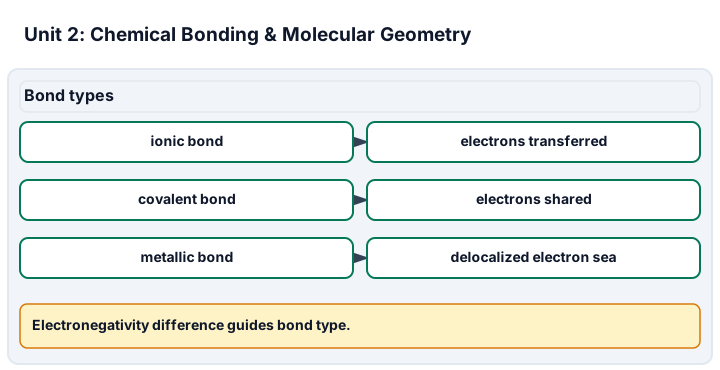
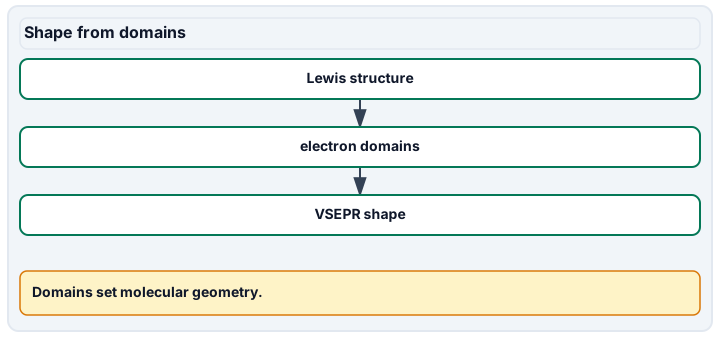
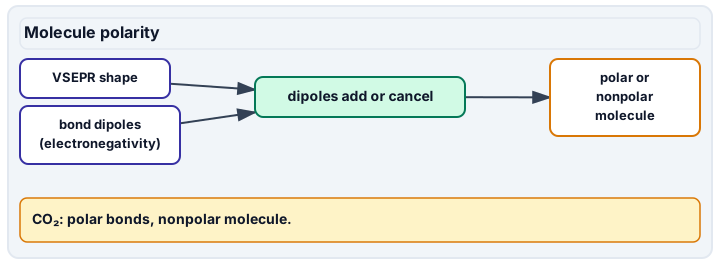
Diagram description
Bond types matches ionic, covalent and metallic bonds with electron behavior. Shape from domains shows Lewis structure leading to domains and VSEPR shape. Molecule polarity uses both shape and bond dipoles from electronegativity to decide whether dipoles add or cancel.
Data, provenance, and assumptions
| Species | Central domains | Central lone pairs | Approximate angle (degrees) | Molecular shape |
|---|---|---|---|---|
| CO2 | 2 | 0 | 180 | linear |
| H2O | 4 | 2 | 104.5 | bent |
| NH3 | 4 | 1 | 107 | trigonal pyramidal |
| BF3 | 3 | 0 | 120 | trigonal planar |
| Record | Broad 3200–3600 cm^-1 band | Near 1710 cm^-1 band |
|---|---|---|
| X | present | absent |
| Y | absent | present |
| Record | Concentration (mol L^-1) | A1 | A2 | A3 |
|---|---|---|---|---|
| blank | 0 | 0.009 | 0.01 | 0.011 |
| S1 | 0.00002 | 0.209 | 0.21 | 0.211 |
| S2 | 0.00004 | 0.409 | 0.41 | 0.411 |
| S3 | 0.00006 | 0.609 | 0.61 | 0.611 |
| S4 | 0.00008 | 0.73 | 0.732 | 0.734 |
Paper investigation sequence and exact evidence record
Scope and safety: All new cases are paper/data investigations, not laboratory procedures. Any physical exercise requires prior educator and safety approval, an approved protocol, suitable facilities and accessibility provisions. Do not improvise acid/base, electrolysis, gas, high-voltage, combustion, toxic-substance or unknown-substance experiments from these tables. Supplied records do not demonstrate hands-on technique or performed lab hours.
Materials and preparation
- [molecular-structure] Use molecular-structure, molecular-bands, Lewis drawings and paper or software models; use no chemical samples or energized instruments.
- [beer-lambert] Use beer-lambert, the provided 0.510 ± 0.003 sample reading, fivefold dilution, 1.00/0.50 cm paths and the assigned readings.
Procedure and schedule
- [molecular-structure] Question: Which geometric and spectral evidence distinguishes a compatible structural model from a unique molecular identification? Prerequisites: Valence-electron counts, charges, domain counting, vector cancellation and willingness to retain an inconclusive identification.
- [molecular-structure] Design: Vary the candidate structure while keeping formula/charge fixed; compare predicted geometry, dipole and spectral compatibility. Controls: Retain the same atom count and total electrons for each resonance contributor; do not move nuclei during a resonance redraw. Replication: Two independently drawn valid contributors check counting, not physical replication; uncertainty remains in incomplete bands.
- [molecular-structure] Analysis procedure: Build and label models, compute formal charges and bond-order averages, then list both supported inferences and alternatives. Record: Retain labeled electron diagrams, 3-D model or accessible description, charge sum, band compatibility table, assumptions, source/date and NO2- transfer.
- [beer-lambert] Question: Over which supplied concentration interval does a linear optical model support a defensible concentration estimate? Prerequisites: Mean, line slope/intercept, logarithm meaning, molarity, dilution factors and the difference between precision and accuracy.
- [beer-lambert] Design: Concentration is the explanatory variable and absorbance the response; the transfer changes path length deliberately. Controls: Hold wavelength, solvent, temperature, pH, matrix, optical path and blank treatment fixed within each calibration. Replication: Three supplied synthetic readings per standard model repeat-read spread; independent sample preparations are not supplied.
- [beer-lambert] Analysis procedure: Calculate means, graph accepted standards with labeled axes, inspect S4 residual, invert the calibrated line and propagate the stated fixed-input bounds. Record: Retain raw/mean rows, fitted interval and residual, dimensional slope, blank and dilution calculations, sensitivity endpoints, rejected inference, source/date and transfer.
Record: Label every page with case and dataset IDs, selected readiness level, date and source section. Preserve the independent first attempt, units, assumptions, calculations, uncertainty, feedback and transfer. Cite the specific science criterion; do not sign a practical observation that did not occur. The course-map inventory connects every case to these exact records.
Worked model
[molecular-structure] For nitrate, 5 + 3(6) + 1 = 24 valence electrons; one double bond and two single bonds give (2 + 1 + 1)/3 = 1.333333 model bond order. Water has four domains but only two attached atoms, so tetrahedral electron geometry does not mean a tetrahedral molecular shape. Record X is compatible with an O-H-containing material or moisture, whereas Y supports a carbonyl candidate; neither is a unique structure. At short separation nuclei/electron clouds repel strongly; potential energy has a minimum at a finite bond distance. [beer-lambert] The blank mean is 0.010. S1 and S3 give slope (0.610 - 0.210)/(0.000060 - 0.000020) = 10000 L mol^-1; with b = 1 cm, ε = 10000 L mol^-1 cm^-1. Diluted sample c = (0.510 - 0.010)/10000 = 0.000050 M, inside the calibration interval. Original c = 5 × 0.000050 = 0.000250 M. The S4 mean 0.732 is 0.078 below the linear prediction 0.810; a perfect fit to selected synthetic points is not evidence of a validated assay.
Numerical calibration
- 1.333333333333 model average bond order, dimensionless
- 18 valence electrons in NO2-
- 10000 L mol^-1 at 1.00 cm path
- 0.00025 mol L^-1 in original model sample
- 0.00006 mol L^-1 at 0.50 cm path
Attempt the assigned level
Try the tasks before reading the calibration. These are practice answers, not a secure examination; use a new dataset or changed assumption for the assessed transfer.
Foundation
- [molecular-structure] Read Lewis Symbols and Structures, then draw water and CO2 with all valence electrons. Use molecular-structure to separate electron geometry from atom geometry, and explain one reason a polar bond can occur in a nonpolar molecule.
- [beer-lambert] Use the Beer-Lambert reading to label the units of A, b, c and ε. Calculate blank and S1 means, subtract the blank from the sample, and explain why a raw absorbance is not a percent transmittance.
Check after your attempt
- [molecular-structure] Water has two O-H bonds and two lone pairs on O; its four electron domains yield bent atom geometry. CO2 has two double bonds, two domains and a linear arrangement. Equal opposite C=O bond dipoles cancel in the symmetric molecule; water’s bent bond dipoles do not cancel.
- [beer-lambert] A has no units, b is cm, c is mol L^-1, and ε is L mol^-1 cm^-1. Blank and S1 means are 0.010 and 0.210. Blank-corrected sample A is 0.500. Percent transmittance is 100 × 10^-A under the stated reference convention; absorbance is a logarithm, not a percentage.
High-school core: typically grades 9-10
- [molecular-structure] Read Formal Charges and Resonance, draw all three nitrate contributors, check total charge and compute model bond order. Use molecular-bands to exclude an incompatible candidate without declaring a unique compound. From Strengths of Bonds, explain why a bond-energy-versus-distance curve has a finite minimum.
- [beer-lambert] Fit the four valid standard means, recover diluted and original sample concentration and report a sensitivity interval if sample A is 0.510 ± 0.003 with other inputs fixed. Use the dilution reading to justify which factor multiplies concentration.
Check after your attempt
- [molecular-structure] Each nitrate contributor has N +1, two O -1 and one O 0, summing to -1; the equivalent N-O model order is 4/3. A pure carbonyl-only candidate does not explain X’s broad O-H clue without an added explanation such as water, but incomplete bands do not uniquely establish an alcohol. At long separation attraction weakens; at very short separation repulsion raises energy, giving a finite equilibrium-distance minimum.
- [beer-lambert] Slope 10000 and intercept 0.010 give diluted 0.000050 M and original 0.000250 M. Fixed-input endpoints give original 0.0002485–0.0002515 M. This is an assumed sensitivity interval, not a statistical confidence interval including all uncertainty. Dilution lowered concentration, so recover the original by multiplying by five.
Honors extension: typically grades 11-12
- [molecular-structure] Use Molecular Structure and Polarity to assign ideal sp/sp2/sp3 models to the centers in the geometry table, explain BF3’s electron deficiency, and compare ionic solids and metals without treating electronegativity cutoffs as exact laws.
- [beer-lambert] Compare S4 to the fitted prediction, propose a matrix-matched interference/recovery check, and judge whether triplicate synthetic readings validate the method. Explain how doubling path length changes slope under the unchanged chemical-species assumption.
Check after your attempt
- [molecular-structure] CO2 uses an sp model, BF3 sp2, and NH3/H2O sp3 electron-domain models; these labels idealize bonding. BF3 has only six electrons around B but a correct total. Ionic lattices are stabilized by electrostatic attraction and need mobile ions for conduction; metals have delocalized electrons. Alloys alter packing, not a universal molecule with one fixed bond type.
- [beer-lambert] S4’s mean 0.732 is below the 0.810 prediction and must not be silently included in the linear model. Independent matrix blanks, interference challenges and known additions could assess selectivity/recovery in a separately approved study. These invented triplicates are not method validation. Doubling path doubles slope only if species, wavelength and optical assumptions remain valid.
History, reading, and writing connection
Using the assigned Lewis/resonance and Beer-Lambert readings, compare a useful representation with an actual measurement. Defend a limitation of each model using a specific section; write in your own words without turning an incomplete spectrum into a discovery story.
Write in your own words or use an approved accessible equivalent. Cite a specific assigned section or figure, identify its evidence, and state one limitation or counterargument. Use the AI practice contract only for permitted coaching, never to invent observations or write the assessed response.
Transfer to a new case
[molecular-structure] For NO2-, count valence electrons, draw the two resonance contributors and predict shape and polarity. Explain whether transferring the nitrate average bond order unchanged is justified. [beer-lambert] A new model cell has b = 0.50 cm, the same ε and a separately established intercept 0.010. Its sample A is 0.310 with no dilution. Calculate concentration and state why using the original slope unmodified would be wrong.
Calibration: [molecular-structure] NO2- has 18 valence electrons, two equivalent resonance contributors and one lone pair on N; three domains give bent molecular geometry and a nonzero dipole in the ideal model. The two N-O model orders average 1.5, not nitrate’s 4/3, so the numerical descriptor must be recomputed. [beer-lambert] The new slope is εb = 5000 L mol^-1. Concentration is (0.310 - 0.010)/5000 = 0.000060 M, at the upper stated interval. Using 10000 would underestimate concentration twofold; a changed optical path requires a changed calibration even if the chemistry is unchanged.
Evidence to retain
[molecular-structure] Criteria 1–4: preserve total-electron and formal-charge ledgers, original diagrams, dipole cancellation, energy-distance explanation and a bounded band inference. Criterion 5 may observe paper-model construction; the supplied band table does not replace an approved conductivity/solubility technique observation. [beer-lambert] Criteria 1 and 4: connect a molecular absorber model to measured optical response, units and a qualified concentration inference. Criterion 5 can retain the data-analysis component, but simulated readings are not evidence of operating a spectrometer or performing the published conductivity/solubility practical.
Record units, calculations, source/date, uncertainty, and what is measured versus inferred. A simulation or supplied dataset must stay labeled as such. All new cases are paper/data investigations, not laboratory procedures. Any physical exercise requires prior educator and safety approval, an approved protocol, suitable facilities and accessibility provisions. Do not improvise acid/base, electrolysis, gas, high-voltage, combustion, toxic-substance or unknown-substance experiments from these tables. Supplied records do not demonstrate hands-on technique or performed lab hours.
Return to all eight learning pathways. Print this unit page for the student lessons; the linked five-page packet remains the separate assessment companion.
Unit mastery rubric
| Criterion | Developing | Proficient | Mastery |
|---|---|---|---|
| Bond type & electronegativity | Cannot tell ionic from covalent from metallic. | Classifies bonds by element type but not by electronegativity difference. | Uses electronegativity differences to classify bonds and predict each type's properties. |
| Lewis structures | Draws structures with wrong electron counts. | Draws simple molecules but misses lone pairs, formal charge, or resonance. | Draws valid structures including resonance, expanded octets, and correct formal charges. |
| VSEPR & molecular geometry | Cannot name a molecular shape. | Names shapes from a chart without accounting for lone pairs. | Predicts shape and bond angles from electron domains, distinguishing molecular from electron geometry. |
| Polarity & intermolecular consequences | Calls every molecule with polar bonds polar. | Identifies polar bonds but ignores symmetry. | Uses geometry and dipole cancellation to determine overall polarity and predict solubility; evaluates a Beer-Lambert concentration estimate with stated optical assumptions and limits. |
| Lab technique (model building / conductivity) | Builds models that violate the structure or skips testing. | Builds correct models but cannot link them to a property test. | Builds accurate 3-D models and confirms predictions with a conductivity or solubility test. |
| Integration (cross-domain) | Makes no supported connection between the source and the science. | Uses the source but needs help connecting evidence, writing, or limitations to the science. | Independently connects History, Reading, and Writing using a cited source, appropriate evidence, a limitation, and a scientific explanation. |
Integration is reported separately and cannot lower the science grade or block a science demonstration pass. Science and practical criteria determine that pass. Use the integration guide's evidence checklist for the separately reported criterion.
“CO₂ is linear because carbon has two double bonds and no lone pairs, so VSEPR pushes them 180° apart. Each C=O is polar, but the two pull opposite ways and cancel, so the whole molecule comes out nonpolar.”
“It’s covalent because they share electrons. The shape is bent, maybe? Polar means it has charges somewhere.”
You demonstrate this unit by building physical molecular models and running conductivity and solubility tests, then explaining your structures aloud — not a multiple-choice test. A criterion counts as mastered only when you can both build the model and justify why the bonding produces that shape and behavior. Mastery is demonstrated, not awarded.
A 5-page clipboard packet — unit overview, key terms, the mastery rubric, anchor examples, and a score sheet you can print and grade against.