Unit 03 · Stoichiometry & the Mole
Stoichiometry is the accounting of chemistry: the mole as the bridge between the atomic scale and the gram, balanced equations as conservation of mass made explicit, and the mole-ratio as the conversion that lets you predict exactly how much product a reaction can make. Mastery means you can carry a quantity from mass to moles to particles and back, find the limiting reagent, and reconcile theoretical with actual yield.
Student learning: Material, particle and solution ledgers
Choose the level by readiness, not age alone, and record it before instruction. Foundation, core, and honors tasks are study pathways, not an AP course or a promise of college credit. The instructor retains practical assessment and the published science rubric; integration is reported separately.
Prerequisites: Molar mass, ratios, ions, balanced coefficients, volume conversions and percentage calculations.
Suggested sequence: read and discuss the explanation; attempt the worked model; analyze the data at your selected level; check the answers; then complete the source-linked response and a fresh transfer question. These activities supplement, not replace, supervised practical work and the full-year schedule.
Assigned reading and focus
- OpenStax Chemistry 2e, 4.3 Reaction Stoichiometry. [limiting-yield] Read the mass-to-mass and mole-ratio calculations. Annotate why coefficients convert moles, not grams, and show canceled units in every conversion.
- OpenStax Chemistry 2e, 4.4 Reaction Yields. [limiting-yield] Read Limiting Reactant and Percent Yield. Explain why a recovered mass requires identity/purity evidence before it can stand for the amount of desired product.
- OpenStax Chemistry 2e, 3.2 Determining Empirical and Molecular Formulas. [limiting-yield] Read empirical versus molecular formulas. Reduce mole ratios, not raw mass ratios, then use an independent molar mass to select a molecular formula.
- OpenStax Chemistry 2e, 4.1 Writing and Balancing Chemical Equations. [solution-reactions] Read molecular, complete ionic and net ionic equations. Mark which dissolved species cancel and verify both atom and charge balance.
- OpenStax Chemistry 2e, 4.2 Classifying Chemical Reactions. [solution-reactions] Read precipitation reactions and their classification. Separate a chemical precipitation model from a physical dilution; solubility rules are contextual evidence, not an instruction to mix unknown materials.
- OpenStax Chemistry 2e, 3.3 Molarity. [solution-reactions] Read the solution-volume definition of molarity and dilution. State when volumes are assumed additive and which total volume is the final denominator.
- Chemistry LibreTexts / CK-12: 2.10 Separating Mixtures. [mixture-separation] Read the filtration, distillation and chromatography explanations as principles only. Match a physical property to a separation goal; do not follow any apparatus or preparation instructions.
- CUNY City Tech Biology OER: Chromatography. [mixture-separation] Read the Chromatography section for stationary/mobile-phase interactions and the retention-factor definition. Use only the supplied distances for calculation; no sample extraction or solvent procedure is assigned.
Learn the science
Foundation support does not by itself demonstrate Mastery; all rubric decisions require the published independent science evidence. Honors adds breadth and model criticism, not an extra practical-pass gate. The public worked answers are nonsecure practice, not unseen exams. Complete an independent first attempt, check the explanation, then defend a fresh transfer or educator-chosen variant. Source citations used to justify chemistry are science evidence; the History/Reading/Writing integration judgment is reported separately and cannot lower the science grade or block a practical pass.
[limiting-yield] Stoichiometric extent, limiting reagent and a yield claim. For the written reaction 2Al + 3CuCl2 -> 2AlCl3 + 3Cu, compare available moles divided by the appropriate coefficient. The smallest quotient is the maximum reaction extent. Changing a subscript to balance an equation changes the substance; only coefficients may change. Theoretical yield assumes the limiting reactant follows the stated reaction completely. Recovered material may include water or impurities, so a mass above the theoretical product mass is not proof of an unusually successful reaction.
[limiting-yield] Assumptions before calculation: The supplied record describes an ideal anhydrous CuCl2/Al reaction with no side reactions; it is a calculation, not permission to run that reaction. Use the listed rounded molar masses and a hypothetical 7.000 g of dry, pure recovered Cu. Elemental-composition inputs use C = 12.0, H = 1.0 and O = 16.0 g mol^-1 for the separate formula exercise.
[limiting-yield] Uncertainty and model checks: Hydrated copper salt would have a different molar mass and invalidate an anhydrous calculation. Incomplete reaction, product loss and wet product bias yield differently. The table does not establish actual purity or observed completion. Report the assumed dry-pure condition and do not infer the cause of a yield deficit from mass alone.
[solution-reactions] Net ionic equations, solution denominators and spectators. A dissolved formula unit and a particle in solution are not interchangeable counting units. In the ideal strong-electrolyte model Na3PO4 supplies three Na+ per formula unit, while CaCl2 supplies two Cl-. The molecular equation is 2Na3PO4 + 3CaCl2 -> Ca3(PO4)2(s) + 6NaCl. Its net ionic equation is 3Ca2+ + 2PO4^3- -> Ca3(PO4)2(s); charge sums to zero on both sides. Spectator ions remain dissolved even though the limiting precipitating ion is nearly removed.
[solution-reactions] Assumptions before calculation: The constructed calculation treats precipitation as quantitative, the named salts as completely dissociated, volumes as additive and phosphate as PO4^3- without competing protonation or complexation. These simplify real aqueous chemistry; actual yield needs a coupled equilibrium calculation. Molar mass of Ca3(PO4)2 is supplied as 310.18 g mol^-1.
[solution-reactions] Uncertainty and model checks: Real phosphate speciation depends strongly on pH and finite solubility, so the ideal record is not a recipe or a solubility measurement. Concentration errors and nonadditive volumes alter ion amounts. A visual cloud does not uniquely identify a precipitate. No physical trial is implied by this supplied dataset.
[mixture-separation] Separation choices, component recovery and product purity. Separation methods exploit physical differences: an appropriate filter retains suspended particles but does not ordinarily capture dissolved salt ions; evaporation/crystallization can recover a nonvolatile solute, while distillation can collect a volatile component. Chromatography uses differing interactions with mobile and stationary phases. Recovery compares target mass recovered with target mass initially present; purity compares target mass with the whole recovered fraction. Neither denominator is the reaction-theoretical yield unless an actual reaction is defined.
[mixture-separation] Assumptions before calculation: Use the supplied component compositions as independently given teaching inputs, not values inferable from total mass alone. The named product includes retained sand and water and is not assumed dry or pure. All output streams, including collected solvent, are accounted for without chemical reaction. Chromatographic distances share one origin, solvent system and stationary phase, with spot centers and solvent front in cm.
[mixture-separation] Uncertainty and model checks: Real composition would require independent assay and moisture evidence. The synthetic ledger closes exactly by construction and does not validate a method. Product lost into another stream can reduce recovery without changing the identity of the target. A chromatographic spot can contain co-migrating substances; equal retention factors are not unique identity or purity evidence.

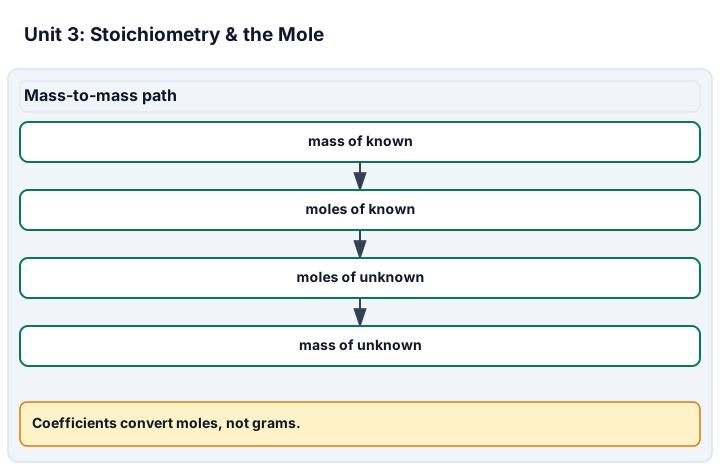
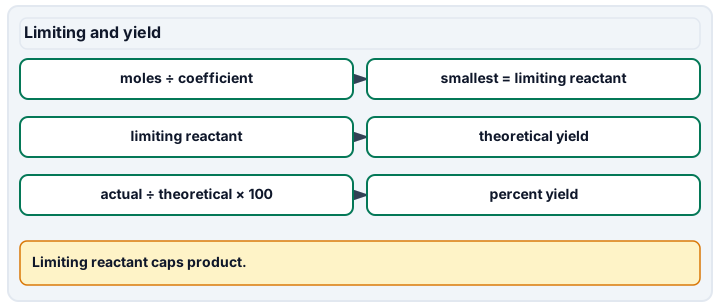
Diagram description
Mass-to-mass path converts known mass to known moles, applies the coefficient ratio to unknown moles, and converts to unknown mass. Limiting and yield uses moles divided by coefficient to identify the limiting reactant, then theoretical yield, then percent yield.
Data, provenance, and assumptions
| Record | Al mass (g) | Al molar mass (g mol^-1) | CuCl2 mass (g) | CuCl2 molar mass (g mol^-1) | Cu molar mass (g mol^-1) | Recovered Cu (g) |
|---|---|---|---|---|---|---|
| P | 2.69815 | 26.9815 | 16.134 | 134.45 | 63.546 | 7 |
| Element | Mass (g) | Atomic molar mass (g mol^-1) |
|---|---|---|
| C | 2.4 | 12 |
| H | 0.4 | 1 |
| O | 3.2 | 16 |
| Record | Na3PO4 volume (L) | Na3PO4 molarity | CaCl2 volume (L) | CaCl2 molarity | Ca3(PO4)2 molar mass |
|---|---|---|---|---|---|
| S | 0.04 | 0.15 | 0.06 | 0.1 | 310.18 |
| Stream | Salt (g) | Sand (g) | Water (g) |
|---|---|---|---|
| Feed | 10 | 5 | 100 |
| Recovered crystals | 8.5 | 0.1 | 0.2 |
| Filter residue | 0.3 | 4.8 | 1 |
| Other collected streams | 1.2 | 0.1 | 98.8 |
| Band | Spot-center distance (cm) | Solvent-front distance (cm) |
|---|---|---|
| A | 2 | 8 |
| B | 6 | 8 |
Paper investigation sequence and exact evidence record
Scope and safety: All new cases are paper/data investigations, not laboratory procedures. Any physical exercise requires prior educator and safety approval, an approved protocol, suitable facilities and accessibility provisions. Do not improvise acid/base, electrolysis, gas, high-voltage, combustion, toxic-substance or unknown-substance experiments from these tables. Supplied records do not demonstrate hands-on technique or performed lab hours.
Materials and preparation
- [limiting-yield] Use limiting-yield, elemental-composition, the 8.000 g challenge and the assigned textbook sections; no reagents are required.
- [solution-reactions] Use solution-reactions, a paper ion ledger and the assigned net-ionic/molarity readings; do not obtain or mix the named substances.
- [mixture-separation] Use separation-streams, chromatogram-distances, the new 9.0 g fraction and the assigned conceptual reading sections; no substances or apparatus.
Procedure and schedule
- [limiting-yield] Question: Which reagent limits the written reaction, and how much can a recovered-mass record actually establish about process performance? Prerequisites: Balancing by coefficients, mole/mass conversion, proportional reasoning and empirical formula ratios.
- [limiting-yield] Design: Change available Al in the transfer; calculate limiting extent, Cu yield and leftover reagent as dependent quantities. Controls: Hold reaction stoichiometry, anhydrous identity and molar-mass conventions fixed; keep inferred product purity explicit. Replication: Independent balance and dimensional checks are analytical repeats; the single synthetic yield is not a replicate experiment.
- [limiting-yield] Analysis procedure: Build an atom ledger, compute both extent limits, calculate theoretical and recovered fractions, then list non-unique loss explanations. Record: Save equation, supplied identities, mole chains, limiting comparison, excess and percent yield, empirical/molecular formulas, alternative explanations and transfer.
- [solution-reactions] Question: How do stoichiometry and final volume together determine residual-ion concentrations in the ideal precipitation model? Prerequisites: Molarity, strong-electrolyte particle representations, ionic charges and coefficient-based limiting-reagent reasoning.
- [solution-reactions] Design: Change calcium-solution volume; observe calculated product, excess-ion amount and final concentration. Controls: Keep formula-unit concentrations and the ideal speciation assumption fixed; recompute total volume rather than treating it as fixed. Replication: Have a second calculation verify material and charge closure; no physical replication or conversion measurement is supplied.
- [solution-reactions] Analysis procedure: Convert volumes to moles, cancel spectators, calculate extent and final ions, then check charge closure and alternate speciation. Record: Save reaction and charge ledgers, before/after particle representation, initial/final volumes, remaining-ion concentrations, assumptions, source/date and halved-volume transfer.
- [mixture-separation] Question: How can a larger isolated fraction have lower target recovery and purity, and what measurements would establish those claims? Prerequisites: Read additive component masses, percentages with different denominators, physical versus chemical change, and distance ratios.
- [mixture-separation] Design: Compare output stream compositions and chromatographic migration while retaining the stated initial component masses and common origin. Controls: Keep chemical identities, ledger boundaries and the chromatographic solvent/stationary-phase system fixed in each comparison. Replication: Independently sum each component and recalculate ratios; these analytic checks are not independently repeated laboratory separations.
- [mixture-separation] Analysis procedure: Sum output columns, compare with feed, name both percentage denominators, calculate Rf and challenge the larger-product claim. Record: Retain separation goals and properties, labeled balances, recovery/purity calculations, chromatographic distances, source/date, limitations and the new-fraction response.
Record: Label every page with case and dataset IDs, selected readiness level, date and source section. Preserve the independent first attempt, units, assumptions, calculations, uncertainty, feedback and transfer. Cite the specific science criterion; do not sign a practical observation that did not occur. The course-map inventory connects every case to these exact records.
Worked model
[limiting-yield] Al amount = 2.69815/26.9815 = 0.1000 mol; CuCl2 amount = 16.134/134.45 = 0.1200 mol. Extents are 0.0500 and 0.0400 mol of reaction, so CuCl2 limits. Cu = 3(0.0400) = 0.1200 mol = 7.62552 g; Al excess = (0.1000 - 0.0800)26.9815 = 0.53963 g. Conditional percent yield = 7.000/7.62552 × 100 = 91.797018%. In the separate elemental record the amounts 0.2:0.4:0.2 mol reduce to CH2O; empirical mass 30 g mol^-1 and measured 180 imply C6H12O6, not a unique structural isomer. [solution-reactions] Both salts supply 0.00600 mol of their formula units. Divide phosphate by 2 and calcium by 3: extent limits are 0.00300 and 0.00200 mol, so Ca2+ limits. Product mass is 0.00200 × 310.18 = 0.62036 g. Residual model phosphate is 0.00200 mol in 0.100 L = 0.0200 M. Na+ is 3 × 0.00600/0.100 = 0.180 M and Cl- is 2 × 0.00600/0.100 = 0.120 M. The dissolved charge balance is +0.180 - 0.120 - 3(0.0200) = 0 equivalents L^-1. [mixture-separation] Recovered crystals total 8.8 g but contain 8.5 g salt. Salt recovery is 8.5/10 times 100 = 85%; wet-fraction purity is 8.5/8.8 times 100 = 96.590909%. Output salt, sand and water separately total 10, 5 and 100 g, so total output is 115 g. Retention factors are 2/8 = 0.25 and 6/8 = 0.75; different migration reflects interactions under the stated system, not molecule size alone.
Numerical calibration
- 7.62552 g Cu, theoretical
- 0.53963 g Al remaining in the ideal model
- 91.7970184328 percent conditional yield
- 3.81276 g Cu, transfer theoretical yield
- 0.62036 g Ca3(PO4)2 in the ideal model
- 0.18 mol L^-1 Na+ in final model solution
- 0.057142857142857 mol L^-1 residual model PO4^3-
- 85 percent of initial salt mass
- 96.5909090909 percent salt by mass of the wet recovered fraction
- 115 g across all output streams
- 0.25 dimensionless retention factor
- 0.75 dimensionless retention factor
- 81 percent of initial salt mass in the new fraction
Attempt the assigned level
Try the tasks before reading the calibration. These are practice answers, not a secure examination; use a new dataset or changed assumption for the assessed transfer.
Foundation
- [limiting-yield] Using Reaction Stoichiometry, check the Al/Cu/Cl atom ledger and convert both reagent masses to moles. With the supplied extent method n/coefficient, identify the limiting reagent and explain why the larger mass can still limit.
- [solution-reactions] Use Writing and Balancing Chemical Equations to write the molecular and net ionic equations, then compute formula-unit moles from the supplied molarity and litre volumes. Name the spectators, check charge and distinguish physical dilution from forming the modeled precipitate.
- [mixture-separation] Choose a separation principle for suspended sand, dissolved salt, collection of water, and two colored dissolved components. Explain why sending salt water through an ordinary sand-retaining filter does not produce pure water.
Check after your attempt
- [limiting-yield] Both sides contain 2 Al, 3 Cu and 6 Cl atoms. The amounts are 0.1000 mol Al and 0.1200 mol CuCl2; their extent limits are 0.0500 and 0.0400 mol, so CuCl2 limits despite its larger mass. Grams cannot be compared directly across different molar masses and coefficients.
- [solution-reactions] 2Na3PO4 + 3CaCl2 -> Ca3(PO4)2 + 6NaCl; the net equation is 3Ca2+ + 2PO4^3- -> Ca3(PO4)2. Na+ and Cl- cancel as spectators. Each starting formula-unit amount is 0.00600 mol; +6 and -6 charge cancel. Dilution changes concentrations without itself creating a new substance; precipitation changes dissolved-ion populations into a solid chemical product.
- [mixture-separation] Filtration targets suspended sand; dissolved salt ions ordinarily pass through that filter. Crystallization/solvent removal targets nonvolatile salt, distillation can collect volatile water, and chromatography can separate components with different phase interactions. Each choice depends on a property, not appearance alone.
High-school core: typically grades 9-10
- [limiting-yield] Independently calculate theoretical Cu, excess Al and conditional percent yield. From Determining Empirical and Molecular Formulas, reduce the elemental-composition record and use 180 g mol^-1 to distinguish empirical and molecular formulas.
- [solution-reactions] Determine the limiting ion, ideal precipitate mass, excess phosphate and final Na+/Cl- concentrations. Use the Molarity reading to explain why neither starting solution volume alone is the correct final concentration denominator.
- [mixture-separation] Close all three component balances, calculate salt recovery and recovered-fraction purity with named denominators, and explain whether their different numerical values contradict mass conservation.
Check after your attempt
- [limiting-yield] Cu theoretical yield is 7.62552 g, Al excess is 0.53963 g and conditional yield is 91.797018%. The elemental mole ratio is 1:2:1; CH2O is empirical and C6H12O6 molecular. These counts do not identify a unique molecular structure or establish the recovered product purity.
- [solution-reactions] Calcium limits, giving 0.62036 g solid and 0.00200 mol phosphate remaining. The additive final volume is 0.100 L; concentrations are 0.0200 M phosphate, 0.180 M Na+ and 0.120 M Cl-. Dividing by one starting volume would ignore the second solution and violate the stated final-volume model.
- [mixture-separation] Output components sum to 10 g salt, 5 g sand and 100 g water, or 115 g overall. Recovery is 85% and wet-fraction purity about 96.59%. They answer different questions; the remaining 1.5 g salt is in the other supplied streams, not destroyed.
Honors extension: typically grades 11-12
- [limiting-yield] Evaluate a second claimed product mass of 8.000 g. List evidence that could distinguish retained liquid, impurity and an incorrect starting-material hydrate formula, and justify why arithmetic cannot identify the cause by itself.
- [solution-reactions] Draw a before/after ion-count model and test the final charge balance. Explain how protonation of phosphate or appreciable solubility would change the inference, without pretending that a simple ion ledger is a measured yield.
- [mixture-separation] Calculate both retention factors and explain why one visible spot or a matching reference value would not establish complete separation or unique identity. State how moisture or missing output records would affect the mass claims.
Check after your attempt
- [limiting-yield] 8.000/7.62552 × 100 is about 104.91%, inconsistent with the assumed complete conversion to dry pure Cu. Independent drying/purity and starting-material identity records would be needed under an approved method. The excess is not evidence of atom creation and one mass cannot distinguish the competing explanations.
- [solution-reactions] Remove three Ca2+ and two PO4^3- for each product unit; spectators remain. The final model charge balance is 0.180 - 0.120 - 3(0.0200) = 0 equivalents L^-1. Protonated phosphate or finite dissolution requires additional equilibrium and mass balances; those corrections cannot be inferred from a synthetic precipitate label.
- [mixture-separation] Rf values are 0.25 and 0.75. Co-migration can hide multiple substances in one spot, and Rf depends on the solvent/stationary-phase system. It is not proof of purity or identity. Moisture alters the purity denominator; an unmeasured output prevents a verified component balance.
History, reading, and writing connection
Compare the assigned stoichiometry and yield explanations with a historical claim that conservation requires every isolated product mass to equal theoretical yield. Distinguish the conservation principle from recovery efficiency and cite the actual reading rather than attributing an invented quotation.
Write in your own words or use an approved accessible equivalent. Cite a specific assigned section or figure, identify its evidence, and state one limitation or counterargument. Use the AI practice contract only for permitted coaching, never to invent observations or write the assessed response.
Transfer to a new case
[limiting-yield] Replace the Al mass with 1.07926 g while keeping 16.134 g anhydrous CuCl2 and the same molar masses. Identify the new limiting reagent and theoretical Cu mass without carrying the old limiting label forward. [solution-reactions] Halve the CaCl2 volume to 0.030 L at the same concentration and keep the phosphate input unchanged. Calculate the residual model phosphate concentration and explain why simply doubling the old excess concentration fails. [mixture-separation] A new separation of the same 10 g salt feed yields a 9.0 g fraction independently reported to contain 8.1 g salt. Calculate recovery and purity, and decide whether the larger recovered fraction proves an improved separation.
Calibration: [limiting-yield] Al is now 0.0400 mol and permits extent 0.0200 mol, smaller than the unchanged CuCl2 extent 0.0400 mol. Al limits, producing 0.0600 mol Cu or 3.81276 g. Rechecking the coefficient-normalized amounts is essential after the input changes. [solution-reactions] Calcium is 0.00300 mol, consuming 0.00200 mol phosphate and leaving 0.00400 mol. The final volume is now 0.070 L, so residual phosphate is 0.057142857 M. Both the remaining amount and denominator changed; doubling 0.0200 M omits the new total volume. [mixture-separation] Recovery is 8.1/10 times 100 = 81%; purity is 8.1/9.0 times 100 = 90%. Both are lower than before despite the larger total fraction. Extra fraction mass can be retained solvent or impurity, so mass alone is not evidence of better separation.
Evidence to retain
[limiting-yield] Criteria 1–4: retain atom ledger, canceled-unit mole chains, extent comparison, excess amount and elemental formula distinction. Criterion 5 receives the yield calculation with an explicit dry/pure assumption; a synthetic recovered mass is not evidence of measuring actual product yield. [solution-reactions] Science criteria 1–4: retain molecular/net ionic equations, charge ledger, particle-count model, limiting calculation and final-volume concentrations. Label the equilibrium and speciation assumptions; the paper record cannot certify a precipitation practical or identify an actual unknown. [mixture-separation] Science criterion 5: justify a property-based separation choice, retain the complete component ledger, distinguish recovery/purity from reaction yield, calculate Rf and evaluate the fresh fraction. These supplied-data results do not certify a performed filtration, distillation or chromatography technique.
Record units, calculations, source/date, uncertainty, and what is measured versus inferred. A simulation or supplied dataset must stay labeled as such. All new cases are paper/data investigations, not laboratory procedures. Any physical exercise requires prior educator and safety approval, an approved protocol, suitable facilities and accessibility provisions. Do not improvise acid/base, electrolysis, gas, high-voltage, combustion, toxic-substance or unknown-substance experiments from these tables. Supplied records do not demonstrate hands-on technique or performed lab hours.
Return to all eight learning pathways. Print this unit page for the student lessons; the linked five-page packet remains the separate assessment companion.
Unit mastery rubric
| Criterion | Developing | Proficient | Mastery |
|---|---|---|---|
| The mole & molar mass | Treats the mole as just a big number with no use. | Converts grams to moles but slips on Avogadro's number or molar mass. | Moves fluently among mass, moles, and particles using molar mass and Avogadro's number. |
| Balancing equations | Changes subscripts to balance or leaves equations unbalanced. | Balances simple equations by trial but struggles with polyatomics. | Balances complex equations by adjusting coefficients only, conserving every atom. |
| Mole-ratio calculations | Ignores coefficients when relating reactants to products. | Uses the ratio but sets it up upside down at times. | Uses balanced coefficients to convert reliably between any two species in a reaction. |
| Limiting reagent & excess | Assumes reactants always run out together. | Identifies the limiter but cannot find leftover excess. | Determines the limiting reagent, the product amount, and the mass of excess remaining. |
| Yield & separation evidence | Reports product mass with no comparison to theory. | Computes theoretical yield but mishandles the actual measurement. | Justifies a separation choice; calculates yield, recovery and purity, explains losses, and separately demonstrates approved measurement technique. |
| Integration (cross-domain) | Makes no supported connection between the source and the science. | Uses the source but needs help connecting evidence, writing, or limitations to the science. | Independently connects History, Reading, and Writing using a cited source, appropriate evidence, a limitation, and a scientific explanation. |
Integration is reported separately and cannot lower the science grade or block a science demonstration pass. Science and practical criteria determine that pass. Use the integration guide's evidence checklist for the separately reported criterion.
“I balanced the equation first, converted grams of magnesium to moles, used the mole ratio to get moles of product, then converted back to grams. Oxygen ran out first, so it’s the limiting reagent — that’s what caps the yield.”
“I multiplied the grams by the other number. A mole is a really big amount, right? I’m not sure which reactant runs out.”
You demonstrate this unit through a synthesis or precipitation lab where you predict the yield, run the reaction, and reconcile your measured product against theory aloud — not a multiple-choice test. A criterion counts as mastered only when you can both do the calculation and produce the matching result at the bench. Mastery is demonstrated, not awarded.
A 5-page clipboard packet — unit overview, key terms, the mastery rubric, anchor examples, and a score sheet you can print and grade against.