Unit 04 · States of Matter & Gas Laws
Matter behaves the way it does because of how its particles move and attract one another. This unit covers kinetic molecular theory, the gas laws that relate pressure, volume, temperature, and amount, the energy bookkeeping of phase changes, and the intermolecular forces that set boiling points and explain why some substances are gases and others solids at room temperature. Mastery means you can connect particle-level motion to a measurement on a gauge.
Student learning: Gas and phase models with defensible units
Choose the level by readiness, not age alone, and record it before instruction. Foundation, core, and honors tasks are study pathways, not an AP course or a promise of college credit. The instructor retains practical assessment and the published science rubric; integration is reported separately.
Prerequisites: Kelvin versus temperature differences, pressure, mole fractions, energy units and piecewise graphs.
Suggested sequence: read and discuss the explanation; attempt the worked model; analyze the data at your selected level; check the answers; then complete the source-linked response and a fresh transfer question. These activities supplement, not replace, supervised practical work and the full-year schedule.
Assigned reading and focus
- OpenStax Chemistry 2e, 9.2 Relating Pressure, Volume, Amount, and Temperature: The Ideal Gas Law. [gas-mixtures] Read the ideal gas equation and combined-gas relationships. Compare compatible pressure-volume units for R and explain why temperature must be absolute.
- OpenStax Chemistry 2e, 9.3 Stoichiometry of Gaseous Substances, Mixtures, and Reactions. [gas-mixtures] Read Dalton’s Law and gas collected with water vapor. Separate total pressure from dry-gas pressure before applying a dry-gas mole fraction.
- OpenStax Chemistry 2e, 9.6 Non-Ideal Gas Behavior. [gas-mixtures] Read the effects of molecular attractions and finite particle volume. State the low-pressure/high-temperature conditions that make the ideal model more defensible.
- OpenStax Chemistry 2e, 10.3 Phase Transitions. [phase-energy] Read heating curves and enthalpy of fusion/vaporization. Distinguish a two-phase plateau at fixed pressure from a sloping single-phase segment.
- OpenStax Chemistry 2e, 10.1 Intermolecular Forces. [phase-energy] Read dispersion, dipole-dipole and hydrogen bonding. Explain why a phase change alters intermolecular organization without automatically breaking molecular covalent bonds.
Learn the science
Foundation support does not by itself demonstrate Mastery; all rubric decisions require the published independent science evidence. Honors adds breadth and model criticism, not an extra practical-pass gate. The public worked answers are nonsecure practice, not unseen exams. Complete an independent first attempt, check the explanation, then defend a fresh transfer or educator-chosen variant. Source citations used to justify chemistry are science evidence; the History/Reading/Writing integration judgment is reported separately and cannot lower the science grade or block a practical pass.
[gas-mixtures] Partial pressure, Kelvin and the limits of the ideal gas model. Gas pressure is momentum transfer from particles to walls. Average translational kinetic energy depends on absolute temperature; equal-temperature gases do not require equal particle speeds. Ideal particles have negligible volume and no intermolecular attraction. The dry-gas pressure in a wet mixture is total pressure minus water-vapor partial pressure. Dry-gas mole fractions apply to that dry pressure, not automatically to the full wet pressure. Compression does not by itself establish a chemical reaction.
[gas-mixtures] Assumptions before calculation: The paper record is at equilibrium with water at 25.00 degrees C; use supplied vapor pressure 3.17 kPa. The dry gas is chemically inert in the calculation, ideal, with nitrogen mole fraction 0.800. Use R = 8.314462618 kPa L mol^-1 K^-1 or the equal numerical SI value in Pa m^3; 1 kPa L = 1 J. These are synthetic vessel records, not gas-handling instructions.
[gas-mixtures] Uncertainty and model checks: A leak, incomplete water saturation, temperature gradient or pressure offset changes the inferred gas amount. Using 25 rather than 298.15 in PV/nRT gives a major scale error. Attractions can lower observed pressure relative to ideal while finite particle volume matters at high density; one residual alone cannot identify a unique non-ideal cause.
[phase-energy] A plateau is an energy transfer, not no energy transfer. In a pure substance at constant pressure, energy supplied during melting changes the phase proportions rather than raising the equilibrium temperature. Once melting finishes, added heat can raise the liquid temperature. Molecular melting reorganizes intermolecular interactions; it does not ordinarily break the covalent O-H bonds of water. Not all solids are molecular: ionic, metallic and network-covalent solids need different particle models to explain conductivity and melting behavior.
[phase-energy] Assumptions before calculation: Start with 10.0 g of pure ice at 0 degrees C and constant 1 atm. Use rounded fusion enthalpy 334 J g^-1 and liquid specific heat 4.184 J g^-1 K^-1 over 0–20 degrees C. Heat loss and vessel heat capacity are set to zero for this model, and the final state is liquid water. No heating or ice-melting experiment is prescribed.
[phase-energy] Uncertainty and model checks: Real heat inputs also warm the vessel and may be lost to surroundings; impure materials can melt over a range. A thermometer lag can make a plateau appear sloped. Supplied exact segments do not establish a sensor response or a measured latent heat. Distinguish nominal model energy from actual supplied electrical energy.

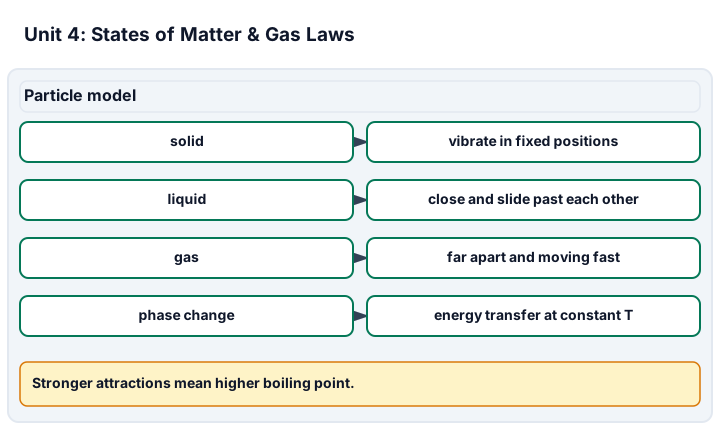
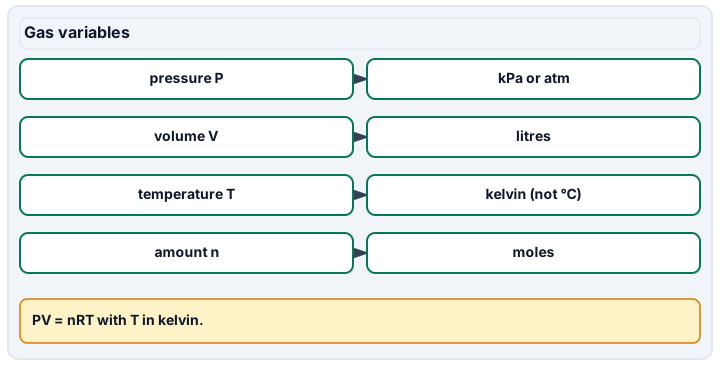
Diagram description
Particle model states solid, liquid, gas and phase-change behavior, including constant temperature during phase change. Gas variables maps pressure, volume, temperature and amount to units and the ideal gas relation.
Data, provenance, and assumptions
| Record | Total pressure (kPa) | Water vapor pressure (kPa) | Volume (L) | Temperature (C) | Dry N2 mole fraction |
|---|---|---|---|---|---|
| G | 100 | 3.17 | 2 | 25 | 0.8 |
| Case | P (kPa) | V (L) | Ideal nRT (kPa L) |
|---|---|---|---|
| low density | 50 | 2 | 100 |
| higher density | 180 | 0.5 | 100 |
| Stage | Energy added (J) | Temperature (C) | State |
|---|---|---|---|
| start | 0 | 0 | ice |
| part-melted | 1670 | 0 | ice + liquid |
| just melted | 3340 | 0 | liquid |
| warm liquid | 4176.8 | 20 | liquid |
Paper investigation sequence and exact evidence record
Scope and safety: All new cases are paper/data investigations, not laboratory procedures. Any physical exercise requires prior educator and safety approval, an approved protocol, suitable facilities and accessibility provisions. Do not improvise acid/base, electrolysis, gas, high-voltage, combustion, toxic-substance or unknown-substance experiments from these tables. Supplied records do not demonstrate hands-on technique or performed lab hours.
Materials and preparation
- [gas-mixtures] Use gas-mixtures, gas-deviation and the supplied transfer; no gas collection, heating, pressurization or vacuum apparatus is required.
- [phase-energy] Use phase-energy and the stated constants; draw a graph and particle diagrams on paper or in a spreadsheet.
Procedure and schedule
- [gas-mixtures] Question: Does an ideal-mixture calculation remain internally consistent after water correction, unit changes and a volume/temperature transfer? Prerequisites: Absolute temperature, mole fraction, dimensional analysis and the difference between pressure and amount.
- [gas-mixtures] Design: Compare units and model density; in the transfer change volume and absolute temperature while keeping dry amount fixed. Controls: Use the same R convention consistently, account for water only in the wet record, and preserve stated gas composition. Replication: Recompute n in two compatible unit systems as an arithmetic check; density cases are not replicated measurements.
- [gas-mixtures] Analysis procedure: Calculate dry pressure, n, nitrogen partial pressure and Z; separate a residual from a proven physical cause. Record: Retain original and converted units, dry/wet labels, PV/RT chains, Z residuals, model limitations, source/date and transfer prediction.
- [phase-energy] Question: Which phase proportions, rather than temperatures alone, account for energy during a constructed melting plateau? Prerequisites: Heat versus temperature, specific heat, latent heat, grams and joule/kilojoule conversion.
- [phase-energy] Design: Added energy varies; temperature and melted fraction are distinct response variables in each phase interval. Controls: Fix total mass, pressure, purity and the zero-loss/zero-vessel-heat-capacity model assumptions. Replication: Check the piecewise sum independently; the four constructed stages are sequential states, not replicate experiments.
- [phase-energy] Analysis procedure: Separate latent and sensible terms, graph the plateau, calculate phase proportions and evaluate the effect of ignored heat sinks. Record: Save stage labels, graph axes and units, phase fractions, heat sums, particle explanation, model limitations, source/date and incomplete-melting transfer.
Record: Label every page with case and dataset IDs, selected readiness level, date and source section. Preserve the independent first attempt, units, assumptions, calculations, uncertainty, feedback and transfer. Cite the specific science criterion; do not sign a practical observation that did not occur. The course-map inventory connects every case to these exact records.
Worked model
[gas-mixtures] Dry pressure = 100 - 3.17 = 96.83 kPa and T = 25 + 273.15 = 298.15 K. n = 96.83 × 2/(8.314462618 × 298.15) = 0.078121564 mol dry gas. Nitrogen partial pressure is 0.800 × 96.83 = 77.464 kPa. With pressure in Pa and volume in m^3, 96830 × 0.002 gives the same 193.66 J numerator. In gas-deviation, Z = PV/nRT is 1.00 and 0.90; the second model record departs from ideal but does not reveal a unique molecular cause. [phase-energy] Melting needs q1 = 10.0 × 334 = 3340 J. Warming the liquid by 20 K needs q2 = 10.0 × 4.184 × 20 = 836.8 J. Total q = 4176.8 J = 4.1768 kJ. During the intermediate 1670 J record, half the ice has melted while T remains 0 degrees C. A 20 degree Celsius temperature difference equals 20 K, but an absolute gas-law temperature of 20 degrees C does not equal 20 K.
Numerical calibration
- 0.078121563904 mol dry gas
- 77.464 kPa N2
- 52.4746176421 kPa dry gas in the transfer
- 4.1768 kJ for melting and warming the model water
- 5.9880239521 g melted with a 2000 J input
Attempt the assigned level
Try the tasks before reading the calibration. These are practice answers, not a secure examination; use a new dataset or changed assumption for the assessed transfer.
Foundation
- [gas-mixtures] From the Ideal Gas Law reading, convert the supplied Celsius temperature to Kelvin and calculate dry pressure. List the units that cancel in PV/RT and explain why water vapor cannot be counted twice.
- [phase-energy] Use Phase Transitions to label single-phase and two-phase segments in phase-energy. Calculate the energy to melt 10.0 g and explain why a constant temperature is compatible with a positive heat input.
Check after your attempt
- [gas-mixtures] Temperature is 298.15 K and dry pressure 96.83 kPa. kPa L divided by kPa L mol^-1 K^-1 and K leaves mol. The total already includes water vapor, so applying the dry fraction to 100 kPa would include some water in the nitrogen estimate.
- [phase-energy] The start-to-just-melted interval changes ice/liquid proportions at 0 degrees C; the final interval warms liquid. Melting needs 3340 J. During the plateau energy changes particle arrangement and phase rather than increasing the average kinetic energy represented by temperature.
High-school core: typically grades 9-10
- [gas-mixtures] Calculate dry moles and N2 partial pressure, repeat the mole calculation in SI pressure/volume units, and compare the two gas-deviation records using Z. Name one assumption each calculation needs.
- [phase-energy] Calculate the total energy from initial ice to 20 degrees C liquid, draw a labeled temperature-versus-added-energy graph, and use Intermolecular Forces to explain what bonds/interactions the model does and does not change.
Check after your attempt
- [gas-mixtures] The dry amount is 0.078121564 mol and N2 pressure 77.464 kPa. Pa m^3 and kPa L give equal PV and identical n. Z values are 1.00 and 0.90. Dalton and PV/RT use the ideal-mixture approximation, and Z comparison also needs fixed amount and uniform temperature.
- [phase-energy] Add 3340 J of fusion to 836.8 J of sensible heating for 4.1768 kJ total. The graph has a horizontal two-phase segment followed by a rising liquid segment. The molecular model changes intermolecular organization; it does not imply breaking water into H and O atoms.
Honors extension: typically grades 11-12
- [gas-mixtures] Evaluate whether the Z = 0.90 record proves intermolecular attraction caused the departure. At equal temperature compare average translational kinetic energy and rms speed for N2 and He, using molar masses 28 and 4 g mol^-1.
- [phase-energy] Explain how a nonzero vessel heat capacity or heat loss would alter a latent-heat inference. Compare the particle organization and mobile charge carriers of ice, NaCl, copper and a network-covalent solid without extending the water model to all solids.
Check after your attempt
- [gas-mixtures] Z below one is consistent with attractions but could also reflect instrument or amount errors; a fitted model is not causation. Both gases have the same average translational kinetic energy at the same T. The rms-speed ratio He/N2 is sqrt(28/4) = sqrt(7), not seven and not one.
- [phase-energy] If vessel heating/loss is assigned to water, inferred latent heat is too large. Ice is molecular, NaCl ionic, copper metallic and a network solid covalently connected throughout. Mobile electrons explain metallic conduction; an ionic solid requires mobile ions, typically on melting or dissolving, rather than merely containing charges.
History, reading, and writing connection
Use the ideal/non-ideal gas and phase-transition sections to explain how a scientific model can remain useful within limits. Contrast a historical idealization with a modern qualified prediction, identifying the source and what the supplied records cannot establish.
Write in your own words or use an approved accessible equivalent. Cite a specific assigned section or figure, identify its evidence, and state one limitation or counterargument. Use the AI practice contract only for permitted coaching, never to invent observations or write the assessed response.
Transfer to a new case
[gas-mixtures] The dry gas amount is retained but the model volume becomes 4.00 L and temperature 50.00 degrees C. Water has been excluded from this new dry-only record. Predict pressure and explain why a twofold Celsius-temperature ratio is invalid. [phase-energy] Only 2000 J reaches the original 10.0 g of ice at 0 degrees C under the same ideal conditions. Calculate melted mass and final temperature; decide whether q = mcΔT alone can represent this state.
Calibration: [gas-mixtures] Using fixed n, P2 = 96.83(323.15/298.15)(2.00/4.00) = 52.474618 kPa. Absolute temperatures set thermal motion; 50/25 is not the correct ratio. Because this is explicitly dry gas, no new water-vapor pressure is added. [phase-energy] Melted mass is 2000/334 = 5.988024 g, leaving about 4.011976 g of ice. Both phases remain at 0 degrees C. Applying q = mcΔT to the entire input would incorrectly predict warming before melting finished; latent heat is required.
Evidence to retain
[gas-mixtures] Criteria 1, 2 and 4: retain the particle-motion explanation, dry/wet distinction, unit-canceling Kelvin calculation, partial pressures and non-ideal limit. Criterion 5 may use model evaluation only; a table is not evidence of taking an actual gas or pressure measurement. [phase-energy] Criteria 1, 3 and 4: retain the particle model, labeled piecewise graph, phase and temperature-difference reasoning and the latent/sensible energy sum. Criterion 5 may record data interpretation, not a performed gas or heating practical.
Record units, calculations, source/date, uncertainty, and what is measured versus inferred. A simulation or supplied dataset must stay labeled as such. All new cases are paper/data investigations, not laboratory procedures. Any physical exercise requires prior educator and safety approval, an approved protocol, suitable facilities and accessibility provisions. Do not improvise acid/base, electrolysis, gas, high-voltage, combustion, toxic-substance or unknown-substance experiments from these tables. Supplied records do not demonstrate hands-on technique or performed lab hours.
Return to all eight learning pathways. Print this unit page for the student lessons; the linked five-page packet remains the separate assessment companion.
Unit mastery rubric
| Criterion | Developing | Proficient | Mastery |
|---|---|---|---|
| Kinetic molecular theory | Describes gases without reference to particle motion. | States the postulates but cannot apply them to behavior. | Uses KMT to explain pressure, temperature, and why real gases deviate from ideal. |
| Gas laws & the ideal gas equation | Plugs numbers into the wrong law or wrong units. | Uses single-variable laws but fumbles PV = nRT. | Selects and applies the correct gas law, tracking units and absolute temperature throughout. |
| Phase changes & energy | Thinks temperature always rises as heat is added. | Names the phase changes but ignores latent heat plateaus. | Reads a heating curve, accounts for latent heat, and explains constant T during a transition. |
| Intermolecular forces | Confuses intermolecular forces with chemical bonds. | Lists the force types but ranks their strength inconsistently. | Identifies dominant forces and uses them to predict boiling point, viscosity, and volatility. |
| Lab technique (gas / pressure measurement) | Misreads the gauge or loses gas to leaks. | Collects data but mishandles temperature or pressure correction. | Measures gas behavior accurately and verifies a gas law against collected data. |
| Integration (cross-domain) | Makes no supported connection between the source and the science. | Uses the source but needs help connecting evidence, writing, or limitations to the science. | Independently connects History, Reading, and Writing using a cited source, appropriate evidence, a limitation, and a scientific explanation. |
Integration is reported separately and cannot lower the science grade or block a science demonstration pass. Science and practical criteria determine that pass. Use the integration guide's evidence checklist for the separately reported criterion.
“When I heated the sealed syringe the pressure climbed, because the molecules hit the walls harder and more often. And water boils at a lower temperature up a mountain because there’s less air pressure for the vapor to push against.”
“Gas just spreads out when it’s hot. The gas law is PV equals something. Boiling is always 100 degrees.”
You demonstrate this unit through a gas-collection or pressure–volume lab and a heating-curve investigation, explaining the particle behavior behind every measurement aloud — not a multiple-choice test. A criterion counts as mastered only when your data confirms the law and you can justify the molecular cause. Mastery is demonstrated, not awarded.
A 5-page clipboard packet — unit overview, key terms, the mastery rubric, anchor examples, and a score sheet you can print and grade against.