Unit 05 · Thermochemistry & Energy
Every reaction is also an energy transaction. This unit covers enthalpy and the sign conventions that mark a reaction exothermic or endothermic, calorimetry as the measurement of heat flow, Hess's law for adding reactions to reach an unmeasurable one, and bond energies as the accounting of energy stored in chemical bonds. Mastery means you can predict, measure, and reconcile the heat released or absorbed by a real reaction.
Student learning: Heat, entropy and thermodynamic favorability
Choose the level by readiness, not age alone, and record it before instruction. Foundation, core, and honors tasks are study pathways, not an AP course or a promise of college credit. The instructor retains practical assessment and the published science rubric; integration is reported separately.
Prerequisites: Signed energy ledgers, reaction extent, Kelvin, logarithms and joule/kilojoule conversions; revisit the Unit 4 phase-energy case.
Suggested sequence: read and discuss the explanation; attempt the worked model; analyze the data at your selected level; check the answers; then complete the source-linked response and a fresh transfer question. These activities supplement, not replace, supervised practical work and the full-year schedule.
Assigned reading and focus
- OpenStax Chemistry 2e, 5.2 Calorimetry. [calorimetry-hess] Read coffee-cup calorimetry and the distinction between system and surroundings. Include calorimeter heat capacity before assigning the negative surroundings heat to the reaction.
- OpenStax Chemistry 2e, 5.3 Enthalpy. [calorimetry-hess] Read standard formation enthalpies and Hess’s law. Reverse or scale both equation and enthalpy; a number without a written reaction and amount basis is incomplete.
- OpenStax Chemistry 2e, 7.5 Strengths of Ionic and Covalent Bonds. [calorimetry-hess] Read average bond-enthalpy estimates. Contrast gas-phase averages with reaction enthalpies at stated phases, and distinguish bond breaking from bond formation.
- OpenStax Chemistry 2e, 16.2 Entropy. [entropy-gibbs] Read microstates and entropy change. Predict qualified effects of phase, dispersion and particle counts; do not use “disorder” as a substitute for a defined system and constraints.
- OpenStax Chemistry 2e, 16.3 The Second and Third Laws of Thermodynamics. [entropy-gibbs] Read the system/surroundings distinction and the third-law reference for a perfect crystal. Distinguish absolute entropy from standard formation enthalpy.
- OpenStax Chemistry 2e, 16.4 Free Energy. [entropy-gibbs] Read temperature dependence and the relation between free energy and equilibrium. Use ΔG = ΔG° + RT ln Q and ΔG° = -RT ln K with a dimensionless quotient.
- OpenStax Chemistry 2e, 16.4 Free Energy. [coupling-dissolution] Read additive free-energy changes and nonstandard conditions. State why summing compatible reaction free energies describes a net reaction but does not establish a kinetic pathway.
- OpenStax Chemistry 2e, 11.1 The Dissolution Process. [coupling-dissolution] Read endothermic/exothermic dissolution and the separate energetic steps of solute separation, solvent separation and solvation. Compare the whole energy balance, not just lattice disruption.
Learn the science
Foundation support does not by itself demonstrate Mastery; all rubric decisions require the published independent science evidence. Honors adds breadth and model criticism, not an extra practical-pass gate. The public worked answers are nonsecure practice, not unseen exams. Complete an independent first attempt, check the explanation, then defend a fresh transfer or educator-chosen variant. Source citations used to justify chemistry are science evidence; the History/Reading/Writing integration judgment is reported separately and cannot lower the science grade or block a practical pass.
[calorimetry-hess] An energy ledger includes the cup, signs and the written reaction. At constant pressure with only pressure-volume work, reaction heat equals the enthalpy change for the amount reacted. If solution and cup warm, their heats are positive and the reaction heat is negative in an insulated model. qsolution = mcΔT and qcup = CcupΔT have different heat-capacity units. A state function does not depend on the route: reverse a reaction and reverse its ΔH, multiply the equation and multiply ΔH. Tabulated formation enthalpies are defined relative to elements in their standard states; average gas-phase bond enthalpies give estimates, not exact solution-reaction energies.
[calorimetry-hess] Assumptions before calculation: Three synthetic trials use 100.0 g solution, c = 4.184 J g^-1 K^-1, cup heat capacity 20.0 J K^-1 and extent 0.0500 mol of the written model reaction. Assume uniform temperature, constant pressure, no evaporation, negligible other work and heat retained by solution plus cup. The supplied Hess equations are rounded reference thermochemical data, not observations from these trials.
[calorimetry-hess] Uncertainty and model checks: Temperature endpoints have a specified possible ±0.1 K reading offset each. Independent random errors and shared calibration bias are different; a mean of repeated readings does not eliminate a common offset. Escaping heat tends to underestimate the magnitude of an exothermic reaction. A larger product mass or temperature change alone does not establish an actual reaction enthalpy without amount and heat-sink accounting.
[entropy-gibbs] Entropy, Gibbs energy and direction under actual conditions. Entropy counts accessible microscopic arrangements consistent with a macroscopic state. A system can become more ordered while its surroundings gain enough entropy for the total change to be positive. The perfect-crystal entropy reference at 0 K is not the same convention as zero formation enthalpy for an element in its standard state. At constant T and p, ΔG = ΔH - TΔS determines thermodynamic direction for the stated conditions; a favorable direction is not necessarily fast. Activation barriers govern rate. Standard-state ΔG° is not automatically the actual ΔG of a mixture.
[entropy-gibbs] Assumptions before calculation: The synthetic isomerization A(g) -> B(g) has ΔH° = +40.0 kJ mol^-1 and absolute entropies 180 and 300 J mol^-1 K^-1. Assume these change negligibly over 298–400 K; this is a teaching approximation, not a real-species extrapolation. Use T in K and R = 8.314462618 J mol^-1 K^-1. Standard-state gas activities use a 1 bar reference; for this ideal gas Q = (pB/p°)/(pA/p°). For dilute solutions the parallel approximation uses c/1 mol L^-1; Q and K are dimensionless activities, not quantities with arbitrary concentration units.
[entropy-gibbs] Uncertainty and model checks: A tiny ΔG near a crossover is sensitive to uncertainties in ΔH, ΔS and T. Heat capacities can make temperature-independent values inaccurate across a wide range. A supplied entropy difference does not measure reaction speed or a transition-state barrier. At equilibrium actual ΔG is zero even if ΔG° is not zero; calling every exothermic reaction favorable ignores the entropy and condition terms.
[coupling-dissolution] Coupling and dissolution need a complete thermodynamic system. A thermodynamically favorable reaction can help drive an unfavorable transformation only if the chemistry actually couples them through a shared process or intermediate. Simply placing two unrelated reactions nearby is not sufficient. Cancel shared species with the correct coefficients and add free energies for the same conditions. Dissolution can be endothermic yet favorable if the entropy contribution dominates; hydration may also order solvent, so “dissolving always increases entropy” is false. Standard dissolution favorability and actual saturation are different questions.
[coupling-dissolution] Assumptions before calculation: The constructed coupling steps A -> I and I + C -> P have actual free-energy changes +12 and -20 kJ per written step at matching T,p and compatible species activities. The separate model salt MX(s) -> M+(aq) + X-(aq) uses standard ΔH = +18 kJ mol^-1 and ΔS = +75 J mol^-1 K^-1 at 298 K. Pure solid activity is one; solute activities depend on composition. No real chemical identities or laboratory operations are assigned.
[coupling-dissolution] Uncertainty and model checks: A proposed shared intermediate needs mechanistic evidence, not just a negative arithmetic sum. Using free energies measured at different activities breaks a simple sum unless conditions are reconciled. At nonstandard concentrations dissolution can approach equilibrium or reverse; strongly concentrated solutions may require activity coefficients. No real salt’s solubility or environmental safety follows from this synthetic model.

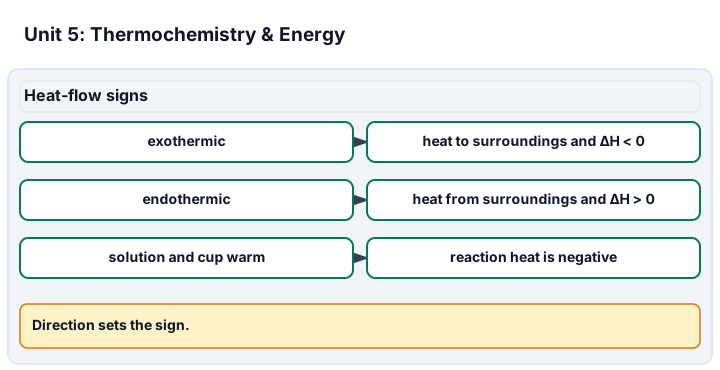
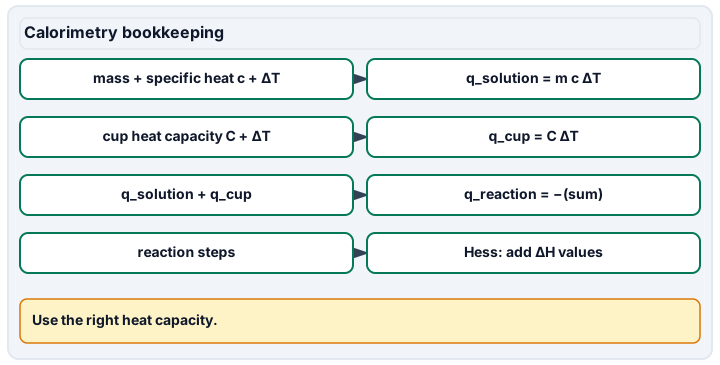
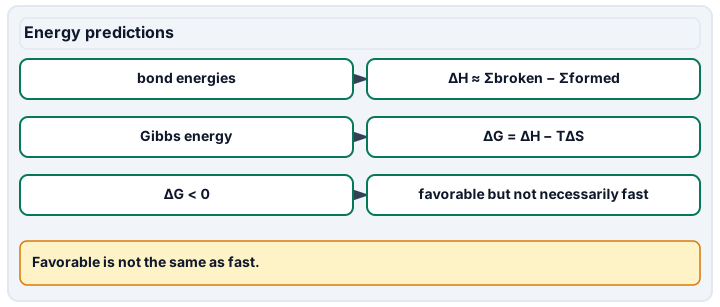
Diagram description
Heat-flow signs contrasts exothermic and endothermic processes and connects warming solution/cup to negative reaction heat. Calorimetry bookkeeping separates specific heat from cup heat capacity and then sums heat terms. Energy predictions gives bond-energy, Gibbs-energy and rate/favorability relations.
Data, provenance, and assumptions
| Trial | Solution mass | Specific heat | Cup heat capacity | Initial T | Final T | Reaction extent |
|---|---|---|---|---|---|---|
| H1 | 100 | 4.184 | 20 | 20 | 24.9 | 0.05 |
| H2 | 100 | 4.184 | 20 | 20 | 25 | 0.05 |
| H3 | 100 | 4.184 | 20 | 20 | 25.1 | 0.05 |
| Equation | Enthalpy (kJ) |
|---|---|
| C(graphite) + O2(g) -> CO2(g) | -393.5 |
| CO(g) + 1/2 O2(g) -> CO2(g) | -283 |
| Bond | Bond enthalpy (kJ mol^-1) |
|---|---|
| H-H | 436 |
| Cl-Cl | 243 |
| H-Cl | 431 |
| Model | Delta H standard | S standard A | S standard B | T (K) | Q |
|---|---|---|---|---|---|
| A -> B | 40 | 180 | 300 | 298 | 0.1 |
| Delta H sign | Delta S sign | Standard favorability |
|---|---|---|
| negative | positive | all positive T |
| positive | negative | no positive T |
| positive | positive | above H/S |
| negative | negative | below H/S |
| Step | Delta G (kJ) |
|---|---|
| A -> I | 12 |
| I + C -> P | -20 |
| Model | Delta H standard | Delta S standard | T (K) |
|---|---|---|---|
| MX(s) -> M+(aq) + X-(aq) | 18 | 75 | 298 |
Paper investigation sequence and exact evidence record
Scope and safety: All new cases are paper/data investigations, not laboratory procedures. Any physical exercise requires prior educator and safety approval, an approved protocol, suitable facilities and accessibility provisions. Do not improvise acid/base, electrolysis, gas, high-voltage, combustion, toxic-substance or unknown-substance experiments from these tables. Supplied records do not demonstrate hands-on technique or performed lab hours.
Materials and preparation
- [calorimetry-hess] Use calorimetry-hess, hess-records, bond-records and the supplied ±0.1 K endpoint bounds; there is no heating or combustion procedure.
- [entropy-gibbs] Use entropy-gibbs, gibbs-signs and the assigned entropy/free-energy sections; work with symbolic gas states on paper only.
- [coupling-dissolution] Use coupling-dissolution and dissolution-terms with the specified revised coupling ratio and assigned readings.
Procedure and schedule
- [calorimetry-hess] Question: How do cup heat, amount basis and reading bounds alter a defensible calorimetric enthalpy inference? Prerequisites: q = mcΔT, total heat capacity, signs, reaction extent, joule/kilojoule conversion and balanced equations.
- [calorimetry-hess] Design: Compare trial ΔT and change cup heat capacity in the transfer; inferred molar ΔH is the response. Controls: Keep solution mass/c, constant-pressure condition and reaction extent fixed while explicitly tracking all modeled heat sinks. Replication: Three invented trials model repeat results; they do not establish physical reproducibility or remove systematic bias.
- [calorimetry-hess] Analysis procedure: Compute each heat ledger, mean and worst-case bound, then independently close the Hess equation and distinguish a bond-energy estimate. Record: Retain raw endpoints, trial calculations, cup/solution terms, amount and phase labels, interval assumptions, Hess cancellation, source/date and transfer.
- [entropy-gibbs] Question: Can changing composition reverse the favored direction without changing temperature or the standard reaction properties? Prerequisites: Kelvin, logarithms/exponentials, J versus kJ, system/surroundings and stoichiometric activity quotients.
- [entropy-gibbs] Design: First change Q at fixed 298 K; then change T at fixed standard activities in the transfer. Treat these as distinct interventions. Controls: Keep the reaction direction, standard-state definition, energy basis and stated constant-H/S approximation explicit. Replication: Check direction independently using ΔG and Q/K; agreement is algebraic consistency, not independent empirical validation.
- [entropy-gibbs] Analysis procedure: Compute entropy difference, standard Gibbs energy, actual logarithm term, K and crossover; compare signs and model limits. Record: Retain the chosen reaction direction, absolute/reference units, Q and standard-state definitions, dimensional calculations, sign table, limitations and transfer.
- [coupling-dissolution] Question: When does a matched thermodynamic sum change sign, and what does that leave unproven about coupling or dissolution? Prerequisites: Hess-style cancellation, Gibbs energy, entropy units, activity quotient and the distinction between standard and actual state.
- [coupling-dissolution] Design: Change the cost-to-driving stoichiometric ratio; separately evaluate standard versus nonstandard dissolution conditions. Controls: Match temperature, pressure, activity convention and the written reaction basis before adding step energies. Replication: A second cancellation/energy ledger is a check of bookkeeping, not mechanistic replication or a solubility measurement.
- [coupling-dissolution] Analysis procedure: Cancel the intermediate, sum compatible ΔG values, compute dissolution ΔG° and list conditions for changing Q. Record: Retain written net equations, coefficient-weighted sums, J/kJ conversion, standard/actual labels, mechanistic limits, source/date and changed-ratio transfer.
Record: Label every page with case and dataset IDs, selected readiness level, date and source section. Preserve the independent first attempt, units, assumptions, calculations, uncertainty, feedback and transfer. Cite the specific science criterion; do not sign a practical observation that did not occur. The course-map inventory connects every case to these exact records.
Worked model
[calorimetry-hess] The middle trial has ΔT = 5.0 K. Solution heat is 2092 J and cup heat 100 J, so qreaction = -2192 J and ΔH = -2192/0.0500 = -43.84 kJ mol^-1 of reaction. The three trial values are -42.9632, -43.8400 and -44.7168 kJ mol^-1; their mean is -43.84. Reversing the second Hess equation and adding yields C + 1/2 O2 -> CO with ΔH = -393.5 + 283.0 = -110.5 kJ. Bond estimate = 436 + 243 - 2(431) = -183 kJ per written H2/Cl2 reaction; no claim of an exact liquid/solution enthalpy follows. [entropy-gibbs] ΔS° = 300 - 180 = 120 J mol^-1 K^-1 = 0.120 kJ mol^-1 K^-1. At 298 K, ΔG° = 40.0 - 298(0.120) = +4.24 kJ mol^-1. The standard forward direction is unfavorable, but with actual Q = 0.100, RT ln Q = -5.705138 kJ mol^-1 and ΔG = -1.465138 kJ mol^-1, so forward change is favorable from that mixture. K = exp(-4240/(R × 298)) = 0.180638; Q < K independently confirms forward direction. The model standard crossover is 40/0.120 = 333.333333 K. [coupling-dissolution] Cancel I to obtain A + C -> P with ΔG = +12 - 20 = -8 kJ. The sum is favorable under the matching specified conditions, not proof that either step is fast or the route occurs. In the dissolution model, ΔG° = 18 - 298(0.075) = -4.35 kJ mol^-1 even though ΔH° is positive. Actual ΔG also includes RT ln(aM aX), so accumulation of dissolved ions changes the driving force; omitting pure solid from Q does not mean it is irrelevant to whether a solid phase exists.
Numerical calibration
- -43.84 kJ mol^-1 of model reaction
- -110.5 kJ per C + 1/2 O2 -> CO
- -183 kJ per H2 + Cl2 -> 2HCl, estimated
- -45.84 kJ mol^-1 with the revised cup capacity
- 4.24 kJ mol^-1, standard state at 298 K
- -1.4651377888 kJ mol^-1, actual Q = 0.100 at 298 K
- 333.3333333333 K, constant-H/S model crossover
- 0.18063846628 dimensionless activity equilibrium constant at 298 K
- -8 kJ mol^-1, standard state at 400 K
- -8 kJ per net A + C -> P
- -4.35 kJ mol^-1, standard model dissolution
- 4 kJ per revised net transformation
Attempt the assigned level
Try the tasks before reading the calibration. These are practice answers, not a secure examination; use a new dataset or changed assumption for the assessed transfer.
Foundation
- [calorimetry-hess] Using Calorimetry, label system and surroundings and calculate trial H2’s separate solution and cup heat. Explain the negative reaction heat and sketch relative reactant/product enthalpy levels with a labeled downward ΔH arrow; do not call that arrow the activation barrier.
- [entropy-gibbs] From Entropy and Free Energy, compute ΔS° from the supplied absolute values, convert J to kJ and find ΔG° at 298 K. Explain why neither positive ΔS of the system alone nor negative ΔH alone settles favorability.
- [coupling-dissolution] From Free Energy, cancel the common intermediate and add the two supplied step free energies. State which part of the calculation describes the overall reaction and which missing information would address speed.
Check after your attempt
- [calorimetry-hess] The reaction is the system; solution and cup gain 2092 J and 100 J, totaling 2192 J. Conservation assigns -2192 J to the reaction. Divide by 0.0500 mol and 1000 J/kJ for -43.84 kJ mol^-1. Products lie below reactants on the enthalpy sketch by that reaction-amount-scaled difference; the endpoint arrow does not specify a transition-state barrier.
- [entropy-gibbs] ΔS° is +120 J mol^-1 K^-1 or +0.120 kJ mol^-1 K^-1. ΔG° is +4.24 kJ mol^-1. Favorability at fixed T,p depends on both system and surroundings, summarized by ΔG; an endothermic process may be entropy-driven and an exothermic one may be unfavorable under specified conditions.
- [coupling-dissolution] I appears once as product and once as reactant, leaving A + C -> P. The sum is -8 kJ per net reaction at the stated conditions. That addresses thermodynamic direction; a rate law, activation barriers and evidence of an actual shared pathway would be needed to address speed.
High-school core: typically grades 9-10
- [calorimetry-hess] Calculate and compare all three trial molar enthalpies, then derive the CO formation reaction from hess-records with explicit cancellation. Use the bond reading to estimate the separate HCl reaction and name a reason it need not equal a precise tabulated value.
- [entropy-gibbs] Use the Free Energy reading to compute actual ΔG for Q = 0.100, calculate K and check the sign by comparing Q with K. Explain the standard-state convention and distinguish a favorable reaction from a fast reaction.
- [coupling-dissolution] Use The Dissolution Process to compute the salt model’s ΔG° with compatible units and explain why positive enthalpy is not enough to rule out dissolution. Write the activity quotient including the treatment of pure solid.
Check after your attempt
- [calorimetry-hess] Trial molar values are -42.9632, -43.8400 and -44.7168 kJ mol^-1. Reverse CO oxidation, add and cancel CO2 and half an O2 to get -110.5 kJ per mole CO formed. Gas bond averages give -183 kJ per written HCl equation, but environment-dependent bond energies and phases limit that estimate.
- [entropy-gibbs] Actual ΔG is -1.465138 kJ mol^-1 and K is 0.180638. Q < K agrees with forward change despite positive ΔG°. Gas activities divide pressure by 1 bar; logarithms take dimensionless ratios. Thermodynamic favorability is not reaction speed: a large activation barrier may make this favorable change slow.
- [coupling-dissolution] Convert +75 J mol^-1 K^-1 to +0.075 kJ mol^-1 K^-1; ΔG° is -4.35 kJ mol^-1. The favorable entropy term outweighs the positive enthalpy in this model. Q = aM aX because the present pure solid has activity one; actual composition changes the driving force.
Honors extension: typically grades 11-12
- [calorimetry-hess] Treat each temperature endpoint as independently bounded by ±0.1 K. Find the worst-case H2 enthalpy endpoints with other inputs fixed, and distinguish this bound from a standard error or a heat-loss correction.
- [entropy-gibbs] Use gibbs-signs to justify all four temperature cases, calculate the crossover, and test the effect of Q = K or Q greater than K without assuming the actual mixture is at standard state. Name a limitation of extrapolating constant H and S.
- [coupling-dissolution] Evaluate a claim that simultaneous A -> I and an unrelated fuel reaction must be coupled. For dissolution, explain why no numerical solubility can be certified from the negative standard energy alone without the correct equilibria and activities.
Check after your attempt
- [calorimetry-hess] The ΔT bounds are 4.8–5.2 K, so ΔH lies from -45.5936 to -42.0864 kJ mol^-1. This is a worst-case input bound, not a confidence interval. A shared thermometer offset may cancel in a difference, while heat leakage is a separate model bias not estimated by these bounds.
- [entropy-gibbs] The -H/+S case stays favorable and +H/-S stays unfavorable at positive T. When both are positive, T above H/S favors reaction; when both are negative, lower T favors it. Here the crossover is 333.333333 K. Q = K gives ΔG = 0; Q > K gives positive forward ΔG. Heat-capacity effects can change H and S with T.
- [coupling-dissolution] Thermodynamic bookkeeping does not establish physical coupling: compatible intermediates, a feasible mechanism and actual conditions matter. A negative standard dissolution energy indicates a standard-state tendency, not a measured saturation concentration. Activities, stoichiometry, speciation and competing equilibria must be addressed before a quantitative real-salt solubility claim.
History, reading, and writing connection
Read the Gibbs introduction and dissolution discussion. Explain why a historical emphasis on released heat alone would miss entropy-driven change; cite a section, trace the scientific evidence and bound any technological or energy-policy claim. This source response is separately reported integration.
Write in your own words or use an approved accessible equivalent. Cite a specific assigned section or figure, identify its evidence, and state one limitation or counterargument. Use the AI practice contract only for permitted coaching, never to invent observations or write the assessed response.
Transfer to a new case
[calorimetry-hess] A new supplied record retains ΔT = 5.0 K, solution mass/c and extent but has cup capacity 40.0 J K^-1. Calculate the molar reaction enthalpy and decide whether neglecting cup heat would overstate or understate exothermic magnitude. [entropy-gibbs] At 400 K, assume the same ΔH° and absolute entropies and evaluate the forward reaction at standard activities Q = 1. Calculate ΔG and judge the claim that the sign change proves a high reaction rate. [coupling-dissolution] A revised symbolic route requires two +12 kJ upstream transformations to produce one intermediate consumed by a single -20 kJ driving step. At matching conditions, calculate net ΔG and decide whether one driving event is sufficient thermodynamically.
Calibration: [calorimetry-hess] qsurroundings = (100 × 4.184 + 40) × 5 = 2292 J, giving -45.84 kJ mol^-1. Neglecting cup heat gives only -41.84 kJ mol^-1, underestimating the magnitude because some released energy warmed the cup rather than the solution. [entropy-gibbs] At Q = 1 the logarithm term is zero, so ΔG = ΔG° = 40.0 - 400(0.120) = -8.00 kJ mol^-1. The forward direction is now thermodynamically favorable in the model, but the sign supplies no rate constant or activation energy and therefore does not prove a fast reaction. [coupling-dissolution] The revised net cost is 2(12) - 20 = +4 kJ, so one driving event is insufficient to make that net direction favorable at the stated conditions. The two-to-one coupling stoichiometry cannot be replaced by the original one-to-one sum.
Evidence to retain
[calorimetry-hess] Criteria 1–4: keep the signed system/surroundings ledger, amount basis, trial comparison, Hess cancellation and bond estimate with phases. Criterion 5 uses the uncertainty/analysis component only; invented temperatures cannot demonstrate actual thermometer technique, insulation control or a performed calorimetry investigation. [entropy-gibbs] Science criterion 1 includes entropy, standard versus actual Gibbs direction and rate/favorability separation. Criteria 2–3 retain the energy-unit ledger and state-function/condition reasoning. Save Q/K sign checks, source interpretation and the changed-temperature transfer; these are science evidence, not a requirement to adopt an integration viewpoint. [coupling-dissolution] Criteria 1 and 3 retain compatible-condition free-energy sums, canceled intermediates, dissolution enthalpy/entropy reasoning and a limitation on solubility inference. This is an original symbolic science argument, not a claim of measured mechanism, bond-energy calculation, performed experiment or an integration grading requirement.
Record units, calculations, source/date, uncertainty, and what is measured versus inferred. A simulation or supplied dataset must stay labeled as such. All new cases are paper/data investigations, not laboratory procedures. Any physical exercise requires prior educator and safety approval, an approved protocol, suitable facilities and accessibility provisions. Do not improvise acid/base, electrolysis, gas, high-voltage, combustion, toxic-substance or unknown-substance experiments from these tables. Supplied records do not demonstrate hands-on technique or performed lab hours.
Return to all eight learning pathways. Print this unit page for the student lessons; the linked five-page packet remains the separate assessment companion.
Unit mastery rubric
| Criterion | Developing | Proficient | Mastery |
|---|---|---|---|
| Enthalpy, entropy & Gibbs energy | Confuses heat, entropy, favorability or reaction speed. | Assigns enthalpy signs but needs help with entropy, units or actual conditions. | Interprets energy diagrams and bond-energy signs; calculates entropy and Gibbs changes at stated conditions, distinguishes standard from actual states, and separates favorability from rate. |
| Calorimetry calculations | Cannot set up q = mcΔT. | Uses the equation but mishandles units or the system–surroundings sign. | Calculates heat transfer correctly and assigns it to the reaction with the right sign. |
| Hess's law | Adds reactions without adjusting their enthalpies. | Manipulates equations but forgets to flip or scale ΔH. | Combines, reverses, and scales reactions and enthalpies consistently; adds compatible free-energy steps with correct coupling stoichiometry and limits. |
| Bond energy estimates | Ignores bonds when reasoning about energy. | Sums bond energies but mixes up bonds broken vs. formed. | Estimates ΔH from bond energies, correctly subtracting bonds formed from bonds broken. |
| Lab technique (calorimetry) | Loses heat to the surroundings and ignores it. | Runs the calorimeter but records temperature carelessly. | Measures ΔT precisely, accounts for heat loss, and computes a defensible ΔH. |
| Integration (cross-domain) | Makes no supported connection between the source and the science. | Uses the source but needs help connecting evidence, writing, or limitations to the science. | Independently connects History, Reading, and Writing using a cited source, appropriate evidence, a limitation, and a scientific explanation. |
Integration is reported separately and cannot lower the science grade or block a science demonstration pass. Science and practical criteria determine that pass. Use the integration guide's evidence checklist for the separately reported criterion.
“The reaction warmed the water, so heat left the system — it’s exothermic and ΔH is negative. I used q = mcΔT on the water for the heat, then divided by the moles of fuel to report it per mole.”
“It got hot, so energy went in. Enthalpy is just the heat. I’d add the numbers from the table together.”
You demonstrate this unit by running a coffee-cup calorimetry experiment, predicting the enthalpy change and reconciling it with your measured temperature data aloud — not a multiple-choice test. A criterion counts as mastered only when your measured heat matches your calculation within reason and you can explain the discrepancy. Mastery is demonstrated, not awarded.
A 5-page clipboard packet — unit overview, key terms, the mastery rubric, anchor examples, and a score sheet you can print and grade against.