Unit 08 · Electrochemistry & Redox
The year closes with the chemistry of electron transfer. This unit covers assigning oxidation states, identifying what is oxidized and what is reduced, balancing redox equations by half-reactions, and building the two kinds of electrochemical cells — galvanic cells that turn a reaction into a voltage, and electrolytic cells that use a voltage to force a reaction. Mastery means you can trace electrons from one species to another and build a working cell.
Assigned practice: charge, electrons, and product
Before starting: review Unit 03 mole ratios, grams per mole, minutes-to-seconds conversion, and balancing charge. Allow about 50 minutes for reading and practice, followed by a separate 15-minute transfer check. Choose foundation, core, or honors by readiness before instruction. Completing foundation practice does not by itself demonstrate Mastery: scaffolded calculations prepare for the same independent criterion evidence. Honors deepens the model, not the practical-pass requirements.
These paper models are not a laboratory procedure or safety authorization. Naming copper, silver, or electrolysis does not authorize obtaining chemicals, plating metal, generating gases, or opening a battery. Actual practical work stays separate and requires an instructor-approved, supervised procedure and the pre-lab safety check, including electrical, chemical, and disposal controls.
Specified source readings
- OpenStax Chemistry 2e, 17.1: Review of Redox Chemistry. Read “Oxidation Numbers” and “Balancing Redox Equations,” including the half-reaction steps for acidic and basic solution. Identify how both atoms and charge must balance and why electrons cancel in the combined reaction.
- OpenStax Chemistry 2e, 17.3: Electrode and Cell Potentials. Read the opening definitions and the equations for Ecell and standard Ecell. Note that tabulated values are reduction potentials and that multiplying a half-reaction does not multiply its voltage.
- OpenStax Chemistry 2e, 17.7: Electrolysis. Read the opening galvanic/electrolytic comparison and “Quantitative Aspects of Electrolysis,” including “Converting Current to Moles of Electrons” and “Time Required for Deposition.” Follow the charge-to-electron-to-product unit chain. Read only; none of the source's chemical processes is assigned laboratory work.
Given constants, equations, and model limits
Use F = 96485 C per mol e- and 1 A = 1 C s^-1. For constant current, Q = I t with t in seconds, then n(e-) = Q/F. If z moles of electrons make one mole of the specified product and eta is its current-efficiency fraction, n(product) = eta Q/(zF) and mass = n(product) M, where M is molar mass. The electrons per product come from the balanced electrode reaction, not an arbitrary coefficient in the combined equation.
The cases below are synthetic practice data, not laboratory observations. Assume sufficient dissolved metal ions, constant current and stated efficiency over each interval, negligible charge storage, and no depletion or transport limit. Current efficiency is the fraction of the total charge that makes the named cathode product. It is not a reduction of the charge that passed through the wire and is not a claim that electrons disappear. Other electrode reactions must account for the remaining charge; the model does not identify them unless stated.
Write Cu2+(aq) + 2e- -> Cu(s) for copper deposition: one Cu atom on each side, and +2 - 2 = 0 charge on the left, matching neutral Cu. Here z = 2. In the copper practice model, the anode reaction is Cu(s) -> Cu2+(aq) + 2e-. Assume 100% current efficiency at the anode, no loss of copper from the modeled inventory, and that the other cathode reaction does not consume Cu2+. Both electrodes pass the same total charge. Anode copper loss equals cathode copper gain plus the increase of dissolved copper; the missing cathode mass is not lost matter.
Unless asked for a bound, report derived results to three significant figures. The answer keys retain guard digits so the charge and mass accounts can be checked; those digits are not claimed measurement precision.
| Case | I (A) | Time (min) | z (mol e- per mol product) | M (g mol^-1) | Efficiency (%) |
|---|---|---|---|---|---|
| Cu-P | 2.00 | 30.0 | 2 | 63.546 | 80.0 |
| Reduction couple | E standard (V) |
|---|---|
| Zn2+/Zn | -0.76 |
| Cu2+/Cu | +0.34 |
| Ag+/Ag | +0.80 |
Foundation: follow the unit chain
Use the equations in the assigned readings and the supplied Cu half-reactions.
- Label oxidation/anode and reduction/cathode, checking atoms and charge. For the separate galvanic Zn/Cu model, identify electron direction in the external circuit and calculate Ecell = Ecathode - Eanode.
- For Cu-P, first calculate the ideal upper bound by temporarily setting eta = 1 (100%), not the actual 80% case. Convert minutes to seconds, calculate charge and moles of electrons, divide by 2 to obtain moles of Cu, and convert to grams. Explain why voltage alone cannot give deposited mass.
- Cite the quantitative section of 17.7 in a short explanation of why 1 mol e- does not make 1 mol Cu. Give an approved accessible equivalent if needed.
Worked ideal limit: check after your attempt
Zn is oxidized at the anode and Cu2+ is reduced at the cathode in the galvanic Zn/Cu case. Electrons travel through the external circuit from anode to cathode; ions, not electrons, carry charge through the electrolyte/salt bridge. Subtract the listed reduction potentials: +0.34 - (-0.76) = 1.10 V. Reversing that net reaction requires external driving; 1.10 V is its ideal reversible limit under the stated conditions, not a practical operating voltage. Resistance and overpotential require additional driving voltage. This separate Zn/Cu result is not the operating voltage of the copper-transfer model.
For Cu-P, Q = 2.00 C s^-1 x (30.0 min x 60 s min^-1). Then Q/F converts C to mol e-, and dividing by z = 2 converts mol e- to mol Cu. Voltage specifies energy per charge, not how much charge flows in a given time.
- 1800 s; convert time before multiplying.
- 3600 C; the total charge at either electrode.
- 0.03731150 mol e-; Q/F.
- 0.01865575 mol Cu; n(e-)/2 at 100% efficiency.
- 1.185498 g Cu; ideal upper bound (1.19 g to three significant figures).
Core: account for current efficiency and conservation
Use the charge-to-product method in the assigned readings, now with the actual modeled 80.0% cathode efficiency.
- Independently show Q, total mol e-, the charge making Cu, the charge used by other reactions, mol Cu, and mass Cu. State where the factor 0.800 enters and why it must not be applied twice.
- Use the stated 100% copper-dissolution anode efficiency to calculate anode mass loss and the change in dissolved copper. Reconcile the total charge and copper mass accounts.
- Explain how galvanic and electrolytic cells differ while both retain oxidation at the anode and reduction at the cathode. Cite 17.1 for charge balance and 17.7 for the electron-to-product conversion. Name one assumption that would prevent predicting actual product from current and time alone.
Worked efficiency case: check after your attempt
The same 3600 C and 0.03731150 mol e- pass; only 0.800 of that charge deposits Cu. Use n(Cu) = 0.800 x 3600/(2 x 96485), not 0.800 twice. The other 20% of cathode charge is assigned to other reduction processes: electrons do not disappear. Unknown efficiency, depletion, or a different product would invalidate a simple mass prediction.
- 2880 C; makes the target Cu.
- 720 C; other cathode reactions; 2880 + 720 = 3600.
- 0.01492460 mol Cu; useful electrons divided by 2.
- 0.948399 g Cu; 0.948 g to three significant figures.
- 0.237100 g Cu; dissolved inventory increase, given the stated side-reaction assumption.
The 100%-efficient anode loses the ideal 1.185498 g Cu, which is approximately 0.948399 g on the cathode plus 0.237100 g remaining in solution. The half-reactions conserve atoms and charge individually, and the complete copper inventory is conserved. A galvanic cell supplies electrical energy; an electrolytic cell needs an external supply. The anode is negative in a galvanic cell and positive in an electrolytic cell; its oxidation role never changes.
Honors: reverse the calculation and test the model
Use “Time Required for Deposition” in the assigned readings.
- How long at the same 2.00 A and 80.0% cathode efficiency would the model need to deposit 0.500 g Cu? Rearrange the mass equation before substituting.
- Explain whether reducing efficiency raises or lowers the time needed for a fixed target mass. If current is not constant, which part of Q = I t must change? State why a standard cell-potential prediction cannot by itself settle that current.
Check after your attempt
t = mass z F/(eta I M) = 0.500 x 2 x 96485/(0.800 x 2.00 x 63.546) = 948.968 s, or 949 s (15.8 min) to three significant figures. Lower efficiency lengthens the time because useful charge arrives more slowly. For piecewise-constant current use Q = sum(I_i t_i); for continuously varying current use the area under the current-time curve. A final-current reading is not automatically the average, and voltage data alone do not specify resistance, polarization, or current history.
Fresh transfer: a different ion and current history
After the copper practice, use the fresh silver cases below. The cathode half-reaction is Ag+(aq) + e- -> Ag(s), so z = 1, not 2. Assume sufficient Ag+, the same no-depletion/no-storage limits, and 75.0% efficiency for silver formation. Cover the key while assessing. These published checks are not secure examination items; if already studied, the instructor supplies and records a changed variant.
| Case | I (A) | Time (min) | z (mol e- per mol product) | M (g mol^-1) | Efficiency (%) |
|---|---|---|---|---|---|
| Ag-T | 1.20 | 20.0 | 1 | 107.8682 | 75.0 |
- Foundation: balance the Ag half-reaction, explain z, and use the equation scaffold to calculate seconds, Q, and total mol e-. Explain why carrying over copper's factor 2 would be wrong.
- Core: independently calculate Ag-T's charge, total mol e-, mol Ag, and mass Ag with units and efficiency. In a separate galvanic Cu/Ag case, combine Cu oxidation and Ag reduction, identify the agents and electron direction, and calculate the voltage from the supplied potentials.
- Honors: replace Ag-T's constant current/time with the two intervals below, still at 75.0% silver efficiency. Calculate total Q, time-weighted average current, and Ag mass. Explain the error in using only the final current for the whole duration.
| Interval | Constant I (A) | Duration (min) |
|---|---|---|
| V1 | 0.600 | 10.0 |
| V2 | 1.20 | 5.00 |
Instructor calibration: reveal after the transfer
Ag+ has charge +1, so one electron makes one Ag atom. For Ag-T, t = 1200 s and Q = 1.20 x 1200; multiply Q/F by 0.750 and divide by z = 1 before converting to grams.
- 1440 C; total charge, not efficiency-adjusted charge.
- 0.01492460 mol e-; total electrons.
- 0.01119345 mol Ag; 0.750 x Q/F.
- 1.207417 g Ag; 1.21 g to three significant figures.
Separately, the balanced galvanic reaction is Cu(s) + 2Ag+(aq) -> Cu2+(aq) + 2Ag(s). Both sides have one Cu, two Ag, and total charge +2. Cu is the reducing agent, oxidized at the anode; Ag+ is the oxidizing agent, reduced at the cathode. Two electrons leave Cu and two Ag+ each accept one; z for each Ag remains 1. Electrons flow through the external circuit from Cu to Ag. Ecell = +0.80 - (+0.34) = 0.46 V. Doubling the Ag half-reaction balances electrons but does not double its potential.
For Ag-V, Q = 0.600 x 600 + 1.20 x 300. The total duration is 900 s. Use that summed charge, not 1.20 A for the entire run.
- 720 C; the two charge intervals summed.
- 0.800 A; 720/900, not the unweighted mean or final current.
- 0.603709 g Ag; 0.750 x 720 x 107.8682/96485, or 0.604 g to three significant figures.
Criterion evidence to submit
For criterion 4: Galvanic & electrolytic cells, retain the selected level, Cu-P and Ag-T/Ag-V IDs (or recorded variant), dated independent work, the balanced electrode reaction and z, seconds, Q, total mol e-, current efficiency, mol product, and mass with units. Include cell type, electrode roles, electron direction, and the separate voltage prediction. Cite a specific reading section, explain one model limitation, and use the fresh transfer to establish independent reasoning. A student-authored response or approved accessible equivalent is required, not a copied answer key.
Record half-reaction mass and charge checks toward criterion 3 without dropping its acidic/basic balancing requirement. Mastery on criterion 4 needs both the cell explanation and a correct charge-to-product chain; a number with the wrong z, missing units, or ignored efficiency is not sufficient. Criteria 1–2 and supervised practical criterion 5 remain in force. Integration is reported separately and cannot lower the science grade or block a practical pass; citing the calculation's source is scientific evidence, not an integration-grade gate. Follow the AI practice contract for coaching.
Print this student page if needed and attach the work to the existing five-page assessment packet; record its reference in criterion 4's notes. Solving these models does not demonstrate equipment competence or authorize a practical.
Student learning: Redox conservation and actual cell driving force
Choose the level by readiness, not age alone, and record it before instruction. Foundation, core, and honors tasks are study pathways, not an AP course or a promise of college credit. The instructor retains practical assessment and the published science rubric; integration is reported separately.
Prerequisites: Complete existing faraday-practice/faraday-transfer, including current efficiency. Use oxidation states, half-reactions, activities, logarithms and Gibbs energy.
Suggested sequence: read and discuss the explanation; attempt the worked model; analyze the data at your selected level; check the answers; then complete the source-linked response and a fresh transfer question. These activities supplement, not replace, supervised practical work and the full-year schedule.
Assigned reading and focus
- OpenStax Chemistry 2e, 17.3 Electrode and Cell Potentials. [nonstandard-cell] Read standard reduction potentials and cell-potential subtraction. Explain why reversing or scaling a half-reaction does not permit multiplying an electrode potential by its coefficient.
- OpenStax Chemistry 2e, 17.4 Potential, Free Energy, and Equilibrium. [nonstandard-cell] Read ΔG = -nFE, the equilibrium relation and the Nernst equation. Keep the sign tied to the written reaction and distinguish open-circuit thermodynamics from current under load.
- OpenStax Chemistry 2e, 17.1 Review of Redox Chemistry. [redox-balance] Read the half-reaction method in acidic and basic solution. Balance electrons before recombining, cancel spectators and check atom counts and net charge at the end.
Learn the science
Foundation support does not by itself demonstrate Mastery; all rubric decisions require the published independent science evidence. Honors adds breadth and model criticism, not an extra practical-pass gate. The public worked answers are nonsecure practice, not unseen exams. Complete an independent first attempt, check the explanation, then defend a fresh transfer or educator-chosen variant. Source citations used to justify chemistry are science evidence; the History/Reading/Writing integration judgment is reported separately and cannot lower the science grade or block a practical pass.
[nonstandard-cell] Cell potential is intensive; its free-energy consequence is not. For a galvanic cell the written spontaneous reaction has E > 0 and ΔG < 0. E is an intensive potential difference; balancing electron counts does not multiply it. ΔG scales with reaction amount through nF. For an electrolytic cell an external source drives a reaction opposite its favored direction, with additional voltage often required for resistance and overpotential. Oxidation remains at the anode and reduction at the cathode: a galvanic anode is negative and cathode positive, while the externally driven electrolytic signs reverse. Electrons travel through the external circuit from the oxidation electrode toward the reduction electrode, via the power supply when present; ions rather than electrons carry charge through the electrolyte.
[nonstandard-cell] Assumptions before calculation: Use R = 8.314462618 J mol^-1 K^-1 and F = 96485 C mol^-1 electrons. The Zn/Cu reference reaction is Zn(s) + Cu2+(aq) -> Zn2+(aq) + Cu(s), with rounded E° = 1.100 V, n = 2 and T = 298 K. Standard activities use pure solids and a 1 mol L^-1 solute reference; actual Q = aZn2+/aCu2+ = 100. Treat ion activities as normalized dilute concentrations only for this model. The transfer is a separate symbolic one-electron cell.
[nonstandard-cell] Uncertainty and model checks: Nernst E is a reversible/open-circuit prediction. It does not supply a safe operating voltage or predict current, product selectivity, resistance or electrode kinetics. Concentrations can be poor activity estimates at higher ionic strength. Liquid-junction potentials and temperature uncertainty are absent from the ideal record. This supplements, rather than replaces, the previously assigned Faraday current-efficiency practice.
[redox-balance] Mass and charge must both close in acidic and basic ledgers. Oxidation number is an electron-accounting convention; increasing it indicates oxidation and electron loss. The oxidizing agent is itself reduced. In acid, permanganate Mn(+7) can be represented as gaining five electrons to reach Mn(+2); Fe2+ loses one electron, so five iron ions are required. In the supplied basic model Mn(+7) becomes Mn(+4) while sulfite S(+4) becomes sulfate S(+6); the least common electron count is six. Balancing only oxygen/hydrogen while ignoring charge can produce an impossible ionic equation.
[redox-balance] Assumptions before calculation: These are symbolic stoichiometric records with the explicitly stated acid or base medium and assigned products; they are not instructions to prepare acidic permanganate or any redox mixture. Product identity in real chemistry depends on conditions. The particle ledger columns give numbers of atoms per species and signed integer ion charge.
[redox-balance] Uncertainty and model checks: Balanced equations prove conservation, not actual kinetics, selectivity or product identity. A different medium can change the manganese product and electron ratio. Water and H+/OH- are balancing species, not permission to combine the named substances. An oxidation-state argument does not predict a cell potential without thermodynamic data.

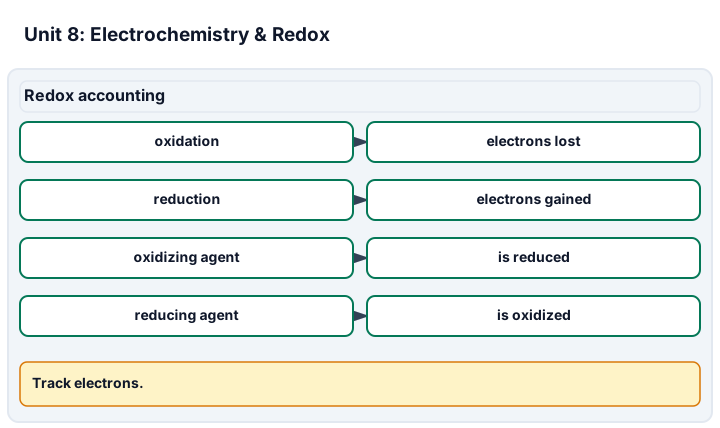
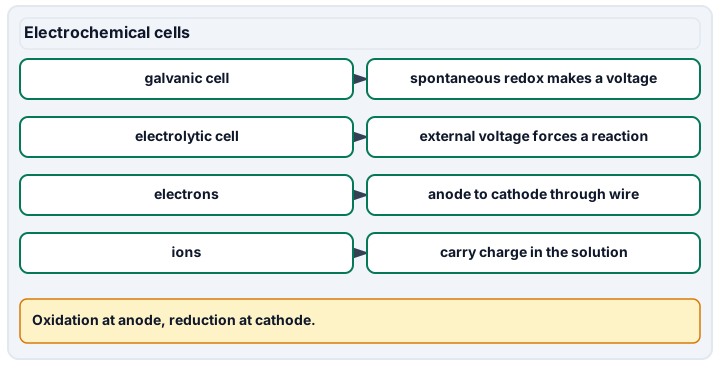
Diagram description
Redox accounting pairs oxidation/reduction and agents with electron change and fate. Electrochemical cells contrasts galvanic and electrolytic cells and distinguishes electron flow through the wire from ion charge transport in solution.
Data, provenance, and assumptions
| Cell | E standard (V) | n | T (K) | Q | F |
|---|---|---|---|---|---|
| Zn/Cu | 1.1 | 2 | 298 | 100 | 96485 |
| separate transfer | 0.06 | 1 | 298 | 100 | 96485 |
| Medium | Side | Species | Coefficient | Mn atoms | Fe atoms | S atoms | O atoms | H atoms | Charge |
|---|---|---|---|---|---|---|---|---|---|
| acidic | left | MnO4- | 1 | 1 | 0 | 0 | 4 | 0 | -1 |
| acidic | left | Fe2+ | 5 | 0 | 1 | 0 | 0 | 0 | 2 |
| acidic | left | H+ | 8 | 0 | 0 | 0 | 0 | 1 | 1 |
| acidic | right | Mn2+ | 1 | 1 | 0 | 0 | 0 | 0 | 2 |
| acidic | right | Fe3+ | 5 | 0 | 1 | 0 | 0 | 0 | 3 |
| acidic | right | H2O | 4 | 0 | 0 | 0 | 1 | 2 | 0 |
| basic | left | MnO4- | 2 | 1 | 0 | 0 | 4 | 0 | -1 |
| basic | left | SO3^2- | 3 | 0 | 0 | 1 | 3 | 0 | -2 |
| basic | left | H2O | 1 | 0 | 0 | 0 | 1 | 2 | 0 |
| basic | right | MnO2 | 2 | 1 | 0 | 0 | 2 | 0 | 0 |
| basic | right | SO4^2- | 3 | 0 | 0 | 1 | 4 | 0 | -2 |
| basic | right | OH- | 2 | 0 | 0 | 0 | 1 | 1 | -1 |
Paper investigation sequence and exact evidence record
Scope and safety: All new cases are paper/data investigations, not laboratory procedures. Any physical exercise requires prior educator and safety approval, an approved protocol, suitable facilities and accessibility provisions. Do not improvise acid/base, electrolysis, gas, high-voltage, combustion, toxic-substance or unknown-substance experiments from these tables. Supplied records do not demonstrate hands-on technique or performed lab hours.
Materials and preparation
- [nonstandard-cell] Use nonstandard-cell and the existing Faraday practice as complementary paper records; no electrodes, voltages or electrolytes are assigned.
- [redox-balance] Use redox-balance and the assigned redox section, with a blank paper ledger for an independent reconstruction.
Procedure and schedule
- [nonstandard-cell] Question: When can composition reverse a predicted cell direction even though its standard potential is positive? Prerequisites: Balanced redox equations, n, galvanic/electrolytic roles, Gibbs energy, natural logarithms and activities.
- [nonstandard-cell] Design: Vary Q at fixed T and compare cell types; E and ΔG are calculated responses tied to a specified reaction direction. Controls: Hold reference conventions, n, T, R and F consistent; omit pure solids from Q only when their pure phases are present. Replication: Cross-check the energy result using two algebraic routes; this is not a replicated voltage measurement or performance test.
- [nonstandard-cell] Analysis procedure: Compute Nernst E, both Gibbs routes and log K; assess open-circuit limits and preserve separate current-efficiency reasoning. Record: Retain reaction, electron number, Q construction, electrode labels, both energy chains, equilibrium limit, uncertainty, source/date and sign-changing transfer.
- [redox-balance] Question: Which independent conservation checks expose a redox equation that looks plausible but is chemically impossible? Prerequisites: Ion charge, oxidation-number conventions, atom counting, half-reaction algebra and acid/base balancing species.
- [redox-balance] Design: Compare acidic versus basic assigned products and deliberately remove one balancing species to test sensitivity. Controls: Keep atom identities, net charges and stated products fixed while adjusting coefficients and canceling shared species. Replication: Separate atom and charge tallies are independent bookkeeping checks, not experimental confirmation of the modeled reaction.
- [redox-balance] Analysis procedure: Derive halves, find a common electron count, combine and cancel, then check every elemental column and total charge. Record: Retain both half-reaction derivations, coefficient ledger, atom/charge sums, corrected missing-water example, assumptions, source/date and mole-ratio transfer.
Record: Label every page with case and dataset IDs, selected readiness level, date and source section. Preserve the independent first attempt, units, assumptions, calculations, uncertainty, feedback and transfer. Cite the specific science criterion; do not sign a practical observation that did not occur. The course-map inventory connects every case to these exact records.
Worked model
[nonstandard-cell] For Zn/Cu, ΔG° = -2(96485)(1.100) = -212267 J mol^-1 = -212.267 kJ mol^-1. E = E° - (RT/nF)ln Q = 1.040870210 V at Q = 100, and actual ΔG = -200.856724 kJ mol^-1. Equivalently add RT ln Q = +11.410276 kJ mol^-1 to ΔG°. log10 K = nFE°/(RT ln 10) = 37.206288. At Q = K the actual E and ΔG become zero even though E° remains 1.100 V. [redox-balance] Acidic half-reactions are MnO4- + 8H+ + 5e- -> Mn2+ + 4H2O and Fe2+ -> Fe3+ + e-. Multiply the iron half by five; electrons cancel. Net: MnO4- + 8H+ + 5Fe2+ -> Mn2+ + 4H2O + 5Fe3+, charge +17 on each side. Basic half-reactions are MnO4- + 2H2O + 3e- -> MnO2 + 4OH- and SO3^2- + 2OH- -> SO4^2- + H2O + 2e-. Multiply by two and three, cancel water/OH-/electrons: 2MnO4- + 3SO3^2- + H2O -> 2MnO2 + 3SO4^2- + 2OH-, net charge -8 on each side.
Numerical calibration
- -212.267 kJ mol^-1 of written Zn/Cu reaction
- 1.04087020999 V at Q = 100 and 298 K
- -200.8567244224 kJ mol^-1 at actual conditions
- 37.2062880615 log10 of dimensionless K at 298 K
- -0.058259580013 V for written transfer reaction
- 5 mol e- exchanged per mol acidic-model MnO4-
- 6 mol e- exchanged per written basic net reaction
- 0.008 mol MnO4- required by the basic model
Attempt the assigned level
Try the tasks before reading the calibration. These are practice answers, not a secure examination; use a new dataset or changed assumption for the assessed transfer.
Foundation
- [nonstandard-cell] From Electrode and Cell Potentials, label oxidation/reduction, anode/cathode and external electron direction for the written Zn/Cu reaction. Calculate standard ΔG with J and kJ labels and explain why n does not multiply E°.
- [redox-balance] Using Review of Redox Chemistry, assign Mn, Fe and S oxidation numbers in the ledger and identify the oxidizing/reducing agents. Verify one atom column and the acidic charge total with coefficients included.
Check after your attempt
- [nonstandard-cell] Zn oxidizes at the galvanic negative anode; Cu2+ reduces at the positive cathode, and external electrons go from Zn to Cu. ΔG° is -212267 J mol^-1 or -212.267 kJ mol^-1. n counts transferred electrons and scales energy, while voltage is energy per charge and remains intensive.
- [redox-balance] Mn is +7 in permanganate, +2 in the acidic product and +4 in MnO2; Fe goes +2 to +3 and S +4 to +6. Permanganate is the oxidizing agent because it is reduced. Iron or sulfite is oxidized. Acidic total charge is -1 + 8 + 10 = +17 on the left and 2 + 15 = +17 on the right.
High-school core: typically grades 9-10
- [nonstandard-cell] Use Potential, Free Energy, and Equilibrium to calculate actual E and ΔG at Q = 100 and cross-check with ΔG° + RT ln Q. Decide whether the standard-state potential alone determines direction for every possible composition.
- [redox-balance] Reconstruct the acidic and basic half-reactions without copying the final ledger. Make electron cancellation explicit, then check every atom column and charge for each net equation.
Check after your attempt
- [nonstandard-cell] Actual E is 1.040870210 V and ΔG -200.856724 kJ mol^-1; the two Gibbs calculations agree when joules are converted once. E° alone does not settle every composition: increasing Q lowers E, and Q > K makes the written direction unfavorable even with a positive E°.
- [redox-balance] Use five iron oxidations for one acidic permanganate reduction. In base, combine two three-electron reductions with three two-electron oxidations, then cancel electrons and shared water/OH-. The resulting acidic and basic net equations match the ledger, with +17 and -8 total charge respectively on both sides.
Honors extension: typically grades 11-12
- [nonstandard-cell] Calculate log10 K and explain the Q = K limit. Contrast this open-circuit value with voltage under load and a driven electrolytic setup; retain the existing current-efficiency accounting instead of treating a Nernst calculation as a product-yield prediction.
- [redox-balance] Test an incorrect basic equation that omits the water reactant. Identify the failed atom balance, repair it without changing product identities, and explain why a balanced result does not establish the real product at any arbitrary pH.
Check after your attempt
- [nonstandard-cell] log10 K is 37.206288. At Q = K there is no net thermodynamic driving force, so E = 0. Under load resistance and polarization reduce delivered voltage; a driven reverse reaction generally needs additional overpotential. Nernst does not fix current efficiency, so the earlier Faraday charge/product evidence remains necessary.
- [redox-balance] Without water on the left, hydrogen is 0 versus 2 and oxygen 17 versus 18. Restoring one H2O balances both without changing the net charge. Conservation alone cannot select a real product: manganese speciation, competing reactions and thermodynamics depend on medium and conditions.
History, reading, and writing connection
Compare the assigned redox and potential readings with a battery-performance claim. Distinguish thermodynamic voltage from current, usable energy and material recovery; cite a section and identify a missing engineering or environmental measurement without inventing a life-cycle result.
Write in your own words or use an approved accessible equivalent. Cite a specific assigned section or figure, identify its evidence, and state one limitation or counterargument. Use the AI practice contract only for permitted coaching, never to invent observations or write the assessed response.
Transfer to a new case
[nonstandard-cell] For the separate one-electron cell in nonstandard-cell, use E° = +0.060 V, T = 298 K and Q = 100. Calculate E for the reaction as written and determine its favored direction rather than assuming every positive standard potential remains positive. [redox-balance] The basic model requires complete oxidation of 0.0120 mol sulfite with sufficient other balancing species. Calculate required permanganate from the balanced electron ratio and explain why the acidic five-electron ratio cannot be reused.
Calibration: [nonstandard-cell] E = 0.060 - (RT/F)ln(100) = -0.058259580 V. The written forward direction has positive actual ΔG, so the reverse is favored at these activities. A positive standard-state potential is not a universal sign guarantee under nonstandard conditions. [redox-balance] The basic equation uses two permanganate per three sulfite, so 0.0120 × 2/3 = 0.00800 mol MnO4-. The basic MnO2 product gains three electrons per Mn rather than five for acidic Mn2+, so the medium/product-specific ledger must be used.
Evidence to retain
[nonstandard-cell] Science criteria 1–4: retain oxidation/electron ledgers, actual versus standard conditions, electrode polarity, intensive-potential reasoning and independent ΔG/Q checks. Keep the existing faraday-practice and faraday-transfer charge/efficiency evidence too; neither set alone demonstrates constructing or operating a cell under criterion 5. [redox-balance] Science criteria 1–3: keep oxidation-state assignments, agent roles, both complete half-reaction derivations, canceled electrons and every atom/charge check. Label medium and assigned products. This does not replace the criterion-4 cell or Faraday evidence and does not demonstrate laboratory cell construction.
Record units, calculations, source/date, uncertainty, and what is measured versus inferred. A simulation or supplied dataset must stay labeled as such. All new cases are paper/data investigations, not laboratory procedures. Any physical exercise requires prior educator and safety approval, an approved protocol, suitable facilities and accessibility provisions. Do not improvise acid/base, electrolysis, gas, high-voltage, combustion, toxic-substance or unknown-substance experiments from these tables. Supplied records do not demonstrate hands-on technique or performed lab hours.
Return to all eight learning pathways. Print this unit page for the student lessons; the linked five-page packet remains the separate assessment companion.
Unit mastery rubric
| Criterion | Developing | Proficient | Mastery |
|---|---|---|---|
| Oxidation states | Cannot assign an oxidation number. | Assigns states for simple ions but errs in compounds. | Assigns oxidation states reliably and uses changes to identify what is oxidized and reduced. |
| Identifying oxidation & reduction | Mixes up which species gains and loses electrons. | Names oxidation and reduction but confuses oxidizing and reducing agents. | Distinguishes oxidation, reduction, and the agents driving each in any reaction. |
| Balancing redox equations | Balances atoms but ignores charge and electrons. | Writes half-reactions but cannot reconcile electrons or add H⁺/OH⁻. | Balances redox equations by half-reactions in acidic or basic solution, conserving mass and charge. |
| Galvanic & electrolytic cells | Confuses cell types, electrode roles, or charge with product amount. | Explains a cell but needs help with voltage, electrode stoichiometry, units, or current efficiency. | Distinguishes cell types, labels electrodes and electron flow, predicts voltage or required potential from supplied half-cell data, and calculates charge, electron amount and product using electrode stoichiometry and stated current efficiency. Relates standard and actual potential to free energy and equilibrium. |
| Lab technique (building a cell) | Cannot assemble a functioning cell. | Builds a cell but with reversed electrodes or a missing salt bridge. | Constructs a working galvanic or electrolytic cell and measures or drives the expected reaction. |
| Integration (cross-domain) | Makes no supported connection between the source and the science. | Uses the source but needs help connecting evidence, writing, or limitations to the science. | Independently connects History, Reading, and Writing using a cited source, appropriate evidence, a limitation, and a scientific explanation. |
Integration is reported separately and cannot lower the science grade or block a science demonstration pass. Science and practical criteria determine that pass. Use the integration guide's evidence checklist for the separately reported criterion.
“Zinc loses electrons, so it’s oxidized and it’s the anode; the copper ion gains them at the cathode. I assigned oxidation states to see what actually changed, then balanced the electrons before the atoms.”
“Redox is reduction and oxidation together. The metal does something with electrons. I’d have to guess which side is the anode.”
Complete the assigned Faraday calculation and fresh transfer alongside the cell explanation. Retain the instructor-approved, supervised galvanic or electrolytic practical, measuring voltage or the specified product and explaining electron flow. Judge each criterion from its own evidence: paper calculations do not replace criterion 5's practical work, and a working cell alone does not demonstrate the quantitative criterion. No named chemical example authorizes a procedure.
A 5-page clipboard packet — unit overview, key terms, the mastery rubric, anchor examples, and a score sheet you can print and grade against.