Unit 07 · Acids, Bases & Solutions
This unit lives at the burette. It covers what acids and bases are, the meaning and math of pH, how to prepare and report concentration, how a titration finds an unknown concentration, how buffers resist pH change, and how solubility governs what dissolves and what precipitates. Mastery means you can take a solution of unknown strength and determine it — cleanly, with a justified endpoint and correct math.
Student learning: Weak equilibria, buffer capacity and titration regimes
Choose the level by readiness, not age alone, and record it before instruction. Foundation, core, and honors tasks are study pathways, not an AP course or a promise of college credit. The instructor retains practical assessment and the published science rubric; integration is reported separately.
Prerequisites: Start with acid-base-intro: proton transfer, balanced neutralization, molarity and final volume. Then use Ka/Kb/Kw, logarithms, quadratic roots and the Unit 6 quotient distinction.
Suggested sequence: read and discuss the explanation; attempt the worked model; analyze the data at your selected level; check the answers; then complete the source-linked response and a fresh transfer question. These activities supplement, not replace, supervised practical work and the full-year schedule.
Assigned reading and focus
- OpenStax Chemistry 2e, 4.2 Classifying Chemical Reactions. [acid-base-intro] Read Acid-Base Reactions and Writing Equations for Acid-Base Reactions. Distinguish proton transfer, neutralization and a weak base reacting with water; no physical mixing is assigned.
- OpenStax Chemistry 2e, 14.2 pH and pOH. [acid-base-intro] Read the pH/pOH definitions and water relation at 25 C. Complete the mole ledger and final-volume calculation before applying a logarithm.
- OpenStax Chemistry 2e, 14.3 Relative Strengths of Acids and Bases. [weak-acid] Read Ka, Kb, percent ionization and the molecular structure/acid-strength discussion. Set an equilibrium balance before taking a square root, then test the fractional depletion.
- OpenStax Chemistry 2e, 14.2 pH and pOH. [weak-acid] Read pH/pOH and water autoionization. Explain why a very dilute strong acid cannot be assigned a basic pH by ignoring water.
- OpenStax Chemistry 2e, 14.6 Buffers. [buffer-capacity] Read How Buffers Work, the Henderson-Hasselbalch equation and buffer capacity. Do a mole-based neutralization ledger before taking any conjugate-base/acid ratio.
- OpenStax Chemistry 2e, 14.3 Relative Strengths of Acids and Bases. [buffer-capacity] Read the acid/conjugate-base relationship. Connect Ka and pKa to buffer composition instead of treating pKa as a measured pH for all mixtures.
- OpenStax Chemistry 2e, 14.7 Acid-Base Titrations. [titration-solubility] Read weak-acid/strong-base titration curves, half-equivalence and equivalence. Distinguish the stoichiometric equivalence point from an observed endpoint and select a model for each region.
- OpenStax Chemistry 2e, 15.1 Precipitation and Dissolution. [titration-solubility] Read solubility-product expressions, common-ion effects and predicting precipitation. Account for dilution on mixing before calculating Qsp; compare protonatable and nonprotonatable anions.
Learn the science
Foundation support does not by itself demonstrate Mastery; all rubric decisions require the published independent science evidence. Honors adds breadth and model criticism, not an extra practical-pass gate. The public worked answers are nonsecure practice, not unseen exams. Complete an independent first attempt, check the explanation, then defend a fresh transfer or educator-chosen variant. Source citations used to justify chemistry are science evidence; the History/Reading/Writing integration judgment is reported separately and cannot lower the science grade or block a practical pass.
[acid-base-intro] Proton-transfer reactions before equilibrium shortcuts. A Bronsted-Lowry acid transfers a proton to a base. For a strong monoprotic acid with hydroxide in this dilute aqueous model, the net ionic equation is H3O+(aq) + OH-(aq) -> 2H2O(l). Dissolved Na+ and Cl- are spectators, not substances that disappear. Neutralization does not guarantee pH 7: an excess of acid or base remains unless the appropriate amounts react. NH3 reacting reversibly with water is also proton transfer, even though it is not the same complete strong-acid/hydroxide model.
[acid-base-intro] Assumptions before calculation: Treat HCl and NaOH as fully dissociated, the reaction as effectively complete, and volumes as additive at a final 25 C. Use concentrations as activity approximations, Kw = 1e-14 and negligible water-ionization correction at the computed excess. The ammonia equation is qualitative and reversible; no ammonia concentration, Kb or quantitative conversion is supplied.
[acid-base-intro] Uncertainty and model checks: These are synthetic solution records, not a titration or a validated concentration assay. Actual thermal/volume changes, concentration uncertainty and activity effects require separate evidence. The simple excess model fails near very low concentrations or when a weak reagent controls equilibrium; a color endpoint is not supplied and must not be invented.
[weak-acid] Weak does not mean dilute, and a square-root shortcut can fail. Acid strength describes the ionization equilibrium under stated solvent/temperature conditions; concentration describes how much solute is present per volume. A strong acid is not necessarily concentrated, and a weak acid need not be dilute. For HA + H2O <-> H3O+ + A-, Ka = x^2/(C - x) if water and initial ions can be neglected. The square-root approximation x approximately equals sqrt(KaC) requires x small relative to C, not merely a small Ka. pH uses hydrogen-ion activity; the supplied dilute model approximates it by [H3O+]/1 M.
[weak-acid] Assumptions before calculation: Use a synthetic monoprotic acid HA with C = 0.1000 M and Ka = 1.8e-5 at 25 degrees C, Kw = 1.0e-14. Ion activities are approximated by normalized concentrations. No initial A- or strong acid is present. For the weak-acid cases water is negligible relative to calculated H3O+; in the separate 1e-8 M strong-acid challenge it is not. Do not prepare any acid/base solutions from these paper values.
[weak-acid] Uncertainty and model checks: A 5% depletion screen is a convenience rule, not a universal error guarantee. At C = 1e-5 M the square-root estimate exceeds total available acid and must be rejected. Temperature or solvent changes alter constants; ionic-strength effects limit the activity approximation. Molecular comparisons need bond strength and conjugate-base stabilization, not a rule that electronegativity alone always decides acid strength.
[buffer-capacity] Neutralize first; a pH ratio is not a capacity reserve. A buffer needs appreciable amounts of both members of a weak conjugate acid-base pair. Added strong H+ reacts stoichiometrically with A- to form HA before the weak equilibrium is evaluated. Henderson-Hasselbalch pH approximately equals pKa + log10(nA-/nHA) when both species remain and equilibrium changes are small relative to their post-neutralization amounts. The ratio controls approximate pH; total amount controls how much added acid/base can be absorbed. Once a component is exhausted, the ratio formula is no longer the right model.
[buffer-capacity] Assumptions before calculation: The synthetic HA/A- pair has Ka = 1.8e-5 at 25 degrees C. Each constructed final record is normalized to 0.100 L; the added strong-acid/base amount is a paper input, not a mixing protocol. Start with 0.0100 mol HA and 0.0100 mol A-. Strong neutralization is treated as complete, and the ratio model neglects activity corrections and small subsequent dissociation. The exhausted example initially neglects HA dissociation, with the approximation assessed separately.
[buffer-capacity] Uncertainty and model checks: A tenfold-diluted buffer can have nearly the same initial pH but one tenth of the neutralization reserve. pH near pKa does not imply unlimited capacity or a guaranteed safe solution. Activity effects, inaccurate amounts and added volume can shift actual pH. “Within about one pH unit of pKa” is a useful operating heuristic, not a sharp universal capacity boundary.
[titration-solubility] Titration regions and solubility require different balances. A titration curve is a sequence of chemical regimes, not one formula for every volume. Initially solve the weak-acid equilibrium; before equivalence neutralize and use the remaining conjugate pair; at equivalence the conjugate base hydrolyzes; after equivalence excess strong base dominates. The endpoint is an observable signal and only approximates stoichiometric equivalence. For a precipitate, compare a properly diluted ion product Qsp with Ksp, including coefficient powers. Solubility and precipitation are condition-dependent; not every salt becomes markedly more soluble merely because acid is added.
[titration-solubility] Assumptions before calculation: The synthetic titration uses 25.00 mL of 0.1000 M monoprotic HA, Ka = 1.8e-5, with 0.1000 M OH- at 25 degrees C and additive volumes; Kw = 1e-14. This is a paper record, not an acid/base setup. The separate AgCl model uses Ksp = 1.8e-10, no complexes and dilute normalized ion activities. For the common-ion estimate assume added chloride 0.0100 M dominates the small dissolved contribution.
[titration-solubility] Uncertainty and model checks: Indicator range and sensor calibration can shift the endpoint systematically; repeated nearby endpoints do not prove equivalence accuracy. Near equivalence the validity of a simple buffer approximation must be rechecked. A Ksp model that ignores complexes, ionic strength or protonation may miss real solubility. A paper curve cannot demonstrate controlled drops, safe handling or a reproducible physical titration.

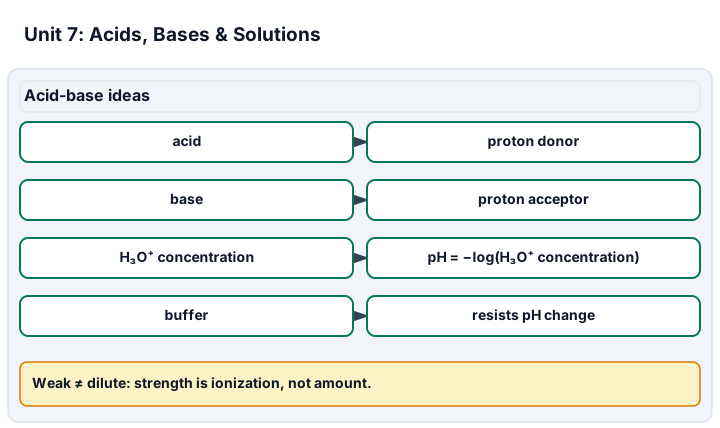
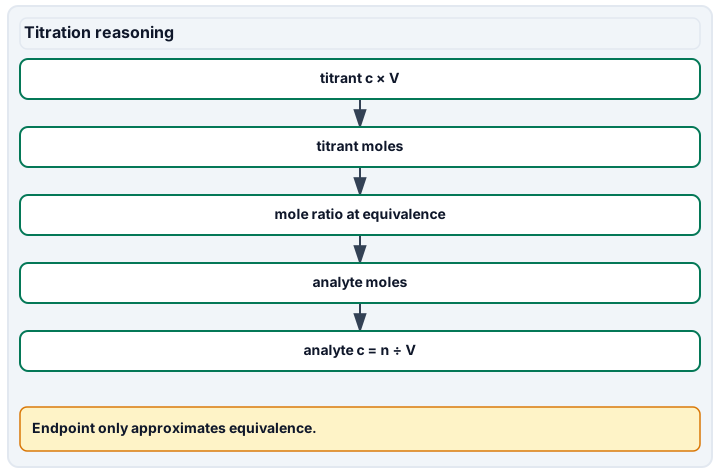
Diagram description
Acid-base ideas defines acids, bases, pH and buffers and distinguishes strength from concentration. Titration reasoning uses titrant concentration and volume to compute moles, applies the mole ratio at equivalence, and divides analyte moles by analyte volume.
Data, provenance, and assumptions
| Solution | Volume (mL) | Concentration (mol/L) |
|---|---|---|
| HCl | 25 | 0.12 |
| NaOH | 20 | 0.1 |
| Model | Equation |
|---|---|
| Strong aqueous neutralization | H3O+ + OH- -> 2H2O |
| Weak base with water | NH3 + H2O <=> NH4+ + OH- |
| Precipitation contrast | Ag+ + Cl- -> AgCl(s) |
| Record | Analytical C (mol L^-1) | Ka |
|---|---|---|
| HA | 0.1 | 0.000018 |
| Comparison | Relevant factor |
|---|---|
| HF versus HCl in water | H-X bond strength and solvation down a group |
| acetic acid versus ethanol | conjugate-base resonance stabilization |
| HA versus A- | conjugate pair differs by one proton |
| Case | Initial HA (mol) | Initial A- (mol) | Added H+ (mol) | Final volume (L) |
|---|---|---|---|---|
| B0 | 0.01 | 0.01 | 0 | 0.1 |
| B1 | 0.01 | 0.01 | 0.002 | 0.1 |
| exhausted | 0.01 | 0.01 | 0.012 | 0.1 |
| low reserve | 0.001 | 0.001 | 0.002 | 0.1 |
| Record | Base volume (mL) | Region |
|---|---|---|
| T0 | 0 | weak acid |
| T1 | 12.5 | half-equivalence |
| T2 | 25 | equivalence |
| T3 | 30 | excess strong base |
| Trial | Endpoint (mL) |
|---|---|
| E1 | 25.1 |
| E2 | 25.2 |
| E3 | 25.3 |
| Case | Input concentration | Ksp |
|---|---|---|
| added Cl- common ion | 0.01 | 1.8e-10 |
| Ag+ before equal-volume mixing | 0.0001 | 1.8e-10 |
| Cl- before equal-volume mixing | 0.0001 | 1.8e-10 |
Paper investigation sequence and exact evidence record
Scope and safety: All new cases are paper/data investigations, not laboratory procedures. Any physical exercise requires prior educator and safety approval, an approved protocol, suitable facilities and accessibility provisions. Do not improvise acid/base, electrolysis, gas, high-voltage, combustion, toxic-substance or unknown-substance experiments from these tables. Supplied records do not demonstrate hands-on technique or performed lab hours.
Materials and preparation
- [acid-base-intro] Use the two supplied symbolic/data tables, the replacement volumes and concentrations, and the assigned classification/pH sections only.
- [weak-acid] Use weak-acid, acid-structure, the 1e-8 M strong-acid challenge and the dilution transfer; all work is on paper.
- [buffer-capacity] Use buffer-capacity and its fixed final-volume model plus the given base transfer; no real acid, base or buffer preparation is required.
- [titration-solubility] Use titration-solubility, endpoint-records and solubility-records plus the given monoprotic and diprotic equations; no chemicals or apparatus are assigned.
Procedure and schedule
- [acid-base-intro] Question: When does a proton-transfer mixture leave acid or base in excess, and what evidence distinguishes it from precipitation or weak equilibrium? Prerequisites: Understand mole concentration, mL-to-L conversion, signed ionic charge and acid/base definitions; logarithms are used only after the amount ledger.
- [acid-base-intro] Design: Change acid and base equivalent amounts; record limiting species, excess concentration and conditional final pH. Controls: Keep monoprotic/monohydroxide stoichiometry, full dissociation, final 25 C and additive-volume assumptions explicit. Replication: Independently check moles, charge and the limiting comparison; recalculation is not a replicate titration or sensor reading.
- [acid-base-intro] Analysis procedure: Write the net ionic equation, calculate both amounts, subtract the limiting equivalent, divide by total volume and apply the appropriate pH relation. Record: Retain equations, proton donor/acceptor labels, spectator and excess ledgers, units, final volume, assumptions, source/date, weak-base critique and transfer.
- [weak-acid] Question: At what dilution does a convenient weak-acid approximation contradict material balance, and when must water be included? Prerequisites: Conjugate pairs, logarithms, Ka/Kb/Kw, molarity, quadratic roots and material/charge balance.
- [weak-acid] Design: Change analytical concentration while holding Ka and temperature fixed; calculate free H3O+, pH and percent ionization. Controls: State the activity approximation, initial conjugate-base amount and when water autoionization is negligible. Replication: Verify physical roots by substitution and compare two solution methods; no actual solution or repeated pH measurement is supplied.
- [weak-acid] Analysis procedure: Solve the equilibrium, compare sqrt and exact roots, test depletion and autoionization, and distinguish structural strength from concentration. Record: Retain C/Ka/Kw, both roots or rejected root explanation, units, pH/percent chains, approximation checks, structure argument, source/date and transfer.
- [buffer-capacity] Question: Can two buffers with the same starting ratio respond very differently to the same acid-equivalent challenge? Prerequisites: Moles, strong neutralization, conjugate pairs, logarithms and the weak-acid equilibrium assumptions.
- [buffer-capacity] Design: Vary total conjugate-pair reserve or sign of added equivalents; compare residual amounts and calculated pH. Controls: Keep Ka, temperature, final volume and ratio-model assumptions explicit; do not confuse matched pH with matched capacity. Replication: Compare independent mole ledgers; four scenarios are not replicate titrations and supply no laboratory repeatability claim.
- [buffer-capacity] Analysis procedure: Neutralize, check whether both partners remain, select ratio or excess-strong-ion model and assess the neglected weak contribution. Record: Retain initial/change/final moles, final volume, pKa and pH, exhaustion verdict, approximation assessment, source/date and reversed-challenge transfer.
- [titration-solubility] Question: Which equilibrium model applies in each titration region, and how do endpoint bias and common ions change the interpretation? Prerequisites: Moles, balanced acid/base stoichiometry, Ka/Kb, buffer conditions, hydrolysis, molarity after mixing and solubility powers.
- [titration-solubility] Design: Base-equivalent amount varies in the curve; added common ion varies separately in the solubility comparison. Controls: Keep temperature, initial acid amount, base concentration and stated activity/speciation approximations explicit; compute each final volume. Replication: Three constructed endpoint volumes illustrate repeatability only. Their mean remains biased relative to the supplied stoichiometric reference.
- [titration-solubility] Analysis procedure: Build a mole ledger for each volume, select its pH model, graph labeled regions, compute endpoint bias and diluted Qsp, then evaluate assumption failures. Record: Retain curve points with regime labels, neutralization/hydrolysis work, volumes, endpoint mean/range and bias, solubility/Qsp chains, source/date and MX2 transfer.
Record: Label every page with case and dataset IDs, selected readiness level, date and source section. Preserve the independent first attempt, units, assumptions, calculations, uncertainty, feedback and transfer. Cite the specific science criterion; do not sign a practical observation that did not occur. The course-map inventory connects every case to these exact records.
Worked model
[acid-base-intro] HCl supplies 0.025 times 0.12 = 0.0030 mol acid equivalents; NaOH supplies 0.020 times 0.10 = 0.0020 mol hydroxide. After reaction, 0.0010 mol excess hydronium remains in 0.045 L: 0.0222222 mol/L and pH 1.653213. The remaining charged-species ledger is 1 mmol H3O+, 2 mmol Na+ and 3 mmol Cl-, whose net charge is zero. [weak-acid] Solving x^2 + Ka x - KaC = 0 gives x = 0.001332670973 M for C = 0.1000 M; pH = 2.875277 and percent ionization = 1.332671%. The sqrt estimate 0.001341640786 M has 1.34% depletion and differs by about 0.67% in x, so it is a stated approximation. For a distinct 1e-8 M strong monoprotic acid, charge balance gives h = C + Kw/h, so h = (C + sqrt(C^2 + 4Kw))/2 and pH = 6.978294, not 8. [buffer-capacity] pKa = -log10(1.8e-5) = 4.744727. B0 has equal pair amounts, so pH approximately 4.744727. In B1, 0.002 mol H+ consumes A-: remaining A- = 0.008 mol and HA = 0.012 mol. pH approximately 4.744727 + log10(0.008/0.012) = 4.568636. In the exhausted case A- is gone and excess strong H+ = 0.002/0.100 = 0.0200 M, giving a leading approximation pH = 1.698970, not a buffer ratio. HA dissociation contributes roughly 1% more H+ here, so this last value is approximate rather than an exact equilibrium answer. [titration-solubility] Initial pH is 2.875277 from the HA quadratic. At 12.50 mL, equal remaining HA/A- gives pH approximately pKa = 4.744727. At 25.00 mL, A- concentration = 0.00250/0.05000 = 0.0500 M and Kb = Kw/Ka; the hydrolysis quadratic gives pH 8.721826, not 7. At 30.00 mL, excess OH- = 0.000500/0.05500 = 0.009090909 M, pH 11.958607. Mean endpoint 25.20 mL would overestimate acid concentration by 0.8%. For AgCl, pure-water model s = sqrt(Ksp) = 1.341641e-5 M; at 0.0100 M Cl-, s approximately Ksp/[Cl-] = 1.8e-8 M. Equal-volume mixing of the given 0.0001 M ions gives Qsp = (5e-5)^2 = 2.5e-9 > Ksp, so precipitation is favored.
Numerical calibration
- 0.003 mol acid equivalents supplied
- 0.002 mol hydroxide supplied
- 0.0222222222222 mol/L in the ideal final mixture
- 1.6532125138 pH in the stated concentration model
- 12.3010299957 pH at 25 C in the changed-input model
- 2.87527706155 pH in normalized-concentration model
- 1.33267097308 percent ionization
- 6.97829431354 pH including water autoionization
- 5.14536035253 pH of diluted 0.0000100 M HA model
- 4.56863623584 approximate pH after stoichiometric neutralization
- 1.69897000434 leading approximate pH after buffer exhaustion
- 0.2 mol/L total acid after neutralization
- 0.00018 mol/L approximate additional hydronium from HA
- 1.69511648207 pH from the stated common-ion equilibrium model
- 5.01357280719 approximate pH after added base
- 8.72182586029 pH, conjugate-base hydrolysis model
- 11.95860731484 pH after 30.00 mL base
- 0.8 percent acid-concentration overestimate
- 0.000013416407865 mol L^-1 in ideal pure-water model
- 1.8e-8 mol L^-1, common-ion approximation
- 2.5e-9 dimensionless diluted ion product
- 0.0001 mol L^-1 MX2 molar solubility
Attempt the assigned level
Try the tasks before reading the calibration. These are practice answers, not a secure examination; use a new dataset or changed assumption for the assessed transfer.
Foundation
- [acid-base-intro] Use the symbolic reactions to identify the proton donor and acceptor in strong neutralization and in ammonia reacting with water. Explain why the silver/chloride contrast is precipitation rather than the listed proton-transfer reaction.
- [weak-acid] Using Relative Strengths of Acids and Bases, identify the conjugate pair and write the HA equilibrium. Explain strength versus concentration, then use the supplied quadratic x to compute pH and percent ionization.
- [buffer-capacity] From Buffers, name the pair that consumes H+ and complete the before/change/after mole ledger for B1. Explain why pKa is not automatically the pH after an unequal pair ratio develops.
- [titration-solubility] Using Acid-Base Titrations, calculate initial acid moles and equivalence volume, assign a model to each titration-solubility row and explain endpoint versus equivalence without using the color change as the definition of chemical equality.
Check after your attempt
- [acid-base-intro] H3O+ donates a proton and OH- accepts it in neutralization. Water donates to NH3 in the ammonia equation, giving NH4+ and OH-. Ag+ and Cl- form the supplied solid without transferring a proton in that written equation; a reaction label needs the actual species and change.
- [weak-acid] HA/A- differ by one proton. Ka describes the equilibrium while 0.1000 M is the analytical amount per volume. With x = 0.001332670973 M, pH is 2.875277 and ionization 1.332671%. Calling HA weak does not mean its concentration is smaller than every strong-acid solution.
- [buffer-capacity] A- consumes the added H+ and becomes HA. The changes are -0.002 mol A- and +0.002 mol HA, leaving 0.008 and 0.012 mol. Equal amounts initially give pH near pKa, but afterward log10(0.008/0.012) is negative, lowering pH to approximately 4.568636.
- [titration-solubility] Initial HA is 0.00250 mol and one OH- neutralizes one HA here, so equivalence is 25.00 mL. Rows use weak-acid, buffer, conjugate-base and excess-OH- models respectively. An endpoint is an instrument/indicator signal; equivalence is the balanced stoichiometric condition, and their volumes need not coincide.
High-school core: typically grades 9-10
- [acid-base-intro] Calculate acid and base amounts from the two solutions, keep a before/after ionic ledger, and find the final excess concentration and pH. Explain what happens to spectator ions and why the result need not be pH 7.
- [weak-acid] Solve the weak-acid quadratic independently and test the square-root/5% approximation. Apply the parallel method to a hypothetical base with Kb = 1.8e-5 and C = 0.1000 M at 25 degrees C, identifying what x now represents.
- [buffer-capacity] Calculate B1 pH from the updated amounts, then compare the high-reserve and low-reserve cases after the same 0.002 mol acid challenge. Explain why similar starting pH does not mean similar capacity.
- [titration-solubility] Calculate the half-equivalence, equivalence and post-equivalence pH values, retaining final volumes. Compare mean endpoint with the true model equivalence, then calculate AgCl solubility with and without added chloride.
Check after your attempt
- [acid-base-intro] The inputs are 3.0 mmol acid and 2.0 mmol hydroxide, leaving 1.0 mmol excess acid in 45 mL. Its concentration is 0.0222222 M and pH is about 1.653. Na+ and Cl- remain as spectator ions; 1 + 2 - 3 = 0 mmol of net charge. Unequal equivalent amounts leave an excess.
- [weak-acid] The physical acid root is 0.001332670973 M, with 1.33% depletion; the sqrt shortcut is close under these assumptions. For the equal-Kb base, x is [OH-], pOH is 2.875277 and pH is 11.124723. Ka and Kb for a conjugate pair multiply to Kw; they are not identical by definition.
- [buffer-capacity] B1 remains a buffer at approximate pH 4.568636. The low-reserve case begins at nearly the same ratio/pH but has only 0.001 mol A-, so the acid challenge exhausts it and leaves excess strong acid. Capacity follows available amounts, not the initial ratio alone.
- [titration-solubility] Half-equivalence pH is approximately 4.744727, equivalence 8.721826 and 30 mL pH 11.958607. Mean endpoint 25.20 mL biases calculated acid concentration 0.8% high. AgCl solubility falls from 1.341641e-5 M to approximately 1.8e-8 M in 0.0100 M Cl-; the added-ion contribution clearly dominates the dissolved chloride.
Honors extension: typically grades 11-12
- [acid-base-intro] Explain why the ammonia/water equation cannot be treated as complete neutralization with the same shortcut. Identify what extra quantitative information and checks would be needed for its pH, and distinguish that issue from the presence of spectators.
- [weak-acid] Use pH and pOH to derive the charge-balance correction for a 1e-8 M strong acid. Contrast bond-strength and resonance arguments in acid-structure and state why the earlier square-root screen is not a general certification of accuracy.
- [buffer-capacity] Evaluate the exhausted case without taking a logarithm of a negative or zero base amount. Derive the formal HA concentration from the supplied total HA plus A- and final volume, then estimate further dissociation in the remaining strong H+ and assess the leading pH approximation.
- [titration-solubility] Use Precipitation and Dissolution to calculate Qsp after equal-volume mixing and assess pH effects for a salt with a basic anion versus AgCl. For 20.0 mL 0.0500 M H2A titrated to its second equivalence with 0.1000 M OH-, use the balanced two-proton stoichiometry.
Check after your attempt
- [acid-base-intro] NH3 is a weak base whose water reaction reaches an equilibrium, not assumed complete conversion. Its analytical concentration, Kb, temperature and appropriate mass/charge balances are needed. Spectator-ion cancellation does not decide reaction extent; check depletion, activities and water contributions separately.
- [weak-acid] h = C + Kw/h gives h about 1.05124922e-7 M and pH 6.978294. Water cannot be ignored in this extreme dilution. H-Cl bond dissociation/solvation and resonance stabilization of acetate illustrate different structural factors. The 5% rule screens depletion only, not activity, temperature or instrument errors.
- [buffer-capacity] Neutralization conserves the acid total: (0.0100 + 0.0100)/0.100 = 0.200 M formal HA; excess strong H+ is 0.0200 M, giving leading pH 1.698970. Further dissociation is approximately Ka × 0.200/0.0200 = 0.000180 M, or 0.9% of that H+. With x the additional dissociation, Ka = (0.0200 + x)x/(0.200 - x) gives x about 0.000178251 M and pH about 1.695116. Excess strong acid does not create more HA after A- is exhausted, and no appreciable A- reserve remains for a buffer-ratio shortcut.
- [titration-solubility] Both mixed ion concentrations are 5e-5 M and Qsp = 2.5e-9 > 1.8e-10. Protonating a basic anion can promote dissolution, but chloride is the conjugate base of a strong acid and that simple mechanism does not apply broadly to AgCl. H2A + 2OH- -> A2- + 2H2O needs 0.00200 mol OH- or 20.0 mL; one-to-one acid/base moles is not universal.
History, reading, and writing connection
Use the buffer and titration readings to evaluate a public claim that one pH or one color change establishes a product’s strength, capacity or environmental safety. Cite the relevant section, explain the quantitative limit and avoid testing household or unknown substances.
Write in your own words or use an approved accessible equivalent. Cite a specific assigned section or figure, identify its evidence, and state one limitation or counterargument. Use the AI practice contract only for permitted coaching, never to invent observations or write the assessed response.
Transfer to a new case
[acid-base-intro] Replace the original inputs with 10.0 mL of 0.100 M HCl and 15.0 mL of 0.100 M NaOH. At the same ideal additive-volume and 25 C assumptions, identify the excess species, its concentration and the resulting pH. [weak-acid] Dilute the same HA model to C = 1.00e-5 M at unchanged Ka and temperature. Compare sqrt(KaC) with the total concentration, solve the quadratic and check whether water can still be neglected to a useful first approximation. [buffer-capacity] Start again from B0, but use 0.00300 mol strong OH- instead of H+, at the same 0.100 L final volume. Calculate post-neutralization pair amounts and approximate pH, then state the condition that permits using the ratio. [titration-solubility] Replace AgCl with a hypothetical MX2(s) <-> M2+ + 2X- having Ksp = 4.00e-12 in ideal pure water, without protonation or complexes. Derive molar solubility and explain why sqrt(Ksp) would use the wrong stoichiometry.
Calibration: [acid-base-intro] The amounts are 1.0 mmol acid and 1.5 mmol hydroxide, leaving 0.5 mmol OH- in 25.0 mL: 0.0200 M. pOH is 1.698970 and pH is 12.301030. Recalculate the limiting equivalent and final volume rather than carrying the earlier acid-excess answer forward. [weak-acid] sqrt(1.8e-5 × 1e-5) = 1.34164e-5 M exceeds C, so the shortcut is impossible. The physical quadratic gives h about 7.15549e-6 M, pH 5.145360 and about 71.55% ionization. Kw/h is about 1.40e-9 M, much smaller than h, so neglecting water is still reasonable here even though ignoring acid depletion is not. [buffer-capacity] OH- consumes HA, leaving 0.00700 mol HA and making 0.01300 mol A-. pH approximately 4.744727 + log10(0.013/0.007) = 5.013573. Both conjugate partners remain appreciable and small equilibrium changes are assumed; neither a negative remainder nor exhaustion may be inserted into this formula. [titration-solubility] If s dissolves, [M2+] = s and [X-] = 2s, so Ksp = s(2s)^2 = 4s^3. Thus s = (4e-12/4)^(1/3) = 1.00e-4 M. A square root assumes a one-to-one dissolution and would fail both the coefficient powers and the particle balance.
Evidence to retain
[acid-base-intro] Science criteria 1, 2 and 3: classify proton transfer, balance atoms/charge, retain molarity-to-amount and final-volume steps, distinguish spectators from excess, and solve the fresh base-excess case. A calculated mixture does not demonstrate a performed titration or an observed endpoint. [weak-acid] Science criteria 1, 2 and 4: retain the equilibrium equation, analytical-versus-free concentration labels, positive quadratic root, depletion check, molecular explanation and water-correction challenge. No calculation establishes safe preparation or actual acid/base handling. [buffer-capacity] Science criteria 1–4: retain neutralization stoichiometry before equilibrium, pKa/ratio calculation, explicit remaining amounts, capacity comparison and the rejected exhausted-buffer shortcut. This reasoning is separate from integration and does not show hands-on solution preparation. [titration-solubility] Criteria 1–4: preserve regime selection, balanced neutralization, all final volumes, endpoint bias and Qsp/Ksp with approximation checks. Criterion 5 may retain repeatability analysis but still needs a separate educator-approved observed titration or formally approved assessment alternative; synthetic endpoints are not performed technique.
Record units, calculations, source/date, uncertainty, and what is measured versus inferred. A simulation or supplied dataset must stay labeled as such. All new cases are paper/data investigations, not laboratory procedures. Any physical exercise requires prior educator and safety approval, an approved protocol, suitable facilities and accessibility provisions. Do not improvise acid/base, electrolysis, gas, high-voltage, combustion, toxic-substance or unknown-substance experiments from these tables. Supplied records do not demonstrate hands-on technique or performed lab hours.
Return to all eight learning pathways. Print this unit page for the student lessons; the linked five-page packet remains the separate assessment companion.
Unit mastery rubric
| Criterion | Developing | Proficient | Mastery |
|---|---|---|---|
| Acid–base definitions & pH | Confuses acids with bases or the pH direction. | Defines pH but cannot calculate it from concentration. | Applies acid/base definitions and proton-transfer classification; distinguishes strength from concentration, computes pH, and checks stoichiometric excess, equilibrium and water assumptions. |
| Concentration & solution prep | Cannot express or calculate molarity. | Calculates molarity but errs in dilution or prep. | Prepares and dilutes solutions to a target molarity and reports concentration correctly. |
| Titration & the equivalence point | Adds titrant past the endpoint with no notice. | Reaches an endpoint but cannot find the unknown concentration. | Identifies the equivalence point, explains why the endpoint only approximates equivalence, and computes unknown concentration using balanced stoichiometry. |
| Buffers & solubility | Treats every solution as freely changing pH. | Names buffers or solubility rules but applies them loosely. | Explains buffer action, checks neutralization and capacity, and uses solubility equilibria to compare solubility and predict precipitation under stated common-ion and pH conditions. |
| Lab technique (titration) | Misreads the burette or overshoots the endpoint. | Titrates but with inconsistent technique or drop control. | Performs a clean, reproducible titration with controlled drops and a justified endpoint. |
| Integration (cross-domain) | Makes no supported connection between the source and the science. | Uses the source but needs help connecting evidence, writing, or limitations to the science. | Independently connects History, Reading, and Writing using a cited source, appropriate evidence, a limitation, and a scientific explanation. |
Integration is reported separately and cannot lower the science grade or block a science demonstration pass. Science and practical criteria determine that pass. Use the integration guide's evidence checklist for the separately reported criterion.
“I titrated to the first lasting pink, read the burette at eye level, and used C₁V₁ over the balanced ratio to find the unknown molarity — to three significant figures, because that’s all my volumes support.”
“Acid rain forms mainly from sulfur dioxide and nitrogen oxides; ocean acidification comes from absorbed carbon dioxide. Both lower pH, but their chemical sources differ.”
“I added base until it turned pink and overshot a bit. pH is how acidic it is. I’m not sure how to get the concentration from the numbers.”
Under the instructor's approved procedure, titrate an unknown to a justified endpoint near equivalence and defend the concentration calculation using the balanced mole ratio. The indicator endpoint approximates equivalence; it does not establish exact equivalence or a universal 1:1 acid/base ratio. Retain reproducible technique and judge the pH, solution-preparation, and buffer/solubility criteria from their own evidence, not from titration success alone.
A 5-page clipboard packet — unit overview, key terms, the mastery rubric, anchor examples, and a score sheet you can print and grade against.