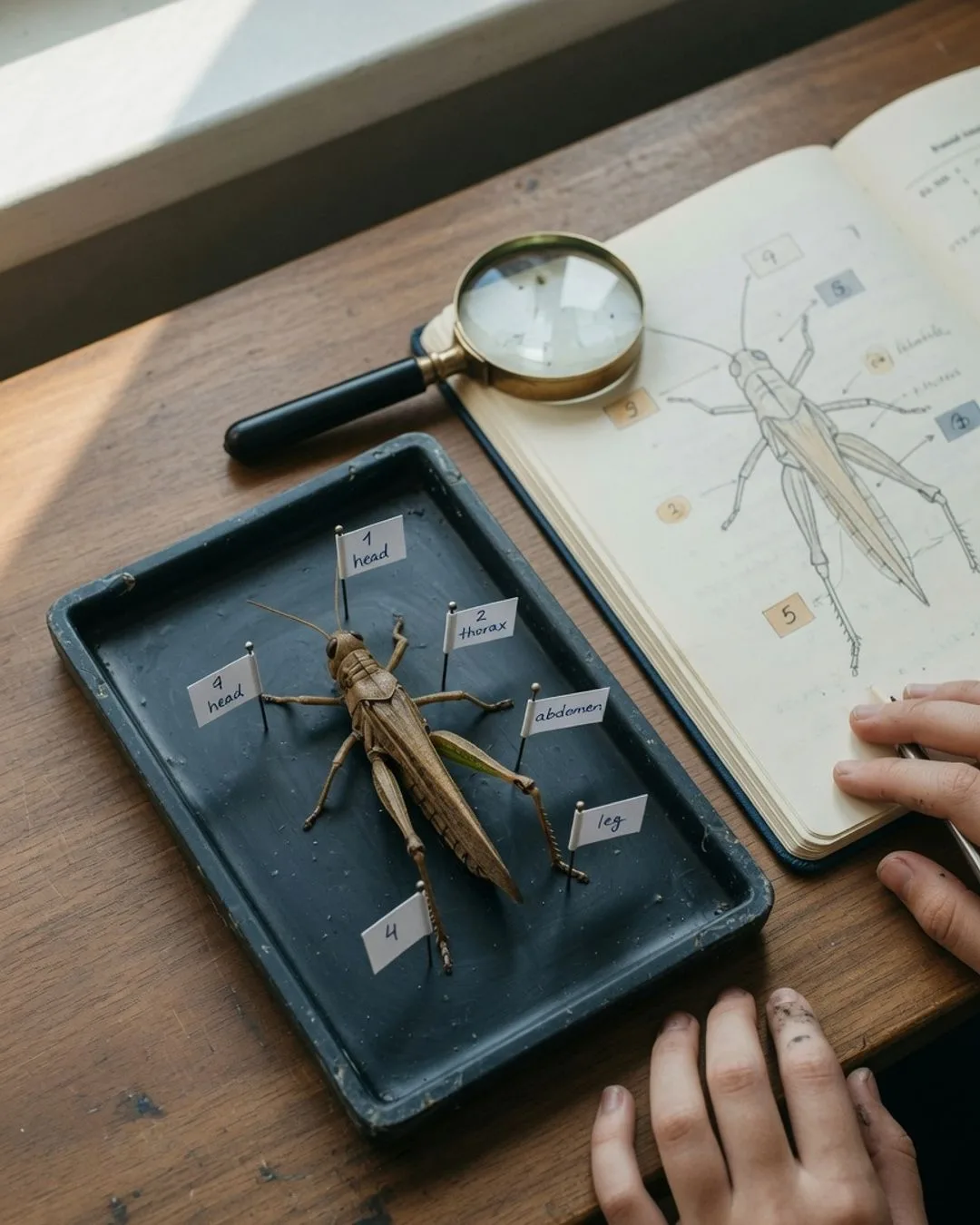
Every Bright Minds course has one unit where the walls between subjects come down on purpose — where the dissection refuses to stay in the biology box and pulls in history, reading, writing, and ethics because it cannot be honestly told without them. In this course, that unit is built around a single idea the sequence of specimens lets students investigate: comparative anatomy, and the common descent it reveals. It is the dissection analog of the cholera map that anchors our biology course — one pattern that turns out to touch everything.
The anatomy first
A perch, frog, and fetal pig share many vertebrate structures, including a heart, liver, and vertebral column, but they do not have identical organs or appendages. For a detailed limb comparison, use a frog forelimb, a pig forelimb, and a human arm reference. Match the humerus, forearm, wrist, and digit regions, allowing for fusion and reduction: a frog has a fused radioulna and four forelimb digits. Use a skeletal reference for structures not exposed on the specimen, and label that evidence as reference-based. A perch is a ray-finned fish; its fin does not display this full tetrapod pattern. Fossils and developmental evidence contribute to the deeper fin-to-limb story that these living specimens alone cannot reconstruct.
What makes comparative anatomy a strong synthesis is that seeing it at all requires nearly everything the course teaches at once. It is a problem in technique — you cannot compare a structure you have mangled, so the earthworm opened in week one is training for the pig opened near the end. It is a problem in observation and drawing: what you cannot capture on paper, labeled and to scale, you cannot compare across two specimens or defend to a teacher. It is a problem in comparison — earthworm, grasshopper, clam or squid, perch, frog, fetal pig — with differences recorded as carefully as similarities. And it is a problem in reasoning from evidence: the student is not told these animals are related; they are shown the bones and asked what could possibly explain the resemblance. They do not get to master one skill; they have to hold all of them at once.
The same care a student brings to opening a specimen and drawing what they find is the care that, two centuries ago, revealed that every backboned animal is a variation on one ancient design.
The history and the idea
In the early nineteenth century, Georges Cuvier was an influential comparative anatomist. He studied how an animal's structures work together and used those relationships to interpret remains. He also held that species were fixed.
In 1843, Richard Owen defined homology as "the same organ in different animals under every variety of form and function." The important distinction is between a shared structural pattern and the different uses to which it can be put.
In On the Origin of Species (1859), Charles Darwin explained such similarities through descent with modification. Shared ancestry helps explain why structures used for swimming, walking, or grasping can have a common underlying arrangement. Students can examine the similarities and then distinguish the observations from the explanation offered for them.
Discussing specimen ethics
And then the course refuses to leave it at the triumphant story, because doing this evidence means using animals that were once alive, and that carries a weight a diagram never could. Every specimen on the tray was a creature; the fetal pigs are a byproduct of the meat industry, the frogs and fish raised or collected for teaching. Handling them well is not squeamishness — it is the ethical center of the craft. We ask students to treat each specimen with the care its origin demands: clean technique, no waste, no showing off, and a genuine reckoning with the trade being made — that a life already ended is being used to teach the living something true about how bodies are built and how they came to be.
We put that responsibility in front of students deliberately, because it teaches something no diagram can:
- Respect is a technique, not a mood. It shows up as the quality of the cut, the neatness of the tray, and the seriousness of the drawing, not as a feeling announced once and then forgotten. A student who works carefully is honoring the specimen whether or not they say so.
- Use carries obligation. To learn from an animal's body is to owe it a real accounting: what did this dissection teach that a model or a screen could not? A serious education names that debt instead of pretending the specimen is just equipment.
- Knowledge has a cost, and honesty means naming it. The clearest window into how a body is built runs through the bodies of the once-living. That is a real cost; a course worth taking neither hides it nor treats it lightly.
And back to biology
The thread runs full circle into the living world. The homologies a student traces on the tray are not a curiosity; they are the visible signature of the tree of life. The earthworm's simple segmented body, the grasshopper's hard exoskeleton and jointed legs, the clam and squid's soft bodies built on a different plan, the fish's fins and gills, the frog's four limbs and lungs, the pig's mammalian heart and diaphragm — these belong on a branching tree. The practice sequence is not a sequence of ancestors, and chamber counts do not make a worm's vessel a step toward a human heart. A student who can defend a valid homology and state where the comparison stops is doing more than labeling: they are separating observations from the historical explanation those observations support.
That is what integration means here. Not a biology lesson with a history anecdote stapled on, but a single pattern held up to the light until a student can see, through it, how anatomy, history, reading, writing, and ethics were never really separate subjects at all. The core spokes, History, Reading, and Writing, are included in every unit; an applied-observation lane (labeling to scale, comparing structures across species, tracing organ systems) runs underneath; and each unit reaches for the elective spokes its story earns — here, the history of comparative anatomy and evolution, and the ethics of working with once-living specimens. The integration guide lays out the full model.