Why dissections is taught this way.
Six short essays for parents and guides. The first two explain the core of the method; the next three address common family questions; the sixth explains how a course like this approaches learning in the age of AI.
The method
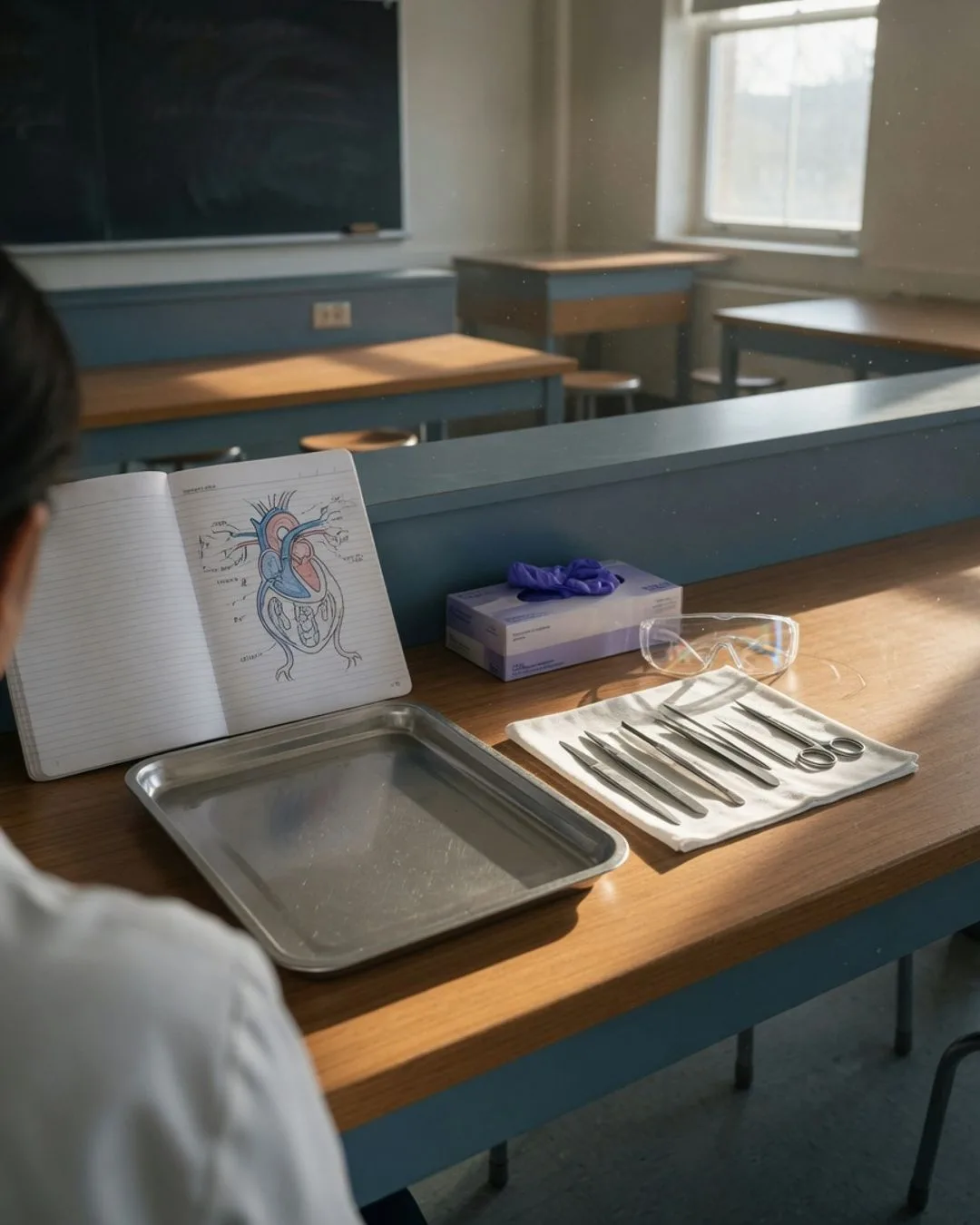
Why dissection is taught at the bench.
Dissection is invisible without the specimen. What the scalpel, the probe, and a real specimen on the tray teach about three-dimensional structure that no diagram or screen can — and why "lab-led, not textbook-led" is the whole game.
Cram, pass, forget in dissections.
Why memorized anatomy diagrams decay especially fast without mastery — and how technique and spatial structure, once earned by doing, are retained. What "Learn → Master → Retain" replaces the test-and-move-on model with.
The demonstrations
The dissection defense.
The single moment that captures the whole course: a student at the tray, an exposed structure, and a guide asking "locate it, identify it, and explain what it does."
Observation under uncertainty.
No two specimens are identical. Natural variation, honest recording, drawing what you actually see rather than the textbook ideal, and why an observation you cannot defend is worthless.
Integration & AI
Integration: comparative anatomy.
How a careful tetrapod forelimb comparison connects history, ethics, and biology — from Cuvier and Owen's "homology" to Darwin's common descent, without turning living species into an evolutionary ladder.
AI-proof by design.
We teach students to use AI thoughtfully while assessing the skills they must demonstrate themselves. This essay explains how the two approaches support each other.