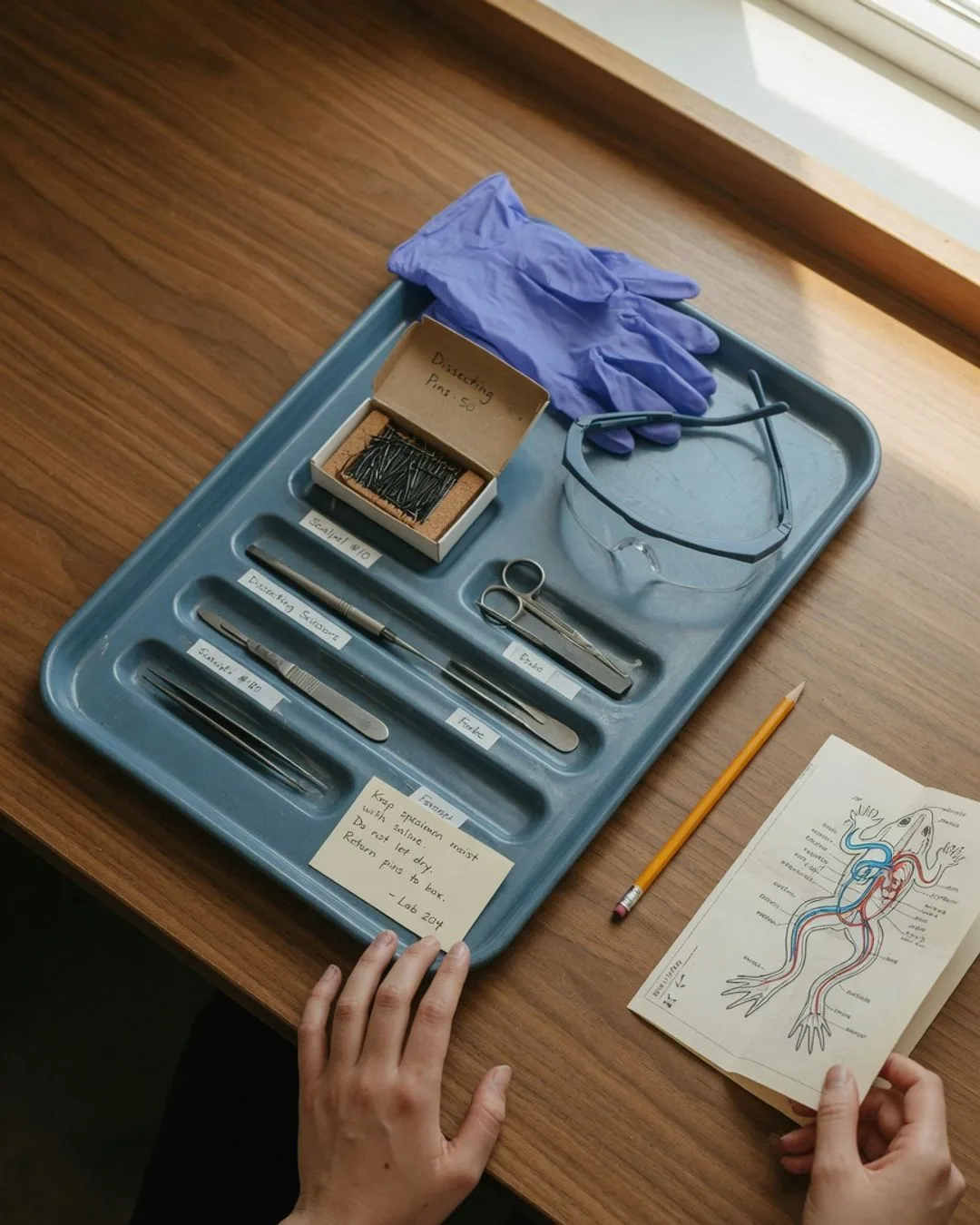
Hand a beginner a specimen and a diagram and they will find whatever the diagram told them to expect, inking in the tidy version even where the real animal is muddier. Hand an experienced dissector the same specimen and they will tell you which structures they can actually see, which they only think they see, and which the textbook drew but this particular animal simply arranged a little differently, and they will know the difference because they understand that no two specimens are identical, and recording a structure you never truly saw is a kind of lie.
Learning to observe honestly is one of the quiet, foundational skills of the whole course, and it is worth slowing down to assess on its own. It is not glamorous. It does not produce a dramatic reveal. But a student who cannot observe honestly cannot do dissection, because every conclusion downstream (every identification, every structure-function claim, every drawing) inherits the quality of the looking it was built on.
Honest observation is a discipline
Students often treat a dissection as a hunt for the picture in the book — find the part, name it, move on. Careful observation is nothing of the kind. It is the practice of recording what is actually in front of you, at the level of certainty you actually have. When you note a pale strand and label it a nerve, you are making a claim; if you are only fairly sure, honesty means writing possible nerve — position fits, but not traced rather than inking it in as fact. Copying the diagram over your own uncertain view is exactly the failure the course is built to prevent: it reports confidence you do not possess.
A real structure is not an artifact
Two things get confused at the bench, and the dissection exists in part to teach the student that they are not the same thing at all:
- A real structure is part of the animal — it was there before your probe was, and it stays consistent as you clear the tissue around it and look again from another angle.
- An artifact is something your own work created — a flap raised by the scissors, a tear that looks like a vessel, a smear of tissue that mimics a membrane. It can look every bit as convincing as the real thing.
- The hard cases are the dangerous ones: a mark that is beautifully clear and quietly false, because a careless cut produced it and the student, wanting to find the textbook structure, wrote it down as one.
A student who internalizes this stops trusting a structure just because it matches the picture, and starts asking the better question: is this part of the animal, or part of what I did to it?
Looking again, and where error comes from
Some of this is muscle: clearing the connective tissue gently so you do not destroy what you are trying to see, looking from more than one angle before you name a thing, knowing that the first glance is always provisional. But the deeper lesson is that a mistake propagates. A structure misidentified early does not stay a small error — it travels into every claim you build on top of it, and the further you go, the more it distorts. A serious observation names its own uncertainty. It says, in effect, "here is what I see, and here is how sure I am that it is what I think."
A structure recorded without honesty about how sure you are is not a careful observation. It is a guess wearing the costume of one.
Doing it right when the clock is running
It is one thing to observe a specimen carefully with all afternoon to do it. It is another to do it honestly during a timed identification, when the clock is running and there is a pull to just write down whatever the diagram says. That is deliberate. In the real practice of dissection, observation always happens under some pressure — a specimen dries, a structure is fragile, time is short — and honesty that evaporates the moment things speed up was never really owned. So the course asks students to observe well and observe promptly — not because speed is the point, but because "I’m not certain," spoken plainly under the clock, is worth more than a confident answer copied from the page.