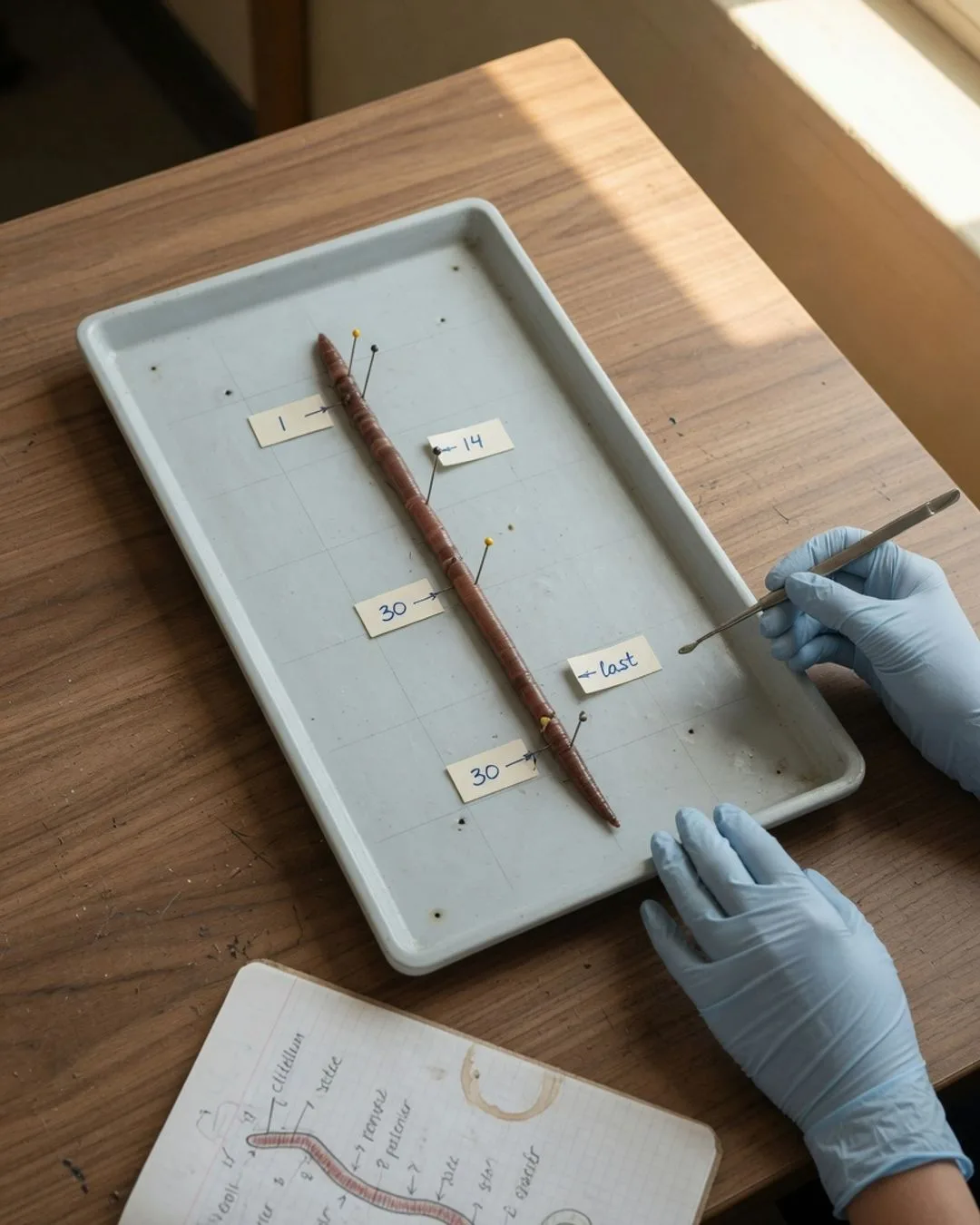
Partway through the year, after students have worked through anatomy, technique, and the way structure follows function, the course arrives at a moment we build everything else toward: the dissection defense. A student stands at the bench with a specimen, a set of instruments, and a guide. They open the animal and expose a structure. Then the guide begins to ask: Why did you cut there? What is this structure, and how do you know? What does it do, and how does its shape serve that job? Show me, on the specimen in front of you, and tell me why you’re right.
It is, quite deliberately, an oral exam conducted over an animal the student opened with their own hands. And it is the clearest single picture of what this whole course is for.
Why a defense, and not a worksheet
A worksheet hands the student a labeled diagram and asks them to match the terms. That is a recognition task, and recognition is the thinnest slice of what dissection actually demands. The defense asks something harder and truer: open the specimen yourself, on a real animal that won’t be arranged exactly like the diagram; find the structure with your own hands and judge whether you have actually exposed it; and then reason out loud about what it is and what it does. That is hard to bluff. Either you can point to the structure on the specimen you opened and say why it is what you claim, or you stand there and you don’t.
Use AI to help you study for the defense. You still have to stand at the bench, open the specimen, expose the structure, and explain it in your own words.
What the guide is actually listening for
The defense isn't a recitation. A guide is listening for three things, and the rubric makes them explicit:
- Technique under control. Did the student make a clean, shallow incision, cut only as deep as the look required, pin the specimen back to reveal the field, and work without destroying the structure — or did they hack through the animal and pretend it counted?
- Identification, reasoned. Can the student explain why this structure is what they say it is — that its position, its shape, and its connections to the tissue around it identify it, and not just its resemblance to a picture?
- Structure and function, defended. Not just naming the organ, but why its form fits its job: the muscular wall that pushes, the surface folded to gain area, the vessel routed to carry — read from the actual specimen, not recited from the page.
That third one is where mastery and memorization separate. A memorized label has no give in it; the moment the guide asks "why is that structure shaped the way it is?" it collapses. Real understanding flexes. It can answer the question it wasn't expecting, because it knows the difference between the name of a structure and the reason it exists.
Why this is the assessment that survives the next decade
There is a practical reason the dissection defense sits at the center of the course, and it has to do with the world students are walking into. A take-home problem set can be generated. A multiple-choice exam can be gamed. But no tool can put its hands on the specimen for a student, open the animal, and reason about the structure actually exposed in front of them in real time. The dissection defense is built around the student’s own work, not because we banned anything, but because students must demonstrate competence themselves.
Years from now, most students will not remember the exact specimen they opened that afternoon. They will remember standing at the bench, lifting the body wall, tracing a structure with a probe, and explaining to a person who kept asking why. What we are really teaching is the confidence that comes from understanding something well enough to explain it.