Unit 06 · The Frog
This unit traces frog systems and comparative physiology while treating the frog as its own branch with artifacts and individual variation.
Student learning: The Frog
Choose the route and level by prerequisites, access needs, and approved supervision before instruction. Foundation, core, and honors tasks are study pathways for this Grades 8-12 semester lab-skills course, not an AP course, college credit, or credential claim.
Prerequisites: Can identify major thoracic and abdominal structures and read a simple quantitative record.
Suggested sequence: read the assigned section, study the teaching explanation, analyze the labeled synthetic data, attempt the selected level, check the answer, then complete a fresh transfer defense. These lessons supplement the assessment packet and do not authorize any procedure.
Assigned reading and focus
- OpenStax Biology 2e: Animal Form and Function. [frog-physiology] Caution: if the source uses ranking words or linear order, correct them with a branching-tree explanation. Use the physiology framing to connect organ structure with environment and function.
- OpenStax Biology 2e: Organizing Life on Earth. [frog-physiology] Caution: if the source uses ranking words or linear order, correct them with a branching-tree explanation. Use the tree explanation to compare frogs with fish and mammals as branches with shared ancestry.
- Galvani, De viribus electricitatis. Use Galvani as the history anchor for why frog preparations mattered in physiology, while keeping modern ethics and specimen limits explicit.
Learn the science
Choose readiness by prerequisites and route approval, not age alone. Public worked answers are nonsecure practice, and no page authorizes a procedure outside the educator-approved plan.
Frog systems and comparative physiology. The frog unit asks for organ-system tracing and comparative physiology: lungs, skin, limbs, digestive structures, and a three-chambered heart. It compares vertebrate systems without making the frog a middle step toward a pig.
Assumptions: The synthetic frog records use labeled model dimensions; inflated lungs, collapsed chambers, or displaced organs may reflect preparation rather than universal anatomy.
Uncertainty: A preserved frog may not show living physiological function. Structure supports an explanation, but physiological claims need references, models, or supervised observation.

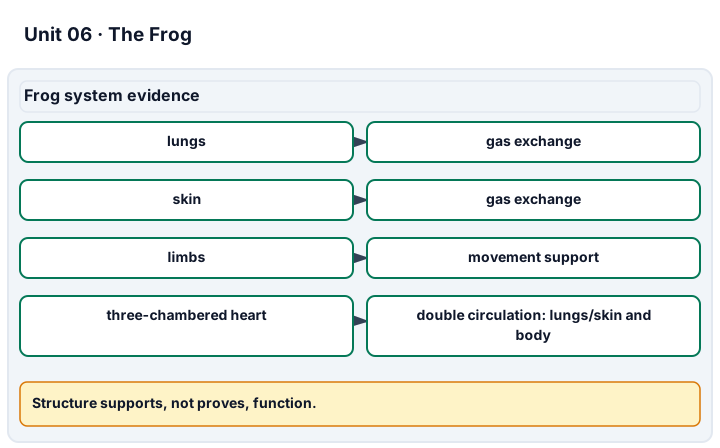
Diagram description
Frog lungs and skin support gas exchange, limbs support movement, and a three-chambered heart supports double circulation through lungs/skin and body. The model ratio uses ventricle width divided by right-atrium width for each specimen, then averages ratios.
Data, provenance, and assumptions
| Model | Ventricle width (mm) | Right atrium width (mm) | Lung note |
|---|---|---|---|
| F1 | 7.2 | 3.4 | right lung collapsed |
| F2 | 6.8 | 3.2 | both lungs partly inflated |
Paper investigation sequence and evidence record
Scope and safety: No improvised procedures, preservatives, latex or other allergens, or instruments are introduced by these public lessons. Hands-on work must follow the educator-approved procedure and SDS, use ethically and legally sourced preserved specimens, and respect opt-out access to an equivalent image-based, virtual, or model route without penalty. No live-animal procedures are part of this course.
Materials and preparation
- [frog-physiology] Use the supplied frog-system-records records, assigned source sections, calculator and an accessible graph or diagram. No physical apparatus is required.
Procedure and schedule
- [frog-physiology] Question: How do frog organ systems support comparative physiology while preserving evidence limits? Prerequisites: Can identify major thoracic and abdominal structures and read a simple quantitative record.
- [frog-physiology] Variables: Structure, measurement, chamber count, lung condition, preservation note, and comparison organism. Controls: Use the same measurement landmarks and label artifact before comparing physiology. Replication: Repeat the comparison with a second image or model when a preserved organ is collapsed or displaced.
- [frog-physiology] Analysis: Compute the ratio and write the physiological explanation plus the artifact warning. Review: An educator reviews prerequisites, source interpretation, reasoning and accessibility before assessment. A paper response does not certify unobserved practical technique; approved hands-on work requires a separate record.
Record: Retain frog-physiology, the selected level, original inputs and first attempt, source/date, system and axes, units, assumptions, calculation/graph, uncertainty, correction and fresh transfer. Link only to the stated science criteria.
Worked model
The ventricle-to-right-atrium ratios are 7.2/3.4 and 6.8/3.2; the mean ratio is about 2.12.
Numerical calibration
- 2.1213235294 mean ventricle-to-atrium width ratio
Attempt the assigned level
Try the tasks before reading the calibration. These are practice answers, not a secure examination; use a new specimen, image set, model, or supervised task for assessment.
Foundation: guided specimen literacy and source-backed vocabulary
- Identify the lungs, heart, and digestive tract on a real, image-based, or model route.
Check after your attempt
- The answer names structures from visible evidence and records the route used.
High-school core: typically grades 9-10, semester lab-skills course with independent evidence and approved routes
- Explain why a three-chambered frog heart is compared with fish and mammal hearts without calling one animal a step toward another.
Check after your attempt
- It supports a comparative physiology explanation across vertebrate branches: the frog has lungs (homologous to the perch swim bladder), a three-chambered heart, and double circulation. It is not a rank order of living species.
Honors extension: typically grades 11-12, quantitative morphology and comparative physiology
- Use the synthetic measurement ratio and describe how preservation could affect a physiological interpretation.
Check after your attempt
- The mean ratio is about 2.12. Collapsed lungs or displaced chambers can change what is visible, so physiological conclusions need reference evidence beyond the specimen.
History, reading, and writing connection
Use animal form and phylogeny sources to compare frog, fish, and mammal systems as related branches with different physiological constraints.
Write in your own words or use an approved accessible equivalent. Cite a specific assigned section, identify its evidence, and state one limitation.
Transfer to a new case
A frog lung is collapsed on one side. Does that prove a one-lung anatomy?
Calibration: No. Record the artifact and use reference evidence or another approved specimen/model before making an anatomical or physiological claim.
Evidence to retain
Completion evidence: the student defends a real specimen identification, explains a valid cross-specimen comparison, and states the limits of the evidence. The student must defend a frog structure identification, a valid vertebrate comparison, and one preservation limit.
Record route, units, source/date, observed structures, calculations, comparison category, uncertainty, and what is measured versus inferred. No improvised procedures, preservatives, latex or other allergens, or instruments are introduced by these public lessons. Hands-on work must follow the educator-approved procedure and SDS, use ethically and legally sourced preserved specimens, and respect opt-out access to an equivalent image-based, virtual, or model route without penalty. No live-animal procedures are part of this course.
Return to all eight learning pathways. Print this unit page for student learning; the linked five-page packet remains the separate assessment companion.
Evidence, routes, and comparison limits
Integration is reported separately and cannot lower the science grade or block a science demonstration pass. Science and practical criteria determine that pass.
Completion evidence: the student defends a real specimen identification, explains a valid cross-specimen comparison, and states the limits of the evidence. The student must defend a frog structure identification, a valid vertebrate comparison, and one preservation limit.
Equivalent routes: Image-based, virtual, model, and professionally supervised routes can meet the same conceptual standard without penalty. Practical skill is credited only when hands-on technique is observed on an approved route.
Safety and ethics: No improvised procedures, preservatives, latex or other allergens, or instruments are introduced by these public lessons. Hands-on work must follow the educator-approved procedure and SDS, use ethically and legally sourced preserved specimens, and respect opt-out access to an equivalent image-based, virtual, or model route without penalty. No live-animal procedures are part of this course.
- Science 1: Instrument handling & safe technique. Only an educator-observed approved practical or professionally supervised route can evidence Instrument handling & safe technique; supplied data, images, virtual routes, or models can support planning and explanation but cannot credit hands-on skill. Rubric row.
- Science 2: Careful exposure & observation. Only an educator-observed approved practical or professionally supervised route can evidence Careful exposure & observation; supplied data, images, virtual routes, or models can support planning and explanation but cannot credit hands-on skill. Rubric row.
- Science 3: Locating & naming external structures. Approved images or models can evidence external frog structure naming where landmarks are visible; specimen handling remains observed-only. Rubric row.
- Science 4: Locating & naming internal organ systems. The frog system records can evidence heart, lung, digestive, and urogenital naming when labeled or visible, while collapsed organs are recorded as artifacts. Rubric row.
- Science 5: Explaining structure & function (and specimen care). The ventricle-to-atrium ratio, lung artifact notes, and comparative physiology explanation evidence structure-function reasoning and preservation limits. Rubric row.
Unit mastery rubric
| Criterion | Developing | Proficient | Mastery |
|---|---|---|---|
| Instrument handling & safe technique | Grips the scalpel, scissors, forceps, or probe awkwardly; cuts too hard or too deep; puts hands or specimen at risk. | Holds the instruments correctly with reminders and cuts more carefully, but still presses too hard or steadies the specimen poorly. | Holds each instrument the right way and makes shallow, controlled cuts, working safely for both the student and the specimen; this technique criterion requires educator observation. |
| Careful exposure & observation | Cuts before looking and slices through organs while opening the body cavity. | Makes the midline incision roughly and pins the body wall back unevenly, disturbing organs before observing them. | Makes a clean midline incision, pins back the body wall, and opens the cavity without damaging organs beneath; this exposure criterion requires observation. |
| Locating & naming external structures | Cannot point to the eyes, tympanum, nares, limbs, or cloaca, or tell fore from hind limb. | Finds a few external landmarks with prompting but confuses the tympanum or misses the nictitating membrane. | Locates and names eyes, nictitating membrane, tympanum, nares, limbs, webbing, and cloaca on the approved specimen, image, model, or virtual route. |
| Locating & naming internal organ systems | Guesses at the organs or names the wrong ones once the cavity is open. | Finds the larger organs but cannot reliably distinguish the small from the large intestine or locate the gallbladder and fat bodies. | Locates and names heart, lungs, liver, gallbladder, stomach, intestines, kidneys, and fat bodies on the approved route, recording collapsed or shifted organs as artifacts. |
| Explaining structure & function (and specimen care) | Cannot say what a structure does, and lets the specimen dry out or handles it carelessly. | Explains one or two organs' functions but not how the systems connect, and keeps the specimen moist only when reminded. | Explains the three-chambered heart, lungs, skin, double circulation, and preservation artifacts using the checked ratio; handling care is observed separately. |
| Integration (cross-domain) | Makes no supported connection between the source and the science. | Uses the source but needs help connecting evidence, writing, or limitations to the science. | Independently connects History, Reading, and Writing using a cited source, appropriate evidence, a limitation, and a scientific explanation. |
Integration is reported separately and cannot lower the science grade or block a science demonstration pass. Science and practical criteria determine that pass. Use the integration guide's evidence checklist for the separately reported criterion.
“This three-chambered heart sits at the front of the cavity — two atria and one ventricle, fewer than ours. Behind it are the two lungs, but a frog also breathes through its skin, so it has dual respiration. I traced the gut from the stomach through the small and large intestine to the cloaca, and the dark bean-shaped organs against the back wall are the kidneys.”
“I cut down the middle but went too deep and nicked something. There’s an organ here — the liver, maybe? I can’t tell the small intestine from the large one.”
You demonstrate this unit by doing the dissection while an instructor watches — opening the body cavity and locating and naming real organ systems on your own specimen while explaining how they work together, not a written test. Technique criteria are mastered only when an educator observes them; identification and explanation criteria can be mastered on the approved specimen, image, model, or virtual route without penalty. Mastery is demonstrated, not awarded.
A 5-page clipboard packet — unit overview, key terms, the mastery rubric, anchor examples, and a score sheet you can print and grade against.