Unit 08 · Comparative Anatomy & the Dissection Defense
This unit requires a real identification defense and a branching cross-specimen comparison that distinguishes homology, analogy, unresolved evidence, and phylogenetic support.
Student learning: Comparative Anatomy & the Dissection Defense
Choose the route and level by prerequisites, access needs, and approved supervision before instruction. Foundation, core, and honors tasks are study pathways for this Grades 8-12 semester lab-skills course, not an AP course, college credit, or credential claim.
Prerequisites: Can identify structures across at least two approved specimen routes and define homology and analogy.
Suggested sequence: read the assigned section, study the teaching explanation, analyze the labeled synthetic data, attempt the selected level, check the answer, then complete a fresh transfer defense. These lessons supplement the assessment packet and do not authorize any procedure.
Assigned reading and focus
- Understanding Evolution: Homologies. [comparison-defense] Use the homology page to define similarities inherited from common ancestors and evidence used to identify them.
- OpenStax Biology 2e: Understanding Evolution. [comparison-defense] Use convergent and divergent evolution to separate homologous and analogous comparisons.
- OpenStax Biology 2e: Organizing Life on Earth. [comparison-defense] Use phylogenetic trees as hypotheses built from multiple evidence sources, not specimen order.
- On the Origin of Species. Use Darwin as the history anchor for common descent, then separate that historical source from the modern evidence needed for each classroom comparison.
Learn the science
Choose readiness by prerequisites and route approval, not age alone. Public worked answers are nonsecure practice, and no page authorizes a procedure outside the educator-approved plan.
Cross-specimen comparison defense. The final defense uses a cross-specimen framework: what is genuinely homologous, what is analogous, what cannot be resolved from these specimens alone, and what phylogenetic evidence adds.
Assumptions: The synthetic evidence matrix labels comparison claims rather than replacing the oral defense. A real defense still requires the student to identify actual structures on an approved specimen route.
Uncertainty: Some comparisons remain unresolved from classroom specimens alone. Fossils, DNA, development, and broader sampling can change or strengthen the phylogenetic explanation.

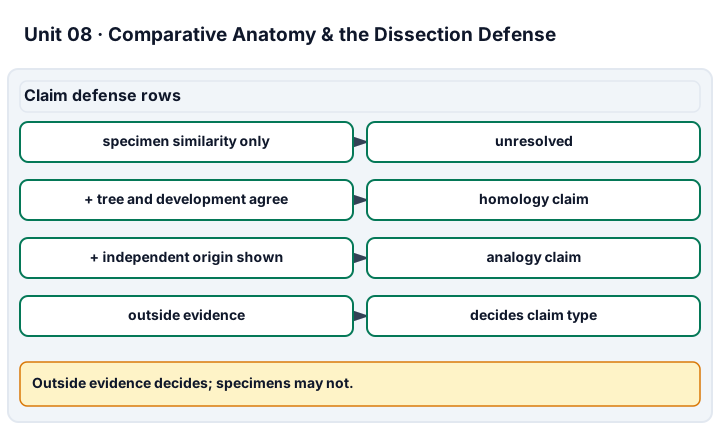
Diagram description
Specimen similarity alone is unresolved. Tree and developmental evidence can support homology. Evidence of independent origin can support analogy. Broader fossils, DNA, development, and sampling decide claim type; classroom specimens alone may not.
Data, provenance, and assumptions
| Comparison | Visible specimen evidence | Outside evidence needed | Classification |
|---|---|---|---|
| frog forelimb / fetal pig forelimb | same limb position and bone-region pattern | phylogenetic tree and development | homologous |
| squid eye / vertebrate eye | similar image-forming function | development and phylogeny | analogous |
| perch fin / tetrapod limb | paired appendage position | fossils, DNA, developmental genetics | cannot resolve from specimens alone |
| frog heart / fetal pig heart | vertebrate heart chambers | comparative physiology references | homologous with functional differences |
Paper investigation sequence and evidence record
Scope and safety: No improvised procedures, preservatives, latex or other allergens, or instruments are introduced by these public lessons. Hands-on work must follow the educator-approved procedure and SDS, use ethically and legally sourced preserved specimens, and respect opt-out access to an equivalent image-based, virtual, or model route without penalty. No live-animal procedures are part of this course.
Materials and preparation
- [comparison-defense] Use the supplied cross-specimen-evidence records, assigned source sections, calculator and an accessible graph or diagram. No physical apparatus is required.
Procedure and schedule
- [comparison-defense] Question: Which comparisons are homologous, analogous, or unresolved, and what evidence supports each category? Prerequisites: Can identify structures across at least two approved specimen routes and define homology and analogy.
- [comparison-defense] Variables: Specimens compared, visible evidence, outside evidence, classification, and limit. Controls: Compare the same structural level and keep specimen observation separate from phylogenetic reference evidence. Replication: Repeat the framework with a fresh comparison selected by the educator.
- [comparison-defense] Analysis: Tally the categories, then defend one unresolved case honestly. Review: An educator reviews prerequisites, source interpretation, reasoning and accessibility before assessment. A paper response does not certify unobserved practical technique; approved hands-on work requires a separate record.
Record: Retain comparison-defense, the selected level, original inputs and first attempt, source/date, system and axes, units, assumptions, calculation/graph, uncertainty, correction and fresh transfer. Link only to the stated science criteria.
Worked model
Four of four synthetic comparison rows are assigned a category: homologous, analogous, unresolved, or homologous-with-functional-differences. The comparison tally is 4/4 = 100%, with one row explicitly unresolved from specimens alone.
Numerical calibration
- 100 % rows assigned a comparison category
Attempt the assigned level
Try the tasks before reading the calibration. These are practice answers, not a secure examination; use a new specimen, image set, model, or supervised task for assessment.
Foundation: guided specimen literacy and source-backed vocabulary
- Sort each matrix row as homologous, analogous, or unresolved using the supplied labels.
Check after your attempt
- The answer must retain the unresolved category instead of forcing every comparison into homology.
High-school core: typically grades 9-10, semester lab-skills course with independent evidence and approved routes
- Defend one real specimen identification and one cross-specimen comparison with evidence and limits.
Check after your attempt
- A valid defense names the structure, cites visible evidence, classifies the comparison, and states what the specimens alone cannot settle.
Honors extension: typically grades 11-12, quantitative morphology and comparative physiology
- Add phylogenetic evidence to one unresolved comparison and explain how it changes the strength of the claim.
Check after your attempt
- Fossils, DNA, development, and broader taxon sampling can support a fin-to-limb history; the preserved perch alone cannot settle it.
History, reading, and writing connection
Use UCMP homology, OpenStax evolution, and OpenStax phylogeny to defend one comparison and state exactly what the specimens do not settle.
Write in your own words or use an approved accessible equivalent. Cite a specific assigned section, identify its evidence, and state one limitation.
Transfer to a new case
Choose a new comparison: frog lung and fetal pig lung. What is the valid claim and what remains limited?
Calibration: They are homologous vertebrate respiratory organs with functional and developmental differences. A fetal pig specimen and preserved frog can show structure, but live physiology and exact adult function require additional evidence.
Evidence to retain
Completion evidence: the student defends a real specimen identification, explains a valid cross-specimen comparison, and states the limits of the evidence. The student must complete the dissection defense with a real identification, a valid comparison, and an evidence-limit statement.
Record route, units, source/date, observed structures, calculations, comparison category, uncertainty, and what is measured versus inferred. No improvised procedures, preservatives, latex or other allergens, or instruments are introduced by these public lessons. Hands-on work must follow the educator-approved procedure and SDS, use ethically and legally sourced preserved specimens, and respect opt-out access to an equivalent image-based, virtual, or model route without penalty. No live-animal procedures are part of this course.
Return to all eight learning pathways. Print this unit page for student learning; the linked five-page packet remains the separate assessment companion.
Evidence, routes, and comparison limits
Integration is reported separately and cannot lower the science grade or block a science demonstration pass. Science and practical criteria determine that pass.
Completion evidence: the student defends a real specimen identification, explains a valid cross-specimen comparison, and states the limits of the evidence. The student must complete the dissection defense with a real identification, a valid comparison, and an evidence-limit statement.
Equivalent routes: Image-based, virtual, model, and professionally supervised routes can meet the same conceptual standard without penalty. Practical skill is credited only when hands-on technique is observed on an approved route.
Safety and ethics: No improvised procedures, preservatives, latex or other allergens, or instruments are introduced by these public lessons. Hands-on work must follow the educator-approved procedure and SDS, use ethically and legally sourced preserved specimens, and respect opt-out access to an equivalent image-based, virtual, or model route without penalty. No live-animal procedures are part of this course.
- Science 1: Comparing structures across specimens. The cross-specimen matrix can evidence comparison setup and structure matching; the real specimen identification in a defense still requires the student to point to the structure on an approved route. Rubric row.
- Science 2: Homology vs. analogy. The matrix can evidence homology, analogy, and unresolved classifications; the oral defense must still distinguish those categories in the student’s own words. Rubric row.
- Science 3: The dissection defense. Only an educator-observed approved practical or professionally supervised route can evidence The dissection defense; supplied data, images, virtual routes, or models can support planning and explanation but cannot credit hands-on skill. Rubric row.
- Science 4: The common-descent argument. The matrix’s fossil, DNA, and development column evidences a branching tree with limits; the category tally supports comparison reasoning, not morphology. Rubric row.
- Science 5: Synthesis & careful communication. The transfer defense evidence is a real identification, a valid cross-specimen comparison, and an explicit limit on what the specimens do not settle. Rubric row.
Unit mastery rubric
| Criterion | Developing | Proficient | Mastery |
|---|---|---|---|
| Comparing structures across specimens | Cannot locate the same organ system in two specimens. | Finds both systems but assumes a shared job proves homology. | Compares an organ system in two specimens or approved models and distinguishes shared function from evidence of shared ancestry. |
| Homology vs. analogy | Treats any two structures that do the same job as the same structure. | Uses the words homology and analogy but applies them to the wrong examples. | Distinguishes homologous structures, analogous functions, and unresolved comparisons on the approved specimens, images, models, or virtual route. |
| The dissection defense | Cannot locate or name the requested structure on the specimen when asked aloud. | Finds and names the structure but cannot explain its function or answer a follow-up question. | Locates, identifies, and explains a structure’s function on the specimen out loud under instructor questioning; this live defense criterion requires educator observation. |
| The common-descent argument | Cannot relate anatomical evidence to common descent. | Names homology but treats living species as successive ancestors. | Explains the shared tetrapod forelimb pattern and places specimens on a branching tree while stating what fossil, DNA, development, or broader evidence adds. |
| Synthesis & careful communication | Reports expected rather than observed anatomy; handles specimens carelessly. | Names most structures but blurs observation and inference. | Uses accurate terms, separates observation from inference, handles specimens respectfully when observed, and communicates comparison limits carefully. |
| Integration (cross-domain) | Makes no supported connection between the source and the science. | Uses the source but needs help connecting evidence, writing, or limitations to the science. | Independently connects History, Reading, and Writing using a cited source, appropriate evidence, a limitation, and a scientific explanation. |
Integration is reported separately and cannot lower the science grade or block a science demonstration pass. Science and practical criteria determine that pass. Use the integration guide's evidence checklist for the separately reported criterion.
“The frog forelimb, pig forelimb, and human arm share an inherited bone pattern, with changes such as fused bones and different digit counts. The perch is a ray-finned fish: its fin does not show that full tetrapod limb pattern. These living animals are branches with shared ancestors, not steps from worm to human.”
“Both structures move the animal, so they must have the same origin. I cannot point to the parts that support that claim.”
You demonstrate this unit by defending a real specimen and a valid cross-specimen comparison aloud. Explain which features support homology, which similarities concern function alone, and what the available specimens cannot show. Use a labeled reference when a structure is not exposed, without claiming to have observed it directly. Mastery is demonstrated, not awarded.
A 5-page clipboard packet — unit overview, key terms, the mastery rubric, anchor examples, and a score sheet you can print and grade against.