Unit 08 · Astronomy & Earth in Space
The year closes by pulling back from the planet to its place in space. This unit covers the Earth–Moon–Sun system and the two things it explains that almost everyone gets wrong — why we have seasons (the tilt of Earth's axis, not its distance from the Sun) and why the Moon shows phases (its position relative to the Sun, not Earth's shadow). From there it builds outward to the structure of the solar system and the staggering scale that separates the planets. Mastery means you can model the system and explain seasons and phases from geometry, not from a guess.
Student learning: Apply orbital scaling and explain seasons with bounded geometry
Choose the level by readiness, not age alone, and record it before instruction. Foundation, core, and honors tasks are study pathways, not an AP course or a promise of college credit. The instructor retains practical assessment and the published science rubric; integration is reported separately.
Prerequisites: Foundation: scale, subtraction and angle diagrams. Core: squares, cubes and square roots. Honors: sine in degree mode, fractional powers and endpoint bounds. Readiness check: sqrt(4^3) = 8, not 4^1.5 entered as 4 x 1.5. Practice with the foundation model before independent orbital calculations.
Suggested sequence: read and discuss the explanation; attempt the worked model; analyze the data at your selected level; check the answers; then complete the source-linked response and a fresh transfer question. These activities supplement, not replace, supervised practical work and the full-year schedule.
Assigned reading and focus
- NASA Science: Orbits and Kepler's Laws. Read Here Are Kepler's Three Laws and the Newtonian generalization in How We Use Kepler's Laws Today. Use semi-major axis and a specified central mass, not an instantaneous distance or an unqualified universal P^2 = a^3.
- NASA Science, Earth Facts: Orbit and Rotation. Read Orbit and Rotation for the connection between tilt, sunlight and opposite hemispheric seasons. The geometry below uses rounded 23.5-degree obliquity for a teaching model, not a new astronomical measurement.
Learn the science
For a negligible-mass object orbiting the Sun, the two-body approximation is P^2 = a^3 when P is in Earth years and a in AU. The variable a is semi-major axis, not instantaneous Sun-object distance. Elliptical orbits do not require constant speed.
For other central masses expressed in solar masses, the model becomes P^2 = a^3/M, still with AU and years. This assumes the orbiting mass is negligible compared with M and ignores other bodies and relativistic corrections; it is not a spacecraft navigation plan.
At local solar noon on a spherical Earth, center-of-Sun altitude h = 90 degrees - absolute(latitude - declination). Latitude and declination must have consistent signs. The supplied 40-degree north case stays above the horizon; polar day/night cases need additional treatment.
With parallel rays of equal incident flux, the projected flux on a horizontal plane is proportional to sin(h). This comparison holds the incoming beam fixed and omits atmosphere, clouds, surface reflectivity, changing distance and day length. It is not daily mean heating or a temperature forecast.
Axial tilt changes solar altitude and day length, producing opposite seasons in opposite hemispheres. Moon phases depend on the illuminated half visible from Earth; eclipses require shadow alignment. A drawn model or an approved image can show this geometry without observing the Sun.

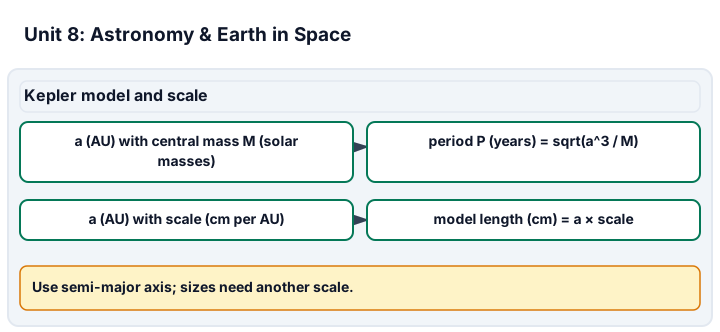
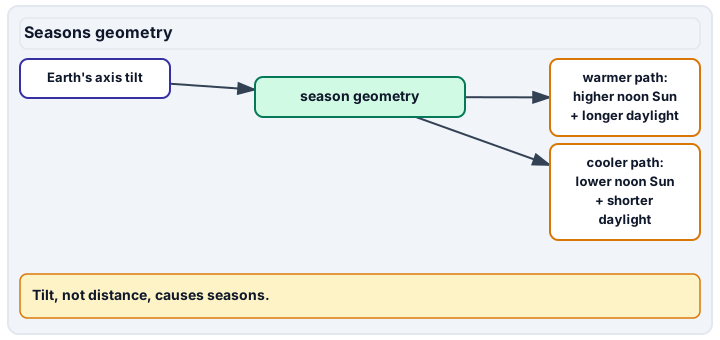
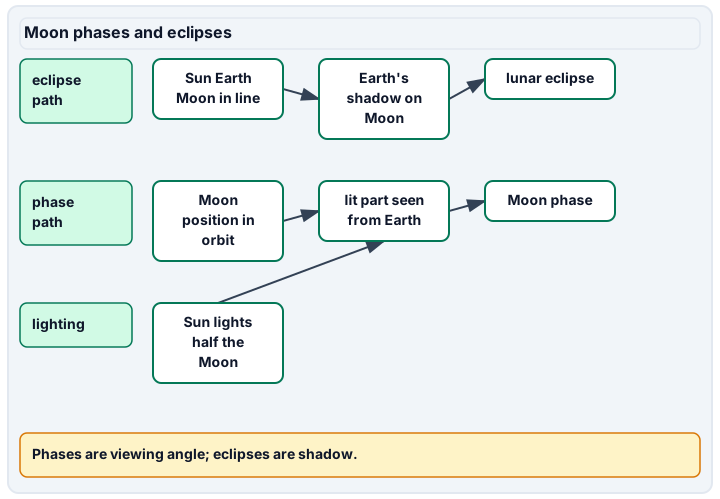
Diagram description
The Kepler panel uses semi-major axis in AU and central mass in solar masses to compute period in years, and a separate scale in cm per AU to compute a model length in cm. The seasons panel shows axis tilt creating a warmer path with higher noon Sun and longer daylight, and a cooler path with lower noon Sun and shorter daylight. The Moon panel separates ordinary phases, caused by the lit part seen from Earth, from lunar eclipses caused by Earth's shadow.
Data, provenance, and assumptions
| Case | Semi-major axis a (AU) | Central mass M (solar masses) |
|---|---|---|
| Reference | 1 | 1 |
| Model object | 4 | 1 |
| Season case | Latitude (degrees north) | Solar declination (degrees north) |
|---|---|---|
| Summer | 40 | 23.5 |
| Equinox | 40 | 0 |
| Winter | 40 | -23.5 |
Worked model
For a = 4 AU and M = 1 solar mass, P = sqrt(4^3) = 8 years. A drawing with 10 cm per AU places the semi-major-axis length at 40 cm, not a scaled planet diameter. At 40 degrees north in the summer case, h = 90 - |40 - 23.5| = 73.5 degrees; at winter noon h = 26.5 degrees.
Numerical calibration
- 8 years for a = 4 AU, M = 1
- 7.7019 years for a = 3.9 AU, M = 1
- 8.3019 years for a = 4.1 AU, M = 1
- 11.3137 years for a = 4 AU, M = 0.5
- 1.5874 AU for P = 2 years, M = 1
- 73.5 degrees above the horizon at solar noon
- 50 degrees above the horizon at solar noon
- 26.5 degrees above the horizon at solar noon
- 2.1489 dimensionless ratio, equal incident beam assumption
Attempt the assigned level
Try the tasks before reading the calibration. These are practice answers, not a secure examination; use a new dataset or changed assumption for the assessed transfer.
Foundation: typically grades 7-8
- Draw the 1 AU and 4 AU semi-major-axis lengths at 10 cm/AU, and label that object sizes are not shown to scale.
- Calculate all three noon altitudes. Draw which hemisphere tilts toward the Sun and explain why a Moon phase is not ordinarily Earth's shadow.
Check after your attempt
- Reference length 10 cm and Model object length 40 cm. A distance scale does not automatically establish a diameter scale.
- Summer 73.5 degrees, equinox 50 degrees, winter 26.5 degrees. The hemisphere tilted toward the Sun has higher noon Sun and longer days; phases show the visible part of the lit lunar hemisphere, while shadow events are eclipses.
High-school core: typically grades 9-10
- Calculate the period for each orbit and invert the Sun-mass relation to find a when P = 2 years. State the required units and central-mass assumption.
- A fictional orbit has a = 4 AU but is momentarily 3 AU from its star. Explain which distance enters Kepler's third law and why the noon-altitude calculation is not a weather forecast.
Check after your attempt
- Periods are 1 and 8 years. For P = 2, a = (2^2)^(1/3) = about 1.587 AU. These values assume a one-solar-mass center and negligible orbiting mass.
- Use the 4 AU semi-major axis, not the momentary 3 AU radius. The noon model omits atmospheric conditions and heat storage, so it does not predict local temperature or safety.
Honors extension: typically grades 11-12
- Calculate period bounds for a = 3.9-4.1 AU at M = 1. Then find the nominal period at a = 4 AU if M = 0.5 solar masses instead.
- Calculate the summer/winter noon projected-flux ratio from sin(73.5 degrees)/sin(26.5 degrees). Explain why it is not the ratio of daily energy or surface temperatures.
Check after your attempt
- P ranges from sqrt(3.9^3) = 7.702 to sqrt(4.1^3) = 8.302 years. With M = 0.5, P = sqrt(64/0.5) = 11.314 years. These are model sensitivity bounds, not observational confidence intervals.
- The ratio is about 2.149 with the same incident beam. Day length, changing beam strength, atmosphere, albedo and heat storage are omitted; a noon projection ratio is not a daily energy ratio or a Celsius-temperature multiplier.
History, reading, and writing connection
Use NASA's Kepler/Newton account to distinguish a mathematical description of an orbit from a physical explanation involving gravitation. Use your half-mass comparison or scaling work to show why historical success of a relation does not remove its unit and mass assumptions.
Write in your own words or use an approved accessible equivalent. Cite a specific assigned section or figure, identify its evidence, and state one limitation or counterargument. Use the AI practice contract only for permitted coaching, never to invent observations or write the assessed response.
Transfer to a new case
A fresh negligible-mass orbit has a = 9 AU and M = 1. Foundation: draw its semi-major axis at 10 cm/AU and find noon altitude for a separate 20-degree north equinox case. Core: calculate orbital period. Honors: recalculate if M = 0.5. All levels: explain why no result authorizes solar viewing or predicts temperature.
Calibration: Foundation: the drawing length is 90 cm; noon h = 90 - |20 - 0| = 70 degrees. Core: P = sqrt(9^3) = 27 years. Honors: P = sqrt(729/0.5) = about 38.184 years. These are model calculations only; no solar viewing is authorized and surface temperature is not determined by noon geometry.
Evidence to retain
Retain the agreed level's labeled scale/season diagram, orbital or projection calculation, assumptions and fresh transfer. These count in the Seasons geometry and Orbital quantities science criteria. A drawing or calculated answer does not demonstrate telescope operation or other practical performance. Sources checked 2026-09-27.
Record units, calculations, source/date, uncertainty, and what is measured versus inferred. A simulation or supplied dataset must stay labeled as such. No field exposure or weather chasing; no water sampling, ingestion, or chemical tests; no solar viewing. Use supplied data and approved images or non-destructive indoor alternatives only. A worksheet does not demonstrate practical performance or authorize a real location or safety forecast.
Return to all eight learning pathways. Print this unit page for the student lessons; the linked five-page packet remains the separate assessment companion.
Unit mastery rubric
| Criterion | Developing | Proficient | Mastery |
|---|---|---|---|
| Seasons geometry | Attributes seasons to distance alone or misreads angles. | Calculates noon altitude with help but overstates heating. | At the agreed level, defends noon altitude or sine projection, tilt and day length without treating noon flux as daily temperature. |
| Moon phases | Thinks Moon phases are Earth's shadow falling on the Moon. | Says phases come from the Moon's position but confuses them with eclipses. | Explains phases from the Moon's position relative to Earth and Sun, and distinguishes them from eclipses. |
| The Earth–Moon–Sun system | Cannot relate day, year, and the motions that produce them. | Names rotation and revolution but mixes up what each causes. | Connects Earth's rotation and revolution and the Moon's orbit to day, year, phases, and tides. |
| Orbital quantities | Confuses distance scale, semi-major axis or period. | Calculates with help but omits units or central mass. | At the agreed level, defends scale, Kepler period or bounds using semi-major axis, AU/years and the stated mass assumption. |
| Scale and phase model reasoning | Cannot label the model or distinguish it from observation. | Explains geometry but omits a limitation. | Defends a labeled diagram and fresh orbital/altitude transfer without claiming solar viewing, practical telescope skill or a forecast. |
| Integration (cross-domain) | Makes no supported connection between the source and the science. | Uses the source but needs help connecting evidence, writing, or limitations to the science. | Independently connects History, Reading, and Writing using a cited source, appropriate evidence, a limitation, and a scientific explanation. |
Integration is reported separately and cannot lower the science grade or block a science demonstration pass. Science and practical criteria determine that pass. Use the integration guide's evidence checklist for the separately reported criterion.
“At a = 4 AU around a one-solar-mass center, the model gives P = 8 years, not four. The 40-degree north noon altitudes are 73.5 and 26.5 degrees for the two solstices. Their sine ratio is about 2.149 under equal incident flux, not a daily-energy or surface-temperature ratio.”
“It’s summer when Earth gets closer to the Sun, and the Moon’s phases are just Earth’s shadow moving across it.”
At the agreed level, submit a labeled drawing, the assigned orbital or season calculation and fresh transfer with units and assumptions. Use the supplied geometry or approved images; no solar viewing is required or authorized. A worksheet does not demonstrate telescope operation. Integration remains separately reported.
A 5-page clipboard packet — unit overview, key terms, the mastery rubric, anchor examples, and a score sheet you can print and grade against.