Unit 05 · Blood & Bodily Fluids
Interpret printed mock screening, confirmation, and ABO cards, including negative and invalid-control outcomes. Calculate error rates and base-rate-dependent predictive values. Measure ideal paper ellipses using angle = arcsin(width/length), with reading bounds and invalid-ratio checks. No bodily samples, reagents, or liquid stains are used; an ellipse angle alone does not reconstruct a three-dimensional origin or an event.
Student learning: Interpret mock screens, typing cards, and idealized stain geometry
Choose the level by readiness, not age alone, and record it before instruction. Foundation, core, and honors tasks are study pathways, not an AP course or a promise of college credit. The instructor retains practical assessment and the published science rubric; integration is reported separately.
Prerequisites: Units 2 and 4; fractions, percentages, controls, right triangles, and degree-mode inverse sine for core/honors.
Suggested sequence: read and discuss the explanation; attempt the worked model; analyze the data at your selected level; check the answers; then complete the source-linked response and a fresh transfer question. These activities supplement, not replace, supervised practical work and the full-year schedule.
Assigned reading and focus
- NIJ: Study Reports Error Rates for Bloodstain Pattern Analysis. Read the first three paragraphs, through the discussion of the 2009 National Academies and PCAST reports. Identify wrong conclusions, disagreements, and reproduced errors as different study outcomes; the percentages below are entirely synthetic and are not that study’s findings.
Learn the science
Kastle–Meyer and luminol are names of professional presumptive blood tests, not student procedures here. A presumptive positive may have other causes and is not a human identification. Acid phosphatase is likewise a presumptive indicator in a different body-fluid context, not a uniquely identifying test. We use printed symbols only.
Positive controls show a test can respond to a target; negative controls check unexpected response. A failed control invalidates the affected interpretation. A valid negative confirmation means the initial lead was not confirmed, not that every possible target has been ruled out. Detection limits, degradation, and different method targets can matter.
ABO antigens are features of red-cell surfaces; matching antibodies can produce agglutination. On the supplied cards, anti-A positive and anti-B negative indicate A; both positive AB; both negative O if controls pass. ABO is a broad group, not an individual identity, and these cards are neither clinical tests nor transfusion guidance.
Sensitivity is the positive fraction among known target-present samples; specificity is the negative fraction among known target-absent samples. False-positive and false-negative rates condition on known truth. Positive predictive value asks the reverse question: what fraction of positive results contain the target? That depends strongly on the base rate and the sampling process.
The ideal mock-data relation is angle = arcsin(width / length), measured in degrees for a projected circular stain on a flat surface, with 0 < width ≤ length and no distortion. Width and length describe only the main ellipse, not tails. The shape of a real stain can violate this model through surface texture, overlap, dynamics, or uncertain boundaries.
An ellipse angle is not a three-dimensional area of origin or a reconstruction of a violent act. Even multiple directions require additional geometric and physical assumptions. Two readers can share the same boundary ambiguity. Analyze drawn ellipses only: do not create stains or drop, spray, or propel liquid.

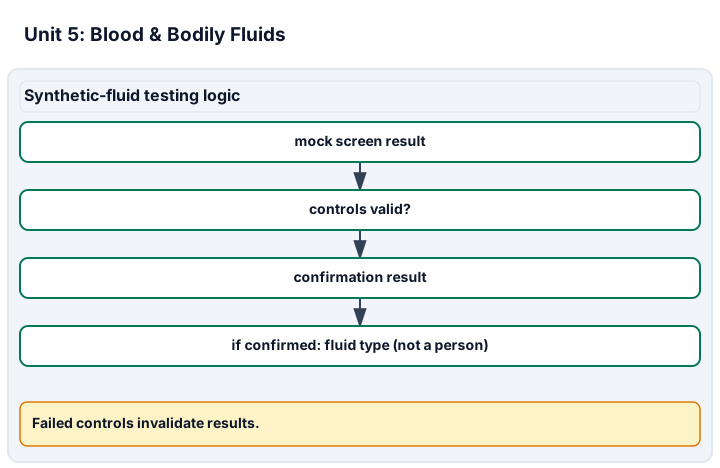
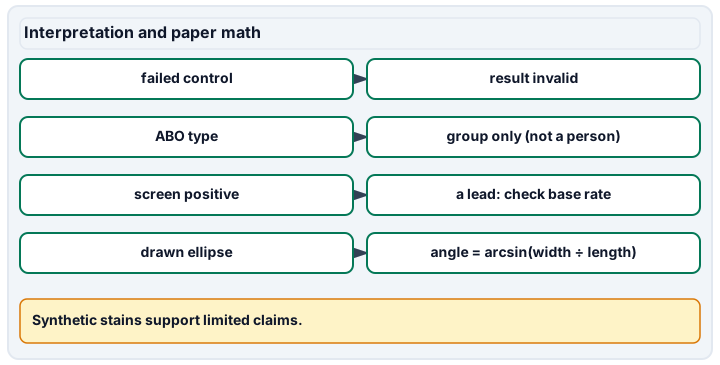
Diagram description
Synthetic-fluid testing logic moves from a mock screen to control validity and a confirmation result; if confirmed, it shows fluid type, not a person. Interpretation rows state failed-control, ABO group-only, base-rate and paper-ellipse-angle limits.
Data, provenance, and assumptions
| Known truth | Screen positive | Screen negative |
|---|---|---|
| target-present | 72 | 8 |
| target-absent | 46 | 874 |
| Card | Screen | Confirmation | Positive control | Negative control |
|---|---|---|---|---|
| M1 | + | - | + | - |
| M2 | - | not run | + | - |
| M3 | + | + | + | - |
| M4 | + | + | + | + |
| Card | Anti-A | Anti-B | Negative control |
|---|---|---|---|
| T1 | + | - | - |
| T2 | + | + | - |
| T3 | - | - | - |
| T4 | + | - | + |
| Ellipse | Width (mm) | Length (mm) |
|---|---|---|
| A | 5 | 10 |
| B | 8 | 10 |
| C | 10 | 10 |
| D | 11 | 10 |
Blinded card interpretation and repeat ellipse measurements
Scope and safety: Only printed cards and drawn ellipses; no biological specimens, test reagents, stains, liquid dropping, or real-case images.
Materials and preparation
- Two copies of each provided mock card and ellipse; ruler and degree-mode calculator.
- Separate decision sheets with control-status, result, and limitation columns.
Procedure and schedule
- State the control rule and geometric assumptions before reviewing the coded cards; do not reveal the intended outcomes.
- Each reader independently classifies the screen/confirmation and typing records, including the invalid cards.
- Each reader marks the main axes of a drawn ellipse and measures width and length twice. Keep disagreement and repeat spread, rather than averaging away an invalid ratio.
- Calculate the synthetic confusion table’s rates with their different denominators. Then consider a new 10,000-card population with 100 targets at the same sensitivity/specificity.
- Reveal the key only after recording decisions. Report negative, not-confirmed, and invalid outcomes explicitly; compare the ideal geometry with the NIJ reading’s limits.
Record: Keep independent card decisions, controls, denominator-labeled rates, base-rate comparison, raw ellipse dimensions, angle bounds, and an explicit no-identity/no-origin statement.
Worked model
The false-positive rate is 46/920 = 5%; false-negative rate is 8/80 = 10%. Of 118 positive screens, 72 contain target: PPV = 61.0169%, not 95%. At 1% prevalence in 10,000 otherwise comparable cases, expect 90 true positives and 495 false positives, giving 15.3846% PPV. For paper ellipse A, arcsin(5/10) = 30°; this is an ideal projection angle only.
Numerical calibration
- 5 % of known target-absent records
- 10 % of known target-present records
- 61.016949 % target-present among positive screens
- 0.907029 % target-present among negative screens
- 15.384615 % PPV in the stated 1% base-rate model
- 30 degrees; ideal paper ellipse A
- 53.130102 degrees; ideal paper ellipse B
- 90 degrees; ideal paper circle C
- 25.376934 degrees; A lower reading bound
- 35.37654 degrees; A upper reading bound
Attempt the assigned level
Try the tasks before reading the calibration. These are practice answers, not a secure examination; use a new dataset or changed assumption for the assessed transfer.
Foundation
- Sort M1–M4 by control status, confirmation, and what may be reported. Interpret T1–T4 using the ABO rule.
- Draw a two-by-two screen table; count all positive results and all target-present records. State why the denominators differ.
Check after your attempt
- M1 is not confirmed; M2 is screen negative, not proven absent; M3 confirms the toy target only, not a person; M4 is invalid because its negative control is positive. T1 A, T2 AB, T3 O, T4 invalid.
- There are 118 positives but only 80 target-present records. The 46 false positives belong among the 920 target-absent records; a screen result and known truth are different labels.
High-school core: typically grades 9-10
- Compute sensitivity, specificity, FPR, FNR, PPV, and target fraction among negative screens. Report M4 before discussing a positive result.
- Use the ideal ellipse relation on A–D and explain which result is invalid and why no 3D origin follows.
Check after your attempt
- Sensitivity 90%, specificity 95%, FPR 5%, FNR 10%, PPV 61.0169%; target among negatives = 8/882 = 0.9070%. M4 is invalid: never claim a confirmed target from that failed-control run.
- A = 30°, B ≈ 53.1301°, C = 90°. D is invalid because width/length = 1.1 lies outside the model. A projected angle alone supplies neither a three-dimensional origin nor the identity or action of a person.
Honors extension: typically grades 11-12
- Recompute expected PPV for 100 targets among 10,000 records with the same sensitivity and specificity. State the assumption that permits transport of those rates.
- Bound A’s angle using the extreme width/length readings. Explain why independent reading, blind review, and replication do not by themselves validate a real forensic method.
Check after your attempt
- Expect 90 true positives, 10 false negatives, 495 false positives, and 9,405 true negatives. PPV = 90/585 = 15.3846%. This assumes comparable case mix, decision rule, and method performance; changing prevalence alone cannot justify changing sensitivity.
- The angle lies between arcsin(4.5/10.5) ≈ 25.3769° and arcsin(5.5/9.5) ≈ 35.3765° in the toy model. These are bounds, not a confidence interval. Shared boundary ambiguity and nonrepresentative cases remain; empirical validation needs known-condition, representative testing.
History, reading, and writing connection
Use the NIJ article’s account of the 2009 scientific review and later known-condition testing. Write a source-cited revision of an overconfident stain report, distinguishing a measured angle, a method-performance study, and a narrative claim. Neither the article’s rates nor our invented rates are a verdict on a particular case.
Write in your own words or use an approved accessible equivalent. Cite a specific assigned section or figure, identify its evidence, and state one limitation or counterargument. Use the AI practice contract only for permitted coaching, never to invent observations or write the assessed response.
Transfer to a new case
A new irregular shape measures 5 × 10 mm, but its edges overlap another shape. Is 30° a defensible reported impact angle?
Calibration: Only as a calculation for an ideal ellipse, not as a reliable interpretation of that irregular record. Mark the geometry inconclusive, retain the image and measurements, and explain the failed assumption instead of reporting false precision.
Evidence to retain
Submit all control/result decisions, ABO interpretations without identity claims, confusion table with denominators, altered-base-rate reasoning, independently marked ellipses, units/bounds, and limits on geometry.
Record units, calculations, source/date, uncertainty, and what is measured versus inferred. A simulation or supplied dataset must stay labeled as such. Fictional cases only. No real bodily samples, personal fingerprints, suspect profiles, personal-device searches, chemicals, cultivation, firearms, ammunition, or projectiles. Use paper, printed diagrams, and supplied mock data. Synthetic arithmetic checks are not empirical forensic-method validation or classroom pilot evidence.
Return to all eight learning pathways. Print this unit page for the student lessons; the linked five-page packet remains the separate assessment companion.
Unit mastery rubric
| Criterion | Developing | Proficient | Mastery |
|---|---|---|---|
| Presumptive testing & error rates | Reads a positive screen as proof. | Computes rates but confuses their denominators. | Interprets mock screens as leads; computes sensitivity, false-positive/negative rates, and predictive value while stating the base-rate assumption. |
| Confirmatory testing & body-fluid identification | Confuses screening with confirmation. | Ignores negative confirmation or failed controls. | Separates screen, confirmation, and control outcomes; retains negative, unconfirmed, and invalid results; explains why professional presumptive tests are not identity tests. |
| ABO blood typing | Claims a type identifies a person. | Reads symbols but omits control or antigen reasoning. | Explains antigen/antibody agglutination on paper cards, correctly interprets ABO and invalid-control outcomes, and reports group evidence only. |
| Mock stain geometry & limits | Infers events from shape alone. | Computes angles without checking the model. | Uses angle = arcsin(width/length) for ideal paper ellipses, rejects invalid ratios, bounds reading uncertainty, and distinguishes angle from three-dimensional origin. |
| Technique & biohazard safety | Uses unauthorized samples or invents readings. | Uses paper records but omits repeats or control documentation. | Uses paper-only cards and ellipses; retains blind independent decisions, repeated measurements, and control failures without biological material, reagents, or stain creation. |
| Integration (cross-domain) | Makes no supported connection between the source and the science. | Uses the source but needs help connecting evidence, writing, or limitations to the science. | Independently connects History, Reading, and Writing using a cited source, appropriate evidence, a limitation, and a scientific explanation. |
Integration is reported separately and cannot lower the science grade or block a science demonstration pass. Science and practical criteria determine that pass. Use the integration guide's evidence checklist for the separately reported criterion.
“The synthetic screen has 5% false positives among target-absent cards, but its positive predictive value is 61.0169%. M1 is not confirmed and M4 invalid. Ellipse A gives 30° only in the ideal model, not a 3D origin or a person’s identity.”
“It turned pink, so it’s definitely his blood. The type proves it was him.”
Interpret printed screening/typing cards and measure drawn ellipses; no bodily samples, reagents, liquid stains, dropping, or spraying. Keep independent initial decisions, denominator-labeled calculations, control failures, and reading bounds. A paper-model angle alone cannot reconstruct an event.
A 5-page clipboard packet — unit overview, key terms, the mastery rubric, anchor examples, and a score sheet you can print and grade against.