Unit 04 · Metamorphic Rocks & the Rock Cycle
Metamorphic rock is stone remade in the solid state — reshaped by heat and pressure deep in the crust without ever melting. This unit covers foliated rocks and the slate–phyllite–schist–gneiss sequence of rising grade, non-foliated rocks like marble and quartzite, the reasoning that recovers a rock's protolith, and the full rock cycle that ties igneous, sedimentary, and metamorphic rock into one continuous system — Hutton's Earth, endlessly recycled with no vestige of a beginning. Mastery means you can name a metamorphic rock, infer what it used to be, and trace a single mineral grain all the way around the cycle.
Student learning: Use pressure-temperature models without treating rock texture as a single-depth gauge
Choose the level by readiness, not age alone, and record it before instruction. Foundation, core, and honors tasks are study pathways, not an AP course or a promise of college credit. The instructor retains practical assessment and the published science rubric; integration is reported separately.
Prerequisites: Mineral composition, pressure and density, unit conversion, and simple linear models.
Suggested sequence: read and discuss the explanation; attempt the worked model; analyze the data at your selected level; check the answers; then complete the source-linked response and a fresh transfer question. These activities supplement, not replace, supervised practical work and the full-year schedule.
Assigned reading and focus
- Physical Geology 2e, 7.1: Controls over Metamorphic Processes. Read the roles of parent composition, temperature, pressure/stress, fluids, and time. Interpret the mineral-stability figure as a model with conditions.
- Physical Geology 2e, 7.2: Classification of Metamorphic Rocks. Compare foliation, bedding, and common protolith examples. Not every composition develops the same texture or follows one sequence of rock names.
Learn the science
Metamorphism changes minerals and textures largely in the solid state. The protolith, pressure-temperature path, fluids, deformation, and time all influence the result. Melting begins a different part of the rock cycle.
Foliation can reflect mineral growth and deformation under directional stress; it is not automatically original sedimentary bedding. Marble and quartzite illustrate why composition influences whether a rock shows a strong aligned fabric.
For this simplified overburden model, P = density times g times depth, with density 2700 kg/m^3 and g = 9.81 m/s^2. Convert kilometers to meters and pascals to MPa. This is not pore pressure and does not describe every tectonic stress state.
Use a teaching temperature model T = 15 C + 25 C/km times depth. A real geotherm varies in space and time. One pressure/temperature estimate does not uniquely identify every metamorphic assemblage, its age, or a safe engineering property.

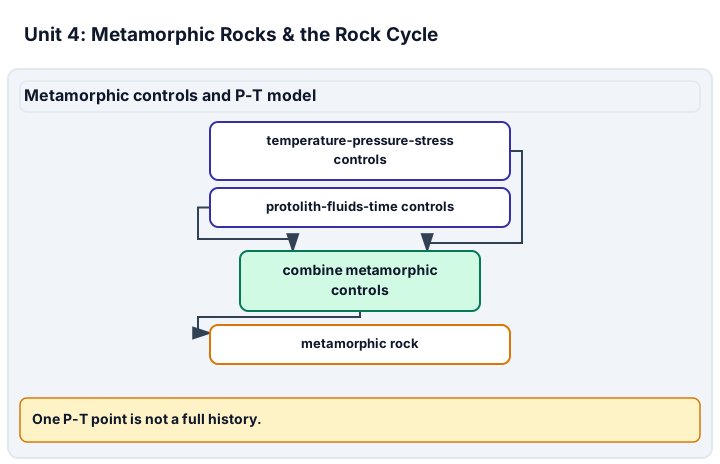
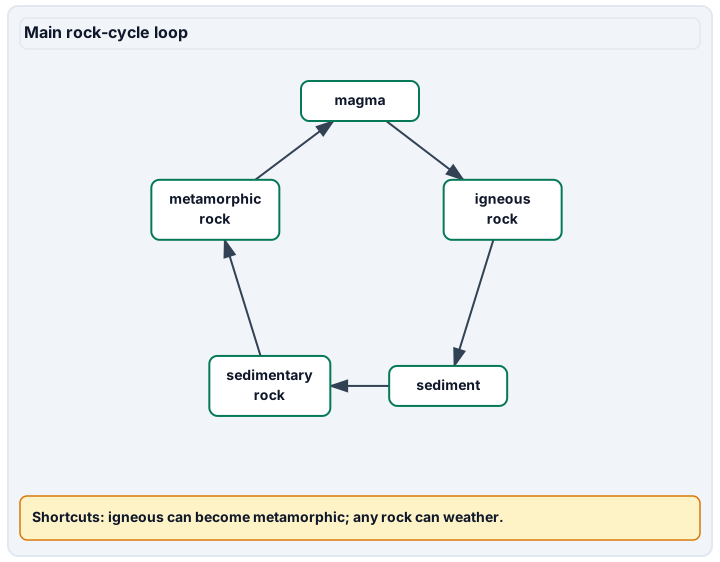
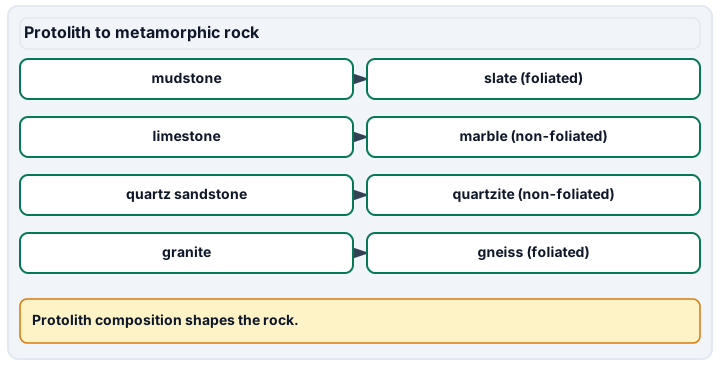
Diagram description
Metamorphic controls include protolith, heat, pressure, directed stress, fluids and time; the diagram groups heat, pressure and directed stress as temperature-pressure-stress controls and groups protolith, fluids and time as protolith-fluids-time controls. Pressure and temperature formulas are stated in the unit text. The main cycle links magma, igneous rock, sediment, sedimentary rock and metamorphic rock; its caption notes that igneous rock can become metamorphic directly and any rock can weather. The protolith grid maps mudstone to slate, limestone to marble, quartz sandstone to quartzite and granite to gneiss.
Data, provenance, and assumptions
| Depth (km) | Interpretation limit |
|---|---|
| 10 | Uniform-density model only |
| 20 | Uniform-density model only |
| 30 | Uniform-density model only |
| Sample | Protolith | Observed texture |
|---|---|---|
| A | Mudstone | Aligned platy minerals |
| B | Limestone | Coarse interlocking calcite |
| C | Quartz sandstone | Interlocking quartz |
Worked model
At 20 km, P = 2700 times 9.81 times 20,000 = 529,740,000 Pa, or 529.74 MPa. The temperature model gives 15 + 25 times 20 = 515 C. The calculations describe the assumptions, not a unique diagnosis of sample A, B, or C.
Numerical calibration
- 529.74 MPa
- 515 C
Attempt the assigned level
Try the tasks before reading the calibration. These are practice answers, not a secure examination; use a new dataset or changed assumption for the assessed transfer.
Foundation
- Compare the three supplied textures and distinguish protolith from the new rock.
- Explain why a nonfoliated rock is not evidence that metamorphism never occurred.
Check after your attempt
- A has an aligned fabric; B and C have different interlocking mineral compositions. The original material influences the result.
- Composition and deformation conditions affect texture; marble or quartzite can lack strong foliation.
High-school core: typically grades 9-10
- Compute pressure and temperature at 20 km with units.
- Explain why substituting pore-water pressure for total overburden pressure would change the model.
Check after your attempt
- 529.74 MPa and 515 C.
- They are different quantities. Effective stress and fluid conditions require additional information, not an interchangeable label.
Honors extension: typically grades 11-12
- Compute pressures at 10 and 30 km and compare the modeled temperature interval.
- State which additional observations would be needed to infer a pressure-temperature history rather than one arithmetic point.
Check after your attempt
- Pressures are 264.87 and 794.61 MPa; modeled temperatures are 265 and 765 C.
- Mineral assemblages, composition, zoning, structures, fluid context, and suitable models or dates can constrain a path; the simple gradient alone cannot.
History, reading, and writing connection
Use the assigned rock examples to explain how composition and physical conditions constrain interpretation. Connect a visible texture to a hypothesis without treating one observation as a full pressure-temperature history.
Write in your own words or use an approved accessible equivalent. Cite a specific assigned section or figure, identify its evidence, and state one limitation or counterargument. Use the AI practice contract only for permitted coaching, never to invent observations or write the assessed response.
Transfer to a new case
A contact-metamorphic rock formed near hot magma at shallow depth. Must it lie on the stated average geotherm?
Calibration: No. Local heating can depart strongly from that teaching gradient; identify which assumption has changed.
Evidence to retain
Retain pressure/unit work, a protolith-texture comparison, and the model limitations. No heating or pressure experiment is required.
Record units, calculations, source/date, uncertainty, and what is measured versus inferred. A simulation or supplied dataset must stay labeled as such. Use supplied data, approved photographs, or the non-destructive observation plan. No hammering, acids, excavation, water sampling, unstable-site entry, or engineering/safety clearance is authorized by these lessons.
Return to all eight learning pathways. Print this unit page for the student lessons; the linked five-page packet remains the separate assessment companion.
Unit mastery rubric
| Criterion | Developing | Proficient | Mastery |
|---|---|---|---|
| Heat & pressure without melting | Thinks metamorphism means the rock melted. | Names heat and pressure but not that the rock stayed solid. | Explains how heat and pressure recrystallize a rock in the solid state, short of melting. |
| Foliated vs non-foliated | Cannot tell banded from unbanded rock. | Labels foliation but cannot say what causes it. | Distinguishes foliated from non-foliated rock and explains foliation as mineral alignment under directed pressure. |
| Metamorphic grade & physical models | Confuses grade, depth, and texture. | Uses one texture as an exact pressure-temperature gauge. | Interprets the common pelitic grade sequence and assigned pressure/temperature calculations, accounting for composition and model limitations. |
| Protolith reasoning | Cannot say what a metamorphic rock started as. | Guesses a protolith without evidence. | Infers the protolith — limestone to marble, sandstone to quartzite, shale to slate — from texture and composition. |
| The rock cycle (lab) | Treats the three rock families as unrelated. | Names the rock cycle but cannot route a grain through it. | Traces a mineral grain around the full rock cycle, linking igneous, sedimentary, and metamorphic paths. |
| Integration (cross-domain) | Makes no supported connection between the source and the science. | Uses the source but needs help connecting evidence, writing, or limitations to the science. | Independently connects History, Reading, and Writing using a cited source, appropriate evidence, a limitation, and a scientific explanation. |
Integration is reported separately and cannot lower the science grade or block a science demonstration pass. Science and practical criteria determine that pass. Use the integration guide's evidence checklist for the separately reported criterion.
“This is gneiss — it has coarse, banded light and dark minerals, so it was squeezed and heated to a high grade without melting. Its protolith could have been granite, or a shale that went slate, phyllite, schist, then gneiss. Melt it and it re-enters the cycle as igneous rock.”
“It’s a striped rock that got hot. I think it melted a little. I don’t know what it was before.”
You demonstrate this unit at the specimen bench — identifying metamorphic rocks with a hand lens, inferring each one's protolith, and sorting rocks by their place in the full rock cycle aloud — not a multiple-choice test. A criterion counts as mastered only when you can both name the rock and defend the protolith and cycle path it records. Mastery is demonstrated, not awarded.
A 5-page clipboard packet — unit overview, key terms, the mastery rubric, anchor examples, and a score sheet you can print and grade against.