Unit 06 · Earthquakes & Earth’s Interior
An earthquake is rock releasing strain it could no longer hold, and its waves are the only direct probe we have of the deep interior. This unit covers elastic-rebound theory — how rock stores strain along a fault and lets go in a sudden rebound — the three wave types (P-waves, S-waves, and surface waves) and how each travels, locating an epicenter by triangulating arrival-time differences from three seismograms, and how the waves reveal the layered interior: crust, mantle, liquid outer core, and solid inner core. Mastery means you can read a seismogram, find the quake, and explain what the waves prove about the planet beneath you.
Student learning: Locate a model event and distinguish magnitude, hazard, and risk
Choose the level by readiness, not age alone, and record it before instruction. Foundation, core, and honors tasks are study pathways, not an AP course or a promise of college credit. The instructor retains practical assessment and the published science rubric; integration is reported separately.
Prerequisites: Graphs, distance and speed, coordinate geometry; honors work uses logarithms and compound probability.
Suggested sequence: read and discuss the explanation; attempt the worked model; analyze the data at your selected level; check the answers; then complete the source-linked response and a fresh transfer question. These activities supplement, not replace, supervised practical work and the full-year schedule.
Assigned reading and focus
- Physical Geology 2e, 11.3: Measuring Earthquakes. Read P/S arrivals, epicenter versus hypocenter, and magnitude versus intensity. Compare local-amplitude and moment-magnitude approaches rather than calling every estimate Richter magnitude.
- Physical Geology 2e, 11.4: The Impacts of Earthquakes. Read how ground conditions, exposure, and infrastructure affect impacts. The examples do not supply a safety assessment for a new site.
- USGS: Can you predict earthquakes?. Distinguish a specific event prediction from a probability statement or early warning after an event begins. Identify what each statement would need to specify.
Learn the science
The hypocenter is a source at depth; the epicenter is the point above it at the surface. P and S waves travel at different speeds. Real paths depend on depth and changing Earth materials; the exercise below deliberately uses a uniform two-dimensional model.
Use P speed 6 km/s and S speed 3 km/s here. Then S-P interval = distance times (1/3 - 1/6), so distance = 6 times the interval. Distance circles can locate a model event; a real location requires suitable travel-time models and uncertainty analysis.
A magnitude is not the intensity at every place. For the separate simplified amplitude exercise, use magnitude difference = log10(corrected amplitude ratio). Approximate radiated-energy ratio = 10 raised to 1.5 times the magnitude difference. These are not direct conversions from one raw uncorrected seismogram to a full moment-magnitude solution.
Hazard concerns a defined physical event or exceedance, while risk also depends on exposure and vulnerability. For a purely hypothetical constant, independent annual event probability p, the probability of at least one event in n years is 1 - (1-p)^n. Real processes need not satisfy that independence model.
A modeled probability is not an earthquake prediction, an engineering design, or a reason to enter a damaged site. Follow public emergency guidance and qualified assessment for real hazards.

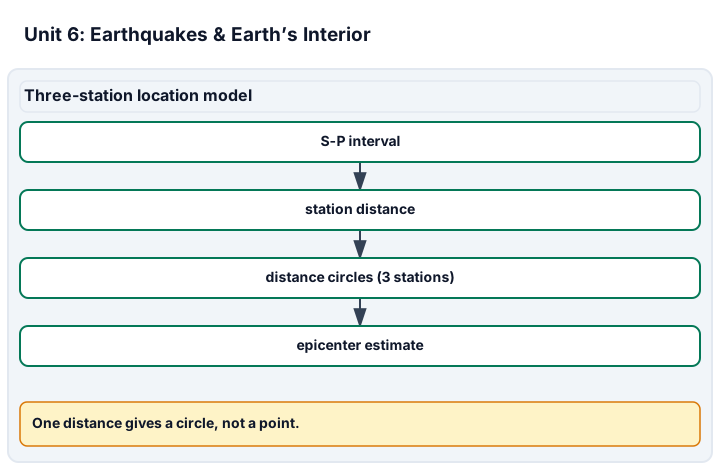
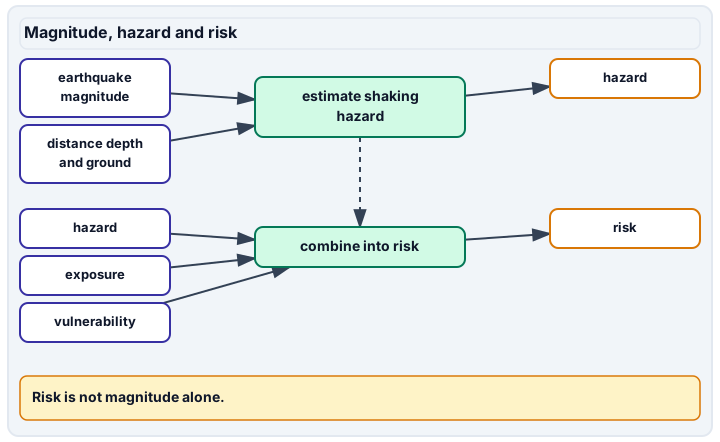
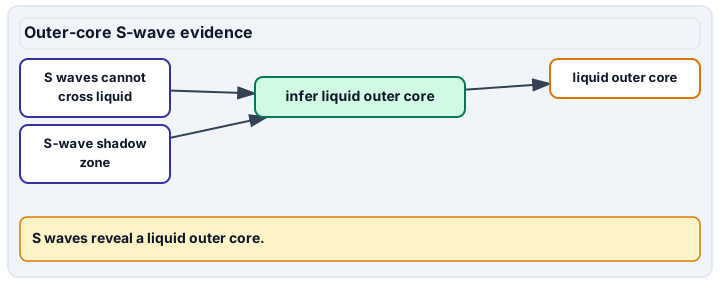
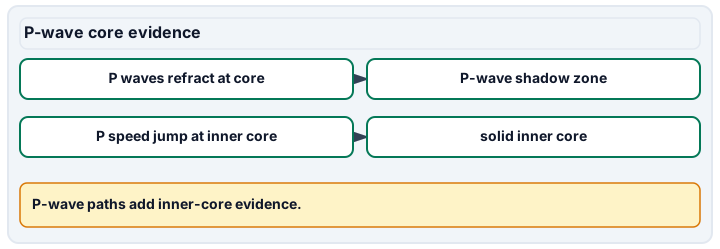
Diagram description
The first panel computes station distances from S-P intervals and uses three station circles for an epicenter estimate. Earthquake magnitude with distance, depth and ground conditions sets the shaking hazard; hazard, exposure and vulnerability combine into risk, so risk is not magnitude alone. S-wave evidence infers a liquid outer core. P-wave refraction creates a P-wave shadow zone, and a P-speed jump supports the solid inner core.
Data, provenance, and assumptions
| Station | East (km) | North (km) | S-P interval (s) |
|---|---|---|---|
| A | 0 | 0 | 8.33 |
| B | 60 | 0 | 8.33 |
| C | 0 | 80 | 8.33 |
| Event A normalized amplitude | Event B normalized amplitude |
|---|---|
| 1 | 100 |
| Annual event probability | Years |
|---|---|
| 0.02 | 10 |
Worked model
Each station gives 6 times 8.33 = 49.98 km, approximately 50 km at the plotting precision. Circles centered at the supplied stations meet near (30, 40) km; the third station distinguishes the two intersections from the first pair. The amplitude ratio of 100 corresponds to a magnitude difference of 2, not an energy ratio of 100.
Numerical calibration
- 49.98 km under the given model
- 2 magnitude units
- 1000 approximate ratio
- 18.29 percent in the hypothetical model
Attempt the assigned level
Try the tasks before reading the calibration. These are practice answers, not a secure examination; use a new dataset or changed assumption for the assessed transfer.
Foundation
- Draw the three stations and approximate distance circles; identify the model epicenter.
- Distinguish an earthquake's magnitude from reported intensity at a location.
Check after your attempt
- The approximate model location is (30, 40) km. Depth and real velocity variation were excluded.
- Magnitude characterizes the event using a defined measurement method; intensity varies with location and observed effects.
High-school core: typically grades 9-10
- Calculate station distance and the magnitude/energy comparisons.
- Explain why a single magnitude does not specify damage at two different sites.
Check after your attempt
- Distance: 49.98 km; magnitude difference: 2; approximate energy ratio: 1000.
- Ground conditions, distance, construction, exposure, and other factors influence the consequences.
Honors extension: typically grades 11-12
- Convert the 0.05-second interval uncertainty to a distance uncertainty in this model.
- Compute the hypothetical ten-year event probability and explain why adding the annual percentages gives a different answer.
Check after your attempt
- The distance contribution is 6 times 0.05 = 0.30 km, excluding velocity-model uncertainty.
- About 18.29%. The complement accounts for years with no event; the assumptions do not make a real event occur on a schedule.
History, reading, and writing connection
Use the USGS explanation to evaluate a fictional headline claiming that a probability calculation predicts an exact earthquake date. Cite the difference between evidence, a model, and an operational warning.
Write in your own words or use an approved accessible equivalent. Cite a specific assigned section or figure, identify its evidence, and state one limitation or counterargument. Use the AI practice contract only for permitted coaching, never to invent observations or write the assessed response.
Transfer to a new case
An event did not occur this year. Does the model guarantee one next year?
Calibration: No. In the stated independent model the next-year probability remains 0.02. A different physical process could have time dependence, but that requires a different justified model.
Evidence to retain
Submit the location sketch, selected calculations, and a qualified hazard statement. Do not use the exercise to judge a real building, road, slope, or evacuation decision.
Record units, calculations, source/date, uncertainty, and what is measured versus inferred. A simulation or supplied dataset must stay labeled as such. Use supplied data, approved photographs, or the non-destructive observation plan. No hammering, acids, excavation, water sampling, unstable-site entry, or engineering/safety clearance is authorized by these lessons.
Return to all eight learning pathways. Print this unit page for the student lessons; the linked five-page packet remains the separate assessment companion.
Unit mastery rubric
| Criterion | Developing | Proficient | Mastery |
|---|---|---|---|
| Elastic-rebound theory | Thinks earthquakes strike with no buildup or cause. | Describes stress on a fault but not the sudden rebound. | Explains how rock stores elastic strain and releases it in a rebound, generating the earthquake and its aftershocks. |
| Seismic wave types | Treats all earthquake waves as the same. | Names P- and S-waves but confuses their motion or speed. | Distinguishes P-, S-, and surface waves by their motion, speed, and the materials each can pass through. |
| Locating an epicenter | Cannot relate arrivals to distance. | Uses a distance circle without checking the model or uncertainty. | Uses S-P intervals and a stated velocity/travel-time model to locate a defensible region, explaining depth and measurement limitations. |
| Earth’s interior from seismic evidence | Describes the layers as guesses with no evidence. | Names the layers but not how waves reveal them. | Uses the S-wave shadow zone and wave refraction to argue for a liquid outer core and a solid inner core. |
| Seismic measurement, magnitude & hazard | Confuses event size, effects, and probability. | Computes a value but overstates its meaning. | Interprets arrivals and assigned magnitude/probability models, distinguishing intensity, exposure, uncertainty, and a forecast from a specific prediction. |
| Integration (cross-domain) | Makes no supported connection between the source and the science. | Uses the source but needs help connecting evidence, writing, or limitations to the science. | Independently connects History, Reading, and Writing using a cited source, appropriate evidence, a limitation, and a scientific explanation. |
Integration is reported separately and cannot lower the science grade or block a science demonstration pass. Science and practical criteria determine that pass. Use the integration guide's evidence checklist for the separately reported criterion.
“The S-waves never arrived at the far station — that’s the shadow zone, which means the outer core is liquid and won’t carry a shear wave. I measured the P–S gap at three seismographs, drew a distance circle from each, and the epicenter is where all three cross.”
“The needle wiggled, so there was an earthquake somewhere. P and S are just two kinds of waves. I’d need the map to already have the dot on it.”
Interpret approved seismic records or the labeled synthetic model, with the appropriate travel-time assumptions and uncertainty. Real measurements need not produce circles meeting at one exact point. Explain the evidence for interior structure and the limits of hazard statements; a classroom calculation is not a site-safety decision.
A 5-page clipboard packet — unit overview, key terms, the mastery rubric, anchor examples, and a score sheet you can print and grade against.